

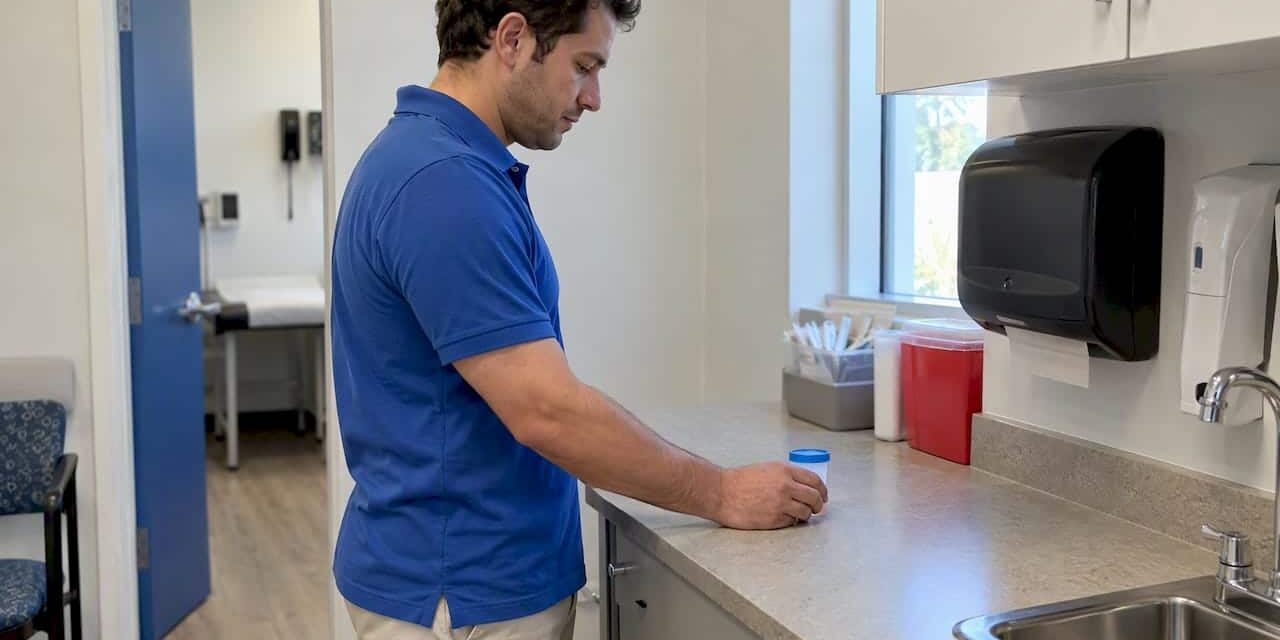
If you were treated for chlamydia, plan to retest about 3 months after you finish your medication, even if your symptoms are gone and your partner was treated too. The CDC recommends this 3-month retest for everyone diagnosed, because the goal is to catch a new infection, not to check whether the antibiotic worked. Pregnancy is the main exception: it adds an earlier test about 4 weeks after treatment.
This guide explains the timing, the reasons behind it, what happens if you test too early, and how to schedule a retest in Lutz without a long wait.
TL;DR
- Retest about 3 months after you finish chlamydia treatment, whether or not you have symptoms and whether or not your partner was treated.
- If you are pregnant, you need a test of cure about 4 weeks after treatment, plus the 3-month retest.
- Testing within 4 weeks of finishing treatment can give a false positive from leftover genetic material, so do not test early unless a clinician asks you to.
- Avoid sex for 7 days after a single-dose treatment, or until you finish a 7-day course, and until your partners are treated.
- Walk-in retesting is available in Lutz seven days a week, 8 AM to 8 PM.
Table of Contents
- The short answer on retest timing
- Why the wait is three months and not three weeks
- What happens if you test too early
- When a test of cure is recommended
- Pregnancy: a different schedule
- Do not skip the steps between treatment and retest
- Our perspective on retesting
- What a retest visit looks like
- If your retest is positive
- Where to get retested in Lutz
- FAQ
- Sources
The short answer on retest timing
There are really two different tests people mean when they search for this, and they have different timing.
| Situation | When to test | What the test looks for |
|---|---|---|
| Most adults and teens after treatment | About 3 months after finishing treatment | New infection (reinfection) |
| Pregnancy | About 4 weeks after treatment, then again at 3 months | Whether the infection cleared (test of cure), then reinfection |
| Symptoms continue, or you missed doses | Talk to a clinician; a test of cure may be advised | Possible treatment failure |
The CDC’s own patient page says that even if you and your partner took medicine, you should be retested in three months. Setting a phone reminder on the day you finish your pills is the simplest way to follow through.
Why the wait is three months and not three weeks
The retest is not there to prove the antibiotic worked. For most people it does. The reason is reinfection, which is common. The 2021 CDC STI Treatment Guidelines state that retesting 3 months after a chlamydia diagnosis can detect repeat infection.
Reinfection usually happens in one of three ways:
- A partner was not treated, or was treated after you had already resumed sex.
- A partner was treated but you had sex before both of you finished treatment.
- You had a new partner who has chlamydia and does not know it.
Chlamydia often causes no symptoms at all, so a partner can carry it without any sign. That is why the guidance does not depend on how you feel or on what you believe about your partner’s treatment.
A modeling study of claims data for young women in the US, published in Sexually Transmitted Infections, looked at the best interval for a repeat test. The research summary we reviewed indicates that reinfection risk peaks between 2 and 5 months after the first treatment, which is why the 3-month mark falls in a useful window.
Retesting is not a sign that you did something wrong. It is a routine safety net, and it is the same advice a clinician gives to anyone treated for chlamydia.
What happens if you test too early
Many people want to retest after a week or two to be sure. It is an understandable instinct, but it can backfire.
Tests used for chlamydia are called nucleic acid amplification tests (NAATs). They detect the bacteria’s genetic material, and that material can linger after the bacteria are dead. The CDC warns that a NAAT should not be used as a test of cure within 4 weeks of finishing therapy, because residual nonviable material can cause a false-positive result.
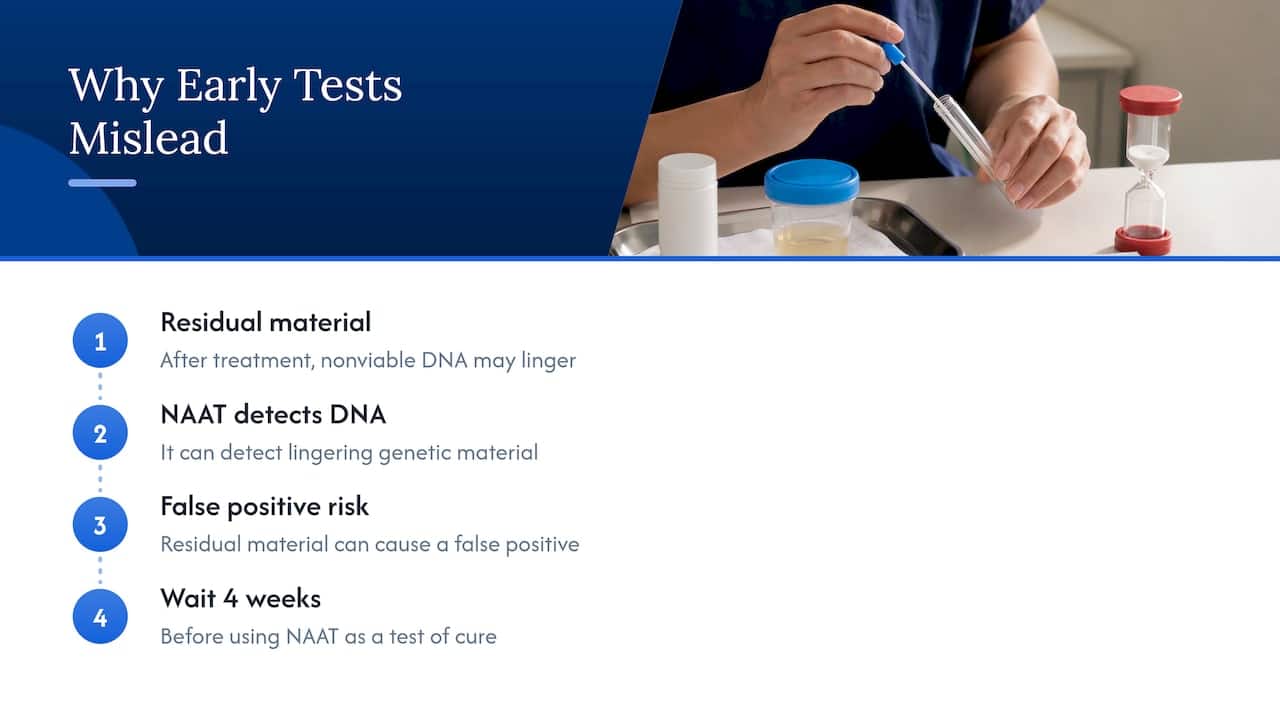
A false positive can cause real distress. You may worry that treatment failed, repeat antibiotics you do not need, or have a hard conversation with a partner for no reason. If you test positive at 10 days, the result does not necessarily mean you have an active infection. Call the clinic that treated you before assuming the worst.
There is one more reason to wait: a test taken too soon after a new exposure can miss an infection. If you think you were exposed again after treatment, see our guide to the STD window period for when each test becomes reliable.
When a test of cure is recommended
For most non-pregnant people, the CDC says that a test of cure 4 weeks after treatment is not advised with the recommended or alternative regimens, unless you may not have taken the medication as directed, symptoms persist, or reinfection is suspected.
Talk to a clinician about an earlier follow-up if:
- You missed doses or stopped the antibiotic early.
- You vomited soon after a single-dose treatment.
- Your symptoms (discharge, burning with urination, pelvic or testicular pain) have not improved after you finished the medicine.
- You may have taken a different antibiotic than the one recommended.
These situations are where a clinician may choose to test sooner, and they will tell you how long to wait so the result is meaningful.
Pregnancy: a different schedule
If you are pregnant, the timeline changes. The CDC’s guidance for pregnant women calls for a test of cure with a NAAT about 4 weeks after treatment, and a retest at about 3 months. Untreated chlamydia in pregnancy can lead to complications for the parent and the newborn, so documenting that the infection has cleared matters.
Azithromycin is the usual choice in pregnancy, while non-pregnant adults are typically treated with doxycycline for 7 days. That is a decision for your clinician, based on your situation. If you are pregnant and have been diagnosed, tell whoever treats you so the 4-week test goes on your calendar before you leave the visit.
If you are planning a pregnancy and had chlamydia, it is reasonable to ask about your reproductive health more broadly. A fertility health check is one type of assessment some people consider when they are trying to conceive, though your primary care provider is the right first conversation.
Do not skip the steps between treatment and retest
The retest only helps if you protect yourself during the three months. The CDC guidance says to avoid all sexual activity until you and your partners have completed treatment, and to wait 7 days after a single-dose regimen before having sex again. If you were prescribed a 7-day course, wait until the last dose is taken.
A practical checklist:
- Take every dose, even if symptoms vanish in a couple of days.
- Tell recent partners so they can be tested and treated. The CDC encourages an empathetic, non-blaming approach, since it is often impossible to know who had the infection first.
- Avoid sex until you and every partner have finished treatment, plus the 7-day wait if you took a single dose.
- Use condoms with any partner whose status you do not know.
- Put the 3-month retest date in your calendar the day you finish treatment.
Not sure how to start the conversation with a partner? Keep it short and factual: “I tested positive for chlamydia and was treated. You should get tested and treated too, so we do not pass it back and forth.” You do not need to assign blame.
Our perspective on retesting
At Your Family Walk-In Clinic, we see the same pattern often: someone is treated, feels fine within days, and assumes the matter is closed. Then three months pass and nobody thinks about a follow-up. Because chlamydia is frequently silent, feeling fine is not proof of anything.
We want you to treat the retest as part of the treatment, not an optional extra. It is a short visit, and it is far easier than dealing with a missed reinfection that spreads to a partner or leads to pelvic inflammatory disease (PID) later. The CDC notes that finishing the full course and avoiding early sex helps reduce the risk of long-term damage like PID.
We also know these visits can feel awkward. Our approach is calm and non-judgmental. You will not be lectured, and we will not assume anything about your relationships. Our providers have more than 25 years of experience, and we offer same-day appointments for adults and teens, so you can come in when it suits you rather than waiting for a slot next week.
A few things we encourage:
- Ask for the retest date before you leave your treatment visit, and write it down.
- If you are not sure whether your partner finished treatment, assume you may be exposed again and retest at 3 months anyway.
- If you want to be screened for other infections at the same time, ask about a panel. Chlamydia often travels with gonorrhea, and the CDC also advises retesting at 3 months for gonorrhea and trichomoniasis.
— Lisa
What a retest visit looks like
A retest is quick. You describe your history, your clinician decides which sample is appropriate, and the lab runs a NAAT. Depending on your sexual history, the sample may be a urine sample or a swab of the genital area, throat or rectum. Your clinician will explain which and why.
What to expect:
- Before you arrive: If it is a urine test, try not to urinate for about an hour beforehand if you can, since a very dilute sample can be less reliable. If you are unsure, call first.
- At the visit: A brief conversation about symptoms, partners and any new exposures. This is confidential.
- After: Results timing depends on the lab used. If your result is positive, you will be treated again and your partners should be told.
If you are comparing options for paying for testing, our page on STD testing without insurance explains how direct lab pricing works, and our guide to what is included in an STD panel can help you decide whether to add other tests.
If your retest is positive
A positive result at the 3-month mark usually means you were reinfected, not that the first treatment failed. It is common and it is treatable. You will be treated again, your partners need to be tested and treated, and you will need another retest about 3 months later.
A positive result at 1 to 4 weeks after treatment is a different case. As explained above, leftover genetic material can cause a false positive. Call your clinician and describe the timing; they will tell you whether to treat or repeat the test later.
Repeat infections matter more than many people realize. The CDC notes that repeated chlamydia infections raise the risk of complications such as PID in women, so catching them early is worth the effort.
Where to get retested in Lutz
We offer STD screening and treatment for adults and teens in Lutz. We are open seven days a week, 8 AM to 8 PM, and we take walk-ins and same-day appointments. We accept major insurance plans, Medicaid and self-pay, so you can choose the option that keeps your visit private and affordable. For teens, our page on STD testing consent in Florida explains how consent and insurance statements work.
You can also reach us at (813) 793-8555 to ask about timing before you come in. If you are unsure whether you are at day 10, day 30 or day 90, we will help you figure out the right moment.
If symptoms return before your retest date, such as pain with urination, discharge, or pelvic or testicular pain, do not wait for the 3-month mark. Come in the same day through our urgent care.
FAQ
How long after chlamydia treatment should I retest?
About 3 months after you finish treatment. This applies even if your symptoms are gone and your partner was treated. The purpose is to find a new infection, which is common.
Can I retest sooner than 3 months?
Not usually, and testing within 4 weeks of finishing treatment can produce a false positive from leftover genetic material. If you are pregnant, or you think you missed doses or still have symptoms, a clinician may advise a test at about 4 weeks. Ask before you test on your own.
Can chlamydia come back without a new exposure?
Most repeat positives come from reinfection by an untreated partner or a new partner. True treatment failure is less common when you take every dose, but it can happen if doses were missed or symptoms persist. A clinician can sort out which one applies to you.
Do I need a retest if my partner and I were both treated?
Yes. The CDC advises a 3-month retest regardless of whether you believe your partners were treated, because it is hard to be sure everyone finished treatment before sex resumed.
Is the retest schedule different during pregnancy?
Yes. Pregnant patients need a test of cure about 4 weeks after treatment and a retest at about 3 months. Tell your prenatal provider about any past chlamydia diagnosis so both tests are scheduled.
Sources
- Chlamydial Infections, STI Treatment Guidelines (CDC)
- Chlamydial Infections, test of cure guidance (CDC)
- Sexually Transmitted Infections Treatment Guidelines, 2021 (MMWR)
- Next steps after testing positive for gonorrhea or chlamydia (CDC)
- Pregnant Women, STI Treatment Guidelines (CDC)
- Insights into the timing of repeated testing after treatment for Chlamydia trachomatis (Sexually Transmitted Infections)