

If you’ve had a possible exposure, the honest answer depends on which infection you’re worried about and which test you take. Some infections show up within days using NAT testing, others need a few weeks, and some require several months for a conclusive antibody result. If you have symptoms, test now. If your exposure involved HIV risk, get evaluated for PEP as soon as possible, ideally within a few days after exposure.
TL;DR:
- NAT testing for HIV can detect infection within 10 to 33 days, whereas antibody-based tests may not turn positive until 23 to 90 days.
- Chlamydia and gonorrhea NAATs become reliable after one to two weeks, with early testing useful primarily for active lesions or symptoms.
- For most infections, retesting at three months is essential because negative results before the window period are not conclusive.
- PEP treatment should start within 72 hours of potential HIV exposure, and specific tests like NAT are recommended for those on PrEP or with weakened immune systems.
- Routine screening every year or every three to six months is advisable for high-risk groups, while waiting longer than three months post-exposure risks delayed diagnosis and treatment.
Table of Contents
- Reference table: detection windows by infection and test type
- How test type changes when infections become detectable
- When to test after exposure: a practical timeline
- Special cases: PrEP, PEP, pregnancy, and weakened immunity
- Interpreting your results: negatives, confirmations, and next steps
- What to expect: samples, rapid tests, and turnaround times
- Retest and follow-up schedules clinicians recommend
- How we handle window-period testing and follow-up
- Clinician takeaway on timing and when to come back
- Getting tested at Your Family Walk-In Clinic
- FAQ
- Sources
Reference table: detection windows by infection and test type
Different infections become detectable at different speeds, and the test you choose changes the timeline even more than the infection itself. The table below gives typical ranges clinicians use to counsel patients after a known or suspected exposure.
| Infection | Test type | Typical detection window |
|---|---|---|
| HIV | NAT | 10 to 33 days |
| HIV | Lab antigen/antibody | 23 to 90 days |
| HIV | Antibody-only | 23 to 90 days |
| Chlamydia/gonorrhea | NAAT | about 1 to 2 weeks |
| Syphilis | Treponemal/nontreponemal antibody | up to about 2 weeks |
| Hepatitis C | HCV RNA (NAT) | as early as about 2 weeks |
HIV testing illustrates the pattern best: a NAT can pick up the virus’s genetic material within 10 to 33 days, while an antibody-only test might not turn positive until 23 to 90 days after exposure, since it has to wait for your immune system to produce antibodies rather than detecting the virus directly. For chlamydia and gonorrhea, NAAT from urine or a swab is the preferred test, and accuracy depends heavily on which body site was exposed. Syphilis antibodies typically need about two weeks to develop, and hepatitis C is unusual in that the RNA test can catch infection well before any antibody response appears, which is why reflex testing for HCV has become standard practice. Herpes is the outlier on this list: a swab of an active lesion, when one is present, remains the fastest and most reliable way to confirm infection, regardless of how much time has passed since exposure.
How test type changes when infections become detectable
The window period isn’t a fixed number for any given infection. It shifts depending on what the test is actually looking for in your blood or sample, and understanding that difference helps you ask for the right test instead of just any test.
- NAT/NAAT looks for the pathogen’s genetic material directly, which is why it detects infection earlier than any method that waits for an immune response.
- Antigen/antibody combination tests, like the ones used for HIV, catch the p24 antigen (a piece of the virus itself) in addition to antibodies, narrowing the window compared to antibody-only testing.
- Antibody-only tests rely entirely on your immune system producing a detectable response, so they need the most time and tend to have longer windows, especially with fingerstick blood rather than a venous draw.
- NAAT is preferred for gonorrhea and chlamydia because sensitivity depends on the exact site exposed, meaning a urogenital swab won’t reliably catch a pharyngeal or rectal infection.
A fingerstick sample is convenient for rapid results, but a venous blood draw processed in a lab generally offers better sensitivity during the early window, which matters most when you’re testing close to a known exposure date.
When to test after exposure: a practical timeline
Rather than guessing, it helps to think in blocks of time tied to what each test can realistically catch. This is the sequence we walk patients through after a reported exposure.
- 0 to 3 days: If your exposure carried HIV risk, get evaluated for PEP right away. CDC guidance recommends starting nPEP as soon as possible and no later than 72 hours after exposure. Test immediately if you already have symptoms.
- Days 3 to 14: If a sore or lesion appears, a direct swab is the most useful herpes test at this stage. NAATs for chlamydia and gonorrhea start to become meaningful during this window.
- Weeks 2 to 6: Most NAATs for chlamydia and gonorrhea are considered reliable by this point. Early HIV NAT or antigen/antibody testing can detect infection, and interim HIV testing at 4 to 6 weeks is part of the standard post-exposure schedule.
- Weeks 6 to 12: Lab-based antigen/antibody HIV tests are generally reliable by now. Final confirmatory HIV testing is recommended at 12 weeks postexposure unless PEP or PrEP has changed the picture.
- Three months: This is the point where antibody-only tests for several infections finally become conclusive. For most sexually active people, routine risk-based screening on a regular schedule makes more sense than repeatedly chasing a single exposure date with ad-hoc testing.
Special cases: PrEP, PEP, pregnancy, and weakened immunity
Not everyone fits the standard timeline, and a few groups need a different conversation with their clinician about which test to request and when.
- Recent use of PrEP or PEP can delay antibody production, which means an antibody-based HIV test might stay falsely negative longer than usual, favoring NAT for anyone currently on or recently off these medications.
- Pregnant patients are typically prioritized for early screening of HIV, syphilis, hepatitis B, and hepatitis C, since timing affects treatment decisions for both parent and baby.
- People who are immunocompromised may need earlier NAT testing and additional repeat tests, since a weaker immune response can further delay antibody detection.
Pro Tip: Ask your clinic for reflex HCV RNA testing automatically if your hepatitis C antibody screen comes back reactive, rather than waiting for a separate appointment to order it.
Interpreting your results: negatives, confirmations, and next steps
A negative result taken too early simply means the window hasn’t closed yet, not that you’re in the clear. Retesting on schedule is what actually rules an infection out.
- A negative test taken before the window period ends can be a false negative, which is why follow-up testing at the recommended intervals matters more than a single early result.
- A reactive HCV antibody test does not confirm active infection on its own. Reflex HCV RNA testing is required to determine whether the virus is currently present.
- A reactive HIV antigen/antibody screen moves into a confirmatory algorithm, often involving a NAT, to distinguish a true positive from a false reactive result.
- For syphilis, repeat nontreponemal testing at 2 to 4 weeks is recommended when early infection is suspected but the first test is inconclusive.
Anyone who tests positive should expect a conversation about treatment and, where relevant, partner notification, so that exposure doesn’t continue in the meantime.
What to expect: samples, rapid tests, and turnaround times
What actually happens during your visit depends on which infections are being checked and how fast you need an answer.
- Urine samples and self-collected vaginal swabs are the standard for chlamydia and gonorrhea, with pharyngeal or rectal swabs added when exposure history calls for it.
- Venous blood draws generally offer better early sensitivity for HIV and hepatitis C antigen/antibody testing than a fingerstick, which matters most close to the exposure date.
- Rapid point-of-care tests can return results the same day, but they often carry lower sensitivity early in infection than lab-based NAT or NAAT, so a lab-confirmed result may follow even after a rapid negative.
- Reflex testing means one visit can still produce staggered results, since a reactive screening test automatically triggers a confirmatory test processed afterward. For more detail on how labs handle this, see our explanation of typical result turnaround times, and for background on how independent labs manage fast processing, EIV Diagnostics outlines what affects same-day lab turnaround.
Retest and follow-up schedules clinicians recommend
Once you’re past the initial exposure window, the schedule shifts toward either routine screening or a structured follow-up plan.
- Routine screening: Sexually active adults are generally advised to screen annually, with higher-risk groups, including sexually active men who have sex with men or anyone with multiple partners, screening every three to six months.
- Post-exposure HIV follow-up: Baseline testing at exposure, interim testing at 4 to 6 weeks, and final testing at 12 weeks, unless PEP or PrEP use modifies that schedule.
- Syphilis follow-up: Repeat nontreponemal testing 2 to 4 weeks after the first test when early infection is suspected.
- Hepatitis C follow-up: HCV RNA at 3 to 6 weeks postexposure, with a final antibody check at 4 to 6 months when clinically indicated.
How we handle window-period testing and follow-up
We offer same-day STD screening and treatment seven days a week, which matters when timing is the whole question. Our panels include reflex testing options, so a reactive screen doesn’t mean a second appointment just to order the confirmatory test; you can read more about what our STD panels include.
- We assess PEP eligibility promptly when exposure occurred within the past 72 hours.
- We schedule baseline testing along with follow-up intervals appropriate to each exposure, to support patients’ testing timelines.
- We explain which test fits your situation, including the differences between NAT and antibody testing options.
Clinician takeaway on timing and when to come back
Test now if you have symptoms or a high-risk exposure. Otherwise, follow the timeline rather than rushing a result that the window period hasn’t caught up to yet. If you’re on PrEP or PEP, or your immune system is compromised, ask specifically for NAT testing rather than an antibody-only panel.
— Lisa
Getting tested at Your Family Walk-In Clinic
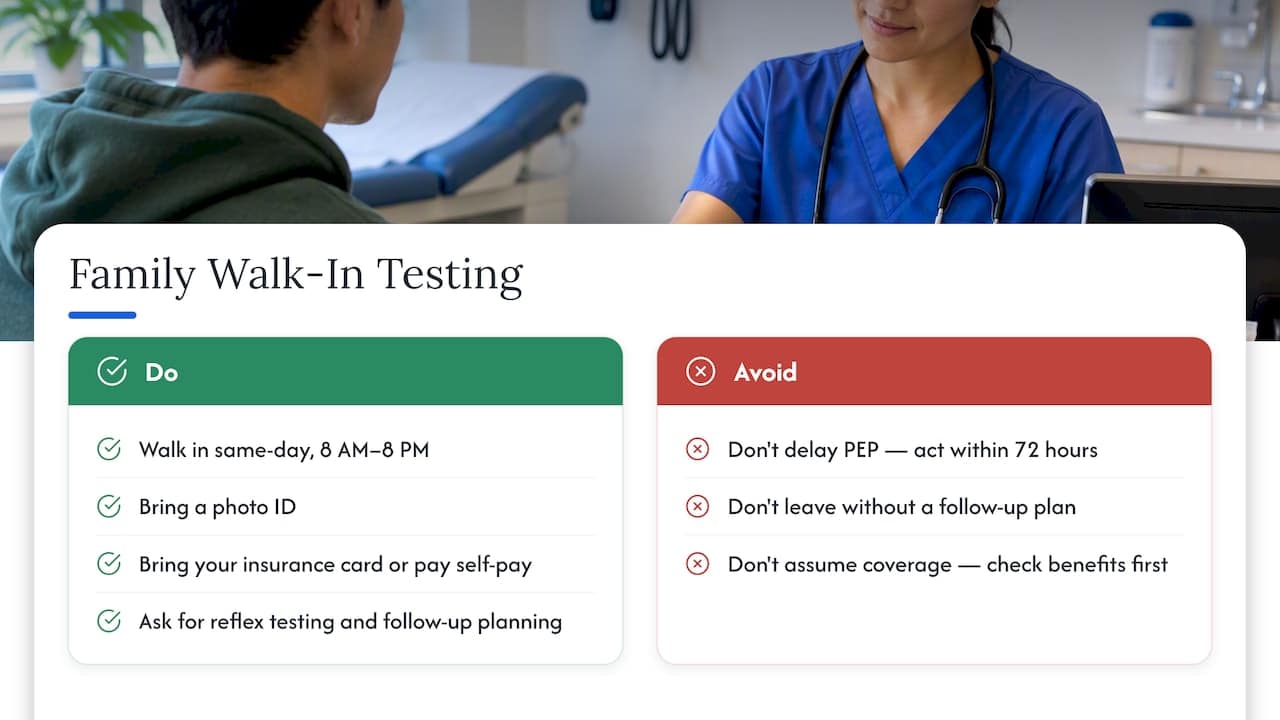
We know exposure anxiety doesn’t wait for a convenient appointment slot, which is why we keep same-day visits open seven days a week from 8 AM to 8 PM for STD screening and treatment and urgent care evaluations, including PEP assessment within that critical 72-hour window.
Walking in is simple: bring a photo ID and your insurance card if you have one, though self-pay is also accepted. Our panels include reflex testing so a reactive screening result moves into confirmatory testing without a second visit, and providers offer personal follow-up planning before you leave. If cost or insurance coverage is part of your decision, resources like Pounds Health’s overview of screening benefits can help you understand what your plan covers before you come in.
This article is general information, not a substitute for advice from a qualified doctor. Consult a qualified healthcare professional about your own circumstances before acting on anything here.
FAQ
Is 2 days too soon to test for an STD?
For most infections, yes: two days is too early for any test to reliably detect them, since even the fastest NAT tests need roughly a week or more to catch HIV, and chlamydia or gonorrhea NAATs need about one to two weeks. The exception is a visible symptom like a sore or discharge, which should be evaluated and tested right away regardless of timing.
What are the three STDs most commonly tested together?
Clinics most often test chlamydia, gonorrhea, and HIV together as a baseline panel, since all three are common, often asymptomatic, and detectable through standard NAAT and antigen/antibody methods. Syphilis and hepatitis C are frequently added based on exposure history and risk factors.
How long is too long to wait to get tested after a possible exposure?
Waiting past the three-month mark without testing leaves you without an answer and delays treatment if you do have an infection, since most window periods close well before then. If you have ongoing risk rather than a single exposure, routine screening on a regular schedule, annually or every 3 to 6 months for higher-risk groups, serves you better than waiting for one specific test date.
Sources
- Sexually transmitted infections (STIs) – CDC: Testing
- Testing for Hepatitis C Virus Infection | CDC
- Antiretroviral Postexposure Prophylaxis After Sexual, Injection Drug Use, or Other Nonoccupational Exposure to HIV — CDC Recommendations, 2025 (MMWR)