

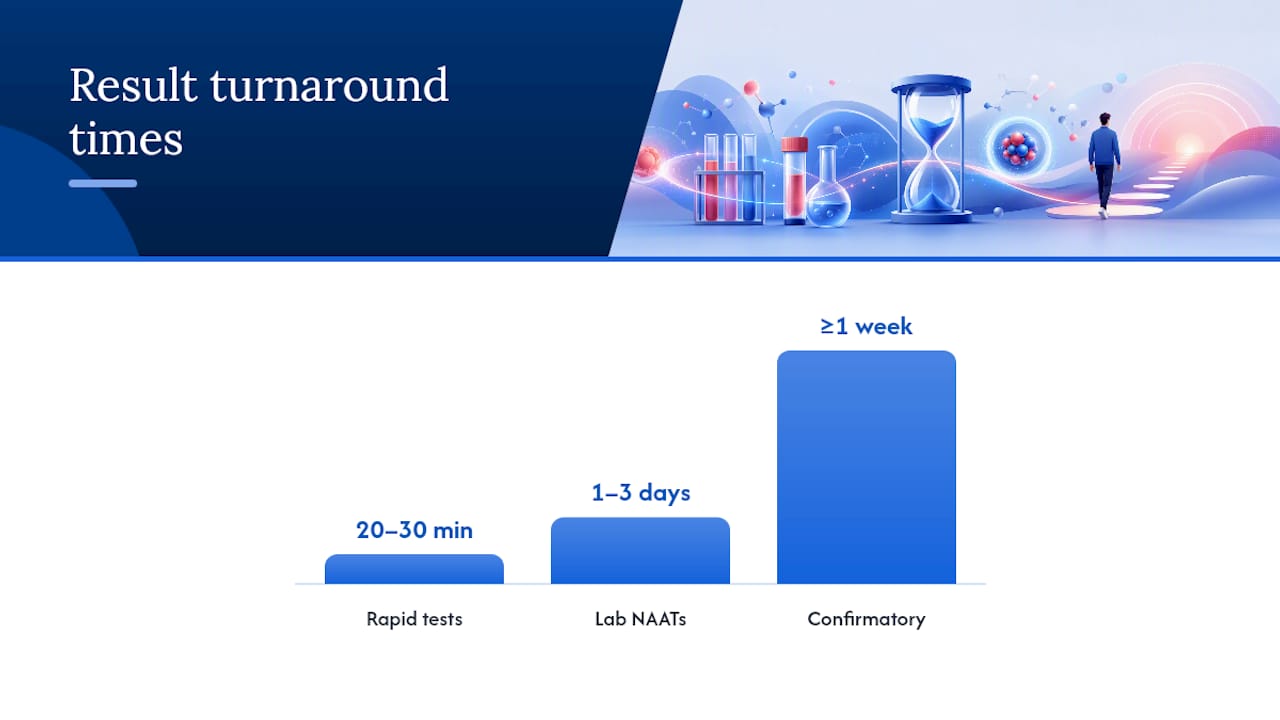
Most STD test results arrive within minutes to a few days. Rapid HIV and syphilis tests can give you a preliminary answer in under an hour, while lab-based NAATs for chlamydia and gonorrhea typically take 1 to 3 business days. Herpes cultures and confirmatory tests run longer, sometimes a week or more.
The CDC recommends that clinics provide results during the same visit whenever possible, because same-day answers mean same-day treatment and fewer patients lost to follow-up. If speed matters to you, ask your clinic directly whether point-of-care testing is available before you book.
- Rapid tests (HIV, some syphilis): 20 to 30 minutes
- Lab-based NAAT (chlamydia, gonorrhea): 1 to 3 business days
- Herpes culture or PCR: 2 to 7 days
- Mail-in kits or confirmatory testing: 5 to 10+ days
Key Takeaways
Rapid point-of-care tests return results in about 20 to 30 minutes, while lab-based NAATs for chlamydia and gonorrhea typically take 1 to 3 business days, and confirmatory or mail-in testing can stretch beyond a week.
| Point | Details |
|---|---|
| Rapid tests are fastest | HIV and some syphilis rapid tests give preliminary results in about 20 to 30 minutes. |
| Lab NAATs take a few days | Chlamydia and gonorrhea NAAT results typically arrive in 1 to 3 business days. |
| Confirmatory testing adds time | A reactive screening result triggers reflex testing, which can add several extra days. |
| Window periods matter | Testing too soon after exposure can produce a false negative; retesting later confirms results. |
| Walk-in clinics reduce delays | Your Family Walk-In Clinic offers same-day appointments and on-site STD testing seven days a week. |
This article is general information, not a substitute for advice from a qualified doctor. Consult a qualified healthcare professional about your own circumstances before acting on anything here.
Table of Contents
- How long does STD testing take by infection and method?
- Why do STD result times vary so much between clinics?
- When can you get same-day STD testing and treatment?
- What is the window period and why does it affect your results?
- How will you receive your results, and what should you do next?
- How walk-in clinics shorten the wait for STD results
- Get Same-Day STD Testing Without the Wait
- Sources
- FAQ
How long does STD testing take by infection and method?
The wait depends far more on which test your sample runs through than on which infection you’re worried about. A rapid finger-prick test and a mail-in swab for the same infection can produce results days apart.
HIV offers the widest range. A rapid antibody test can hand you a preliminary result in 20 to 30 minutes, while a standard lab-based antigen/antibody test takes 1 to 3 days. If a NAT (nucleic acid test) is used to catch very early infection, expect several days for that result to come back.
Chlamydia and gonorrhea almost always rely on NAAT, the nucleic acid amplification test that’s become the standard because of its sensitivity. That FDA-cleared method typically returns results in 1 to 3 business days, though transport schedules can stretch that window.
Syphilis screening through blood serology usually comes back in 1 to 3 days. If your screening test is reactive, a confirmatory test gets ordered automatically, and that reflex step can add real time before you get a final answer.
Herpes is the outlier. A swab from an active sore, tested by PCR or culture, takes 2 to 7 days. Blood-based herpes serology is trickier: antibodies need weeks to build up after exposure, so a test taken too soon can mislead you even if the lab turns it around quickly.
- Rapid HIV or syphilis: same-visit, often under 30 minutes
- Chlamydia/gonorrhea NAAT: 1 to 3 business days
- Syphilis serology: 1 to 3 days, longer if confirmatory testing is triggered
- Herpes swab PCR: 2 to 7 days
- Mail-in kits and specialty cultures: 5 to 10+ days, according to patient-facing lab timeline data
Why do STD result times vary so much between clinics?
Two clinics can run the identical test and hand you results days apart, and it usually comes down to logistics rather than the test itself.
Where the sample gets processed matters most. A clinic with an on-site lab or a point-of-care rapid test skips the shipping step entirely. Samples sent to an external reference lab depend on courier pickup times, and a specimen collected Friday afternoon may not reach the lab until Monday. Weekends and holidays routinely add a full day or two to any lab-based turnaround.

Reactive screening results trigger reflex testing. If your initial syphilis or HIV screen comes back reactive, confirmatory testing is standard practice before a clinic reports a final result, which can tack on several additional days.
Specimen type and paperwork also play a role. Extragenital swabs (throat or rectal) sometimes require special transport media that not every lab stocks. Missing insurance information or an incomplete consent form can put your results on administrative hold even after the lab work is finished.
- On-site testing avoids courier delays entirely
- Weekend and holiday collection adds 1 to 2 days
- Reactive results often require confirmatory testing
- Incomplete paperwork can delay reporting even after lab work is done
Pro Tip: Ask the front desk whether your specimen ships to an outside lab or gets processed on-site. That one question tells you more about your realistic timeline than anything else.
When can you get same-day STD testing and treatment?
Same-day results aren’t available for every infection, but for the tests that matter most in a fast-moving exposure, they usually are.
Clinics commonly stock rapid HIV tests, and some offer rapid syphilis and rapid hepatitis C tests as well. Most of these point-of-care tests deliver a preliminary result in well under an hour, often 20 minutes.
The CDC’s own clinical guidance is blunt about why this matters: providing results during the same visit reduces treatment delays, limits ongoing transmission, and increases the odds a patient actually gets treated before they disappear from follow-up care.
That’s why clinicians will sometimes give empiric treatment, medication based on symptoms and risk factors, before a confirmatory lab result comes back, particularly for gonorrhea or chlamydia in someone with a partner who has a confirmed diagnosis. For other infections, especially anything requiring confirmatory serology, your provider will wait for the lab result before starting treatment. That’s not a delay for delay’s sake. It’s how they avoid treating you for the wrong thing.
- Rapid HIV, syphilis, and (at some sites) HCV tests: results in about 20 minutes
- Empiric treatment: sometimes given same-day based on symptoms or known exposure
- Confirmatory-dependent treatment: waits for the lab result to avoid a wrong diagnosis
What is the window period and why does it affect your results?
The window period is the stretch of time between exposure and when a test can reliably detect infection. Test too early, and you can get a false negative even if you’re infected, because the virus, bacteria, or antibody response hasn’t reached a detectable level yet.
- HIV: NAT can detect infection within about 10 to 33 days of exposure; antigen/antibody tests typically need 18 to 45 days; antibody-only tests can take up to 90 days for a reliable result.
- Chlamydia and gonorrhea: NAAT is usually accurate within 1 to 2 weeks after exposure.
- Syphilis: Serology often needs 3 to 6 weeks after exposure to turn positive.
- Herpes: A swab from an active lesion can confirm infection almost immediately, but blood antibody tests may need several weeks to months to become meaningful.
The CDC notes that risk history should guide which test you get and when. If you test right after a specific exposure, a negative result is a starting point, not a clean bill of health. Retesting at the appropriate interval is often the only way to be sure.
How will you receive your results, and what should you do next?
Most clinics deliver results one of three ways: through a secure patient portal, a phone call from clinic staff, or during a follow-up visit if you tested in person. Rapid tests are usually given to you verbally before you leave.
If your standard lab results haven’t arrived within about a week, call the clinic and confirm your specimen and contact details were entered correctly. Most delays at this stage are administrative, not medical, and get resolved with one phone call.
If a result comes back positive, treatment can often start immediately, sometimes the same day for bacterial infections like chlamydia and gonorrhea. Your provider will also walk you through partner notification and let you know if a test-of-cure is recommended to confirm the infection has cleared.
- Portal or phone: fastest for standard lab results
- In-person follow-up: common for rapid or point-of-care testing
- Delayed results: call the clinic after about 7 days to check specimen status
- Positive result: ask about same-day treatment, partner notification, and test-of-cure timing
Pro Tip: Save the phone number of the clinic that drew your sample. If a week passes with no word, that one call almost always moves things faster than waiting it out.
How walk-in clinics shorten the wait for STD results
Your Family Walk-In Clinic is open seven days a week from 8 AM to 8 PM in Lutz, Florida, with same-day appointments and STD testing built into its regular walk-in services. On-site rapid testing and streamlined specimen handling mirror what the CDC’s own clinical guidance calls for: fewer steps between collection and answer.
- Standing orders and same-day scheduling reduce the gap between visit and test
- On-site rapid tests skip courier and shipping delays entirely
- Clinicians with decades of combined experience oversee specimen panels and result review
A clinic visit gives you a timing edge over mail-in kits precisely because nothing has to travel before it gets tested.
A clinician’s note on speed versus accuracy
Fast tests are genuinely reassuring, but a quick negative isn’t always the final word if you tested too soon after exposure. Ask your clinic exactly which tests they run and whether same-day treatment is on the table.
Get Same-Day STD Testing Without the Wait
Mail-in kits and outside lab referrals both mean waiting on a courier schedule you can’t control. Your Family Walk-In Clinic cuts that wait by offering on-site STD testing, same-day appointments, and confidential care seven days a week, with both insurance and self-pay options available so cost doesn’t hold you back from getting answers fast.
Whether you need a rapid test before a new relationship, a routine screening, or answers after a specific exposure, walking in beats waiting on the mail. Schedule your STD testing visit or check same-day urgent care availability today to get your results on a timeline that actually works for you.
Sources
- Recommendations for Providing Quality Sexually Transmitted Diseases Clinical Services, 2020 (MMWR)
- Morbidity and Mortality Weekly Report (MMWR): Recommendations and Reports / Vol. 68 / No. 5, January 3, 2020
- STD/STI testing: What to expect — Cleveland Clinic
- How long for STD results? — MyMedicalLab
FAQ
How fast do STD results get back?
Rapid tests like HIV and some syphilis screens can return results in about 20 to 30 minutes, while lab-based tests such as chlamydia and gonorrhea NAAT typically take 1 to 3 business days.
How quickly will an STD show up on a test?
It depends on the window period for that specific infection. HIV NAT can detect infection within 10 to 33 days of exposure, while syphilis often needs 3 to 6 weeks before serology turns reliably positive.
Which STDs show up the fastest on testing?
HIV and syphilis have the fastest rapid, point-of-care options, often producing results in under 30 minutes, though a confirmatory lab test may still follow a reactive rapid result.
How long do STD results take if I use a mail-in kit?
Mail-in kits generally take longer than an in-person visit, often 5 to 10 days or more, since your sample has to ship to a lab before processing even begins.
What should I do if my STD test results are delayed?
Call the clinic that collected your sample after about a week and confirm your specimen and contact information were recorded correctly, since most delays at that point are administrative rather than medical.