

Most adults need either two or three doses of hepatitis B vaccine, depending on which vaccine they receive. Heplisav-B is a two-dose series. Engerix-B, Recombivax HB and the combined hepatitis A and B vaccine Twinrix use longer schedules. If you have started a series and fallen behind, you do not start over. You pick up where you left off.
This guide explains who should be vaccinated, how each schedule works, what to do about a missed dose, and when (or whether) a booster is needed. We are a family walk-in clinic in Lutz, Florida, and these are the questions our patients ask us at the front desk.
TL;DR
- The CDC recommends hepatitis B vaccination for all adults aged 19 to 59, and for adults 60 and older who have risk factors or simply want protection.
- Heplisav-B is a 2-dose series. Other vaccines use 3 or 4 doses, depending on the product and schedule.
- A late dose does not mean restarting. Give the next dose as soon as possible.
- Healthy adults who finish the series do not need a booster. Hemodialysis patients are the main exception.
- Immunizations are part of what we offer in Lutz, seven days a week, 8 AM to 8 PM.
Table of Contents
- Who should get the hepatitis B vaccine as an adult
- The hepatitis B vaccine schedules for adults
- What if you miss a dose or the series stalls?
- Do adults need a hepatitis B booster?
- Do you need a blood test after vaccination?
- What to expect at your visit
- Other vaccines and screenings worth reviewing at the same visit
- Our perspective
- Get your hepatitis B vaccination in Lutz
- FAQ
- Sources
Who should get the hepatitis B vaccine as an adult
Hepatitis B is a virus that infects the liver. Vaccination is the main way adults prevent it. The CDC’s current guidance is that all adults aged 19 to 59 should receive the vaccine. Adults 60 and older are also recommended to get it if they have risk factors, and those without identified risk factors who want protection can choose to be vaccinated as well.
That universal recommendation matters because many adults were never vaccinated. If you were born before routine infant vaccination became standard, or you grew up somewhere it was not offered, you may have no record of ever starting the series.
You do not need to prove you are “at risk” to qualify if you are between 19 and 59. Reasons adults commonly get vaccinated include:
- Never having been vaccinated as a child
- Health care, school or public safety work
- Diabetes or chronic liver disease
- Travel to areas where hepatitis B is more common
- Having a new partner or more than one partner
- Living with someone who has hepatitis B
You also do not have to be tested first. According to Immunize.org’s expert guidance, vaccination can begin even if you have not been screened, because protecting someone who may be vulnerable is the priority.
If you are unsure of your history, start with your records. Our guide on how to get immunization records in Florida walks through where to look. If nothing turns up, we can talk through next steps at a visit.
The hepatitis B vaccine schedules for adults
There is more than one way to complete the series. Which one applies to you depends on the vaccine you receive, your health and, sometimes, your timeline.
| Vaccine | Doses | Notes |
|---|---|---|
| Heplisav-B | 2 | Licensed for adults 18 and older |
| Engerix-B or Recombivax HB (standard) | 3 | Typically given at 0, 1 and 6 months |
| Engerix-B (hemodialysis) | 4 | High-dose (40 µg) Engerix-B or Recombivax HB advised |
| Twinrix (hepatitis A and B) | 3 or 4 | Accelerated 4-dose option at 0, 7 days, 21 to 30 days and 12 months |
Two-dose schedule: Heplisav-B
The CDC states that Heplisav-B is licensed for adults 18 and older, who should receive two doses. For many adults, a shorter series is simply easier to finish. Fewer visits means fewer chances for life to get in the way.
One safety point: the Merck Manual notes that Heplisav-B should not be given during pregnancy because safety data are limited. If you are pregnant or planning a pregnancy, tell your provider before your visit so the right vaccine can be chosen.
Three-dose schedule: Engerix-B and Recombivax HB
The traditional adult series is three shots over about six months. The second dose follows the first by about a month, and the third comes around six months after the first. It takes longer than the two-dose option, but it is a well-established way to complete the series.
A third option, PreHevbrio, no longer exists in the U.S. According to an ASHP summary of adult hepatitis B vaccine updates, it was withdrawn from the market in late 2024. Doses someone already received remain valid.
Four doses for adults on hemodialysis
Adults on hemodialysis need a different approach. The CDC advises four doses of Engerix-B for hemodialysis patients, with high-dose (40 µg) Engerix-B or Recombivax HB as the options. If you are on dialysis, your kidney care team should guide the specific product and timing.
Combined hepatitis A and B: Twinrix
Twinrix protects against both hepatitis A and hepatitis B in one product. Its accelerated schedule uses four doses at day 0, day 7, days 21 to 30, and 12 months. Immunize.org’s experts note that this faster schedule may suit people who need protection quickly, such as some travelers leaving soon.
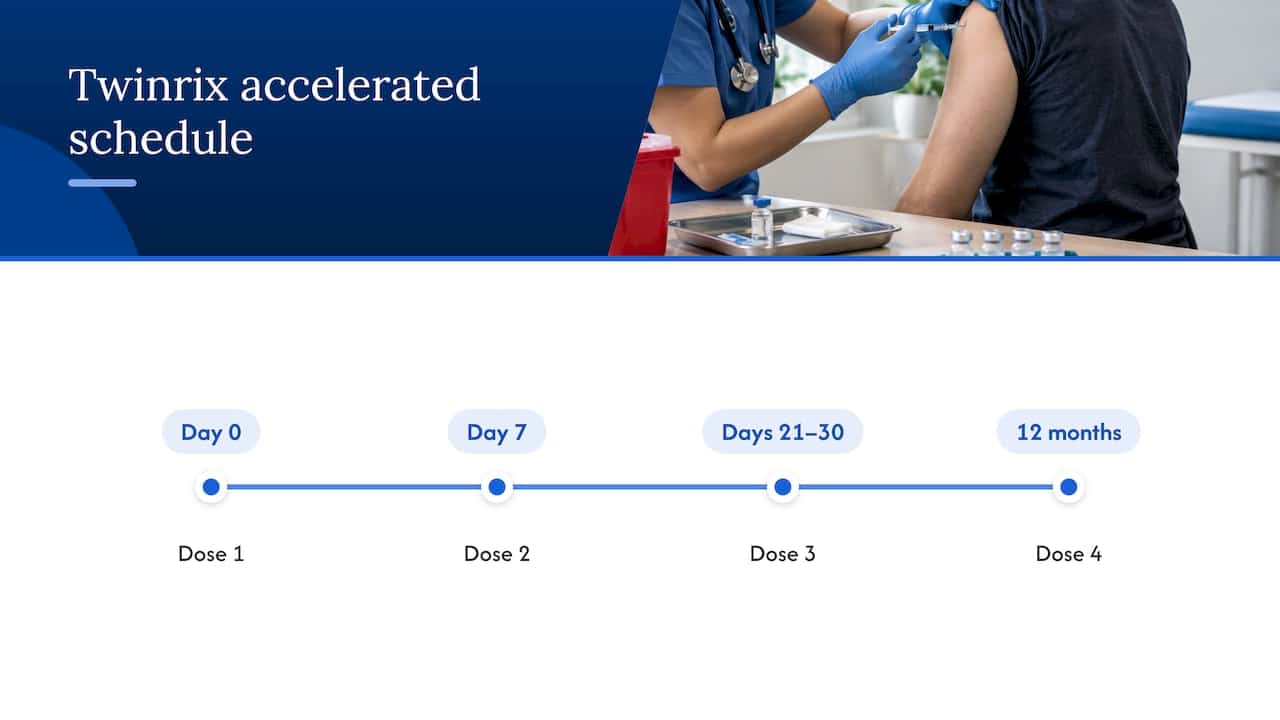
One detail for accelerated Twinrix: doses given up to four days before the minimum interval or age count as valid, except the first three doses on the accelerated schedule. On that schedule, timing is tighter, so keep your appointments.
What if you miss a dose or the series stalls?
This is the most common worry we hear, and the answer is reassuring. The CDC’s guidance states that an interrupted series does not need to be restarted. The next dose should be given as soon as possible, while still respecting the minimum intervals between shots.
In practice that means:
- Do not wait for a “better time.” Book the next dose now.
- Do not repeat doses you already had. They still count, even if they were years ago.
- Bring any record you have, such as a vaccine card, a pharmacy printout or a school or work file.
- If you have no record, tell your provider what you remember and they can guide you.
Switching brands partway through
Whenever feasible, the same manufacturer should be used for the whole series. But the CDC says that if a different brand is given, the doses are still valid and do not need to be repeated. So if you moved, changed jobs or switched pharmacies between doses, you have not wasted anything.
Keeping track of your doses
The date, product and lot number of each dose are what make a stalled series easy to resume. Providers rely on careful documenting of each vaccine dose, and you should keep your own copy as well. Take a photo of your vaccine card after every visit and store it where you can find it.
Do adults need a hepatitis B booster?
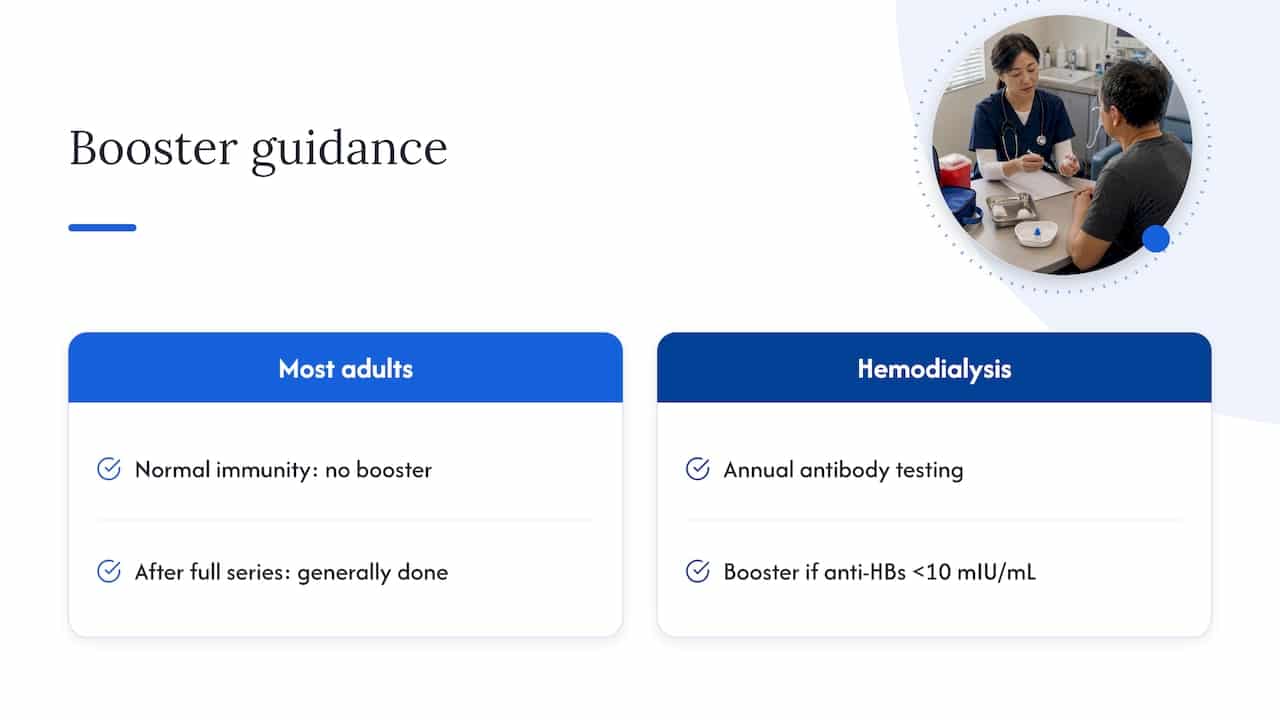
For most healthy adults, no. The CDC’s Q&A states that boosters are not recommended for people with normal immune status who have completed a full series. If you finished your series, you are generally considered done.
The exception is hemodialysis. For those patients, the same CDC document recommends annual antibody testing and a booster if anti-HBs levels fall below 10 mIU/mL.
If you are searching for a booster because your records are missing or you are not sure you finished, that is a different situation. You may not need a booster at all. You may simply need to complete a series you started. That is a conversation to have with a provider.
Do you need a blood test after vaccination?
Most adults do not. Testing to confirm immunity is advised 1 to 2 months after the final dose for people whose later care depends on their immune status. The CDC names hemodialysis patients and other immunocompromised people in that group.
If you work in health care or have a condition that affects your immune system, ask your provider whether post-vaccination testing makes sense for you. We can order lab work at the clinic when it is appropriate.
What to expect at your visit
A hepatitis B vaccination visit is quick. Here is how it usually goes:
- Check-in and history. We ask about prior vaccines, allergies, pregnancy, chronic conditions and any upcoming travel.
- Choosing a schedule. We talk through the options that fit your health and your calendar.
- The injection. The vaccine is given as a shot in the upper arm.
- Planning the next dose. If your schedule has more than one dose, we help you map out when to return.
Sore arm, tiredness or a mild headache after a vaccine are common. If you ever have trouble breathing, swelling of the face or throat, or hives after a shot, call 911.
Other vaccines and screenings worth reviewing at the same visit
A hepatitis B visit is a good moment to look at the rest of your preventive care. Our adult vaccine schedule guide lays out what is recommended by age and health condition. Depending on your situation, you may also want to look at:
- Hepatitis C screening, which is a separate test from hepatitis B vaccination
- Recommended STD tests, if you are due for routine screening
- MMR vaccination, if you do not know your history
- Flu shots during the fall and winter
Students heading to campus can also read our post on vaccines for kids going off to college.
Our perspective
In our experience, the biggest obstacle to finishing a vaccine series is not fear of the shot. It is logistics. People start a series, then work, school or family gets in the way, and months pass.
That is why we built our clinic around access: open seven days a week from 8 AM to 8 PM, with same-day appointments and no long waits. A short visit on a Saturday or after work is much easier to keep than a booking three weeks out.
We see adults and children, so a parent can often bring the whole family and take care of immunizations in one trip. We also want you to feel comfortable asking about records you cannot find or doses you think you missed. Nobody gets a lecture here. We look at where you are, choose the next step and get you moving again.
If you are unsure whether you are protected against hepatitis B, that is a good reason to come in and talk it through.
Lisa
Get your hepatitis B vaccination in Lutz
Immunizations are part of the family care we provide in Lutz, along with lab work, wellness exams and primary care. Walk in any day from 8 AM to 8 PM, or call (813) 792-8555 to ask about your situation before you come. See our immunizations, lab work and wellness exam services for the full list.
If you would like a provider who knows your history over the long term, our primary care team can keep your vaccines and screenings on track year after year.
FAQ
How many doses of hepatitis B vaccine do adults need?
It depends on the vaccine. Heplisav-B is given in two doses, while other adult vaccines typically use three. Twinrix has an accelerated four-dose schedule, and adults on hemodialysis receive four doses of Engerix-B or a high-dose option. Your provider will choose the one that fits your health and timeline.
Do I have to restart if it has been years since my last dose?
No. An interrupted series does not need to be restarted, according to CDC guidance. You get the next dose as soon as possible and continue from there. Bring any record you have so we can count the doses you already received.
Do adults need a hepatitis B booster?
Not if your immune system is normal and you completed the full series. The CDC does not recommend routine boosters for these adults. Hemodialysis patients are the main exception and are checked yearly with an antibody test.
Can I get vaccinated without a blood test first?
Yes. Vaccination can begin without prior screening, since protecting someone who may be vulnerable is the priority. Your provider may still suggest testing for other reasons, such as occupation or an existing health condition.
Is it safe to get hepatitis B vaccine during pregnancy?
This depends on the product. Heplisav-B is not recommended in pregnancy because safety data are limited. Tell your provider if you are pregnant or planning to be, so they can pick a suitable vaccine.
Sources
- Hepatitis B Vaccine Administration, CDC
- Hepatitis B Questions and Answers for Health Professionals, CDC
- Hepatitis B Vaccine Updates for Adults, ASHP
- Ask the Experts: Hepatitis B for Adults, Immunize.org
- Hepatitis B (HepB) Vaccine, Merck Manual Professional Version
- Vaccine Administration Documentation: What to Record