


Your child may benefit from therapy when a change in mood, behavior, sleep, appetite or school performance lasts two weeks or more, causes real distress, or gets in the way of daily life. One rough week is rarely a reason to worry. A pattern is. This guide shows you what to look for, how to separate a phase from a concern, and what to do next, including when to skip the appointment and get emergency help.
TL;DR
- Watch for persistence: changes that last two weeks or more, cause distress, or disrupt school, home or friendships.
- Common signs include mood swings, withdrawal, loss of interest in favorite activities, headaches or stomachaches with no medical cause, and slipping grades.
- Use the “3 Ds” to describe what you see: Distress, Duration and Disruption.
- Start with your pediatrician or primary care provider if you are unsure. Your own gut feeling counts.
- Talk of suicide, self-harm or a safety risk is urgent. Call or text 988, or go to the nearest emergency room or call 911.
Table of Contents
- Why parents often hesitate, and why it helps to act early
- Phase or concern? Three questions that help
- Signs your child may need therapy
- Trust what you see at home
- Red flags that need action now
- How to prepare before you call
- Our perspective: what we see in Lutz
- Who to see first
- What therapy for a child looks like
- How we can help
- FAQ
- Sources
Why parents often hesitate, and why it helps to act early
Almost every parent has wondered whether a child is “just going through something.” That is a fair question. All children are sometimes sad, anxious, irritable or aggressive, and the NIMH notes that in most cases these are typical developmental phases.
But emotional struggles in childhood are common. According to the National Health and Nutrition Examination Survey, as cited by the American Academy of Child and Adolescent Psychiatry (AACAP), 1 in 5 children will experience signs and symptoms of a psychiatric disorder at some point, yet only 1 in 2 of those children receives appropriate treatment. Asking for help is not an overreaction. It is often the step that was missing for many families.
Seeking an opinion also does not commit your child to years of treatment. For some children, a few sessions, some parent coaching or a change at school is enough.
Phase or concern? Three questions that help
The Child Mind Institute suggests parents pay attention to three D’s. They give you a simple way to organize what you notice before you pick up the phone.
- Distress. How hard is your child struggling? Think about the intensity of their emotions and behaviors, such as panic, tears or anger that seem bigger than the situation.
- Duration. How long has it gone on? A bad week after a move is different from three months of withdrawal.
- Disruption. How much does it interfere with school, family life and friendships?
The NIMH points to persistence as the key. If behavior that might look normal for a younger child is still there and getting stronger after weeks or months, or if it impedes daily life, it is time to get professional input.
Signs your child may need therapy
No single sign tells you a child needs therapy. Look for clusters, and look for change from your child’s normal. The signs below draw on guidance from the Child Mind Institute and a Cleveland Clinic psychologist’s list.
Changes in mood and behavior
- Drastic mood swings, or a sudden change in personality
- Frequent anger, tantrums or aggression that is new or getting worse
- Intense worry, fear or panic that keeps your child from doing ordinary things
- Trouble with attention or sitting still that goes beyond what is typical for their age
Changes in daily routines
- Sleeping much more or much less than usual
- Changes in appetite, eating or hygiene
- Losing interest in activities they used to enjoy
- Pulling away from friends and family
Physical complaints
Frequent headaches or stomachaches with no medical cause can be the way a child expresses stress. A medical visit is still the right first step, because you want to rule out a physical illness. Our primary care providers can do that and, if the exam is clear, talk through what comes next.
School and social signs
- Falling grades or trouble finishing work that was easy before
- Resisting school in the mornings, or a sudden refusal to go
- Problems in several settings at once: home, class and the sports field
- New trouble making or keeping friends
Problems in more than one area of life deserve extra attention. Cleveland Clinic lists this as one of its main signs, because a child who struggles only at one place may be reacting to something specific there.
Signs by age
| Age group | What parents often notice |
|---|---|
| Preschool and early elementary | Frequent meltdowns, clinginess that is new, regression such as bedwetting after being dry, stomachaches before school, play that repeats the same upsetting theme |
| Late elementary | Perfectionism or constant worry, avoiding school or activities, anger outbursts, trouble with friendships, drop in grades |
| Preteens and teens | Withdrawal, irritability, changes in sleep or eating, loss of interest, risky behavior, talk of hopelessness |
This table is a guide, not a diagnosis. Children vary a lot, and what looks like a concern at 5 can be typical at 3.
Trust what you see at home
You know your child’s baseline better than anyone. Experts at the Child Mind Institute encourage parents not to dismiss a gut feeling, since you are the first to notice small shifts in personality or mood, even before they meet the threshold for any specific diagnosis. Starting with a low-stakes conversation with a pediatrician is often the best first step.
If you want a broader read on why acting on early observations matters, this parent guide to early detection in children makes the case from a health perspective, though it is written for a UK audience.
Red flags that need action now
Some signs should not wait for a routine appointment. AACAP lists situations where a professional evaluation is recommended:
- Self-harm, such as cutting or burning
- Fighting with weapons
- Suicide attempts
- Sudden school avoidance
- Persistent hallucinatory experiences
- No meaningful improvement after 6 to 8 weeks of intervention
If you are worried about suicide
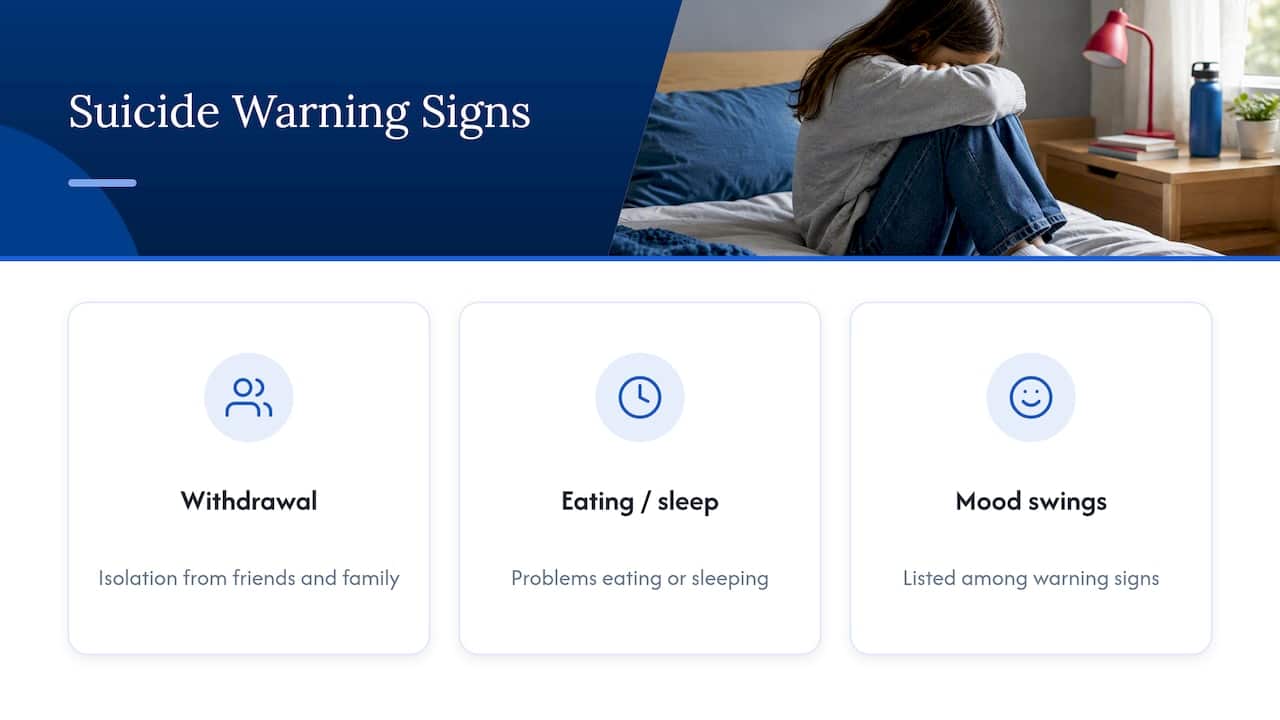
Warning signs the Child Mind Institute lists include isolation from friends and family, problems eating or sleeping, and mood swings, among others.
Many parents fear that asking about suicide will plant the idea. Experts say the opposite: asking directly is often the most effective way to find out, and it shows your child that someone cares. Treat any suicidal thoughts or behavior as urgent. In a life-threatening situation, go to the nearest emergency room or call 911 rather than waiting for an appointment.
In Florida, you can also call or text 988. The 988 Florida Lifeline is a free service, available 24/7, managed by the Florida Department of Children and Families, and it can connect a caller with a mobile response team when in-person help is needed.
For teens, our guide on depression symptoms in teens explains what two weeks of change can mean and what to do.
How to prepare before you call
The more specific you are, the easier it is for a clinician to understand your child. The Child Mind Institute suggests documenting examples. “He gets upset when asked to stop one activity and start another” tells a professional far more than “he is uncooperative.”
Before the visit, jot down:
- What you see, with two or three recent examples
- When it started and whether it is getting better, worse or staying the same
- Where it happens: home, school, activities or all of them
- Recent changes, such as a move, a divorce, a loss, a new school or a new sibling
- Sleep, eating and any physical complaints
- Medications, medical history and what you have already tried
Child and adolescent psychiatrists describe an evaluation as a collaborative effort. The goal is to sort out the child’s environment, short-term triggers and long-term temperament, then choose the most supportive path. That path may be parent education or brief counseling rather than intensive treatment.
Our perspective: what we see in Lutz
We are a family walk-in clinic, so many parents first meet us for a sore throat, a sports physical or an immunization. Often the mental health concern comes up near the end of the visit: “Can I ask you something else?” We always make room for that question.
Three things guide how we respond.
Start with the whole child. A child with stomachaches, poor sleep or trouble focusing deserves a medical look first. Because we offer primary care, urgent care, lab work and therapy under one roof, a parent does not have to guess which door to knock on.
Make the first step small. Parents often wait because they imagine a big, formal process. It does not have to be. Our therapy page introduces our collaborative therapist, and sessions are available both in the office and virtually, which helps when school and activity schedules are tight. If you want to understand how approaches differ by age and by your role as a parent, see our guide to child therapy types.
Keep the parent in the picture. Younger children usually do better when the adults around them are part of the work. For some families, family therapy is the right fit. For teens, privacy matters too, and we explain how it works in our article on therapy for minors and confidentiality in Florida.
If your gut says something is off, you do not have to prove it first. Call us and tell us what you have noticed.
— Lisa
Who to see first
Parents often ask where to begin. Several types of professional can help, and the NIMH lists a primary care provider as one of the places to start. Treatment usually includes therapy (virtual or in person), medication, or a combination.
| If you want | Consider |
|---|---|
| A medical check and a first conversation | A pediatrician or primary care provider |
| Talk therapy, play therapy or parent coaching | A licensed therapist or counselor |
| Diagnosis and medication management for complex cases | A child and adolescent psychiatrist |
| Immediate safety help | 988, an emergency room or 911 |
You are also entitled to a second opinion. AACAP notes that this is especially reasonable if there are language or cultural barriers, or if the diagnosis or treatment plan is unclear. If you have trouble getting a specialist on time, you can contact your insurance plan’s patient advocate, or the Department of Consumer Affairs.
What therapy for a child looks like
The first visit is mostly conversation. The therapist asks about your child’s history, strengths and worries, and about your family routines. Younger children may draw or play while the therapist observes. Teens may be offered some one-on-one time.
A typical early plan covers:
- Goals you and the therapist agree on, such as fewer outbursts, better sleep or going to school without a fight
- Skills for your child, such as naming feelings, calming the body and facing fears in small steps
- Tools for you, such as how to respond to meltdowns or reinforce progress
- A check-in point. If there has been no meaningful improvement after 6 to 8 weeks, AACAP’s guidance lists that as a reason to seek further evaluation
For teens with anxiety, our article on 12 weeks of CBT walks through what a structured course looks like. After a loss, see our guide to grief counseling for teens.
How we can help
Your Family Walk-In Clinic in Lutz is open seven days a week, 8 AM to 8 PM, and offers same-day appointments for adults and children. If you are not sure whether your child’s symptoms are physical, emotional or both, you can start with a primary care visit, or explore therapy for your child. Call (813) 793-8555 to ask about scheduling. If your child needs immediate medical attention for an injury or illness, our urgent care is available too.
FAQ
How do I know if my child’s behavior is a phase or needs therapy?
Look at how long it lasts and how much it interferes. If the behavior has continued for two weeks or more, is causing distress, or is disrupting school, home or friendships, it is worth a professional conversation. Behavior that is intensifying after weeks or months is another cue.
Should I see a pediatrician before a therapist?
That is often a good first step, especially when your child has physical complaints such as headaches or stomachaches. A medical visit can rule out physical causes and help you decide what comes next. You can also go straight to a therapist if the emotional signs are clear.
Is it okay to ask my child directly about suicide?
Yes. Experts at the Child Mind Institute say asking directly is often the best way to find out and does not plant the idea. If your child says yes, treat it as urgent: call or text 988, or go to the nearest emergency room or call 911 if the danger is immediate.
Can I get a second opinion about my child’s diagnosis or treatment plan?
Yes. AACAP says parents are entitled to seek a second opinion, particularly when the diagnosis or plan is unclear. You do not have to stay with the first clinician you see.
Does my child have to come to the office for therapy?
Not always. Our clinic offers therapy for adults and children both in the office and virtually. Your child’s age, needs and comfort level will help decide which format works best.
Sources
- Advocating For Your Child, AACAP
- Children and Mental Health: Is This Just a Stage? NIMH
- 11 Signs of Mental Illness in Children, Child Mind Institute
- Recognize the signs and help your child, Child Mind Institute
- 10 Signs That Your Child May Need a Therapist, Cleveland Clinic
- Signs Your Child Might Be Suicidal, Child Mind Institute
- When to Seek Referral or Consultation with a Child Adolescent Psychiatrist, AACAP
- Normal or Not: When to Get Help, AACAP
- Help for Mental Illnesses, NIMH
- 988 Florida Lifeline, Florida Department of Children and Families