


CBT (cognitive behavioral therapy) helps you spot and change unhelpful thoughts and behaviors, usually over a few months. DBT (dialectical behavior therapy) grew out of CBT and adds acceptance, emotion skills and more support between sessions, usually over a year or longer. If your main problem is anxiety or low mood, CBT is often the first place to look. If your emotions feel overwhelming, or you struggle with self-harm, DBT is built for that.
This guide explains the difference in plain words, so you can walk into a first appointment knowing what to ask for. If you feel unsafe or are thinking about hurting yourself, call or text 988 (the Suicide & Crisis Lifeline) or call 911 now. Do not wait for an appointment.
TL;DR
- DBT is a type of CBT adapted for very intense emotions. CBT focuses on changing thoughts, while DBT balances change with acceptance.
- CBT is typically short-term, about 10 to 16 sessions. DBT usually runs about a year and includes individual therapy, a skills group and between-session coaching.
- CBT is commonly recommended for anxiety, depression and some trauma-related problems. DBT is recommended for borderline personality disorder, self-harm and some substance use problems.
- The two are not rivals. Many therapists blend them, and the right choice depends on your symptoms, your schedule and how much structure you want.
- A primary care or therapy visit is a practical way to get matched to the right approach.
Table of Contents
- What CBT and DBT are, and how they are related
- CBT vs DBT side by side
- How the goals differ
- What a course of treatment looks like
- What each therapy is used for
- When CBT can feel invalidating
- Who may need a different approach
- How to decide between CBT and DBT
- Our perspective
- Get started in Lutz or online
- FAQ
- Sources
What CBT and DBT are, and how they are related
CBT is a structured talk therapy. You and your therapist look at how your thoughts, feelings and actions feed each other, then practice changing the patterns that keep you stuck. Sessions follow an agenda, and you usually get homework between visits.
DBT is a form of CBT, not a separate invention. According to the Association for Behavioral and Cognitive Therapies, psychologist Marsha Linehan developed it at the University of Washington to help people with chronic suicidal thoughts and borderline personality disorder (BPD). Cleveland Clinic describes DBT as talk therapy based on CBT but adapted for people who feel emotions very intensely. It is a common therapy for BPD and is also used for other mental health conditions.
The word “dialectical” points to the central idea. The ABCT fact sheet explains that DBT balances accepting you exactly as you are right now with strong efforts to change your life, with the goal of building “a life worth living.”
CBT vs DBT side by side
| CBT | DBT | |
|---|---|---|
| Main goal | Identify and reframe unhelpful thoughts and change behaviors | Build skills to handle intense emotions and distress, while accepting yourself |
| Typical length | About 10 to 16 sessions, or 12 to 16 weeks | About 1 year, sometimes up to 18 months |
| Weekly structure | One session of 45 to 60 minutes | Individual session plus a skills group, plus phone coaching as needed |
| Style | Highly structured, agenda-driven | More flexible and responsive to what is happening in your week |
| Often recommended for | Anxiety, depression, OCD, some trauma-related problems | BPD, self-harm, chronic suicidal thoughts, some substance use problems |
The lengths and session times come from Psychiatry Advisor (2025) and Verywell Health (2025). A 2024 consensus guideline article in the American Journal of Psychotherapy gives a similar picture: 16 to 20 sessions for CBT across many diagnoses, and 12 months of individual and group work for DBT aimed at BPD. Exact numbers vary by therapist and by person.
How the goals differ
Both therapies want you to feel better and function better. They take different routes.
CBT works on the assumption that some thoughts are distortions. Swapping them for more balanced ones can ease depression or anxiety. A common example: “I always fail” becomes “I struggled with this one task, and I have handled others well.”
DBT puts more weight on what to do when emotion is already running high. A 2022 economic evaluation describes DBT’s goal as raising your ability to tolerate emotional distress by practicing alternative coping strategies. It describes CBT’s goal as identifying and reframing cognitive distortions.
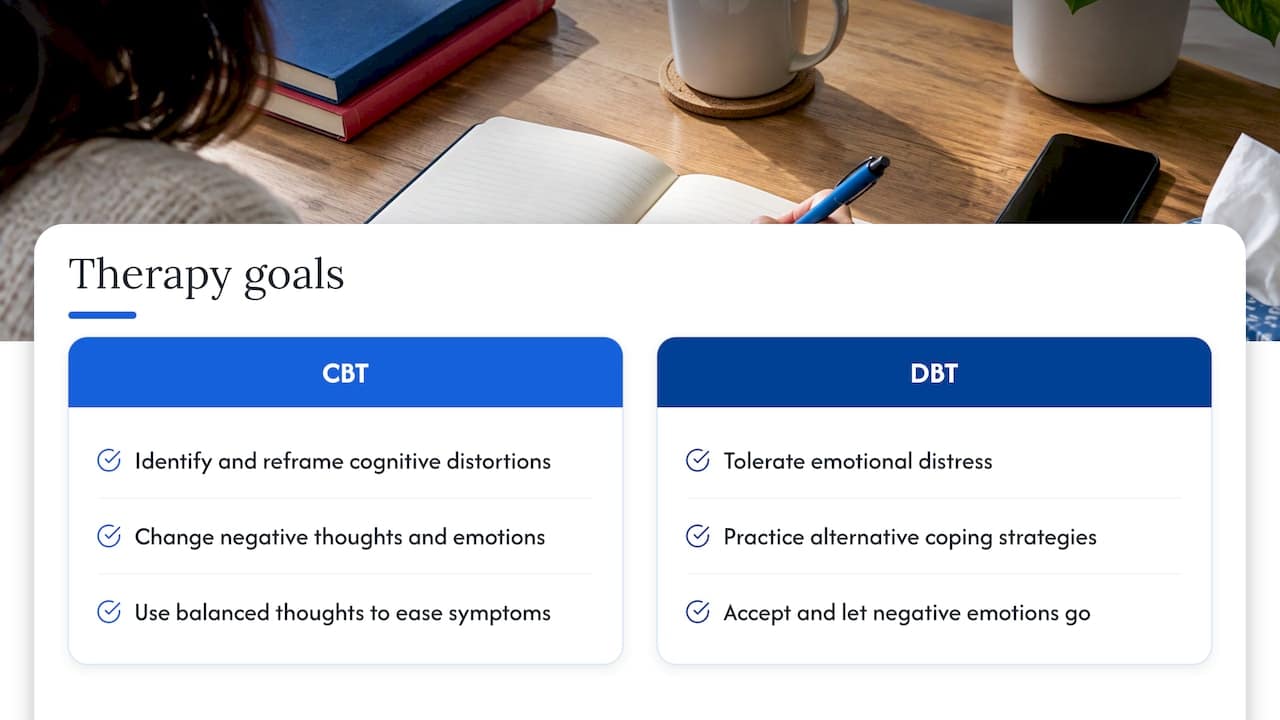
Verywell Health puts the difference this way: CBT encourages changing negative thoughts and emotions, while DBT promotes accepting negative emotions, feeling them and letting them go.
What a course of treatment looks like
A typical CBT course
You meet weekly for about 45 minutes to an hour. Early sessions map out the problem and set goals. Later sessions practice specific tools, such as challenging a thought, scheduling activities that lift mood or facing a feared situation step by step. Homework between visits is part of how it works.
If you want to know what the first visit feels like, our guide to preparing for your first therapy session walks through it.
A typical DBT course
In its standard outpatient form, DBT has four parts:
- Weekly individual therapy. Cleveland Clinic notes these sessions last about 40 to 60 minutes. They focus on safety first, then on behaviors that get in the way of therapy, then on your goals and quality of life.
- Weekly skills training, usually in a group. Psychiatry Advisor says this runs about 2 hours once a week, in a classroom-style setting.
- Between-session coaching. You can contact your therapist at certain times for help applying a skill or getting through a crisis.
- A weekly therapist consultation team. The therapists meet to discuss their DBT cases.
The group teaches four core skill areas: mindfulness, emotion regulation, interpersonal effectiveness and distress tolerance. Many people also find that calming routines help them practice the skills at home. Some use guided audio such as binaural beats for anxiety as one way to settle before practicing a breathing or grounding exercise.
What each therapy is used for
Current recommendations tie the choice of therapy to the diagnosis. The 2022 economic evaluation notes that DBT is recommended for BPD and substance use disorder, while CBT is recommended for depression, anxiety and some trauma-related disorders.
Anxiety
For generalized anxiety, CBT has a strong track record. In a randomized trial of 65 adults with generalized anxiety disorder, CBT was clearly better than a wait-list at the end of treatment. During follow-up, only CBT led to continued improvement. For panic, phobias, social anxiety and OCD, therapists usually reach for CBT-based methods, including exposure.
If your child or teen is the one struggling, see our page on CBT for teen anxiety and our guide to matching therapy types to your child’s age.
Intense emotions, self-harm and BPD
DBT has the deepest research base here. In a randomized trial of 84 outpatients, people who completed 20 weeks of DBT skills training had larger drops in self-injury than people on a waitlist. They also improved more on anger, distress tolerance and emotion regulation.
A 2010 review by Alexander Chapman found the strongest support for women with BPD, with promising results for substance use disorders, binge-eating disorder and depression in older adults. A 2024 Australian trial found that 8 weeks and 16 weeks of group DBT skills training produced similar gains, so a longer format was not automatically better.
Depression
CBT is the usual first-line choice for mild to moderate depression. DBT may be considered when depression comes with mood swings, impulsive behavior or self-harm.
When CBT can feel invalidating
Some people try CBT and come away feeling criticized. This is a real and common experience.
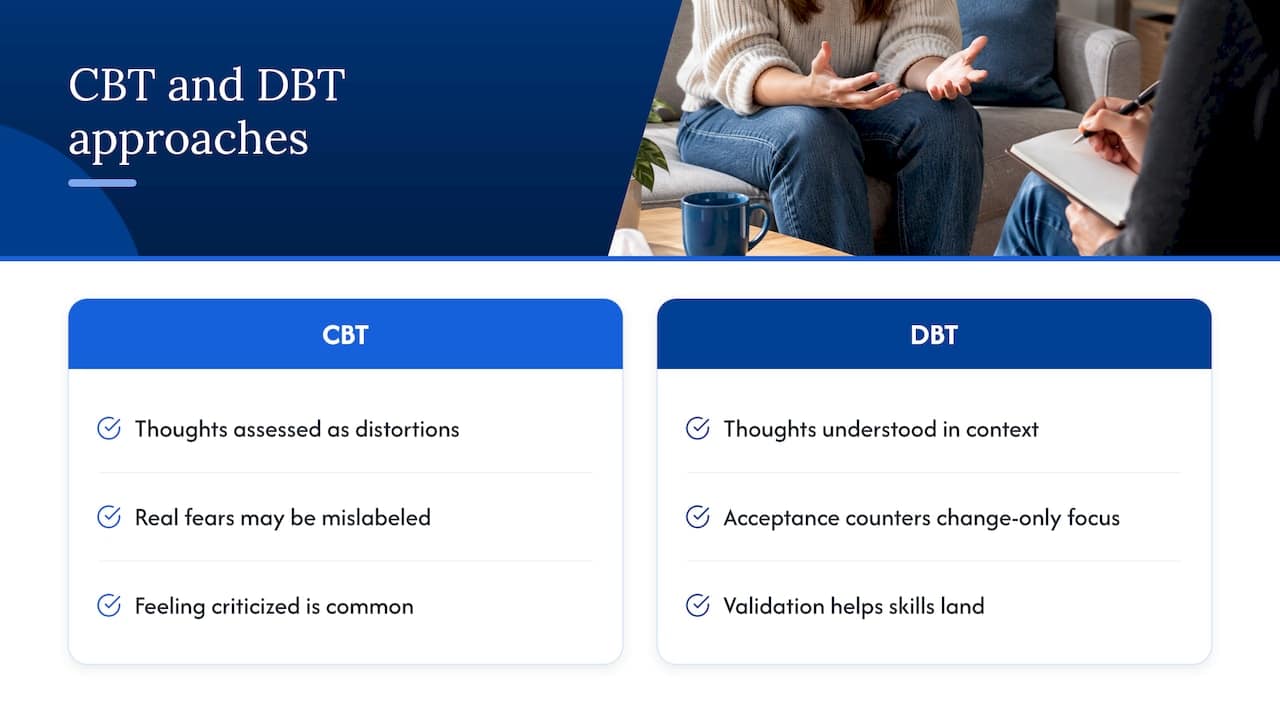
Harvard Health explains that CBT assumes certain negative thoughts are distortions. For someone with very deep emotions and convictions, being told those thoughts are “wrong” can feel invalidating. A DBT-trained therapist instead acknowledges that your thoughts make sense given who you are and what you have lived through.
Validation does not mean agreeing with everything. As Dr. Aarika V. White explains, it means being able to see why you responded or interpreted something the way you did. She adds that when a client feels unheard, skills teaching tends not to land.
This matters for cultural context too. Psychiatric Times notes that purely change-based cognitive restructuring can label fear rooted in real discrimination as a distortion. It describes acceptance-oriented approaches such as DBT as a counterbalance.
If CBT has felt like being told you are thinking wrong, say so to your therapist. A good clinician will adjust the pace and add more validation, and may suggest acceptance-based skills.
Who may need a different approach
DBT is demanding. Cleveland Clinic says it is more likely to work if you are ready to commit to therapy and homework, willing to focus mostly on the present and future, and able to do some sessions in a group.
Two more points help you shop wisely:
- Comprehensive DBT vs. “DBT-informed” therapy. Psychologist Kiki Fehling writes in Psychology Today that many people who think they are getting DBT are getting DBT-informed therapy or learning a few skills inside another treatment. She says people with BPD, self-harm, heavy substance use, frequent dissociation or other harmful impulsive behaviors are likely to benefit more from comprehensive DBT. A clinical practice blog makes the same point for self-injury and suicidal thoughts.
- Single-problem conditions. If your main issue is panic, a phobia, social anxiety or straightforward depression, one DBT clinician notes that CBT and exposure usually work faster. For OCD, the standard treatment is exposure and response prevention.
If you or someone in your home has thoughts of suicide or has been self-harming, tell a provider right away. That situation calls for a full evaluation and, often, comprehensive DBT.
How to decide between CBT and DBT
Use these questions as a starting point. They do not replace an evaluation.
- What is the main problem? Specific anxiety, low mood, OCD or sleep trouble point toward CBT. Mood instability, chronic suicidal thoughts, or impulsivity alongside other conditions point toward DBT, according to a Palo Alto University resource.
- How safe are you right now? Self-harm or suicidal thoughts come first. Say so at the start.
- How much time can you commit? CBT is often a few months of weekly sessions. DBT adds a weekly group and runs about a year.
- What style do you prefer? The same resource suggests that people who like logic, structure and a shorter timeline often gravitate to CBT. Those who want emotional depth, mindfulness and longer-term change may prefer DBT.
- Do you feel heard? If past therapy made you feel dismissed, mention it. It may shape which approach and which therapist suit you.
It also helps to know the choice is not all-or-nothing. Simply Psychology’s comparison describes the two as complementary, notes that many programs integrate both, and says some therapists deliver DBT-informed CBT that brings acceptance and distress-tolerance skills into CBT’s structure.
A caution on evidence: a Cochrane review from 2020 rated the DBT trial evidence as low quality overall, while still finding real benefits, and both therapies have randomized trial support. For you, the practical lesson is to look at the fit between the therapy, your diagnosis and the therapist’s training.
For help with the human side of the decision, read our guide on how to choose a therapist.
Our perspective
We see people every week who have already read about CBT and DBT and still do not know where to start. That is normal. The labels sound clinical, but the real question is simple: what is getting in the way of your daily life, and what kind of support helps you feel steady enough to work on it?
Our view is that the first step matters more than the perfect label. A conversation with a clinician who listens, asks about your symptoms and your safety, and explains your options will do more for you than weeks of searching online. We offer therapy and counseling for adults and children, both in the office and by video, so you can pick the setting that fits your week.
We also believe care works best when your whole health is considered. Sleep, medications, medical conditions and stress all affect mood. Being a family clinic with primary care and same-day visits means we can look at the whole picture, and we can help you or your child take the next step without long waits.
If you are unsure whether you need CBT, DBT or something else, bring your questions. You do not have to know the answer before you come in.
Lisa
Get started in Lutz or online
Your Family Walk-In Clinic provides therapy and counseling for adults and children in Lutz, with in-office and virtual sessions. We are open seven days a week from 8 AM to 8 PM, and we accept major health insurance plans, Medicaid and self-pay.

If you would like to talk through your symptoms and options, contact our clinic to set up a visit. If you plan to try virtual sessions, our online therapy checklist helps you prepare, and our summary of online therapy research covers how well it works. You can also start with a visit to our primary care providers to talk through how you have been feeling.
FAQ
Is DBT better than CBT?
Neither is better across the board. CBT is generally the recommended choice for anxiety and depression, while DBT is recommended for BPD, self-harm and intense emotional swings. The better therapy is the one that matches your main problem and that you can stay with.
Who is DBT not recommended for?
DBT can be hard going, and it works best when you are ready to take part in group sessions and homework. If your main problem is panic, a phobia, social anxiety or OCD, other treatments such as CBT with exposure are usually more direct. A clinician can help you sort this out.
Which is better for anxiety, DBT or CBT?
For most specific anxiety disorders, CBT has the stronger research behind it, including trials in generalized anxiety disorder. DBT skills can still help when anxiety comes with overwhelming emotion, and some therapists blend the two.
Why does CBT sometimes feel invalidating?
CBT treats some thoughts as distortions to be reframed. If you already feel misunderstood, that can sound like being told your feelings are wrong. Tell your therapist how it lands. DBT-style validation, which acknowledges why your reaction makes sense, can be added.
How long does each therapy take?
CBT is usually about 10 to 16 sessions, roughly 12 to 16 weeks. DBT usually lasts about a year, and sometimes up to 18 months, because it includes a skills group and ongoing coaching.
Sources
- Dialectical Behavior Therapy fact sheet, ABCT
- Dialectical Behavior Therapy (DBT), Cleveland Clinic
- Psychotherapies at a Glance: Consensus guideline, American Journal of Psychotherapy
- Cognitive-Behavioral Therapy vs Dialectical Behavior Therapy, Psychiatry Advisor
- Dialectical Behavior vs. Cognitive Behavioral Therapy, Verywell Health
- Economic Evaluation of Long-Term Dialectical Behavioral Therapy, PMC
- A Randomized Clinical Trial of CBT for generalized anxiety disorder, PMC
- A randomized trial of brief dialectical behaviour therapy skills training, PubMed
- Dialectical Behavior Therapy: Current Indications and Unanswered Questions, PMC
- Randomized effectiveness-implementation trial of DBT, Griffith University
- Dialectical behavior therapy: What is it and who can it help, Harvard Health
- Acceptance and Change: the role of validation in DBT, Cummins Behavioral Health Systems
- Validation of Minoritized Experiences, Psychiatric Times
- Not All DBT Is Created Equal, Psychology Today
- Comprehensive DBT vs DBT-informed treatment
- Is DBT Right for Me?
- CBT vs DBT: Evidence-Based Choices for Anxiety and Depression Treatment, Palo Alto University
- CBT vs DBT: Key Differences, Simply Psychology
- CBT vs. DBT: What’s The Difference?, Simply Psychology
- Binaural beats for anxiety