
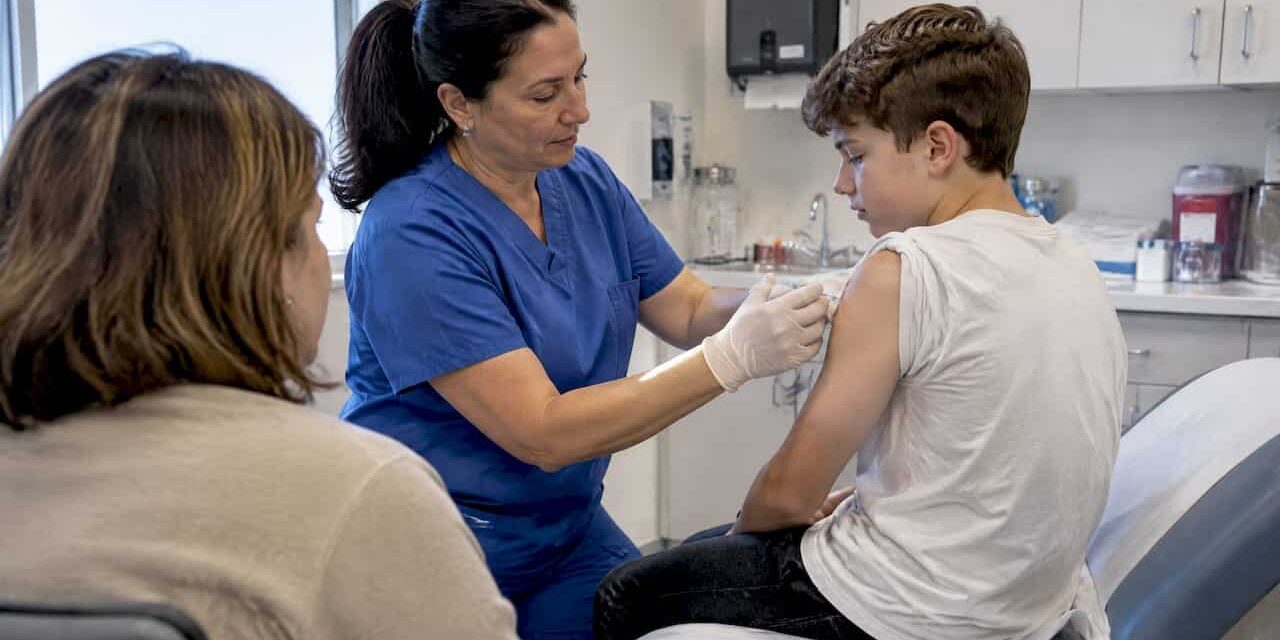
The CDC recommends the HPV vaccine routinely at age 11 or 12. The series can start as early as age 9, and anyone who missed it should catch up through age 26. From 27 through 45, it becomes a personal decision you make with your provider. These are national recommendations, and they apply in Florida the same way. Below, we explain what each age group should know, how many doses you need, what it costs, and how to get the shot in the Lutz and Tampa area.
TL;DR
- Ages 11 to 12 is the routine age. The CDC says vaccination may begin at age 9.
- Through age 26, catch-up vaccination is recommended for anyone not already vaccinated.
- Ages 27 to 45 use shared clinical decision-making. It is not a routine recommendation, and the vaccine is not licensed after 45.
- Doses: 2 doses if you start before age 15, 3 doses if you start at 15 or older or have a weakened immune system.
- Florida families can call us to ask about the HPV vaccine and your child’s records. We are open 8 AM to 8 PM, seven days a week.
Table of Contents
- The recommended age for the HPV vaccine
- Starting at age 9 or 10
- Ages 13 through 26: it is not too late
- Ages 27 through 45: a decision, not a default
- How many doses, and how far apart
- Is the HPV vaccine required in Florida?
- Safety: what parents ask most
- What it costs and how to pay
- Our perspective: make the visit easy to finish
- Getting the shot in Lutz and the Tampa area
- What if you never got the vaccine?
- FAQ
- Sources
The recommended age for the HPV vaccine
HPV (human papillomavirus) is a very common virus. Some types can cause cancers later in life, including cervical cancer. The vaccine protects against those types, but it works best when it is given before any exposure.
That is why the CDC recommends routine vaccination at 11 or 12 years old and allows the series to begin at 9. The goal is full protection well before sexual activity typically begins, with a strong and lasting immune response.
Here is the whole picture at a glance:
| Age at first dose | What the CDC recommends | Doses |
|---|---|---|
| 9 to 10 | May be started, at your provider’s discretion | 2 |
| 11 to 12 | Routine recommendation | 2 |
| 13 to 14 | Catch-up recommended | 2 |
| 15 to 26 | Catch-up recommended | 3 |
| 27 to 45 | Shared clinical decision-making | 3 |
| 46 and older | Not licensed | Not applicable |
The dose counts in this table follow the CDC’s HPV vaccine information statement and its adult schedule notes. Your provider may adjust the plan if you have started the series before or have a medical condition.
Starting at age 9 or 10
Parents are sometimes surprised that a 9-year-old is even eligible. The earlier start is allowed, not required. Some pediatric offices use it to tie the shot to another visit, or to make sure a child finishes the series on time. Ask your child’s provider whether starting early makes sense for your family.
There is no need to rush if your child is 11 or 12 and healthy. The routine window is wide, and what matters is that the series is finished.
Ages 13 through 26: it is not too late
If your teen or young adult never got the vaccine, the CDC recommends catch-up vaccination for everyone through age 26. That includes both males and females.
Two things change with age:
- Teens who start at 13 or 14 still qualify for the shorter, 2-dose schedule.
- Teens and young adults who start at 15 through 26 need three doses. The same is true for people with a weakened immune system.
The practical advice: start now rather than wait for the “right” moment. Each dose you complete counts, and a series that was interrupted generally does not need to start over. Bring any records you have, and we will help work out what is left. If you need them, our guide to getting immunization records in Florida walks through the steps.
Ages 27 through 45: a decision, not a default
This is the group that gets the most confusing answers. The FDA licensed the vaccine through age 45, but the CDC does not recommend it for everyone in that range. It recommends shared clinical decision-making, which means you and your provider decide together.
Why the difference? By this age, most people have already been exposed to some HPV types. The benefit of the vaccine as prevention is smaller than it is for adolescents, according to the CDC’s guidance for clinicians. Some adults can still benefit, especially if they have a new partner or are at risk of new infections.
A good visit on this topic covers:
- Your age and your sexual history, in a private and non-judgmental conversation
- Whether you have a new partner or expect to
- Any conditions that affect your immune system
- Cost and insurance coverage, which can vary for adults in this range
If you want to see how HPV fits with the rest of your adult shots, our adult vaccine schedule guide lays it out by age.
How many doses, and how far apart
The number of shots depends on your age when you start, not your age at the last dose.
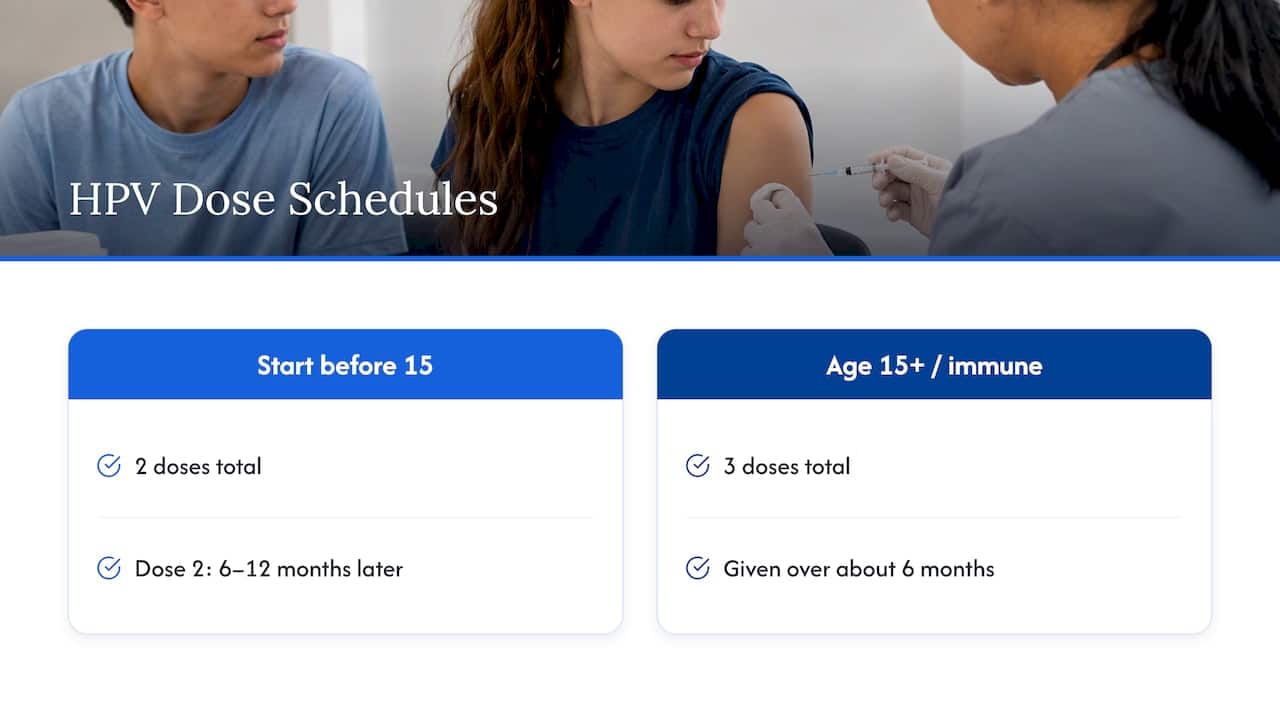
Two-dose series (start before 15): The second dose follows the first by 6 to 12 months.
Three-dose series (start at 15 or older, or immunocompromised): The doses are given over about six months, according to the CDC.
If your child gets dose one at age 12, you have a comfortable window for the second. Put the second visit on the calendar before you leave the first, and consider timing it around a sports physical or a school break so it does not get lost.
Is the HPV vaccine required in Florida?
The Florida Department of Health publishes the vaccines needed for school entry on its school enrollment page. That page is the authority, and requirements can change, so check it before each school year rather than rely on a blog post, including ours. The CDC’s recommendation for HPV vaccination is separate from any school rule, and it applies to every family regardless.
If your child needs school records, Florida uses the Form DH 680. It must be completed by a licensed Florida physician or health department official. If you are new to the state, bring the records from your old state and ask us to help you get the form completed. We also explain the same-day DH 680 process for parents who are short on time.
Safety: what parents ask most
It is natural to want details before your child gets any vaccine. Here is what the CDC says:
- HPV vaccines have been studied extensively, with over 160 studies and extensive testing before licensing.
- The vaccine is not a live virus. It is designed to mimic the virus so your body builds protection, so it cannot cause an HPV infection.
- Safety monitoring continues through reporting systems such as VAERS, which gives you a transparent record.
Common reactions after any vaccine include a sore arm, mild fever or feeling tired. Fainting can happen after vaccines in teens, so having your child sit or lie down for about 15 minutes afterward is sensible. Call your provider or seek urgent care if you see signs of a severe allergic reaction, such as hives, swelling of the face or throat, or trouble breathing. Call 911 for trouble breathing.
What it costs and how to pay
Cost depends on your age and coverage.
- Children 18 and younger may qualify for the federal Vaccines for Children program if they are Medicaid-eligible, uninsured, underinsured, or American Indian or Alaska Native. Eligible children can receive no-cost vaccines from enrolled providers. Providers may still charge an administration fee, so ask about it when you book.
- Insured patients: Check your plan’s coverage for the vaccine and the visit. Many plans cover recommended vaccines for the ages the CDC recommends, but call the number on your card to confirm.
- Adults 27 to 45: Coverage may differ because the recommendation is not routine. Ask your plan before you book.
We accept major health insurance plans, Medicaid and self-pay. We do not publish a price for the HPV vaccine, so call us and we will tell you what to expect before your visit.
Our perspective: make the visit easy to finish
The hardest part of the HPV series is usually not the shot. It is finishing the second or third dose. Families are busy, kids have practices, and a visit at the pediatrician’s office can mean waiting weeks for an opening.
That is why we think of HPV vaccination as a family-planning task, not a one-time errand. We are open seven days a week from 8 AM to 8 PM, we offer same-day appointments, and we see both adults and children. A parent can bring a 12-year-old for dose one and a college-age sibling for a catch-up dose during the same trip.
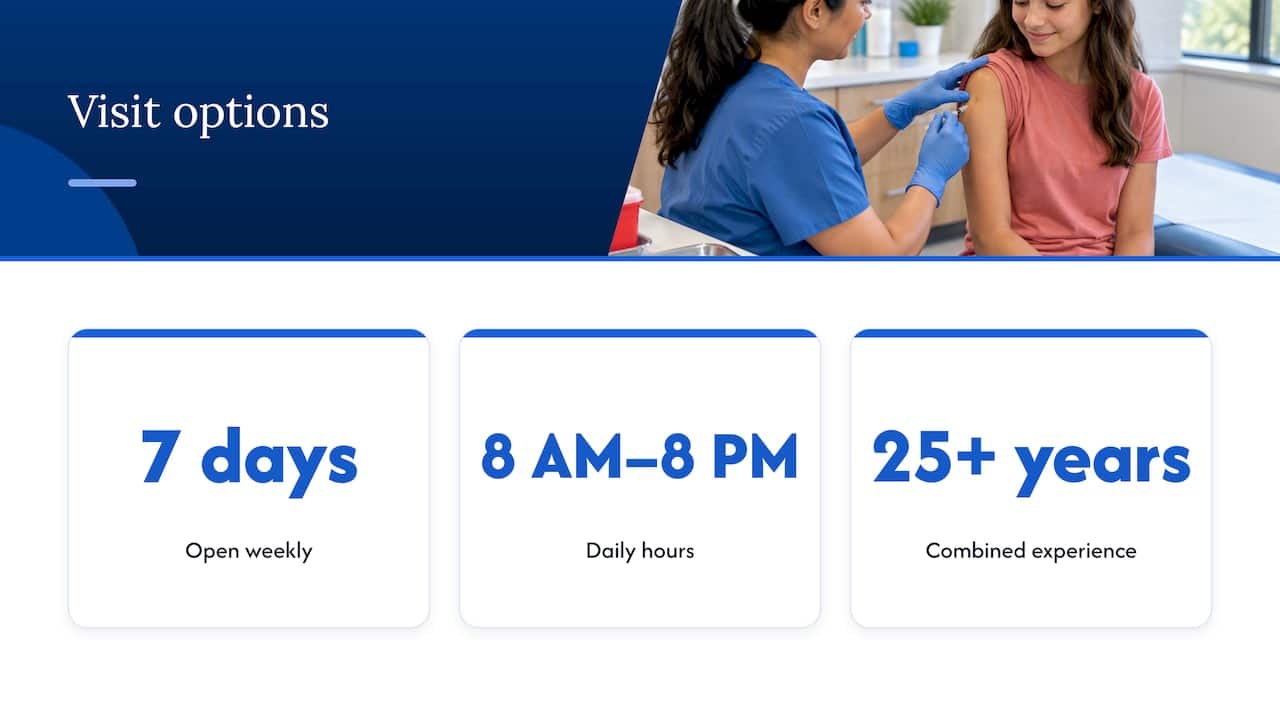
We also encourage honest conversations. Teens may feel awkward about this topic, and adults in their late 20s or 30s often are not sure whether they “count.” Our providers have more than 25 years of combined experience, and we will explain the options plainly, without judgment. If the decision for you is “not recommended,” we will tell you that too.
One more practical step: ask for your records after every dose, or confirm they are entered in the state registry. A single, current record saves hours when school, camp, or college asks for proof.
— Lisa
Getting the shot in Lutz and the Tampa area
We offer immunizations alongside primary care, sports and school physicals, and health screenings. Many families combine the HPV vaccine with a sports or school physical, since the 11 to 12 age is also when many kids need a physical for middle school sports.
Before you come:
- Call us at (813) 792-8555 to confirm the vaccine is available and ask what your visit will cost.
- Gather any prior immunization records, even partial ones.
- Bring your insurance card or Medicaid information. Minors need a parent or guardian, so ask us about what is required.
- Note which dose you are on and when the last one was given.
You can see everything we provide on our prices and services page, or learn about our primary care option if you want one provider to manage your family’s vaccines year to year. If your question is about sexual health testing too, see our page on STD screening and treatment.
What if you never got the vaccine?
This is one of the most common questions. If you are 26 or younger, you can still start. If you are 27 to 45, talk with a provider about your risk. If you are older than 45, the vaccine is not licensed for you, and regular screening matters more. For women, that means keeping up with cervical cancer screening as your provider advises, whether or not you were vaccinated.
Having the vaccine also does not replace safer sex practices or screening. It protects against the HPV types it covers, not every infection. If you are concerned about an exposure, our STD testing guide explains what a panel includes, and our page on testing windows explains when results are reliable.
FAQ
What is the best age to get the HPV vaccine?
The best time is age 11 or 12, before any exposure to the virus. The series can start as early as 9. Children who start before 15 need only two doses, so starting on time also means fewer shots.
Can I get the HPV vaccine at 30 or 40?
Possibly. The vaccine is licensed through age 45, but the CDC recommends shared clinical decision-making for ages 27 to 45 rather than a routine shot. Your provider will talk through your personal risk and whether you are likely to benefit. Insurance coverage may vary at these ages, so check before you book.
Does Florida have a program for free HPV vaccines?
Children 18 and younger who are Medicaid-eligible, uninsured, underinsured, or American Indian or Alaska Native may get no-cost vaccines through the Vaccines for Children program from enrolled providers. An administration fee may still apply. Your county health department can also tell you what it offers, as shown on Florida Department of Health county pages.
Do boys need the HPV vaccine too?
Yes. The CDC recommends it for all children at 11 or 12, and for everyone through age 26 who was not vaccinated earlier. Florida’s health department also lists the vaccine for males and females in its immunization FAQ.
How many HPV shots does my child need?
Two doses, 6 to 12 months apart, if the first is given before age 15. Three doses over about six months if the first is given at 15 or older, or if your child has a weakened immune system.
Sources
- HPV Vaccine Information Statement, CDC
- HPV Vaccine Recommendations, CDC
- Evidence to Recommendations for HPV Vaccination of Adults 27 through 45, CDC ACIP
- Adult Immunization Schedule Notes, CDC
- HPV Vaccine Safety, CDC
- Vaccines for Children Program: Information for Parents, CDC
- School Enrollment, Florida Department of Health