
Florida schools accept either a Tuberculin Skin Test (TST) or an IGRA blood test for students identified by a risk assessment, not for every student. The TST needs a return visit 48 to 72 hours later to read the result, while the IGRA blood draw wraps up in a single visit. You can get either test at a county health department, a pediatrician’s office, or a walk-in clinic, then bring the results or your school-entry exam paperwork to enrollment.
TL;DR:
- Florida risk assessments flag close contact with TB, travel from countries where it is common, congregate settings, or a weakened immune system.
- For children five and older, IGRA is often preferred after BCG vaccination; providers may favor TST under age five because evidence is limited.
- IGRA results usually arrive within a few business days and cost $80 to $150 out of pocket; county health departments often charge less.
- Positive results require clinical evaluation, usually chest imaging and a symptom check; known exposure may prompt repeat testing 8 to 10 weeks after last contact.
- When testing is requested, school documentation should include the test type, date, result, and provider signature; TST records need placement and reading dates.
Table of Contents
- Accepted test types: TST and IGRA blood tests, explained
- Who actually needs a TB test for school in Florida
- Where to get a TB test in Florida and what it costs
- Timing and the testing process from start to finish
- Documentation Florida schools require for enrollment
- What to expect at your TB testing appointment
- A clinic perspective on getting this done without the stress
- Same-day TB testing and school paperwork at Your Family Walk-In Clinic
- FAQ
- Sources
Accepted test types: TST and IGRA blood tests, explained
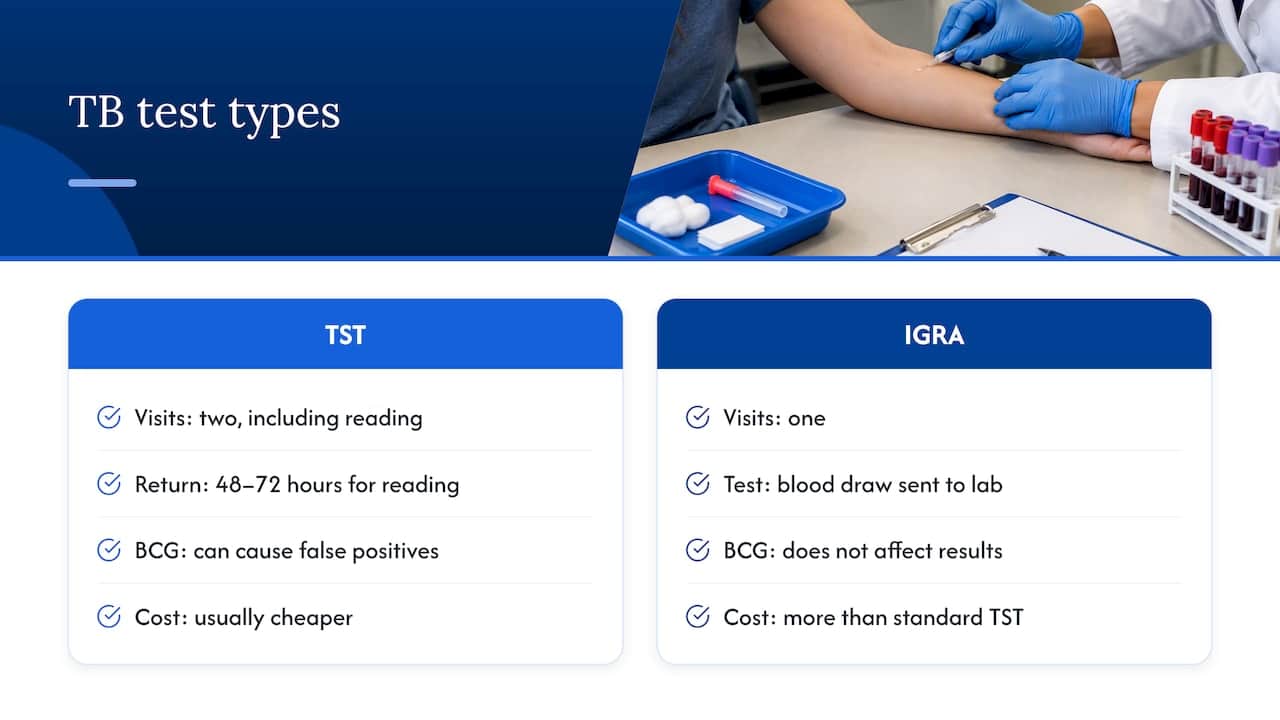
The Tuberculin Skin Test, also called the Mantoux test, involves a small injection just under the skin of your forearm. Nothing happens at that visit. You have to come back 48 to 72 hours later so a trained provider can measure any raised bump at the injection site and determine whether the reaction counts as positive. Miss that window, and you typically need to start over.
The IGRA blood test, which includes brands like QuantiFERON and T-SPOT, only requires one visit. A provider draws blood and sends it to a lab, and you get your answer without a second appointment. The CDC notes that IGRA is often preferred for people age 5 and older, especially those who received the BCG vaccine as children, since BCG can cause a false positive on a skin test but does not affect IGRA results.
For children under 5, many pediatricians and public health providers still lean toward the TST, since IGRA has less validation data in very young kids. If your child is younger, expect your provider to walk you through that reasoning rather than defaulting straight to the blood test.
Cost and convenience often settle the decision for families. The TST is usually the cheaper option and widely available, but it demands two visits and some planning around your schedule. IGRA costs more but fits better when you are short on time or cannot guarantee you will make it back within the reading window. Either test satisfies a Florida school’s risk-based testing request when a provider administers and reads it correctly.
Who actually needs a TB test for school in Florida
Here is something that surprises a lot of parents: Florida does not require every student to get tested for TB before enrolling. Florida Statute 1003.22 requires a school-entry health examination within one year before a child first enrolls in a Florida school, but TB testing itself only comes into play when a risk assessment flags a specific concern.
That risk assessment usually asks about things like:
- Close contact with someone who has active TB disease or a known infection.
- Recent immigration or travel from a country where TB is common.
- Living or spending time in a congregate setting, such as a shelter or correctional facility.
- A weakened immune system from a medical condition or medication.
Counties use standardized forms to walk through these questions. Miami-Dade County’s TB risk assessment form, for example, lists these exact risk categories for school admissions and spells out that a positive answer leads to testing, with a chest x-ray to follow if that test comes back positive.
If none of these risk factors apply to your child, you likely will not need TB testing at all for enrollment. The school-entry health exam itself, covering a physical checkup and vision and hearing screening, is the actual statutory requirement. For most families, one TB test covers the requirement permanently. Repeat testing only comes up for ongoing exposure risk, ongoing work in high-risk settings, or specific school or program policies that ask for annual screening.
Where to get a TB test in Florida and what it costs
You have several solid options depending on your budget and timeline.
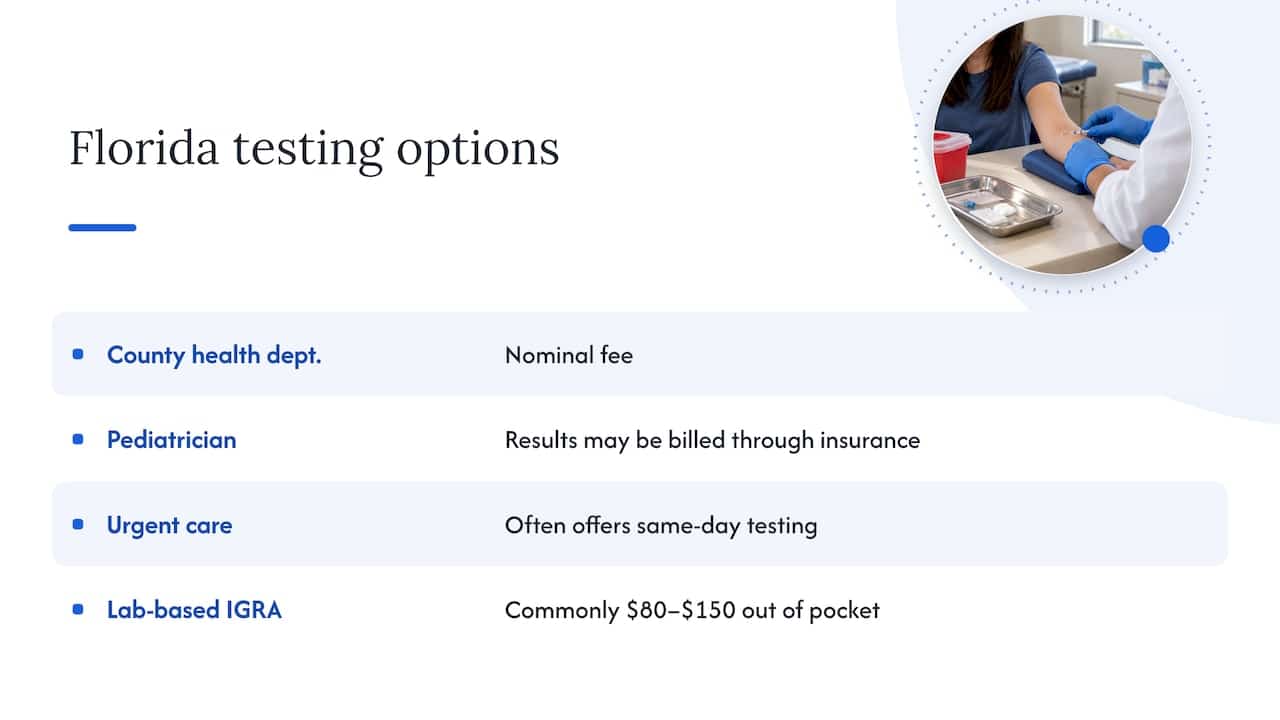
County health departments tend to be the cheapest route. The Florida Department of Health notes that county offices commonly charge a nominal fee for TB testing done for school or work, and some county pages list nominal, low-cost fees for TB testing. Appointments can book up during back-to-school season, so call ahead.
Your pediatrician or primary care provider is another good option, particularly if your child already has a relationship there and you want results billed through insurance. This route works best when you are not racing a tight deadline, since many offices need a few days’ notice to schedule.
Urgent care and walk-in clinics often offer same-day testing without an appointment in most cases. This matters when a school deadline is days away and you cannot wait for a pediatric opening.
A lab-based IGRA blood draw, whether through a commercial lab or a clinic that orders it, costs more than a standard TST but saves you the second visit. Insurance often covers IGRA when a provider documents medical necessity, though out-of-pocket pricing commonly falls somewhere between $80 and $150 depending on the lab.
When you call around, ask whether the fee includes the reading visit for a TST, whether same-day appointments are available, and whether the provider can complete a DH 680 form on the spot if your school asks for one.
Timing and the testing process from start to finish
Your calendar matters here. If you choose the TST, you need two separate visits: the injection, then a return 48 to 72 hours later for the reading. Plan backward from your school’s deadline, and build in a buffer in case the clinic is busy or you need a different time slot for the reading.
IGRA skips that entirely. One visit, one blood draw, and results typically come back from the lab within a few business days, though turnaround varies by provider and lab volume.
If a test comes back positive, that is not the end of the process, and it does not mean your child has active TB disease. Florida Department of Health guidance explains that a positive TST or IGRA result calls for further clinical evaluation, which usually includes a chest x-ray and a symptom check to rule out active disease. Depending on those findings, a provider might also order a sputum test.
In situations involving a known exposure, such as close contact with someone diagnosed with active TB, public health teams often run a baseline test first and then a second test 8 to 10 weeks after the last exposure, since infection does not always show up immediately after contact.
Documentation Florida schools require for enrollment
The school-entry health exam is the paperwork your school actually needs to see for enrollment, and it covers more than TB status. It documents a general physical exam along with vision and hearing checks, completed within one year before your child starts school, as required under Florida Statute 1003.22.
When TB testing is part of the picture, your school will want to see the test date, the type of test performed, the result, and the signature of the administering provider. For a TST, that means both the placement date and the reading date need to appear on the documentation.
Florida’s Certification of Immunization, known as Form DH 680, is the standard form schools use to track immunization status, and it is completed by a licensed health care provider. If your child is transferring from out of state or you cannot locate prior records, a provider can typically complete a new DH 680 the same day, based on a current exam and any available history, which helps you avoid delays at enrollment.
What to expect at your TB testing appointment
A little preparation keeps you from needing a second trip. Here is what to bring and plan for:
- Your child’s photo ID or your own, plus the school’s name and exact submission deadline.
- Any prior TB test records or documentation of a previous positive result, since this changes the recommended approach.
- Your insurance card, if you plan to bill the visit, along with a vaccination record if you have one.
- A clear idea of whether you need a single-visit result (IGRA) or can manage a return trip in 48 to 72 hours (TST).
If your child recently received a live vaccine, such as MMR, mention it. The CDC notes that live vaccines can affect TST accuracy for several weeks, so providers often recommend waiting 4 to 6 weeks after a live vaccine before placing a TST, or choosing IGRA instead to sidestep the timing conflict entirely.
At the visit itself, a clinician will review the risk assessment with you, administer the chosen test, and explain what to expect next, whether that is a return date or a lab turnaround estimate.
Pro Tip: If your school deadline is close and you are not sure you can make a 48 to 72 hour return window, ask about IGRA testing instead so you only need one appointment.
A clinic perspective on getting this done without the stress
Many families find that starting early in this process makes it easier to complete. Waiting until the week before a school deadline turns a simple test into a scramble, especially with the TST’s return-visit requirement.
It is advisable to call as soon as your school mentions a TB risk assessment or a missing form, rather than waiting until the deadline is close. Same-day DH 680 completion may be possible depending on timing.
— Lisa
Same-day TB testing and school paperwork at Your Family Walk-In Clinic
When a school deadline is bearing down, what you need most is speed without sacrificing care, and that is exactly how we built our urgent care services in Lutz. Some clinics offer same-day TB testing, school and sports physicals, and DH 680 completion, so one visit can sometimes cover the needed requirements.
Here is what you can expect when you come in:
- Same-day TST placement or IGRA blood draw, with no appointment required in most cases.
- School and sports physicals completed alongside your TB test when your school needs both.
- On-the-spot DH 680 completion when records are current and complete.
- Extended hours seven days a week, from 8 AM to 8 PM, so you are not stuck waiting for a weekday pediatric slot.
- Billing through major insurance plans or self-pay options for families without coverage.
Walk in during our open hours, or call ahead if you want to confirm timing for a TST reading visit. Either way, we will help you figure out the fastest path to meeting your school’s requirement before the deadline hits.
This article is general information, not a substitute for advice from a qualified doctor. Consult a qualified healthcare professional about your own circumstances before acting on anything here.
FAQ
How often should I get a TB test for school?
For most Florida students, one TB test satisfies the school requirement permanently unless a new risk factor comes up, such as a known exposure or travel to a TB-endemic area. Students in ongoing high-risk situations, like certain congregate living settings, may need periodic retesting as determined by a provider or health department.
How do I get a TB test in Florida?
You can get a TB test at a county health department, your pediatrician’s office, or a walk-in clinic like ours, depending on how quickly you need results. County health departments tend to offer the lowest fees, while urgent care clinics typically offer same-day appointments.
Does CVS still do TB testing?
Availability of TB testing at retail pharmacy clinics varies by location and changes over time, so it is best to call ahead and confirm before relying on that option. County health departments, pediatricians, and walk-in clinics remain consistent, dependable options for both TST and IGRA testing in Florida.
Why do schools require a TB test?
Florida schools do not require TB testing for every student. Testing only comes into play when a risk assessment under Florida law identifies specific risk factors, such as recent immigration from a high-TB-rate country or close contact with someone diagnosed with TB.
Sources
- Florida Statutes §1003.22 — School-entry health examinations; immunization against communicable diseases; exemptions; duties of Department of Health.
- Tuberculin skin testing (TST) | CDC
- Tuberculosis | Florida Department of Health
- TB risk assessment for school admissions — Miami‑Dade County Florida Department of Health (PDF)