


For most ankle sprains, urgent care is the right next step because it offers same-day evaluation, imaging when needed, and a splint before you go home. The main exception is a true emergency: visible deformity, numbness, or a foot you cannot bear weight on at all belongs in the ER. Clinicians use the Ottawa Ankle Rules to decide whether an X-ray is necessary, and getting evaluated quickly at a clinic like Your Family Walk-In Clinic lowers your risk of long-term instability.
TL;DR:
- Most ankle sprains can be safely evaluated and treated at urgent care, with imaging needed only if pain over the bone or swelling occurs quickly.
- Signs indicating urgent care include swelling within 30 minutes, bruising beyond the ankle, a popping sound during injury, or bone pain upon pressing, not just ligament tenderness.
- In cases of deformity, inability to bear weight, numbness, or open wounds, patients should go directly to the emergency room for immediate evaluation.
- Urgent care visits typically include history review, physical exam with Ottawa rules, on-site X-ray if needed, splinting, pain management, and follow-up guidance.
- Preparation involves noting the injury details, bringing medications and IDs, and applying RICE immediately after injury to optimize healing.
Table of Contents
- Should You Go to Urgent Care for a Sprained Ankle?
- When a Sprained Ankle Is Actually an Emergency
- What Happens During an Urgent Care Visit for a Sprained Ankle
- How to Prepare for Your Urgent Care Visit
- First Aid Before You Get to the Clinic
- How Long Does a Sprained Ankle Take to Heal?
- Why Same-Day Evaluation Actually Changes Your Outcome
- Same-Day Ankle Care at Your Family Walk-In Clinic
- Sources
- FAQ
Should You Go to Urgent Care for a Sprained Ankle?
Most people can safely start with a simple test before deciding where to go. Try to take four steps on the injured ankle, unassisted and without shifting your weight to the other foot. If you can manage it, even with pain, urgent care is almost always appropriate.
Do not force this test if the pain is severe or the ankle looks visibly bent out of shape. Stop immediately if something feels wrong.
Watch for these signs that point toward urgent care rather than “wait and see”:
- Swelling that develops within 30 minutes of the injury
- Bruising that spreads beyond the ankle itself
- A popping or tearing sound at the moment of injury
- Sharp, specific tenderness when you press directly on the bone, not just the soft tissue around it
That last point matters most. Pain over the ankle bones themselves, rather than the ligaments beside them, is one of the clearest signals that this could be a fracture and not a straightforward sprained ankle, which is exactly the kind of ankle injury treatment decision an X-ray settles fast.
When a Sprained Ankle Is Actually an Emergency
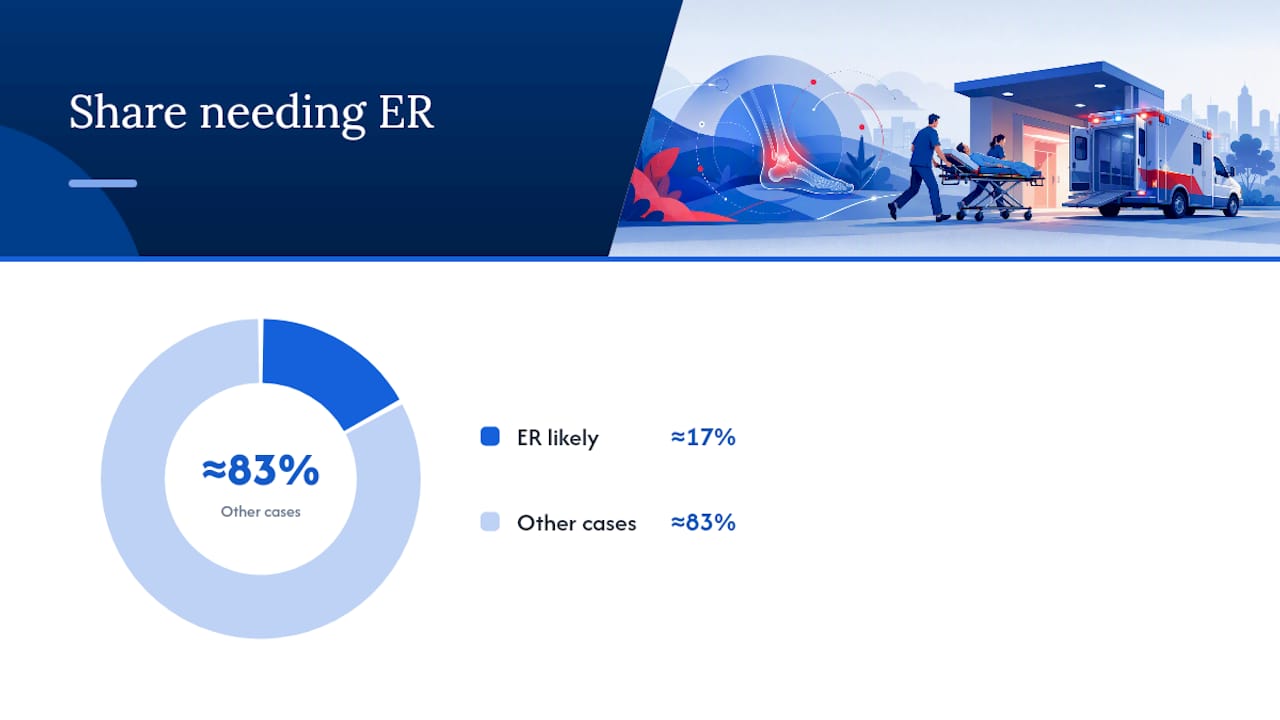
Some ankle injuries need an emergency room, not urgent care. About one in six ankle injuries involving these signs may indicate a fracture or dislocation that requires emergency evaluation rather than outpatient treatment.
Head to the ER instead of urgent care if you notice:
- Visible deformity or a bone pushing against (or through) the skin
- Complete inability to put any weight on the foot, even briefly
- Numbness, tingling, or a foot that looks pale, blue, or feels cold
- A high-speed injury (car accident, fall from height) or any open wound near the joint
These symptoms can mean the blood supply or nerves to your foot are compromised, which is a different level of urgency than ligament damage. If you’re ever unsure which category your injury falls into, this walk-in clinic vs. ER guide breaks down the decision further.
What Happens During an Urgent Care Visit for a Sprained Ankle
Urgent care clinicians follow the same evaluation standards emergency departments use for ankle injuries, starting with a focused history and physical exam. Here’s the typical sequence:
- History and mechanism review. The clinician asks how the injury happened, what you heard or felt, and where the pain is worst.
- Physical exam using the Ottawa Ankle Rules. This is a validated method that checks specific bony landmarks and your ability to bear weight to determine whether an X-ray is medically necessary.
- On-site X-ray, if indicated. Most urgent care centers can image and read results the same visit, avoiding a separate trip to a radiology center.
- Splinting or bracing and crutch instructions. You’ll typically leave with support for the joint and clear guidance on weight-bearing.
- Pain management and discharge planning. This includes medication guidance and a follow-up recommendation.
Clinics refer patients to orthopedics or the ER when imaging shows a displaced fracture, when there’s evidence of vascular compromise, or when a sprain looks severe enough to suggest complete ligament rupture.
Pro Tip: Describe the mechanism as precisely as you can, “rolled inward on a curb, heard a pop,” rather than just “I twisted my ankle.” That detail helps the clinician target the right pressure points during the exam and decide faster whether imaging is warranted.
How to Prepare for Your Urgent Care Visit
A few minutes of preparation can shorten your time in the exam room considerably.
- Note exactly how the injury happened, including any sound you heard
- Bring a list of current medications and your insurance card or ID
- Take a photo if swelling has changed noticeably since the injury
- Wear shorts or loose pants so the ankle is easy to examine
- Expect to leave with a splint or boot and written instructions on how much weight to put on it
Showing up with this information ready means less time answering questions and more time getting treated.
First Aid Before You Get to the Clinic
What you do in the first hour after a sprain can influence how fast you recover, so start with RICE, rest, ice, compression, and elevation, right away. Icing for 15 to 20 minutes at a time, several times over the first two days, helps limit swelling. Wrap the ankle with an elastic bandage snugly, but not so tight that toes go numb or tingly, and keep the foot raised above heart level when you can.
Over-the-counter NSAIDs like ibuprofen can ease pain and swelling; follow the dosing on the label and check with a clinician if you have kidney issues or take blood thinners.
Avoid these common mistakes:
- Applying heat in the first 48 hours (it increases swelling)
- Massaging directly over a suspected fracture site
- Aggressively stretching the joint to “test” it
Pro Tip: If you’re not sure whether it’s safe to keep icing or start moving the ankle, treat it as a possible fracture until a clinician tells you otherwise. Erring on the side of caution costs you nothing.
How Long Does a Sprained Ankle Take to Heal?
Recovery time depends heavily on how much ligament damage occurred, and clinicians grade sprains from 1 to 3 accordingly.
- Grade 1 (mild stretching): About one to three weeks, often with minimal formal rehab needed
- Grade 2 (partial tear): Roughly three to six weeks, usually with bracing and guided exercises
- Grade 3 (complete tear): Several months, frequently involving physical therapy and sometimes an orthopedic referral
These ligament recovery milestones line up closely with what rehab specialists see in practice, and they underscore why early, guided movement, not just rest, protects against long-term instability. Skipping structured rehab after a moderate or severe sprain raises the odds of the ankle giving out again months or years later. Urgent care typically handles the initial diagnosis and immobilization, then arranges a timed follow-up with orthopedics if the injury looks complex or unstable.
Why Same-Day Evaluation Actually Changes Your Outcome
The value of a same-day visit isn’t just convenience, it’s the difference between catching a fracture early and letting a “probably just a sprain” assumption go unchecked for days. Clinics that see these injuries constantly develop a feel for which mechanisms and sounds warrant a closer look, something that only comes from repetition. Providers with extensive experience make judgment calls like this, and clinics open seven days a week from morning until evening mean you’re rarely stuck waiting until Monday to get answers.
If you take away one practical tip from a clinician’s point of view: report your mechanism clearly, and resist the urge to keep testing the ankle by walking on it “to see how bad it is.” That repeated testing is one of the more common ways a partial ligament tear turns into a worse one.
— Lisa
Same-Day Ankle Care at Your Family Walk-In Clinic
Your Family Walk-In Clinic gives you a faster path than sitting in an ER waiting room for an injury that usually doesn’t need one. Same-day urgent care can include on-site X-ray, splinting or bracing, and treatment for both adults and kids, so a weekend soccer injury or a slip on wet tile can get handled without a multi-hour wait.

You don’t need an appointment. Walk in any day of the week during typical urgent care hours, bring your ID and insurance card, and check in at the front desk. A clinician will walk you through the evaluation process, decide whether imaging is needed on the spot, and provide you with a clear plan. For hours, directions, and what to expect when you arrive, visit the urgent care page or check same-day availability through urgent care seven days a week.
This article is general information, not a substitute for advice from a qualified doctor. Consult a qualified healthcare professional about your own circumstances before acting on anything here.
Sources
- Urgent Care for Sprained Ankle: When to Go + What to Expect
- Evaluation and Management of Ankle Injuries in Urgent Care (JUCM)
- Sprained ankle — Symptoms and causes (Mayo Clinic)
- Ankle fractures (American Orthopaedic Foot & Ankle Society / OrthoInfo)
FAQ
Should You Go to Urgent Care With a Sprained Ankle?
Yes, for most sprains, urgent care is the appropriate choice because it can evaluate, image, and splint the injury in one same-day visit. Go to the ER instead only if you see deformity, cannot bear any weight, or notice numbness or color changes in the foot.
At What Point Should I Go to Urgent Care for a Sprained Ankle?
Go as soon as possible after the injury, ideally the same day, especially if swelling develops quickly or you feel pain when pressing directly on a bone. Early evaluation using the Ottawa Ankle Rules helps rule out a fracture and starts proper treatment sooner, which lowers your risk of long-term instability.
How to Tell if an Ankle Sprain Is Grade 1 or 2?
A Grade 1 sprain involves mild ligament stretching with swelling but usually little bruising, and it tends to heal in about one to three weeks. A Grade 2 sprain means a partial ligament tear, with more noticeable swelling, bruising, and instability, and recovery generally takes three to six weeks.
Will Urgent Care Give You a Boot for a Sprained Ankle?
Yes, urgent care commonly provides a splint, brace, or walking boot depending on the severity of the sprain, along with crutch instructions if needed. You’ll also receive written guidance on how much weight to put on the ankle as it heals.
What Does an Urgent Care Visit for an Ankle Injury Cost at Your Family Walk-In Clinic?
Pricing details for urgent care visits are available directly on the clinic’s services and pricing page. The clinic accepts major insurance plans, Medicaid, and self-pay options.