


Most pink eye can be seen at urgent care; go to the ER only for vision-threatening or severe systemic signs. If you notice sudden vision loss, severe eye pain, intense light sensitivity, chemical exposure, or swelling that suggests the infection has spread beyond the eyelid, that is an emergency. For everything else, same-day urgent care imaging can usually examine your eye and start treatment that same day.
TL;DR:
- Most cases of pink eye can be treated at urgent care or through telehealth if symptoms are mild without vision loss or severe pain.
- Seek emergency care immediately if experiencing sudden vision loss, intense pain, chemical splash, or eyelid swelling with fever, as these indicate serious complications.
- Contact lens wearers with redness or pain should visit urgent care promptly for lens removal and examination since infections can escalate quickly.
- For persistent symptoms beyond 3 to 4 days or worsening pain and vision changes, a prompt evaluation by a healthcare professional is recommended.
- Urgent care can perform basic eye exams and prescribe antibiotics for bacterial infections but cannot diagnose corneal ulcers or more serious issues requiring specialist referral.
Table of Contents
- Quick Decision Matrix: Urgent Care, ER, Telehealth, or Primary Care
- Emergency Red Flags That Mean You Need the ER
- What Urgent Care Can and Can’t Do for Pink Eye
- How Doctors Tell Pink Eye Apart From More Serious Red-Eye Conditions
- Treatments by Cause and What to Do at Home Right Now
- Pink Eye in Babies and Children: What Parents Need to Know
- Follow-Up Care: When to Come Back or Call
- How We Approach Pink Eye at Our Clinic
- Our Take: Stop Overthinking the Triage, Start With the Symptom
- Get Same-Day Pink Eye Care Without the ER Wait
- FAQ
- Sources
Quick Decision Matrix: Urgent Care, ER, Telehealth, or Primary Care
Pink eye symptoms fall into a few recognizable buckets, and each one points you toward a different type of care. Sorting out which bucket you are in takes less than a minute and saves you a wasted trip.
- Mild, viral-style symptoms (watery discharge, mild redness, one eye that spread to the other): urgent care or even a telehealth visit works well here.
- Thick, colored discharge with crusting (bacterial-leaning): urgent care can usually examine the eye and prescribe antibiotic drops the same day.
- Contact lens wearers with pain or redness: urgent care should remove the lens and examine you promptly, since lens-related infections can progress faster than typical pink eye.
- Trauma, chemical splash, or a foreign object in the eye: this goes to the ER, not urgent care.
- Fever, facial swelling, or eyelid swelling that looks like it is spreading: this needs emergency evaluation for possible orbital involvement.
According to MedlinePlus, urgent care and walk-in clinics are built for non-life-threatening conditions, including infections that just need a prescription, while emergency departments exist for genuinely life- or vision-threatening problems. That distinction is the whole decision in a sentence.
A quick three-step gut check:
- Ask whether your vision itself has changed, not just your eye’s appearance.
- Rate your pain: mild irritation is common with pink eye, but sharp or severe pain is not typical and deserves a closer look.
- Check for swelling around the eye or fever, which can signal a deeper infection.
If none of those apply, book a same-day urgent care visit or a telehealth call with your primary care provider. If your symptoms have lingered past 3 to 4 days without improvement, the CDC recommends seeking professional evaluation rather than waiting it out longer.
Emergency Red Flags That Mean You Need the ER
Certain symptoms point to problems that go beyond typical conjunctivitis and can threaten your cornea, your eye socket, or your overall health. These are not symptoms to monitor at home.
- Sudden or significant vision loss: this can signal corneal involvement or a condition mimicking pink eye, like uveitis or scleritis.
- Severe eye pain, rather than mild irritation or a gritty feeling.
- Extreme light sensitivity (photophobia) that keeps you from opening your eye comfortably.
- Chemical exposure, including cleaning products or industrial splashes.
- Swelling around the eye with fever, which can indicate orbital cellulitis, an infection that has moved into the tissue around the eye socket.
- A penetrating injury or something embedded in the eye.
One in a small number of conjunctivitis cases involves a hyperacute bacterial infection severe enough to threaten the cornea within hours, not days. The CDC notes that hyperacute bacterial conjunctivitis can progress quickly and needs immediate ophthalmology or emergency department evaluation, especially when discharge is heavy, eyelids are severely swollen, or pain is significant.
If someone is in acute distress, confused, or showing signs of a spreading infection with high fever, call 911 rather than driving yourself. Otherwise, head straight to the ER. Bring your current medications, your glasses if you wear contacts, and if possible a photo of how the eye looked when symptoms started, since appearance can change quickly and that comparison helps the clinician assess progression.
What Urgent Care Can and Can’t Do for Pink Eye
Urgent care is built for exactly this kind of problem: common, uncomfortable, and usually not dangerous, but still worth a same-day look. Most visits for pink eye at an urgent care clinic include a few standard steps.
- A clinical exam of both eyes, including a check of your eyelids, discharge, and the pattern of redness.
- A basic visual acuity check to confirm your vision has not been affected.
- A prescription for antibiotic drops or ointment when the exam points to a bacterial cause.
- Removal of a foreign body or contact lens if either is contributing to irritation.
- Guidance on symptom relief, like cool compresses, while your body or the antibiotics do their work.
Where urgent care reaches its limit is advanced eye diagnostics. Most urgent care clinics do not have a slit lamp, the specialized microscope ophthalmologists use for detailed corneal exams, so if your clinician suspects a corneal ulcer, keratitis, or another condition that mimics pink eye, you will likely be referred to an eye specialist or the ER for that closer look. Contact lens wearers and people with weakened immune systems fall into this referral category more often, since infections in those groups can escalate faster than typical viral or bacterial conjunctivitis.
Pro Tip: Take out your contact lenses before your visit if your eyes feel irritated. Wearing them any longer only adds risk while you wait to be seen.
How Doctors Tell Pink Eye Apart From More Serious Red-Eye Conditions
A clinician’s first job is ruling out the handful of red-eye conditions that look similar but are not conjunctivitis at all. That starts with a focused set of questions before any exam tools come out.
Expect to be asked about:
- When your symptoms started and how fast they progressed.
- What color and texture the discharge is (watery, stringy, or thick and colored).
- Whether you wear contact lenses and how often.
- Whether you have pain, not just irritation, and whether your vision has changed.
- Any recent trauma, chemical exposure, or eye surgery.
From there, a typical exam includes a visual acuity check, a fluorescein stain to look for scratches or ulcers on the cornea under a blue light, and an inspection of your eyelids and the surrounding skin. Cultures and imaging are reserved for cases that look unusual or are not responding to standard treatment, not for routine pink eye.
The American Academy of Ophthalmology warns that conditions like keratitis, uveitis, and scleritis can mimic conjunctivitis while carrying real risk to your vision. Any exam finding involving the cornea, significant pain disproportionate to redness, or vision changes that do not clear with blinking typically triggers a same-day referral to ophthalmology or the ER rather than a wait-and-see approach.
Treatments by Cause and What to Do at Home Right Now
Treatment depends entirely on what is causing your pink eye, which is part of why an exam matters even for something that seems minor.
- Bacterial conjunctivitis usually responds to antibiotic eye drops or ointment, often improving within a day or two of starting treatment.
- Viral conjunctivitis has no antiviral cure. Supportive care, cool compresses, and time are the treatment, since antibiotics have no effect on a virus.
- Allergic conjunctivitis responds to antihistamine or mast-cell-stabilizer drops, and avoiding the allergen when you can identify it. If you are unsure whether your symptoms are infectious or allergic, our guide to pink eye versus allergies walks through the differences.
- Chemical exposure needs immediate irrigation with clean water and emergency evaluation, not home treatment.
While you sort out the cause, a few home habits matter regardless of what’s behind your symptoms: use a clean washcloth for compresses, wash your hands before and after touching your eye, skip contacts until you are symptom-free, and wash pillowcases and towels separately in hot water to avoid reinfecting yourself or spreading it to others.
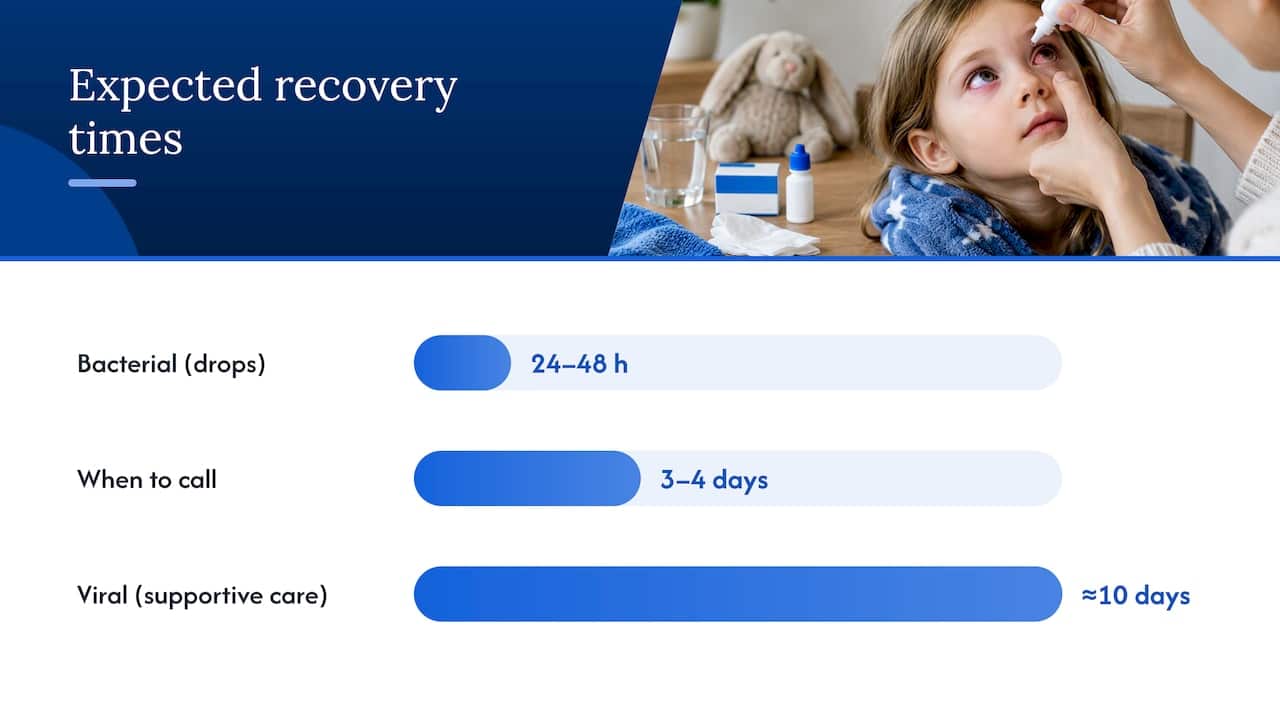
Viral conjunctivitis typically resolves on its own in about ten days, according to the CDC, and antibiotics will not speed that up. For bacterial cases on antibiotics, you should notice real improvement within 24 to 48 hours. If you are past that window with no change, or past 3 to 4 days with no improvement at all, it’s time to call your clinic back rather than wait longer. Our pink eye treatment guide covers home care and recovery expectations in more detail.
Pink Eye in Babies and Children: What Parents Need to Know
Pediatric pink eye comes with its own set of rules, and the most important one applies to the youngest patients.
Any eye redness or discharge in a newborn needs immediate evaluation. The CDC is specific about this: neonatal conjunctivitis can stem from bacteria picked up during birth, including organisms that cause serious complications if treatment is delayed. This is not a wait-and-see situation for a baby, even if symptoms look mild.
For toddlers and older children, use these signs to decide where to go:
- Urgent care fits a child with typical redness, discharge, and mild irritation who is otherwise acting normally and eating and drinking as usual.
- ER is the right call if your child has a fever alongside eye symptoms, cannot open the eye due to swelling, complains of real pain rather than itchiness, or shows any change in vision.
- Call your pediatrician if you are unsure, especially for a child under a few months old who is not quite a newborn but still very young.
Schools and daycares commonly ask that a child stay home while discharge is present, since viral conjunctivitis spreads easily in close quarters. Frequent handwashing, not sharing towels or pillows, and keeping your child’s hands away from their eyes go a long way toward limiting spread at home and once they return to class.
Pro Tip: Pack a small bottle of hand sanitizer in your child’s backpack once they’re cleared to go back. Reinfection often comes from touching a contaminated surface, not from another sick classmate.
Follow-Up Care: When to Come Back or Call
A little monitoring after your visit prevents small problems from becoming bigger ones. Use these benchmarks to judge whether treatment is working.
- Bacterial conjunctivitis on antibiotics should show noticeable improvement within 24 to 48 hours.
- Viral conjunctivitis can take up to 10 days to clear fully, and that is normal, not a sign of treatment failure.
- Any new or worsening pain, vision change, or light sensitivity after you start treatment means you should call or return right away, not wait for your next scheduled check.
- No improvement after 3 to 4 days, regardless of which type you were diagnosed with, is a signal to call your clinic back.
If symptoms are not responding as expected, your clinician may switch your prescription, take a culture to identify a resistant organism, or refer you to ophthalmology for a closer look at your cornea. None of that means something went wrong with your first visit. It means your case needs a different level of attention, and catching that early protects your vision.
How We Approach Pink Eye at Our Clinic
Pink eye cases in urgent care often follow a predictable path: an exam, a look at discharge and eyelid involvement, and either a prescription or supportive-care guidance before you leave. The clinic offers extended hours, which matters for an eye infection that tends to worsen overnight and look much angrier by morning.
What we treat directly includes typical viral and bacterial conjunctivitis, allergic flare-ups, and mild contact-lens-related irritation once lenses are removed. What we refer out promptly includes anything suggesting corneal involvement, severe pain disproportionate to redness, or swelling that looks like it’s spreading beyond the eyelid. That’s not a limitation unique to us. It reflects where urgent care’s scope should end and an eye specialist’s or emergency department’s should begin.
Same-day access matters most in the first 24 hours of symptoms, when the difference between simple conjunctivitis and something more serious is still easy to catch.
Our Take: Stop Overthinking the Triage, Start With the Symptom
The biggest mistake we see isn’t choosing urgent care when the ER was needed, or vice versa. It’s hesitating, often for a full day, while trying to self-diagnose from symptoms that genuinely do overlap between mild and serious causes. Pink eye and early keratitis can look nearly identical in the mirror.
Our honest take: skip the diagnosis and triage the symptom instead. Pain versus irritation, vision change versus normal vision, swelling that is spreading versus swelling that is just puffy eyelids. Those distinctions are simpler to judge than “is this viral or bacterial,” and they are the ones that actually determine urgency.
The conventional advice to “watch and wait” with pink eye is reasonable for mild cases, but it has let too many people sit at home with worsening pain or light sensitivity for an extra day, which is exactly the window where a same-day exam would have caught a bigger problem early. If something about your eye feels different from a typical cold-related pink eye, that feeling is worth acting on the same day, not the next one.
— Lisa
Get Same-Day Pink Eye Care Without the ER Wait
If your symptoms match the urgent care bucket (no severe pain, no vision change, no chemical exposure), we can usually see you the same day at our urgent care clinic in Lutz. We’re open seven days a week, which covers evenings and weekends when pink eye symptoms tend to flare.

Booking is simple:
- Call ahead or book online for a same-day slot.
- Bring a photo ID, your insurance card if you have one, and any contact lenses or glasses you’ve been using.
- Many clinics accept major insurance plans, Medicaid, and self-pay, so cost shouldn’t be the reason to delay care.
If you’re reading this because your pain is severe, your vision has changed, or you suspect a chemical exposure, please go to the ER instead. Otherwise, book your visit now and get seen before the day is over.
This article is general information, not a substitute for advice from a qualified doctor. Consult a qualified healthcare professional about your own circumstances before acting on anything here.
FAQ
Can the ER do anything for pink eye?
Yes, though the ER’s role is mainly for severe or vision-threatening cases rather than typical conjunctivitis. The American Academy of Ophthalmology notes that ER-level care includes ocular irrigation for chemical burns, treatment for orbital cellulitis, and urgent evaluation when a corneal injury or perforation is suspected.
Does urgent care see pink eye?
Yes, urgent care is designed for exactly this kind of non-life-threatening condition. MedlinePlus confirms that urgent care and walk-in clinics can evaluate and prescribe treatment for common infections like conjunctivitis, reserving the ER for life- or vision-threatening emergencies.
What day is pink eye the worst?
Symptoms often feel most intense in the first day or two, especially right after waking up when discharge has crusted overnight. For viral cases, the CDC notes that the illness typically runs about 10 days total, with gradual improvement rather than a single worst day for everyone.
Where do I go to see for pink eye, an eye doctor or a regular doctor?
Either can work for typical pink eye: a primary care provider or urgent care clinic can usually diagnose and treat straightforward cases. An eye doctor becomes necessary when symptoms suggest something beyond standard conjunctivitis, such as significant pain, vision changes, or no improvement after a few days of treatment.
Sources
- How to Treat Pink Eye | Conjunctivitis (Pink Eye) | CDC
- When to go to urgent care vs emergency care | MedlinePlus