


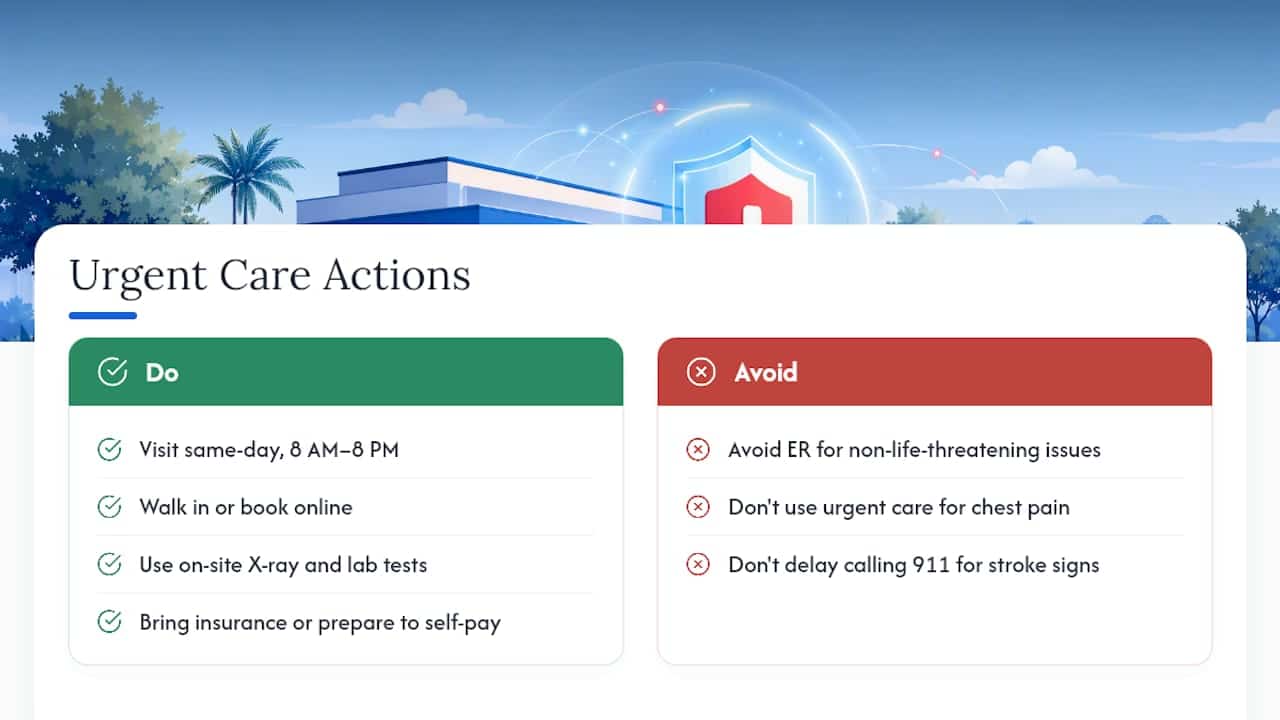
Go to the emergency room or call 911 for chest pain, stroke symptoms, severe bleeding, or trouble breathing. Choose urgent care for same-day issues that aren’t life-threatening, like a sprained ankle, a bad sore throat, or a cut that needs stitches. Save your primary care provider for ongoing conditions, medication refills, and routine checkups. If you’re ever unsure and symptoms feel serious, the ER is always the safer call.
TL;DR:
- Most minor bone injuries, cuts, burns, and infections can be handled safely at urgent care centers, avoiding ER visits and reducing costs.
- Symptoms such as chest pain, stroke signs, severe bleeding, or difficulty breathing require immediate ER attention or calling 911 without delay.
- Urgent care cannot perform advanced imaging like CT scans or complex procedures, often necessitating transfer to the ER for serious or unknown injuries.
- Calling your primary care provider or using telemedicine is advisable for routine illnesses, medication questions, or chronic condition management before seeking urgent care.
- Preparing a list of medications and documenting symptom history can significantly speed up your visit and improve the accuracy of care received at urgent care clinics.
Table of Contents
- When to Go to Urgent Care vs. the ER or Your Doctor
- What Conditions Are Right for Urgent Care?
- Which Symptoms Mean You Should Go to the ER Instead?
- What Services and Tests Does Urgent Care Actually Offer?
- How Do You Prepare for an Urgent Care Visit?
- Should You Call Your Doctor or Try Telemedicine First?
- What Should You Expect to Pay, and How Long Will You Wait?
- How We Approach Urgent Care Decisions at Our Clinic
- Get Same-Day Urgent Care at Your Family Walk-In Clinic
- Sources
- FAQ
When to Go to Urgent Care vs. the ER or Your Doctor
Deciding where to go for care usually comes down to three quick questions. Ask them in order, and you’ll almost always land on the right answer before you even pick up your keys.
Is this life-threatening or getting worse by the minute? If yes, stop reading and go to the ER or call 911. Chest pain, stroke symptoms, severe bleeding, and difficulty breathing don’t wait for a decision tree. According to the University of Maryland Medical System, any rapidly worsening or life-threatening symptom warrants immediate emergency care.
Does this need imaging beyond an X-ray, or a specialist right now? Urgent care handles a lot, but it isn’t equipped for CT scans, MRIs, or emergency surgical teams. If a broken bone looks deformed, or a head injury comes with confusion or vomiting, the ER has the tools urgent care doesn’t.
Can this wait for an appointment with your regular doctor? Chronic condition flare-ups, medication questions, and preventive care usually belong with your primary care provider, who already knows your history. Calling first is smart. According to Harvard Health, your primary care doctor can often triage a problem over the phone and tell you exactly where to go next, saving you a wasted trip.
Here’s the quick version to keep in mind:
- Life-threatening or worsening fast → ER or 911, no delay.
- Needs same-day care but isn’t an emergency → urgent care.
- Routine, chronic, or preventive → primary care provider or telemedicine.
Cost and speed follow the same logic. Urgent care visits are typically faster and cheaper than an ER trip for the same non-emergency problem, while your PCP offers the lowest cost per visit for anything that isn’t urgent. If you’re torn between two options, err toward the setting with more capability. It’s a lot easier to be sent home from the ER than to be transferred there from urgent care after wasting an hour.
What Conditions Are Right for Urgent Care?
Most people who walk into urgent care fall into a fairly predictable set of categories. Recognizing where your symptom fits saves you time and, often, money.
- Sprains, strains, and minor fractures (no visible deformity): Urgent care can X-ray and splint most of these. Go to the ER instead if the limb looks crooked or you can’t feel or move it.
- Cuts that need stitches: Clean, straightforward lacerations get sutured at urgent care. Deep wounds with heavy bleeding that won’t stop need the ER.
- Minor burns: First and small second-degree burns are urgent care territory. Large or deep burns, or burns on the face or hands, need emergency evaluation.
- Ear infections, sinus infections, and sore throats: Urgent care can test for strep and prescribe treatment same day. Telemedicine works well for milder versions of these if you can describe your symptoms clearly.
- UTIs: A urinalysis at urgent care usually confirms it and gets you started on antibiotics quickly. Fever with back pain can signal a kidney infection, which sometimes needs more than urgent care can offer.
- Colds, flu, and mild respiratory symptoms: Great fit for urgent care or telemedicine. Severe shortness of breath is not.
- Conjunctivitis (pink eye): Straightforward urgent care visit in almost every case.
- Insect and animal bites: Urgent care handles cleaning, tetanus updates, and infection monitoring. Bites with heavy bleeding or from an animal with unknown rabies status need faster escalation.
- Vomiting and diarrhea: Fine for urgent care if you’re staying hydrated. Watch for signs of severe dehydration, which changes the picture entirely.
The Blue Cross Blue Shield guidance echoes this pattern closely: sprains, minor fractures, cuts, ear infections, sore throats, UTIs, rashes, and minor burns are the textbook reasons to choose urgent care over the ER, largely because you’ll get seen faster and pay less for the same outcome.
Pro Tip: Keep a running list of your current medications and allergies on your phone. Whether you end up at urgent care, the ER, or on a telemedicine call, having that list ready shaves real time off your visit.
Which Symptoms Mean You Should Go to the ER Instead?
Some symptoms don’t leave room for judgment calls. If you notice any of the following, skip urgent care and act immediately.
- Chest pain or pressure, especially with sweating, nausea, or pain radiating to the arm or jaw.
- Sudden weakness, numbness, or drooping on one side of the face or body.
- Slurred speech or sudden confusion.
- Severe difficulty breathing or shortness of breath at rest.
- Severe or uncontrolled bleeding.
- Sudden, severe abdominal pain.
- Loss of consciousness or a seizure.
- Signs of stroke (use the FAST method: face drooping, arm weakness, speech difficulty, time to call 911).
- Anaphylaxis (swelling of the face or throat, hives with breathing trouble after a sting, food, or medication).
- A severe head injury, especially with vomiting, confusion, or loss of consciousness.
- Suicidal thoughts or a mental health crisis.
If you see any of these, call 911 immediately rather than driving yourself or waiting to see if symptoms improve. If someone is unconscious but still breathing, place them on their side and stay with them until help arrives. If they’ve stopped breathing, begin CPR if you’re trained, and follow the 911 dispatcher’s instructions if you’re not.
For a mental health emergency, including suicidal thoughts, calling 988 connects you to the Suicide and Crisis Lifeline, and it’s available around the clock, every day of the year. Urgent care centers aren’t equipped for psychiatric emergencies, and there’s no reason to wait or wonder. Go straight to 988, 911, or the nearest ER.
What Services and Tests Does Urgent Care Actually Offer?
Urgent care centers are built for speed on a specific range of problems, not everything a hospital can handle. Knowing the boundary in advance keeps you from wasting time in the wrong waiting room.
On the “yes” side, most urgent care clinics offer X-rays, rapid strep and flu testing, COVID testing, basic lab work like urinalysis and blood panels, wound cleaning and suturing, and splinting for suspected fractures. According to Cleveland Clinic, urgent care is specifically designed for conditions that need attention within 24 to 48 hours, not months from now and not in the next five minutes.
What urgent care generally can’t do:
- CT scans or MRIs
- Advanced cardiac monitoring or critical care
- Surgery or complex specialist consults
- Extended IV therapy for severe dehydration or infection
That gap explains why some patients get referred out. The North Carolina Medical Board notes that transfers to the ER typically happen for suspected fractures needing orthopedic care, head injuries with altered mental status, suspected stroke, or signs of sepsis. It’s worth calling ahead, too. Capability varies by location: some clinics run limited lab panels and handle wound care only, while larger centers offer broader diagnostics.
How Do You Prepare for an Urgent Care Visit?
A little prep goes a long way toward getting you in and out faster.
- Bring a photo ID and your insurance card.
- Have a list of current medications and allergies ready, even a quick note on your phone works.
- Know your symptom timeline: when it started, what makes it better or worse, and anything you’ve already tried.
- Use online check-in if your clinic offers it. Many systems let you hold your place in line before you even arrive.
- Bring immunization records for kids if the visit involves a vaccine question or school requirement.
- Mention any mobility or language needs when you check in so staff can accommodate you right away.
Keep in mind that urgent care triages by clinical acuity, not arrival order. If someone comes in with a more urgent issue after you, they may be seen first. That’s not a flaw in the system. It’s the same logic every ER and urgent care uses to make sure the sickest patients get help fastest.
Pro Tip: Snap a photo of the injury or rash before you leave home, especially if swelling or redness is spreading. It gives the provider a baseline to compare against once you’re seen.

Should You Call Your Doctor or Try Telemedicine First?
For a lot of common complaints, your primary care provider or a telemedicine visit is actually the better first move, not a consolation prize.
Call your PCP first for chronic disease flare-ups (diabetes, asthma, hypertension), medication refills, preventive care like screenings and physicals, and routine infections if your doctor has a same-day sick visit slot open. Harvard Health points out that primary care doctors can often triage by phone and tell you within minutes whether you need to be seen today, next week, or not at all.
Telemedicine fits well for mild upper respiratory infections, pink eye, rashes, and medication questions where a visual or verbal exam is enough. It is not the right tool when you need imaging, when dehydration is severe, or when someone’s mental state has changed. According to the University of Maryland Medical System, telemedicine works well for many minor issues, but a physical exam or urgent procedure still requires an in-person visit.
- Chronic condition flare → call your PCP
- Medication refill or preventive screening → call your PCP
- Mild cold, rash, or pink eye → telemedicine or urgent care
- Confusion, severe dehydration, or need for imaging → skip telemedicine, go to urgent care or the ER
What Should You Expect to Pay, and How Long Will You Wait?
Cost is often the deciding factor once the medical question is settled, and the numbers usually favor urgent care by a wide margin for non-emergency issues.
Insurers consistently steer patients toward urgent care for same-day, non-life-threatening needs because it’s the faster and cheaper option compared to an ER visit for the same condition, according to Blue Cross Blue Shield. Your exact out-of-pocket cost still depends on your specific plan and network, so a quick call to your insurer before a non-urgent visit can prevent a surprise bill later.
Wait times come down to acuity and volume, not who walked in first. Clinics triage patients by how serious their condition looks, which means a high-acuity case can move ahead of someone who arrived earlier with a minor complaint.
A few habits help you avoid the worst of it:
- Use online check-in where it’s offered.
- Ask about estimated wait times when you call ahead.
- Confirm the clinic’s billing policy and your copay before you’re seen.
- Save your receipts and paperwork in case you need to file an insurance claim later.
Arriving during off-peak hours (early morning on weekdays tends to be quieter than evenings and weekends) can also shorten your wait considerably.
How We Approach Urgent Care Decisions at Our Clinic
Your Family Walk-In Clinic is open 8 AM to 8 PM, seven days a week, specifically so families in Lutz don’t have to choose between waiting weeks for an appointment or overpaying at the ER. Our team, led by professionals with many years of combined experience, triages every walk-in by symptom severity and refers patients to the ER without hesitation when a case needs imaging or specialty care we don’t provide onsite… We also coordinate with your primary care provider afterward, so follow-up care doesn’t fall through the cracks.
— Lisa
Get Same-Day Urgent Care at Your Family Walk-In Clinic
When your symptoms fall into urgent care territory, you shouldn’t have to wait days for relief or pay ER-level prices to get it. Your Family Walk-In Clinic gives you same-day access seven days a week, from 8 AM to 8 PM, with no long-term contract or referral required, just walk in or book online.
We handle the conditions covered throughout this guide: sprains, minor fractures, cuts that need stitches, ear and sinus infections, UTIs, and more, along with on-site X-rays and lab testing so you get answers the same day instead of waiting on a referral. We also offer STD testing and sports physicals for families who need more than a one-time urgent care visit. We accept most major insurance plans, Medicaid, and self-pay, and our team can walk you through costs before you’re seen.
If you’re dealing with chest pain, stroke symptoms, or another life-threatening emergency, call 911. For everything else that needs same-day attention, visit our urgent care page to check hours and get directions, or explore what to expect at your visit before you come in.
This article is general information, not a substitute for advice from a qualified doctor. Consult a qualified healthcare professional about your own circumstances before acting on anything here.
Sources
- Should I Go to the ER, Urgent Care or Primary Care? – University of Maryland Medical System Health Hub
- Urgent care vs emergency room: What’s the right choice? – Harvard Health
- When to visit: Primary care, urgent care or emergency room? | Blue Cross Blue Shield
FAQ
What symptoms should you go to urgent care for?
Go to urgent care for sprains, minor fractures, cuts needing stitches, ear or sinus infections, sore throats, UTIs, minor burns, and mild cold or flu symptoms that need same-day attention.
Can urgent care treat an ingrown toenail?
Yes, most urgent care clinics, including Your Family Walk-In Clinic, can treat ingrown toenails, including minor procedures to relieve pain and prevent infection.
What are the most common reasons people visit urgent care?
The most common reasons include minor injuries, infections like strep throat and UTIs, rashes, minor burns, and cold or flu symptoms that can’t wait for a regular doctor’s appointment.
When should you go to the ER instead of urgent care for a migraine?
Go to the ER if a headache comes on suddenly and severely, includes vision changes, slurred speech, weakness, or confusion, since these can signal a stroke rather than a typical migraine.
How do you know if you need urgent care or the ER?
If symptoms are life-threatening or rapidly worsening, such as chest pain or severe breathing trouble, go to the ER; if the issue is urgent but stable, like a sprain or minor cut, urgent care is the right choice.