


An uninsured urgent care visit typically runs $100–$300 for a straightforward evaluation, though adding tests or imaging can push the total to $500 or more. That range exists because no two visits are identical: a rapid strep test, a chest X-ray, or a set of sutures each carries its own price tag on top of the base office fee. The single most useful thing you can do right now is call the clinic before you go and ask for a written self-pay estimate.
A few anchoring facts to keep in mind:
- GoodRx reports that the same procedure code can cost dramatically different amounts depending on your region and the type of facility, and recommends requesting a Good Faith Estimate before any service.
- SolvHealth’s national data puts the average self-pay evaluation at $150–$280, with add-ons commonly pushing totals to $300–$500 or more.
- Your Family Walk-In Clinic in Lutz, Florida offers self-pay pricing and encourages patients to call ahead for a cost estimate before their visit.
Key Takeaways
An uninsured urgent care visit typically costs $100–$300 for a basic evaluation, but tests, imaging, and procedures can push the total to $500 or more, making a pre-visit call for a self-pay estimate the single most effective cost-control step.
| Point | Details |
|---|---|
| Typical cost range | Most uninsured visits run $100–$300; add-ons like X-rays or sutures push totals higher. |
| Biggest cost drivers | Diagnostic tests, imaging, and facility type (hospital-affiliated vs. independent) shape the final bill most. |
| Call ahead for pricing | Ask for the self-pay or cash-pay rate and a Good Faith Estimate before you arrive. |
| Lower-cost alternatives | FQHCs, telehealth, and retail clinics offer lower-cost options for minor or non-urgent conditions. |
| Your Family Walk-In Clinic | An independent walk-in clinic in Lutz, FL, offering self-pay pricing with no hospital facility fees, open 7 days a week. |
Table of Contents
- How much does urgent care cost without insurance? A line-by-line breakdown
- What drives the final price of your visit
- How no insurance changes your billing experience
- Practical ways to lower your out-of-pocket costs
- What to expect when you pay: estimates, receipts, and billing timelines
- When to use urgent care vs. the ER vs. primary care
- How Your Family Walk-In Clinic handles self-pay patients
- Affordable urgent care in Lutz and Tampa for uninsured patients
- Sources
- FAQ
How much does urgent care cost without insurance? A line-by-line breakdown
Understanding the range is one thing. Seeing how a real bill adds up is more useful.
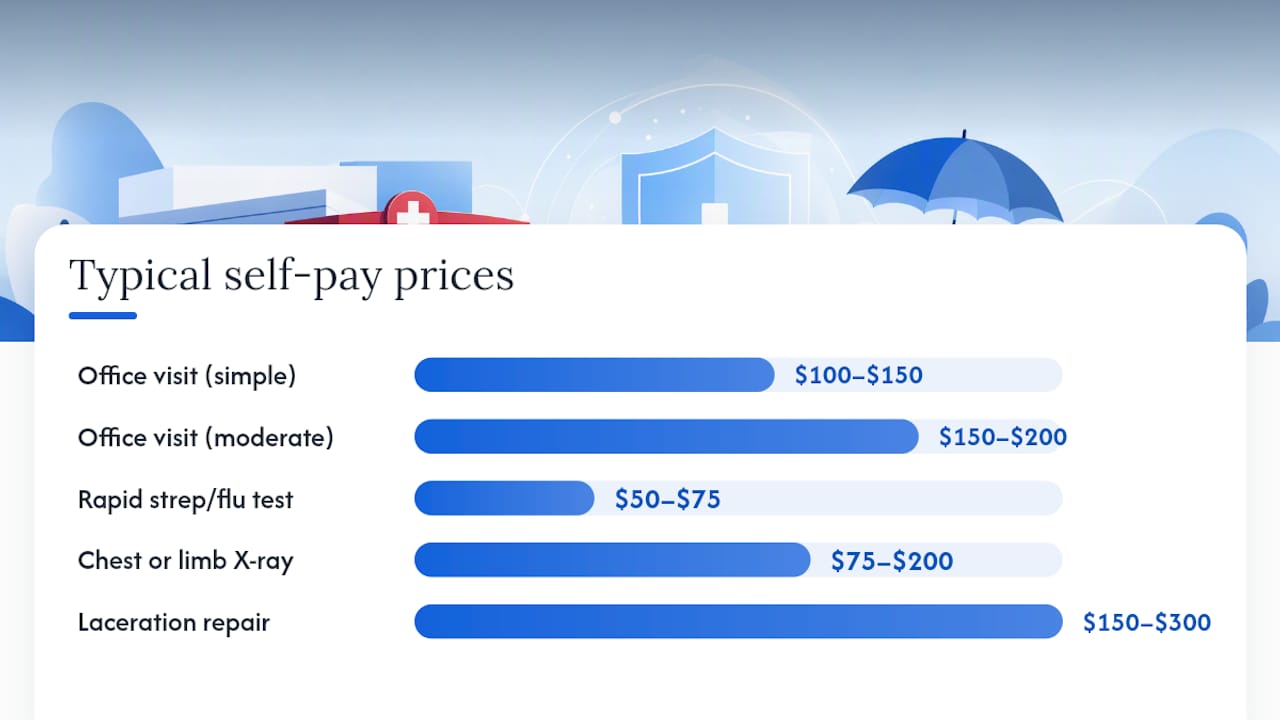
Typical self-pay prices by service
| Service | Typical Self-Pay Range |
|---|---|
| Base office visit (simple) | $100–$150 |
| Base office visit (moderate complexity) | $150–$200 |
| Rapid strep or flu test | $50–$75 |
| Urinalysis | $50 |
| Basic blood panel (CBC, metabolic) | $50–$150 |
| Chest or limb X-ray | $75–$200 |
| Laceration repair / sutures | $150–$300 |
| IV fluids | $100–$200 |
| Vaccine (flu, tetanus) | $50–$75 |
| Wound care / dressing change | $50–$100 |
Sources: CityHealth and SolvHealth national self-pay ranges.
Two sample bills
Sample Bill A: Sore throat with rapid strep test
- Base office visit: $130
- Rapid strep test: $50
- Estimated total: $180
Sample Bill B: Ankle sprain with X-ray
- Base office visit (moderate complexity): a representative amount
- Two-view X-ray: a representative amount
- Ace wrap / wound supply: a representative amount
- Estimated total: a typical total
National midpoint: CityHealth notes that most uninsured urgent care visits fall between $100 and $300, with base office visits commonly landing between $100 and $200.
One cost that catches many patients off guard: outside lab work. If the clinic sends blood or urine samples to an external laboratory, that vendor bills you separately, sometimes weeks later. Always ask whether any tests will be processed in-house or sent out.
What drives the final price of your visit
Several factors shape what you’ll actually owe, and knowing them helps you anticipate the bill before it arrives.
- Reason for visit and complexity. Clinics use visit-complexity levels to set the base fee. A quick evaluation for a minor cut costs less than a visit requiring a thorough history, multiple systems review, and a treatment plan. The more complex the encounter, the higher the base charge.
- Diagnostic tests and imaging. A visit that stays at the evaluation level is the cheapest. Every add-on, whether a rapid test, urinalysis, or X-ray, increases the total. Imaging is often the single largest line item.
- Facility ownership. Hospital-affiliated urgent care clinics frequently add a facility fee on top of the physician fee. Independent or physician-owned clinics typically skip that charge, which can mean a meaningfully lower bill for the same service.
- Geography. Prices in urban Florida or coastal California run higher than in rural Midwest markets. Local cost of living and competition both influence what clinics charge.
- Ancillary vendor bills. External labs, radiology reads, and specialist referrals arrive as separate invoices. These are the most common source of surprise charges.
Pro Tip: Before any imaging or lab work is ordered, ask the front desk: “Will this be processed here, or will I receive a separate bill from another provider?” Getting the answer in writing protects you from unexpected invoices.
How no insurance changes your billing experience
When you have insurance, the clinic bills your plan, your plan negotiates a contracted rate, and you pay a copay or a portion of the allowed amount. Without insurance, that negotiated rate disappears.
What self-pay actually means: Clinics bill uninsured patients at their “chargemaster” or list price unless they offer a specific self-pay or cash-pay discount. Many clinics do offer a reduced cash rate, sometimes 20–40% below the standard rate, but you have to ask for it. It is rarely applied automatically.
Uninsured urgent care vs. uninsured ER: a cost comparison
- Urgent care (uninsured): typically $100–$500 depending on services
- Emergency room (uninsured): commonly runs into the thousands for even routine conditions, per comparative cost data
- Hospital-owned urgent care: may include a facility fee that pushes costs closer to ER territory
Balance billing is a related risk. If a clinic is out-of-network with your insurer (relevant if you later get coverage), the provider can bill you the difference between their charge and what the plan pays. Healthcare that balance billing rules vary by state and plan type, so uninsured patients dealing with hospital-affiliated clinics should ask upfront whether any facility fee applies.
Two quick answers you’ll want before you go:
- Do I have to pay upfront? Many clinics require payment at the time of service for self-pay patients. Some offer a prompt-pay discount if you pay in full at checkout.
- Will I get billed later for lab work? Yes, if samples go to an outside lab. Ask specifically whether any tests will be sent out before you agree to them.
Practical ways to lower your out-of-pocket costs
You have more control over the final bill than most people realize. Here’s a prioritized checklist.
Before you arrive
- Call and ask for the self-pay rate. Ask specifically: “What is your cash-pay or self-pay price for an office visit?” Many clinics have a lower rate they don’t advertise.
- Ask about flat-rate packages. Some clinics bundle the office visit and common tests into a single flat fee for uninsured patients.
- Request a Good Faith Estimate. Under the No Surprises Act, you have the right to a written cost estimate before scheduled services. Ask for one in writing.
- Check whether telehealth fits your situation. A virtual visit for a minor issue like a UTI, rash, or cold symptoms often costs $50–$75, well below an in-person urgent care visit.
On-site tactics
- Ask for the cash-pay or prompt-pay discount at check-in, not after the bill arrives.
- Before agreeing to any test, ask: “Is this test required for my treatment today, or is it optional?” Declining non-essential tests can meaningfully reduce your total.
- Request an itemized receipt before you leave so you can review every charge.
Lower-cost alternatives worth knowing
- Federally Qualified Health Centers (FQHCs): These community clinics charge on a sliding-scale fee based on income. The HRSA clinic finder helps you locate one near you.
- Retail clinics (inside pharmacies): Handle minor issues at lower base rates than most urgent care clinics.
- Community health centers: Similar sliding-scale model to FQHCs, often with broader hours.
- Telehealth platforms: For non-urgent issues, a virtual visit is the most cost-effective first step.
Pro Tip: If the bill feels unmanageable after your visit, call the billing office and ask two questions: “Do you offer an interest-free payment plan?” and “Do you have a charity care or financial hardship program?” Most clinics have both, but they rarely volunteer the information.
What to expect when you pay: estimates, receipts, and billing timelines
Most urgent care clinics ask self-pay patients to pay at the time of service. That’s standard practice, not a penalty for being uninsured. Some clinics offer a prompt-pay discount, typically 10–20%, if you pay in full at checkout rather than requesting a payment plan.
Good Faith Estimates are a consumer protection tool worth using. For any non-emergency scheduled service, you can request a written estimate of expected charges before your visit. Health systems that publish self-pay pricing recommend asking for this estimate as a baseline, since the actual bill can differ if your condition turns out to be more complex.
A few things to know about the billing timeline:
- The clinic’s bill for the office visit usually arrives within a few weeks.
- External lab or radiology bills arrive separately, sometimes 4–8 weeks later.
- If you don’t recognize a charge, call the billing office and ask for an itemized statement that lists every service by code and description.
- Healthcare.gov’s emergency care guidance notes that surprise billing protections apply in specific situations, so it’s worth reviewing if you receive an unexpected charge from a facility-based provider.
Pro Tip: Before you leave the clinic, ask the front desk: “Can I get an itemized receipt today, and what is the billing office phone number?” Having both in hand makes it far easier to dispute a charge or set up a payment plan later.
When to use urgent care vs. the ER vs. primary care
Choosing the right site of care protects both your health and your wallet.
Simple decision rules:
- Life-threatening symptoms → Emergency room. Chest pain, difficulty breathing, signs of stroke, severe allergic reaction, major trauma, or uncontrolled bleeding require an ER. No urgent care clinic can substitute.
- Minor to moderate acute illness or injury → Urgent care. Sprains, minor cuts, ear infections, UTIs, sore throats, mild fevers, and similar conditions are exactly what urgent care is designed for. Harvard Health notes that urgent care is intended for non-life-threatening problems, and that patients unsure about the right level of care should call their primary care clinician first when possible.
- Ongoing or non-urgent health concerns → Primary care. Chronic condition management, prescription refills, preventive screenings, and follow-up care belong with a primary care provider, not an urgent care clinic.
Cost reality check: An uninsured ER visit for a common condition routinely runs into the thousands of dollars. Choosing urgent care for an appropriate condition, rather than defaulting to the ER, can save you $1,000 or more on a single visit.
For guidance on choosing between a walk-in clinic and the ER in the Tampa area, Your Family Walk-In Clinic’s care guide walks through common scenarios.
How Your Family Walk-In Clinic handles self-pay patients
Your Family Walk-In Clinic in Lutz, Florida is a practical example of how a transparent, independent clinic approaches uninsured patients.
What the clinic offers self-pay patients:
- Upfront self-pay pricing with no hidden facility fees typical of hospital-owned clinics
- Same-day walk-in availability, seven days a week, 8 AM to 8 PM
- A range of services covered in a single visit: office evaluation, rapid tests, basic labs, wound care, and immunizations
- Prompt-pay options for patients paying at the time of service
- A welcoming, non-judgmental environment for patients of all ages
Sample estimate for a common visit (based on typical self-pay pricing):
| Visit Type | Estimated Self-Pay Range |
|---|---|
| Sore throat evaluation only | $100–$150 |
| Sore throat + rapid strep test | $150–$200 |
| Minor laceration evaluation + wound care | $180–$300 |
| Sprain evaluation + X-ray | $250 |
Note: These are sample estimates based on typical self-pay pricing ranges. Actual charges depend on the complexity of your visit and any additional services needed. Call the clinic for a written estimate specific to your situation.
The clinic’s services and pricing page outlines what’s available, and the clinic overview gives a full picture of on-site capabilities.
Pro Tip: Call Your Family Walk-In Clinic before your visit and ask: “What is your self-pay rate for an office visit, and do you offer a prompt-pay discount?” That one call can save you a meaningful amount and eliminate billing surprises.
The case for calling ahead: a perspective on cost transparency
Most of the financial stress around urgent care visits without insurance comes from one thing: not knowing the price before you walk in. The solution is almost embarrassingly simple. Call first. Ask for the self-pay rate. Ask whether any tests will be billed separately. Ask whether there’s a prompt-pay discount.
Independent clinics that compete on transparent pricing, like Your Family Walk-In Clinic, have a real incentive to give you a straight answer. Hospital-affiliated systems often can’t, because their billing involves multiple departments and facility fees that no front-desk staff member can fully quote. That structural difference matters more than most patients realize when they’re comparing options.
The other thing worth saying plainly: the ER is not a fallback for uninsured patients with non-emergency conditions. It is the most expensive site of care in the U.S. healthcare system, and for a sprained ankle or a sore throat, it can cost ten times what an urgent care visit would. Choosing the right level of care is itself a financial decision, and it’s one you can make confidently with the right information.
Affordable urgent care in Lutz and Tampa for uninsured patients
If you’re uninsured and need care today, Your Family Walk-In Clinic offers a straightforward alternative to the ER or a long wait for a primary care appointment. The clinic is open seven days a week, 8 AM to 8 PM, with same-day walk-in availability for adults and children.

Self-pay patients are welcome, and the clinic’s model, as an independent walk-in clinic rather than a hospital-affiliated system, means you avoid the facility fees that inflate bills at larger health systems. Services range from urgent care evaluations and rapid testing to wound care, lab work, immunizations, and physicals, all under one roof. Payment is collected at the time of service, and the team can walk you through your options before care begins.
Call the clinic or check available hours before your visit and ask for a self-pay estimate. Knowing your cost upfront is the simplest way to walk in prepared.
Sources
- How Much Does Urgent Care Cost Without Insurance? 2026 Price Guide – SolvHealth
- Urgent care vs. emergency room: What’s the right choice? – Harvard Health
- Costs and Pricing – UMMS urgent care
- How much is urgent care without insurance – GoodRx
This article is general information, not a substitute for advice from a qualified doctor. Consult a qualified healthcare professional about your own circumstances before acting on anything here.
FAQ
Will urgent care cost a lot without insurance?
It depends on what you need. A basic evaluation runs $100–$200 for most uninsured patients, but adding tests, imaging, or procedures can bring the total to $300–$500 or more.
What is the cheapest urgent care option with no insurance?
Federally Qualified Health Centers charge on a sliding-scale fee based on income and are often the lowest-cost option for uninsured patients. Telehealth visits for minor conditions typically run $50–$75. For in-person care, independent clinics like Your Family Walk-In Clinic tend to cost less than hospital-affiliated urgent care because they don’t add facility fees.
Do you have to pay upfront at urgent care without insurance?
Most clinics ask self-pay patients to pay at the time of service. Some offer a prompt-pay discount of 10–20% for paying in full at checkout, so it’s worth asking about that option when you check in.
What happens if a tourist or visitor gets sick in the U.S. without insurance?
Urgent care clinics accept self-pay patients regardless of insurance status. You’ll be asked to pay at the time of service, typically $100–$300 for a basic visit. For anything life-threatening, go to the nearest emergency room, which is required by law to provide stabilizing care regardless of your ability to pay or insurance status.
Can you negotiate an urgent care bill after the visit?
Yes. Call the billing office, ask for an itemized statement, and ask whether the clinic offers a financial hardship program, charity care, or an interest-free payment plan. Many clinics have these options but don’t advertise them proactively.
Recommended
- Urgent Care 7 Days a Week – Your Family Walk In Clinic
- Comprehensive and Immediate Healthcare at Your Family Walk In Clinic – Your Local Urgent Care Clinic
- Lutz Family Heath Care | Family Practice Tampa | Your Family Walk-in Clinic
- When to Visit a Walk-In Clinic vs. ER in Tampa: Your Healthcare Guide