

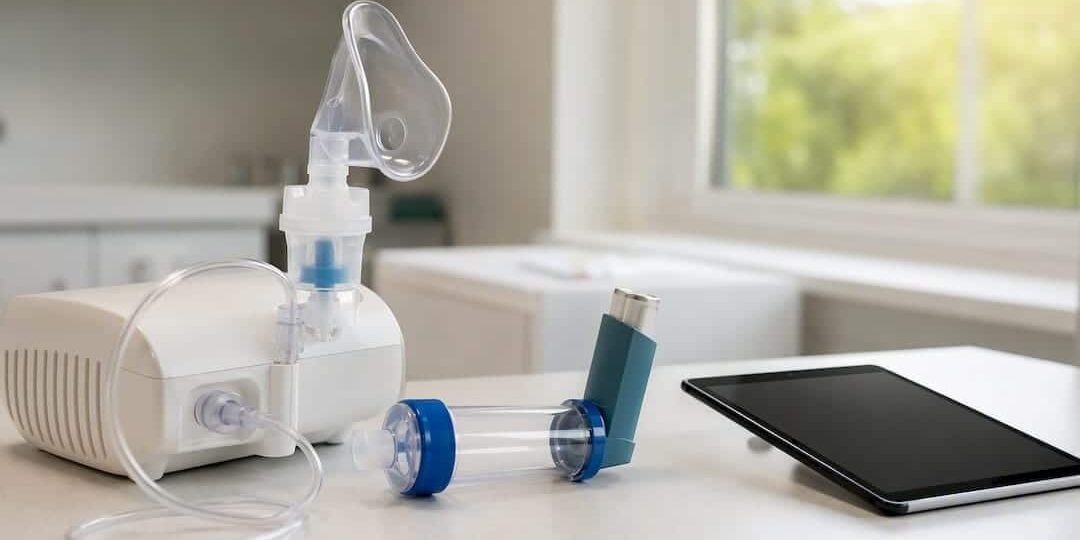
If you feel an asthma flare starting, use your prescribed rescue inhaler right away, following the dosing your clinician gave you. If your breathing does not improve within a few minutes, or you notice any severe warning signs, seek urgent or emergency care immediately. Either way, book a follow-up visit within a week so your treatment plan can be adjusted before another flare hits.
TL;DR:
- Most asthma flares respond within the first hour to proper inhaler use, but escalation to emergency care is necessary if oxygen drops or breathing becomes severely impaired.
- Using a spacer with inhalers improves medication delivery and tracking puffs helps prevent undertreatment during acute episodes.
- Objective signs like cyanosis, inability to speak in full sentences, or a low oxygen saturation confirm the need for immediate emergency services.
- Hospital treatment for severe exacerbations involves oxygen therapy, repeated bronchodilators, steroids, and possibly adjunct treatments like magnesium sulfate or ventilatory support.
- Follow-up within 2 to 7 days after a flare is critical for preventing relapse through inhaler technique correction, medication adjustments, and trigger management.
Table of Contents
- Home First-Aid for an Asthma Flare Treatment: Inhaler, Spacer, and Nebulizer Steps
- When Should You Go to Urgent Care, the ER, or Call 911?
- What Happens During Clinical Treatment for an Asthma Exacerbation?
- When Do You Need Hospital Admission or ICU Care?
- What Should Happen at Discharge and Follow-Up?
- What to Expect at Your Family Walk-In Clinic After a Flare
- Why Guideline-Driven Care Beats Guesswork on Asthma Flares
- Get Same-Day Care for an Asthma Flare in Lutz
- Sources
- FAQ
Home First-Aid for an Asthma Flare Treatment: Inhaler, Spacer, and Nebulizer Steps
The first few minutes of a flare set the tone for everything after. Acting fast, and acting correctly, often keeps a manageable flare from turning into an ER visit.
For adolescents and adults, standard home treatment for a mild to moderate flare is 2 to 4 puffs of your rescue inhaler (albuterol or levalbuterol), repeated every 20 minutes for up to three doses in the first hour, following the guidance in your Acute Asthma Exacerbations: Management Strategies recommendations. If your clinician has prescribed ICS-formoterol as your reliever instead of a standard SABA, use that per your specific action plan; some newer guidelines now favor this combination as the anti-inflammatory reliever for eligible patients.
Here is the sequence to follow at the first sign of tightness, wheeze, or cough:
- Sit upright. Do not lie down. This keeps your airway as open as possible and reduces the sense of panic.
- Take your rescue inhaler with a spacer if you have one. A spacer catches the medication in a holding chamber so you inhale more of it into your lungs instead of losing it to the back of your throat.
- Breathe slowly and deeply through the spacer, either as one steady breath or several relaxed tidal breaths, whichever your clinician taught you.
- Wait 20 minutes and reassess. If symptoms persist, repeat the dose, up to three total rounds.
- If you have a home nebulizer, use it as directed. Nebulizer dosing and timing sometimes differ slightly from inhaler dosing, so follow your specific prescription rather than guessing.
- If your written Asthma Action Plan includes a step for an emergency oral steroid dose, take it once, according to the plan. If your plan does not include this step, contact your clinician instead of self-prescribing.
In cooperative adults, a metered-dose inhaler with a spacer delivers medication just as effectively as a nebulizer treatment, without the setup time. Nebulizers tend to work better for young children or anyone struggling to coordinate a puff with a breath, according to the MSD Manual’s treatment guidance. Pair inhaler use with slow pursed-lip exhales; a partner like Revo2’s breathing technique guide covers methods that can reduce the sense of breathlessness while your medication takes effect.
Pro Tip: Count your puffs out loud and time the 20-minute intervals with a phone timer. Panic distorts your sense of time, and undertreating a flare because you lost count is more common than you’d think.
Staying calm changes your breathing mechanics, not just your mood. Shallow, rapid panic breathing works against the bronchodilator you just took, so slow everything down: your movements, your voice, your breath.
When Should You Go to Urgent Care, the ER, or Call 911?
Most flares respond to rescue medication within the first hour. When they don’t, the decision about where to go depends on specific warning signs rather than how you feel emotionally about the situation.
Call 911 or go straight to the emergency department if you notice any of these:
- You cannot speak in full sentences or complete a sentence between breaths.
- Your lips or fingertips look blue or gray (cyanosis).
- You feel drowsy, confused, or unusually hard to wake.
- Your chest sounds silent instead of wheezy when someone listens, meaning too little air is moving to even make noise.
- Your breathing rate suddenly speeds up dramatically or drops off in a way that feels wrong.
Objective numbers matter here too. If you have a home pulse oximeter and your oxygen saturation is low, that is a signal to seek emergency evaluation, not a wait-and-see situation. If you track peak flow remains significantly below your personal best after using your rescue inhaler as directed, that also points toward urgent-care or ED-level treatment.
When you are unsure whether your symptoms qualify as an emergency, treat that uncertainty itself as a reason to go in rather than wait it out. A walk-in clinic versus emergency room guide can help you sort moderate flares from ones that need a 911 call.
Before you head out, grab your rescue inhaler, spacer, written Asthma Action Plan, and a list of current medications. Having these in hand saves precious minutes once you are in front of a clinician.
What Happens During Clinical Treatment for an Asthma Exacerbation?
Once you arrive at urgent care or the ED, treatment follows a fairly predictable sequence, and knowing what is coming tends to lower anxiety considerably.
Clinicians typically start with oxygen therapy, targeting safe oxygen saturation levels in adults, adjusting the flow rate based on continuous pulse oximetry monitoring, according to the MSD Manual’s treatment guidance. Bronchodilator treatment intensifies from what you tried at home:
- Repeated SABA dosing every 20 minutes for the first hour, delivered by MDI with spacer (just as effective in cooperative patients) or nebulizer.
- Ipratropium bromide added to the bronchodilator mix for moderate to severe presentations, since it works through a different airway pathway than albuterol and adds a modest additional benefit.
- Systemic corticosteroids started early, often within the first hour of arrival, because early steroid administration measurably reduces the odds of hospital admission.
Adult outpatient steroid courses commonly run prednisone 40 to 50 mg daily for 5 to 7 days, usually without a taper if you continue your inhaled steroid. Pediatric dosing is weight-based dosing for several days.
When first-line treatment isn’t enough: For patients who do not respond adequately to repeated bronchodilators and steroids, clinicians escalate to adjunct therapies. IV magnesium sulfate is one of the better-studied options here. A PMC review of magnesium sulfate evidence found it produces a modest reduction in hospital admissions and measurable lung function improvement in patients unresponsive to initial therapy, in both adults and children. It is not a routine add-on for every flare, but a reasonable next step for severe, treatment-resistant cases.
Heliox (a helium-oxygen mixture) and noninvasive positive-pressure ventilation are reserved for patients whose work of breathing remains dangerously high despite these measures. Intubation and mechanical ventilation become necessary only when a patient shows signs of respiratory fatigue or failure. Epinephrine has a role too, but specifically when anaphylaxis is suspected as a trigger, not for a typical asthma exacerbation.
Clinicians reassess response using a combination of how you feel, your peak flow or FEV1 numbers, and your oxygenation, typically checking again around the one-hour mark to decide whether you’re ready for discharge or need a longer stay.
When Do You Need Hospital Admission or ICU Care?
Not every flare resolves in the ED within a few hours, and knowing the thresholds for admission helps you understand why a clinician might recommend staying rather than going home.
Clinicians generally consider admission when:
- Symptoms and objective measures fail to improve adequately after several hours of ED treatment, despite repeated bronchodilator doses.
- Oxygen levels stay low despite supplemental oxygen and ongoing treatment.
- Lung function numbers remain poor, such as a post-treatment FEV1 under 40% of predicted, or a peak flow that never climbs back to 60 to 80% of personal best.
- You need bronchodilator treatment so frequently that spacing doses out safely for home use isn’t realistic yet.
ICU-level care becomes necessary in a smaller subset of cases: patients showing respiratory fatigue, rising carbon dioxide levels in the blood (hypercapnia), severe hypoxemia, or altered mental status. These are signs the body is losing its ability to keep up with the work of breathing on its own.
Inpatient care typically centers on continuous or frequent bronchodilator treatment, ongoing systemic steroids, and close monitoring, with ventilatory support added if breathing continues to deteriorate. The goal throughout is the same one guiding every earlier step: get you breathing effectively enough, and stably enough, to go home safely.
What Should Happen at Discharge and Follow-Up?
Getting sent home is not the finish line. What happens in the days after discharge often determines whether you end up back in urgent care within the month.
You will typically leave with a prescription and a plan:
- Adults commonly receive a 5 to 7 day course of oral prednisone, often without a taper.
- Children receive weight-based dosing, generally for 3 to 5 days.
- Clinicians often start or step up inhaled corticosteroid therapy, or shift you to an ICS-formoterol maintenance-and-reliever approach (sometimes called SMART or MART), since this strategy reduces severe exacerbations compared with relying on a SABA-only reliever for many adolescents and adults, per the GINA 2026 update.
The follow-up timing matters more than most patients realize. A review of relapse patterns after acute asthma care identifies a real relapse window in the four weeks following an exacerbation, and urgent follow-up within 2 to 7 days meaningfully cuts that risk. A more comprehensive review, ideally within about two weeks, gives your clinician time to check inhaler technique, confirm adherence, and revisit your trigger list.
Pro Tip: Bring your inhaler and spacer to the follow-up visit itself, not just a description of them. Watching you use your device catches technique errors that are nearly impossible to describe accurately from memory.

Poor inhaler technique and inconsistent controller use rank among the most preventable causes of repeat flares, which is exactly why that follow-up visit should include a hands-on technique check rather than a quick refill and goodbye.
Prevention beyond medication matters just as much. Identifying and reducing exposure to your specific triggers, whether that’s dust mites, pet dander, smoke, or seasonal pollen, lowers your baseline flare risk. Staying current on flu and other recommended vaccinations reduces respiratory infections that commonly kick off exacerbations. And if you have allergic rhinitis or GERD alongside asthma, treating those conditions directly often improves asthma control that otherwise seems stubborn no matter how well you manage your inhalers.
What to Expect at Your Family Walk-In Clinic After a Flare
At Your Family Walk-In Clinic, same-day evaluation means you don’t wait days to get a flare checked out properly. We can deliver rescue bronchodilator treatment, provide oxygen when indicated, and prescribe a short oral steroid course when your presentation calls for it.
Every visit includes an inhaler technique check and time spent updating your written Asthma Action Plan, because education prevents the next flare better than medication alone. Bring your inhalers, spacer, action plan, and current medication list so we can move quickly.
Why Guideline-Driven Care Beats Guesswork on Asthma Flares
The biggest gap in how people manage asthma flares isn’t medication access. It’s timing. Patients wait too long to take that second or third inhaler dose, wait too long to decide a flare qualifies as an emergency, and then wait far too long to schedule follow-up once the crisis passes.
Conventional advice treats the ED visit as the finish line. The research says otherwise: the four weeks after a flare carry real relapse risk, and skipping the 2 to 7 day follow-up is one of the more fixable mistakes patients make. That visit is where inhaler technique gets corrected, where controller therapy gets adjusted, and where the next flare potentially gets prevented instead of just treated.
If there’s one priority to take from all of this, it’s not the inhaler dosing chart. It’s the follow-up appointment. Treating the flare is reactive. Following up is where actual control gets built.
— Lisa
Get Same-Day Care for an Asthma Flare in Lutz
An asthma flare doesn’t wait for a convenient time, and neither should your care. Your Family Walk-In Clinic is open seven days a week from 8 AM to 8 PM, offering same-day urgent care appointments so you’re not stuck choosing between a crowded ER waiting room and toughing it out at home.

Beyond treating the flare itself, our team checks your inhaler technique, reviews your Asthma Action Plan, and connects you with primary care follow-up so your controller therapy stays on track between episodes. We also offer flu and other recommended vaccinations that reduce your risk of the respiratory infections that commonly trigger flares in the first place.
To book, call ahead or walk in directly at our Lutz location. Bring your rescue inhaler, spacer, and any written action plan you have, and we’ll take it from there.
This article is general information, not a substitute for advice from a qualified doctor. Consult a qualified healthcare professional about your own circumstances before acting on anything here.
Sources
- Acute Asthma Exacerbations: Management Strategies | AAFP (2024)
- Treatment of Acute Asthma Exacerbations – MSD Manual Professional
FAQ
How can I quickly stop an asthma flare-up?
Use your prescribed rescue inhaler, ideally with a spacer, at 2 to 4 puffs every 20 minutes for up to three doses, per the AAFP’s guidance. If you don’t see improvement, seek urgent evaluation.
Why is my asthma suddenly getting worse?
Sudden worsening usually points to a trigger exposure (infection, allergens, smoke), poor inhaler technique, or inconsistent controller use, all common preventable causes of flares. A visit to Your Family Walk-In Clinic can identify which factor is driving the change.
How do I stop an asthma attack without an inhaler?
Sit upright, breathe slowly through pursed lips, and try to stay calm, but these measures only buy time. Without a rescue inhaler, a worsening flare requires urgent medical care since there is no safe substitute for bronchodilator medication.
What are some treatments for asthma fatigue?
Fatigue after a flare often reflects the physical toll of hard breathing plus a missed steroid course or unaddressed trigger. A follow-up visit within 2 to 7 days to review your treatment plan and screen for related issues like poor sleep or GERD typically resolves it faster than waiting it out.