


Online therapy is a legitimate, evidence-backed option for many teens dealing with anxiety, depression, stress, grief, or limited access to in-person care. It works best for teens who are motivated to engage and don’t need crisis-level intervention. If your teen is struggling, the next right step is simple: book an introductory telehealth consult with a licensed provider to see if the fit feels right.
TL;DR:
- Online therapy is most effective for teens with mild to moderate anxiety, depression, grief, or social anxiety, while severe cases may need in-person care.
- Matching your teen with a licensed therapist experienced in adolescent care and providing a clear crisis plan increases treatment safety and effectiveness.
- Evidence shows internet-delivered cognitive behavioral therapy can significantly reduce symptoms, especially when guided by a therapist rather than unguided apps.
- Confirm the provider uses HIPAA-compliant platforms, obtains proper consent, and has a transparent confidentiality and safety policy before starting.
- Ensure the therapist is licensed in your state, has experience with your teen’s specific issue, and offers flexible formats like video, phone, or messaging.
Table of Contents
- How Does Online Therapy Work for Teens?
- What Teen Mental Health Issues Does Online Therapy Treat?
- Does Online Therapy Actually Work for Teens?
- Is Online Therapy Safe and Confidential for Teens?
- How Do You Choose the Best Online Therapy for Teenagers?
- How Should You Prepare for the First Virtual Therapy Session?
- What Does Online Therapy Cost, and Does Insurance Cover It?
- Why Your Family Walk-In Clinic Is a Trusted Local Option
- Balancing Access, Evidence, and Family Involvement
- Get Started With Teen Therapy at Your Family Walk-In Clinic
- Sources
- FAQ
How Does Online Therapy Work for Teens?
Virtual counseling for adolescents looks a lot like traditional therapy, just delivered through a screen instead of a waiting room. Most providers offer secure video sessions as the main format, with some adding phone check-ins or therapist-guided text messaging between sessions for teens who process feelings better in writing.
The process typically starts before your teen ever sees a therapist’s face. Intake forms ask about symptoms, history, and current stressors. A clinician then conducts an assessment, often over a first call, to figure out what’s going on and whether teletherapy is even the right fit. From there, the therapist and family build a treatment plan together, covering session frequency, goals, and how progress gets measured.
Here’s what that early process usually includes:
- Intake paperwork covering medical history, current symptoms, and emergency contacts
- An initial assessment to identify diagnosis, severity, and appropriate treatment approach
- Informed consent signed by a parent or guardian, outlining confidentiality rules and limits
- Therapist matching, where a service pairs your teen with a clinician based on specialty and personality fit
- A treatment plan laying out session frequency, methods used, and check-in points for progress
“Therapist matching” matters more than it sounds. A mismatch between a socially anxious teen and a therapist with a fast, direct style can shut down engagement fast. Reputable services offer an introductory session, sometimes free or discounted, precisely because a session that follows a similar clinical flow to in-person care still depends heavily on whether your teen feels comfortable enough to open up.
What Teen Mental Health Issues Does Online Therapy Treat?
Teen mental health services online tend to work well for a specific range of conditions, and less well for others. Understanding that line helps you set the right expectations from the start.
Conditions that respond well to teletherapy include:
- Anxiety disorders, including generalized anxiety and panic symptoms
- Depression, particularly mild to moderate cases
- Grief and loss, including reactions to death, divorce, or major life disruption
- Social anxiety, where the lower pressure of a screen can actually help a teen open up faster
- OCD, especially with therapist-guided programs built around exposure and response prevention
- Adjustment issues tied to school stress, bullying, or family conflict
Clinicians commonly use cognitive behavioral therapy (CBT) and dialectical behavior therapy (DBT) skills training online, along with family-involved sessions when a parent’s participation supports treatment.
Online therapy is not the right starting point for every situation. Teens with active suicidal ideation, a severe eating disorder, or a need for complex medication management usually require in-person evaluation, sometimes urgently. If you notice a sudden shift in mood or behavior lasting more than two weeks, that’s worth a same-day conversation with a provider, not a wait-and-see approach. Protective factors like consistent sleep, physical activity, and parental monitoring are linked to lower rates of hopelessness and suicide risk indicators in adolescents, and they matter just as much as therapy itself.
Does Online Therapy Actually Work for Teens?
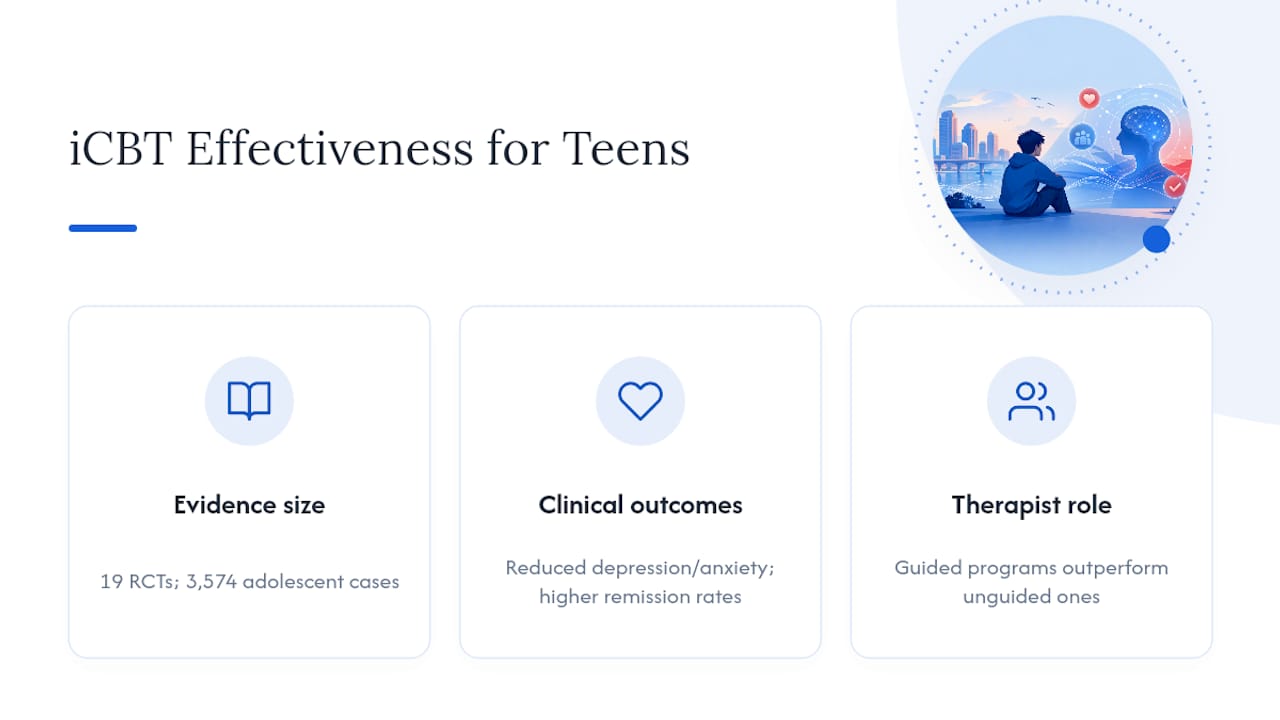
The research on this is more solid than most parents expect. A 2024 meta-analysis reviewing 19 randomized controlled trials and 3,574 adolescent cases found that internet-delivered cognitive behavioral therapy (iCBT) produced meaningful reductions in depressive and anxiety symptoms, with improved remission rates immediately after treatment compared to control groups.
By the numbers: Across 19 clinical trials covering 3,574 adolescents, iCBT showed significant improvement in depression remission and quality of life right after treatment ended.
The evidence gets more specific for certain conditions. A therapist-guided internet-based CBT trial for adolescent OCD reported medium to large effect sizes along with high patient satisfaction, suggesting remote delivery doesn’t have to mean a watered-down version of treatment. Clinical guidance from the American Academy of Child and Adolescent Psychiatry similarly notes that telepsychiatry can produce outcomes comparable to in-person care for many pediatric populations, while expanding access for families who can’t easily get to a clinic.
None of this means every study is airtight. Study quality varies, sample sizes differ, and a good chunk of the evidence base still calls for larger trials with more diverse teen populations. The consistent thread, though, is that therapist involvement, not just an app, drives the results. Guided programs outperform unguided ones.
Is Online Therapy Safe and Confidential for Teens?
Before your teen logs into a first session, a few legal and privacy basics deserve a look. Most states require informed consent for telebehavioral health, and a parent or guardian typically signs it before treatment begins, sometimes with verbal reconfirmation at each session.
Confidentiality works a little differently for teens than for younger children. Therapists generally discuss with both the teen and parent what stays private and what doesn’t, especially around safety concerns.
- Confirm the platform is a HIPAA-covered entity, not a general wellness app without the same legal privacy protections
- Ask how the practice documents consent, whether it’s written e-consent or verbal at each session
- Use headphones and a private room, and have your teen do a quick “scan the room” before starting
- Avoid public Wi-Fi for sessions that involve personal health information
- Ask directly how the clinician handles a disclosure of suicidal thoughts or self-harm risk
Pro Tip: Ask your teen’s provider to explain their “break the glass” policy: the exact circumstances under which confidentiality gets set aside for safety, and how they’d contact you or emergency services if needed.
If your teen is in crisis right now, call or text 988 to reach a trained crisis counselor, available 24/7, before doing anything else.
How Do You Choose the Best Online Therapy for Teenagers?
Picking a provider comes down to a handful of concrete checks, not gut feeling alone. Here’s a sequence that works:
- Confirm licensure and jurisdiction. The therapist must be licensed in your teen’s state, and should be able to tell you this without hesitation.
- Check adolescent-specific experience. A clinician who mainly treats adults may not know how to engage a reluctant 14 year old.
- Compare formats. Decide whether video, phone, or text-based support fits your teen’s comfort level and communication style.
- Ask about session frequency. Weekly is standard for most conditions; some programs offer biweekly maintenance once symptoms improve.
- Verify insurance and cost transparency. Get a straight answer on copays and out-of-network billing before the first appointment.
- Review the crisis plan. Every legitimate provider should have a clear answer for what happens if your teen reports feeling unsafe.
On a first call or intro session, it helps to ask directly:
- “What’s your license number and what state is it valid in?”
- “How many teens with [specific issue] have you treated?”
- “What happens to session notes, and who can access them?”
- “What’s your cancellation and rescheduling policy?”
- “How involved will I be as a parent in treatment updates?”
Watch for red flags that suggest a service isn’t ready to handle a teen client responsibly:
- No informed consent process, or a rushed, vague version of one
- A therapist who can’t name their license number or supervising state
- Guarantees of a specific outcome or timeline (“fixed in 3 sessions”)
- Privacy terms that are unclear, buried, or missing entirely
- No stated plan for handling a mental health crisis
A practical guide to choosing a therapist can help you organize these questions before that first call, so nothing gets missed in the moment.
How Should You Prepare for the First Virtual Therapy Session?
The first session sets the tone, so a little prep goes a long way. Start with the tech side: test the device, camera, and internet connection at least a day ahead, and skip public Wi-Fi given the sensitive nature of the conversation.
Environment matters just as much as equipment — consider exploring an online Entspannungskurs to help your teen develop relaxation skills before sessions. A private room with the door closed, headphones for audio privacy, and a quick scan of the camera view to confirm nothing sensitive is visible in the background all help your teen feel secure enough to talk openly.
- Test video, audio, and internet connection the day before
- Choose a private, quiet room, ideally not shared with siblings during the call
- Use headphones so conversations can’t be overheard
- Have a current medication list ready if relevant
- Gather any recent school or behavioral notes worth sharing with the therapist
Pro Tip: Have your teen do a “room scan” with the camera before the session starts, panning briefly to confirm nothing private or personal is visible in the background.
A first-session prep checklist can walk you through this in more detail if your teen tends to get nervous about new experiences.
What Does Online Therapy Cost, and Does Insurance Cover It?
Coverage for teletherapy varies quite a bit by plan and by state, so this is worth confirming before you commit to a provider. Many private insurance plans now cover telehealth behavioral health visits at the same rate as in-person sessions, but copays and network status still differ from plan to plan.
- Call your insurer directly and ask specifically about telehealth behavioral health coverage for minors
- Ask what billing codes the therapist uses, and whether the provider is in-network or out-of-network
- Check whether your plan requires prior authorization for a set number of sessions
- Ask about Medicaid coverage if applicable; many state Medicaid programs now include teletherapy
- If insurance won’t cover it, ask about sliding-scale fees, school-based counseling, or community mental health centers as lower-cost alternatives
Reviewing your accepted insurance plans ahead of time saves you a frustrating phone call after your teen has already connected with a therapist they like.
Why Your Family Walk-In Clinic Is a Trusted Local Option
Families in the Lutz and Tampa area don’t have to choose between convenience and quality care. Your Family Walk-In Clinic brings together providers with over 25 years of combined experience, offering both virtual and in-person therapy for teens alongside the primary care coordination that mental health treatment often requires.
That combination matters more than it might seem. A teen managing anxiety may also need a physical checkup, a medication refill, or grief support after a loss, and having one clinic handle all of it cuts down on the runaround.
- Ask about therapist credentials and adolescent-specific training before booking
- Confirm whether the intake process for telehealth includes the same informed consent steps outlined earlier in this guide
- Check insurance acceptance directly with the front desk, since coverage details change often
- Same-day appointments are available seven days a week for families who need a faster path to care
Balancing Access, Evidence, and Family Involvement
Online therapy solves a real problem: not every family has a child psychiatrist or licensed adolescent therapist within driving distance. But access without follow-through doesn’t help anyone.
The evidence supports teletherapy when a licensed clinician guides it, not when an app replaces one. Check credentials, confirm the safety plan, and stay involved as a parent. Therapy works best paired with school support, primary care, and the everyday habits, sleep and connection especially, that protect teen mental health long after the session ends.
— Lisa
Get Started With Teen Therapy at Your Family Walk-In Clinic
Unlike a national telehealth app with rotating therapists and no local backup, Your Family Walk-In Clinic gives Lutz and Tampa area families a single place for both virtual therapy sessions and same-day in-person care when a teen needs more than a screen can offer.

The clinic offers virtual therapy, grief counseling, and same-day appointments for teens dealing with anxiety, depression, or major life changes, provided by experienced clinicians. If your teen ends up needing a physical exam, lab work, or a med refill alongside therapy, that’s handled under the same roof instead of a separate referral chain.
Before your teen’s first session, verify your insurance coverage and ask the front desk about the telehealth intake and consent paperwork so nothing holds up your first appointment. If your teen needs urgent, same-day support beyond a scheduled therapy session, Your Family Walk-In Clinic’s urgent care team is open seven days a week to help. Call to schedule an introductory session and find a therapist who fits your teen’s needs.
This article is general information, not a substitute for advice from a qualified doctor. Consult a qualified healthcare professional about your own circumstances before acting on anything here.
FAQ
What Is the Best Online Therapy for Teens?
There’s no single “best” option since fit depends on your teen’s specific needs, but the strongest choices share three traits: licensed clinicians with adolescent experience, clear informed consent processes, and a documented crisis plan. Your Family Walk-In Clinic offers virtual therapy alongside in-person backup for families who want both options under one roof.
How Does a Teen Start Online Therapy?
A teen typically starts with an intake form covering symptoms and history, followed by an assessment call and therapist matching based on need and personality fit. A parent or guardian signs informed consent before treatment begins, and many providers offer an introductory session to confirm the therapist is a good match.
Does Online Therapy Actually Work for Teens?
Yes, for many conditions. A meta-analysis of 19 randomized trials covering 3,574 adolescents found that internet-delivered CBT meaningfully reduced depression and anxiety symptoms, with improved remission rates right after treatment. It tends to work best when a licensed therapist guides the process rather than relying on a self-guided app alone.
Can a 12 Year Old Use Online Therapy Services?
Age minimums vary by platform and by state licensing rules, and not every teletherapy service accepts younger adolescents. Parents should confirm the minimum age directly with any provider and check that the platform’s consent process is designed for younger adolescents rather than adapted from adult intake forms.
What Should Parents Ask Before Choosing a Provider?
Ask about licensure and the state it’s valid in, experience treating your teen’s specific concern, how session notes are handled, and what happens if your teen reports feeling unsafe. A provider who can’t answer these clearly, or who guarantees a fixed outcome, is a red flag worth taking seriously.