
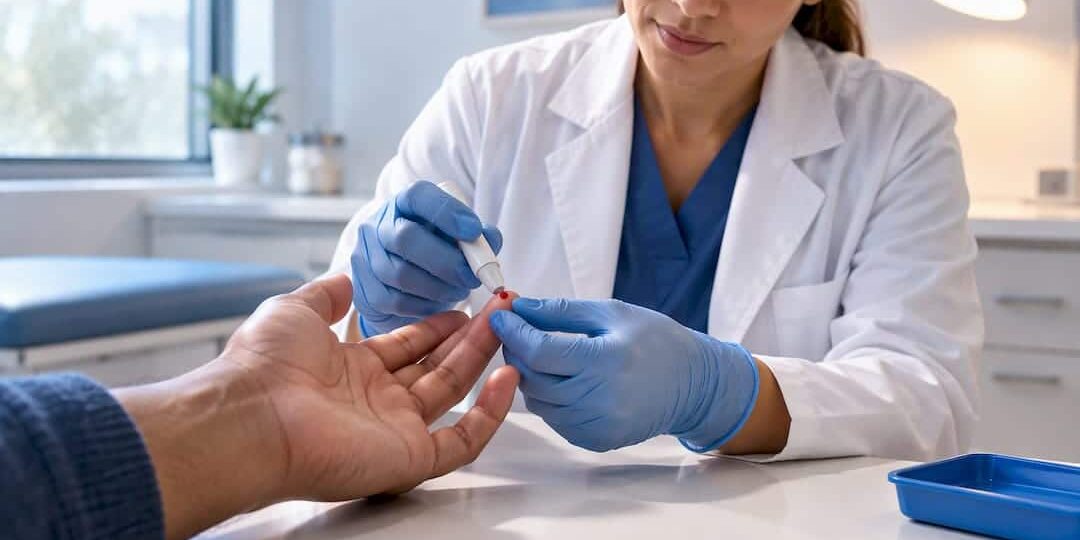
Rapid HIV tests are highly accurate at ruling in a true positive and reasonably good at ruling one out, but they are not infallible, especially soon after exposure. Any reactive result needs confirmatory lab testing, and a negative result within three months of a possible exposure should be treated as provisional, not final.
TL;DR:
- Rapid HIV tests have a sensitivity around 92% and a specificity near 99.98%, requiring confirmatory lab testing after reactive results due to false positives.
- The window period for accurate detection varies: about 10 to 33 days for nucleic acid testing, 18 to 45 days for lab-based antigen/antibody tests, and up to 90 days for most rapid or self-tests.
- Self-tests are less effective for early detection, especially within the first three weeks after exposure, making timely follow-up testing critical if recent high-risk activity occurred.
- False negatives can occur if testing is done too early; people should retest or seek lab-based testing if exposure was recent or if symptoms suggest acute infection.
- For high-risk or recent exposures, visiting a clinic for lab-based antigen/antibody tests or NAT provides more reliable results than relying solely on home self-tests.
Table of Contents
- How Accurate Are Rapid HIV Tests, Really?
- What Are the Different Types of HIV Tests?
- How Long After Exposure Is an HIV Test Accurate?
- What Do I Do After a Reactive or Nonreactive Result?
- Why Might a Rapid HIV Test Be Wrong?
- Home Test, Clinic Rapid Test, or Lab Test: Which Should You Choose?
- What Testing and Follow-Up Look Like at Your Family Walk-In Clinic
- A Balanced Take on Testing Anxiety and Timing
- Ready to Get Tested or Confirm a Result?
- Sources
- FAQ
How Accurate Are Rapid HIV Tests, Really?
Sensitivity and specificity are the two numbers that determine whether you should trust a rapid HIV test result, and they measure different things. Sensitivity is how often the test correctly flags someone who actually has HIV. Specificity is how often it correctly clears someone who doesn’t. A test can excel at one and lag on the other, and with HIV rapid tests, that’s exactly what happens.
The OraQuick In-Home HIV Test, the most widely used self-test on the market, carries an expected sensitivity around 92% and specificity around 99.98%, according to FDA-reviewed clinical data. Translate that into plain numbers: roughly 1 in 12 people who are truly infected could get a false negative, while a false positive happens in roughly 1 in 5,000 uninfected people. That asymmetry is the whole story. A reactive result almost never happens by chance. A nonreactive result can still hide a recent infection.
A systematic review and meta-analysis comparing point-of-care rapid tests against fourth-generation lab assays found pooled sensitivity around ninety-four point five percent (95% CI 87.4 to 97.7) and around ninety-three point seven percent against nucleic acid amplification testing (NAAT). Those confidence intervals matter. They show real variability across studies, sample types, and populations, not a fixed number you can bank on in every scenario.
Rapid HIV test sensitivity and specificity, by measure:
- OraQuick sensitivity: approximately 92%
- OraQuick specificity: approximately 99.98%
- Pooled rapid test sensitivity vs. lab immunoassay: approximately 94.5%
- Pooled rapid test sensitivity vs. NAAT: approximately 93.7%
Statistic Callout: A specificity of 99.98% means that out of 5,000 HIV-negative people tested, you’d expect roughly one false positive. That’s why a single reactive rapid result is called “preliminary,” not diagnostic. It’s rare enough to demand confirmation, common enough that confirmation is mandatory.
One more layer readers often overlook: these percentages describe test performance, not your personal odds. Positive and negative predictive value depend on how common HIV is in your community and how recent or high-risk your exposure was. A reactive result in someone with a known high-risk exposure is far more likely to be a true positive than the same result in someone with no risk factors at all, even though the test itself performed identically in both cases.
What Are the Different Types of HIV Tests?
Not every “rapid” HIV test works the same way, and the differences in what they detect explain most of the confusion around accuracy. Four main categories exist, and knowing which one you took (or are considering) changes how much weight to put on the result.
Antibody-only rapid tests. These detect antibodies your immune system builds in response to HIV, typically from oral fluid or a fingerstick blood sample. OraQuick falls into this category. Antibodies take time to develop, so these tests have the longest window period among common options.
Rapid antigen/antibody (Ag/Ab) combo tests. These look for both antibodies and the p24 antigen, a viral protein that appears earlier than antibodies do. In theory, that should shorten the detection window. In practice, antigen sensitivity on some point-of-care combo devices is inconsistent, and the antigen component often underperforms compared with instrumented lab versions of the same technology.
Laboratory fourth-generation Ag/Ab tests. Run on venous blood in a lab setting, these are the instrumented version of the combo concept, and they detect infection earlier and more reliably than their point-of-care cousins. CDC’s recommended diagnostic algorithm starts here for a reason.
Nucleic acid testing (NAT). NAT looks directly for viral RNA, detecting infection before antibodies or meaningful antigen levels appear. It’s the earliest and most sensitive option, but it’s a lab test, not a rapid or home test, and it’s typically reserved for situations where early detection genuinely changes management.
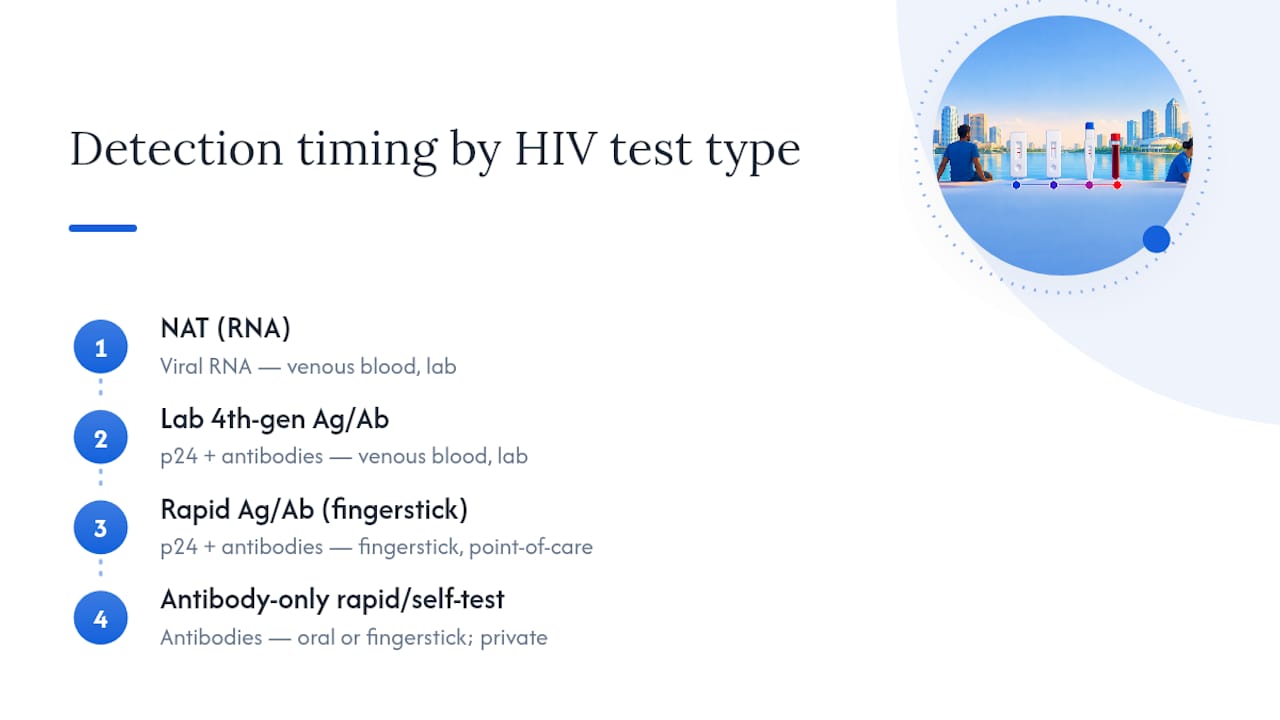
Ranked by how early each can detect infection: NAT comes first, followed by lab-based fourth-generation Ag/Ab testing, then rapid Ag/Ab fingerstick tests, and last, antibody-only rapid or oral self-tests. Self-tests sit at the accessible, private end of that spectrum. They’re built for convenience and confidentiality, not for catching an infection in its earliest days. If you’ve had a recent high-risk exposure and want the earliest possible answer, a self-test isn’t the right tool for that specific question, even though it remains a valid tool for routine or periodic screening.
How Long After Exposure Is an HIV Test Accurate?
Timing determines almost everything about whether you can trust a negative result. The interval between exposure and when a test can reliably detect infection is called the window period, and it varies by test type.
According to CDC guidance, window periods vary by type of HIV test and generally span these ranges:
- NAT: about ten to thirty-three days after exposure
- Laboratory antigen/antibody tests: about eighteen to forty-five days after exposure
- Antibody-only tests, including most rapid tests and self-tests: about twenty-three to ninety days after exposure
Most rapid and self-tests fall into that last, longest category. That’s why a negative self-test taken two weeks after a possible exposure tells you very little. It’s why the honest answer, even from a highly specific test, is often “test again later” rather than “you’re clear.”
There’s a related concept worth understanding: the eclipse period. This is the earliest stretch after infection when literally no test, not even NAT, can detect the virus, because viral levels haven’t yet risen high enough to measure. The window period is the broader span during which a specific test type might still miss the infection. The eclipse period is universal and brief. The window period is test-specific and can stretch to three months.
Here’s how that plays out in practice:
- Single, low-risk exposure: A rapid test at four to six weeks gives a reasonable early read; confirm with a repeat test at three months for certainty.
- Known higher-risk exposure (needle-sharing, exposure to a partner with detectable viral load, sexual assault): Skip straight to a clinic for lab-based Ag/Ab testing or NAT rather than waiting on a home test, and ask about post-exposure prophylaxis if it’s been under 72 hours.
- Symptoms of acute HIV (fever, sore throat, rash, swollen lymph nodes within two to four weeks of exposure): See a provider promptly for NAT or lab Ag/Ab testing, since a negative rapid test at this stage would not be reassuring.
Because rapid HIV test accuracy is so tightly linked to timing, the single biggest reading error people make isn’t misusing the test kit. It’s testing too early and treating a negative result as the final word.
What Do I Do After a Reactive or Nonreactive Result?
A rapid HIV test gives you a preliminary answer, not a diagnosis. What you do next depends entirely on which result you got and how recent your exposure was.
- If your result is reactive (preliminary positive): Don’t panic, and don’t assume it’s definitive. CDC’s recommended pathway calls for a laboratory antigen/antibody immunoassay, followed by a supplemental antibody differentiation immunoassay, with NAT added if the results are indeterminate or if acute infection is suspected. This sequence is what turns a preliminary flag into a confirmed diagnosis.
- If your result is nonreactive but your exposure was recent: Retest according to the window period for whichever test you used, or ask a clinic for a lab Ag/Ab test or NAT if you want an earlier answer than a repeat rapid test can give.
- If you’re waiting on confirmatory testing: Most lab-based confirmatory results return within a few days to about a week, depending on the lab and whether NAT is required. A confirmed diagnosis requires the full algorithm, not a single reactive screening result.
- If you develop symptoms or had a very high-risk exposure in the past 72 hours: Contact a clinic or seek urgent care rather than waiting for a scheduled test. Post-exposure prophylaxis is time-sensitive and most effective when started quickly.
Pro Tip: Write down the exact date of your possible exposure before you test. Clinicians use that date, not the test date, to decide whether your result falls inside or outside the window period, and it’s the detail people forget under stress.
Why Might a Rapid HIV Test Be Wrong?
Most inaccurate results trace back to a handful of predictable causes, and understanding them helps you judge your own result more clearly.
User error tops the list for home tests. Insufficient oral fluid swabbing, reading the result before or after the specified window, or misreading a faint line can all produce an incorrect or invalid read. FDA guidance for OraQuick specifies a 20 to 40-minute reading window; results checked outside that range aren’t considered reliable, in either direction.
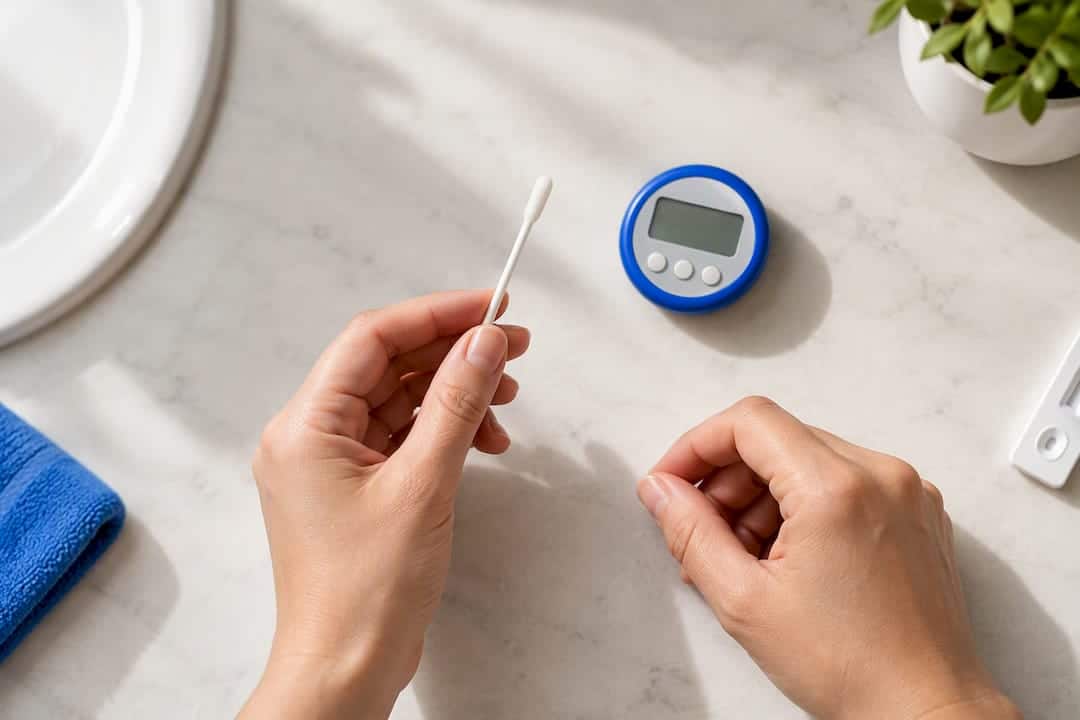
Specimen type matters too. Oral fluid tests generally run slightly less sensitive than fingerstick or venous blood tests, because antibody concentrations in oral fluid tend to lag behind blood. That’s a tradeoff for the comfort of avoiding a needle, and it’s worth knowing about if you’re choosing between a swab and a blood-based option.
Biology can also work against the test. Someone in the acute phase of infection simply hasn’t built up detectable antibody levels yet, regardless of how carefully the test was performed. People with certain immune-suppressing conditions or treatments may develop antibodies more slowly, extending their personal window period beyond the typical range. Supervised or app-guided self-testing has been shown to reduce user error compared with unsupervised testing, which is one reason clinics increasingly offer guided testing options.
None of this makes rapid tests unreliable as a category. It’s exactly why confirmatory testing exists: to catch the rare false positive before it becomes a misdiagnosis, and to catch the early false negative before someone assumes they’re in the clear.
Home Test, Clinic Rapid Test, or Lab Test: Which Should You Choose?
The right test depends less on which one is “best” and more on your specific timeline and risk situation.
Choose a home self-test when:
- You want privacy and are testing as part of routine, periodic screening rather than after a specific recent exposure
- Your last potential exposure was more than three months ago
- You’re comfortable retesting if the timing doesn’t clearly fall outside the window period
Choose a clinic or lab test when:
- Your exposure happened within the last 45 days and you want an earlier, more sensitive answer
- You’re managing PrEP or PEP and need periodic monitoring integrated with your care
- You have symptoms suggestive of acute infection
- You want NAT specifically; this requires a clinical order and isn’t available as a home test
Research on testing strategies in PrEP and long-acting PrEP programs suggests rapid tests can offer comparable negative predictive value at certain points in a monitoring schedule, with the real advantage being speed and access rather than earliest possible detection. That’s a reasonable tradeoff for routine screening. It’s the wrong tradeoff if you’re two weeks past a high-risk exposure and want a real answer.
Pro Tip: If your exposure was under 45 days ago and carried real risk, don’t rely on a home test’s result alone. Go straight to a clinic and ask for a lab-based Ag/Ab test or NAT. You’ll get a more sensitive answer sooner, and you avoid an anxious 90-day wait.
What Testing and Follow-Up Look Like at Your Family Walk-In Clinic
Your Family Walk-In Clinic offers STD screening and treatment alongside on-site lab work, giving you a path from an initial rapid result to full confirmatory testing without bouncing between offices. Testing here follows the CDC-recommended algorithm, which lowers the risk of the reading errors that trip up unsupervised home testing.
Same-day appointments are often available most days, so you may avoid long waits for an answer. Bring a photo ID and insurance card if you have one; many clinics accept major insurance, Medicaid, and self-pay. Many visits include same-day rapid results, with confirmatory lab work sent out when a result comes back reactive or when timing calls for a more sensitive test.
A Balanced Take on Testing Anxiety and Timing
The hardest part of HIV testing isn’t the test itself. It’s sitting with a negative result you don’t fully trust because you tested too soon. That anxiety is legitimate, and it deserves a straight answer rather than false comfort: rapid tests are excellent at confirming what they catch and imperfect at catching everything early. If your exposure was recent, symptomatic, or high-risk, don’t let a single early negative settle the question. Retest on schedule, or better yet, get a lab-based Ag/Ab test or NAT that can see further back than a rapid test can. If you’re unsure which category your situation falls into, that’s a conversation worth having with a clinician rather than a search engine. Reach out to a clinic for testing or counseling when the timeline feels uncertain. That’s what the confirmatory pathway is built for.
— Lisa
Ready to Get Tested or Confirm a Result?
Waiting on a rapid result you’re not sure about is worse than just getting the confirmatory answer. Some walk-in clinics provide a same-day path from initial screening to lab-based confirmation in one visit, avoiding referral delays or scheduling backlogs often encountered when chasing separate providers for testing and follow-up.
If you had a recent exposure, are managing ongoing risk, or just want a periodic screening done right, urgent care visits are open seven days a week from 8 AM to 8 PM, with no long wait typical of scheduled specialist visits. For a full picture beyond HIV, including other STDs that share overlapping symptoms and exposure risks, the clinic’s STD screening and treatment service covers panel testing and treatment in one visit. Reactive results are typically handled through the CDC-recommended confirmatory process, not treated as a final diagnosis immediately. Patients are usually encouraged to call ahead or walk in to request a same-day appointment.
This article is general information, not a substitute for advice from a qualified doctor. Consult a qualified healthcare professional about your own circumstances before acting on anything here.
FAQ
How long can a rapid HIV test detect infection after exposure?
Most rapid and self-tests need up to 90 days after exposure to give a conclusive negative, since they primarily detect antibodies that take time to develop, according to CDC. Lab-based antigen/antibody tests shorten that to 18 to 45 days, and NAT can detect infection in as little as 10 to 33 days.
Can an HIV rapid test give a wrong result?
Yes, though it’s uncommon. The OraQuick test carries a specificity around 99.98% and sensitivity around 92%, per FDA data, meaning false positives are rare but a small percentage of true infections, especially recent ones, can be missed. Any reactive result requires confirmatory lab testing, and a negative soon after exposure should be repeated later.
Can you read HIV rapid test results after the recommended time window?
No. OraQuick specifically requires reading between 20 and 40 minutes after starting the test, per its FDA-reviewed instructions; results checked earlier or later than that window aren’t considered reliable. If you missed the reading window, the safest move is to retest with a fresh kit rather than trust a late or early read.
I got a negative HIV test, but I’m still worried. Should I be concerned?
If your last possible exposure was more than three months ago, a negative antibody-based test is generally considered reliable. If it was more recent, or if you have symptoms of acute infection, the negative result may not be conclusive yet, and a follow-up test or a clinic visit for lab-based Ag/Ab testing or NAT is the appropriate next step. A visit to a clinic for STD screening and treatment can resolve that uncertainty faster than waiting out the full window period alone.