


Under Florida law, a minor may consent to STI testing and treatment without parental permission, no matter their age. Florida Statute §384.30 grants this right directly, and the same law keeps your records confidential. There is one practical gap worth knowing about before your visit: insurance Explanation of Benefits statements can still reveal a visit to a parent, so we will walk you through how to avoid that.
TL;DR:
- A parent’s insurance plan may send an Explanation of Benefits listing the service, date, and sometimes provider, despite statutory confidentiality.
- Before booking, ask whether the clinic offers generic billing codes or cash payment, which can keep a claim off a parent’s insurance.
- County health departments and community health centers often offer sliding fees; call ahead to confirm confidential care and whether billing will involve parental insurance.
- A rapid HIV test can give a preliminary result in about 20 minutes, but confirmatory testing is needed for a final diagnosis.
- Confidentiality has narrow exceptions, including court orders and legally required communicable disease reports; ask staff how results and follow up will reach you.
Table of Contents
- What Florida law says about minors’ consent and confidentiality
- Why insurance billing can still reveal your visit, and how to stop it
- Where teens can get confidential STI testing in Florida
- How consent, testing, and treatment work at your appointment
- Costs, sliding fees, and how paying smart protects your privacy
- Quick checklist: what to bring and what to ask staff
- How Your Family Walk-In Clinic handles confidential testing for teens
- What actually matters most in this process
- How to book confidential testing with us
- FAQ
- Sources
- Primary sources: Florida statutes and authoritative medical guidance
What Florida law says about minors’ consent and confidentiality
Florida Statute §384.30 lets any minor consent to examination and treatment for a sexually transmissible disease, with no minimum age attached. You do not need a parent or guardian present, and you do not need their permission before a provider can test or treat you. The law covers physicians, licensed health professionals, and both public and private clinics, so the protection travels with you regardless of where you seek care in Florida.
Confidentiality is built into the same statute. The 2026 version of §384.30 bars providers from divulging the fact that you were consulted, examined, or treated, and that includes indirect disclosures, such as a bill mailed to a parent that reveals the visit happened. Your records are also exempt from public disclosure under §384.29.
Here is what that protection means in practice:
- Any licensed physician, clinic, or public health department in Florida can test and treat you under this law.
- Your parents do not need to be told you sought care, directly or through a mailed bill.
- The confidentiality applies to the fact of the visit itself, not just the test results.
Why insurance billing can still reveal your visit, and how to stop it
Confidentiality on paper does not always hold up once insurance gets involved. An Explanation of Benefits, or EOB, is the summary a health plan sends to the policyholder after a claim, and if you are on a parent’s plan, that EOB can list the service, the date, and sometimes the provider name. A University of Miami legal and public-health analysis identifies EOBs as the main practical risk to a minor’s confidentiality in Florida, even though the underlying statute protects you.
A few steps reduce that risk substantially:
- Ask the front desk whether the clinic offers confidential or generic billing codes before you check in.
- Ask whether paying cash avoids a claim being filed with the parent’s insurer altogether.
- Ask about sliding-fee pricing if cash payment is a concern.
- Request that results and follow-up communications go directly to you, by phone, portal, or text, rather than by mail.
Pro Tip: Say this at check-in: “I’d like to pay out of pocket today so no claim goes to my parent’s insurance plan.” Front-desk staff hear this request often and can walk you through the options.
Our guide to avoiding EOB disclosure covers these steps in more detail if you want to prepare before your appointment.
Where teens can get confidential STI testing in Florida
Several types of sites in Florida provide confidential testing under §384.30, and each fits a different situation. County health departments and community health centers typically offer the lowest-cost testing and are familiar with minor-consent law. School-based health clinics, where available, provide another low-barrier option during the school day. Walk-in family clinics offer same-day appointments and extended hours, which matters if you need care outside school or work hours.
Most sites test for the same core panel:
- Gonorrhea and chlamydia, usually by urine sample or swab.
- Syphilis, by blood draw.
- HIV, by rapid finger-stick test with a confirmatory blood test when needed.
Before you go, call ahead and ask directly whether the site treats minors confidentially and whether billing will involve a parent’s insurance. Not every front desk is equally prepared for that conversation, so asking first saves a wasted trip.
How consent, testing, and treatment work at your appointment
Florida law presumes you have the capacity to understand and agree to STI testing and treatment, so the consent process is simpler than for most other medical care. You will sign a standard consent form at intake, the same as any adult patient, confirming that you understand the test and agree to it.
A typical visit moves through a few stages:
- Intake and consent, where you confirm you understand what is being tested and why.
- Sample collection, by urine, swab, or blood draw depending on the test.
- Results, often back within a few days for standard panels, with HIV rapid tests giving a preliminary result in about 20 minutes and requiring confirmatory testing for a final diagnosis.
- Treatment, which you can receive without parental consent if results are positive, along with instructions for follow-up and partner notification support.
Confidentiality has very narrow exceptions, mainly court orders and certain communicable disease reports required by public health law. Outside those situations, your provider cannot share your treatment history with a parent.
Costs, sliding fees, and how paying smart protects your privacy
Public health departments and community clinics in Florida commonly run sliding-fee scales for communicable disease screening, which adjust cost based on income so inability to pay does not block access to testing or treatment. Eligibility rules vary by clinic, so it is worth asking directly what documentation, if any, is required.
A few cost-related points matter for privacy specifically:
- Paying cash avoids triggering an insurance claim, which avoids the EOB problem entirely.
- Using a parent’s Medicaid or private insurance can still generate a notice to the policyholder, so ask about this before using insurance.
- Grant-funded community testing events sometimes offer free testing with no insurance involved at all, which removes the paper-trail question completely.
Our breakdown of sliding-fee STD testing costs in Florida walks through typical pricing ranges and how to find a sliding-fee clinic near you.
Quick checklist: what to bring and what to ask staff
A little preparation keeps your visit fast and private. Bring a photo ID if you have one, though many Florida clinics will test minors without it. Decide ahead of time whether you plan to use insurance or pay cash, since that decision shapes what you ask at check-in.
Use these questions at the front desk:
- “Will an Explanation of Benefits be sent to my parent if I use insurance today?”
- “Can I pay cash or a sliding-fee rate so no claim is filed?”
- “How will you deliver my results, and will anyone else be notified?”
- “What happens if a parent calls and asks about my visit?”
If you ever feel your confidentiality was not respected, or a parent requests records you believe should stay private, ask to speak with a clinic supervisor and reference §384.29 directly.
How Your Family Walk-In Clinic handles confidential testing for teens
Confidential STD screening and treatment for teens is available, with same-day appointments available seven days a week from 8 AM to 8 PM. Front-desk staff can answer billing questions directly, including whether a visit will generate an insurance claim visible to the policyholder.
Here is what you can expect:
- Same-day scheduling, so you are not waiting weeks for an appointment.
- Sliding-fee and self-pay options discussed openly at check-in.
- Experienced providers in family and urgent care.
- A private conversation about how your results will be shared with you and with no one else without your consent.
If confidentiality is your top concern, mention it when you call, and staff can walk you through your options before you arrive.
What actually matters most in this process
The statute itself is not the hard part. Florida has made minor consent for STI testing straightforward for decades, and most clinics know the law well. The part that trips people up is billing, not law, and most advice online stops at “you can consent” without explaining that an insurance claim can undo that protection in practice.
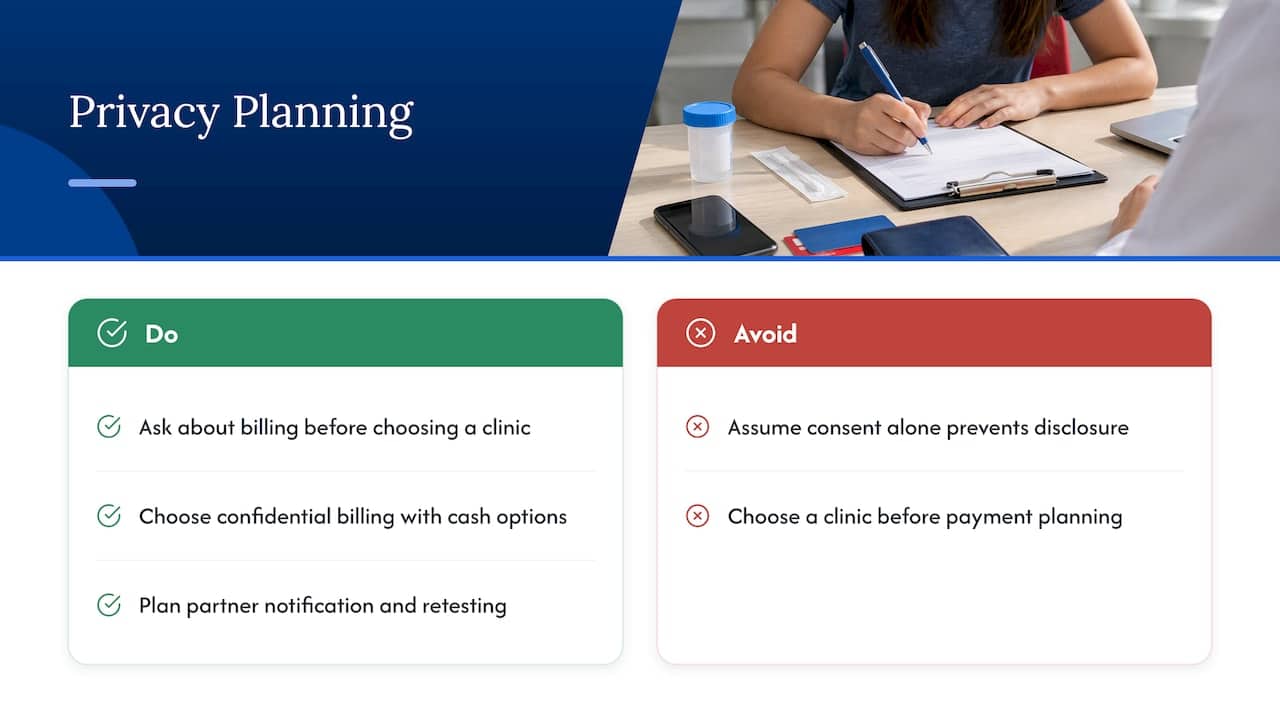
If you take one thing from this article, make it this: decide how you are paying before you decide where you are going. A clinic with a confidential billing process and a cash or sliding-fee option will protect you more reliably than one that simply knows the statute exists. Ask the billing question first, every time, even if it feels awkward. Staff at clinics that regularly see teens will not find it unusual.
The other overlooked piece is follow-up. A positive result means nothing changes about your right to confidential treatment, but it does mean you need a plan for partner notification and retesting, and that conversation deserves the same directness as the first one.
— Lisa
How to book confidential testing with us
Booking same-day STD testing is simple: call the clinic or request an appointment online, and mention if confidentiality or billing is a concern so staff can prepare ahead of your visit.
The clinic is open seven days a week from 8 AM to 8 PM, and sliding-fee pricing is available for teens who want to pay without involving a parent’s insurance. Visit the STD screening and treatment page for details and scheduling options.
This article is general information, not a substitute for advice from a qualified doctor. Consult a qualified healthcare professional about your own circumstances before acting on anything here.
FAQ
Can I take my 14-year-old to urgent care for an STD test?
Yes, Florida law allows a minor of any age to consent to their own STI testing and treatment under §384.30, so a minor can be seen without a parent present or notified. Most walk-in clinics and urgent care centers in Florida, including ours, can provide this testing directly.
Is 17 years old a minor in Florida?
Yes, Florida law defines a minor as anyone under 18. That status does not limit STI testing and treatment rights, since §384.30 applies to minors of any age without a minimum.
What are the STD laws in Florida?
Florida’s core law is §384.30, which allows minors to consent to STI examination and treatment without parental permission, paired with §384.29, which keeps those records confidential and exempt from public disclosure. The main practical exception involves billing, since an insurance Explanation of Benefits can still reveal a visit to a policyholder parent.
What is the “Juliet law” in Florida?
There is no statute in Florida officially named the “Juliet law”; this appears to be a misremembered reference, possibly confused with Romeo and Juliet close-in-age exceptions found in some states’ statutory rape laws, which are unrelated to STI testing consent. For questions about age-of-consent laws outside the context of STI testing, consult a legal professional or the official Florida Statutes directly.
Sources
- Florida Statutes §384.30 Minors’ consent to treatment
- Florida Statutes (2026) — 384.30 Minors’ consent to treatment
- CDC: STI testing for adolescents — parent resources
- University of Miami analysis: minors’ access to confidential health care in Florida (2005)
Primary sources: Florida statutes and authoritative medical guidance
- Florida Statutes §384.30 Minors’ consent to treatment
- Florida Statutes (2026) — 384.30 Minors’ consent to treatment
- CDC: STI testing for adolescents, parent resources
- University of Miami analysis: minors’ access to confidential health care in Florida