


Yes, STD testing is generally confidential, and minors can usually consent to it without parental permission. The main limits to expect are mandatory public health reporting for certain infections, safety exceptions like abuse disclosures, and billing statements that can accidentally reveal testing to a parent or policyholder. Asking your clinic about result delivery and billing options before you test closes most of those gaps.
TL;DR:
- Even with legal protections, billing statements sent to the policyholder are a common source of accidental disclosure for minors seeking STD testing.
- Asking about out-of-pocket payment options, generic billing codes, and result delivery methods before testing can significantly protect privacy.
- Confidential testing connects results directly to your medical record, while anonymous testing uses codes that make follow-up care more difficult but offer greater privacy.
- State laws generally allow minors to consent to STI testing and treatment without parental approval, but confidentiality can be compromised through insurance EOBs.
- Clinics that prioritize privacy share practices like secure portals, staff training on confidentiality, and allowing patients to specify communication preferences.
Table of Contents
- How confidentiality works: HIPAA basics and clinic practices
- Minor consent and parental notification laws
- When confidentiality can be broken: reporting and safety rules
- Billing, EOBs, and records: the real confidentiality risk
- Where to get confidential or anonymous testing
- A step-by-step checklist to protect your privacy
- How clinics protect your privacy in practice
- What actually matters here
- How Your Family Walk-In Clinic supports confidential testing
- Sources
- FAQ
How confidentiality works: HIPAA basics and clinic practices
Your medical information, including STD test results, is protected under the HIPAA Privacy Rule once it’s held by a doctor’s office, clinic, or lab. This federal law limits who can see or share your health records and requires your permission before most of that information goes anywhere else. HHS updated its HIPAA guidance in 2022 to strengthen protections specifically around reproductive and sexual health information, reinforcing that disclosures outside of direct care are narrow and specific.
Clinics turn that legal protection into daily practice in a few concrete ways:
- Secure patient portals let you view results online instead of waiting for a call or a letter.
- Staff access to sensitive records is often limited to the people directly involved in your care.
- Many clinics offer opt-in delivery, so you choose text, portal, or phone instead of a default mailed letter.
It helps to know the difference between confidential and anonymous testing. Confidential testing links your results to your name and medical record, which allows follow-up care and treatment. Anonymous testing, offered at some public health sites, uses a code instead of your name, which protects privacy further but can make it harder to connect you to care if you test positive.
Minor consent and parental notification laws
Every state and the District of Columbia allows minors to consent to their own STI testing and treatment, and CDC guidance confirms no state requires parental consent for these services. That means a teenager can walk into a clinic, ask for testing, and receive care without a parent’s signature anywhere in the United States.
Where things get less uniform is around related services:
- Some states set different age thresholds for HIV treatment consent compared to general STI testing.
- HPV vaccination and PrEP access rules vary more by state than basic STI testing and treatment.
- State-specific fact sheets, searchable by state name plus “minor consent STI fact sheet,” spell out these details.
If you’re a minor considering testing, ask about confidentiality and billing before you’re seen, not after. You’re also welcome to bring a trusted adult if that feels better, but it isn’t required for consent.
When confidentiality can be broken: reporting and safety rules
Certain infections, including syphilis, gonorrhea, chlamydia, and HIV, must be reported by your provider to public health authorities in every state. CDC’s clinical reporting guidance explains that this reporting exists for disease surveillance and partner services, not for notifying your parents or anyone else in your personal life.
A few points worth separating clearly:
- Public health reporting is itself confidential and protected by law, kept separate from your everyday medical record sharing.
- It is not the same thing as a clinic calling your home or your parent seeing a diagnosis.
- Clinicians are legally required to break confidentiality in narrow situations, such as suspected child abuse or an imminent safety threat, and a provider should explain these limits to you at your first visit.
The AMA Journal of Ethics notes that adolescents are more likely to seek care and disclose sensitive information honestly when they trust that confidentiality will hold, which is exactly why clinicians are trained to name these limits upfront instead of leaving patients guessing.
Billing, EOBs, and records: the real confidentiality risk
Legal protections aside, the biggest practical threat to your privacy is often a piece of paper: the Explanation of Benefits, or EOB, that your insurer mails to the policyholder. CDC’s public health guidance on STI screening points out that billing and insurance communication are a frequent source of accidental disclosure for adolescents and young adults using a parent’s insurance plan.
A few steps reduce that risk:
- Ask if paying out-of-pocket is realistic for your situation, since self-pay visits typically generate no EOB at all.
- Ask your clinic whether it can use a generic billing code for your visit instead of a specific diagnosis code.
- Check your state’s EOB protection laws, since some states now limit what insurers can disclose to a policyholder for sensitive services.
Pro Tip: Call your insurer directly and ask them to send EOBs to your own address or email instead of the policyholder’s, if your plan allows it.
Electronic health records and patient portals carry a smaller but real version of the same risk. If a parent or ex-partner has portal access tied to your account, ask the clinic directly how access controls work before you test.
Where to get confidential or anonymous testing
Your options break down by how much privacy you need versus how much follow-up care matters to you.
- Clinic-based confidential testing connects your results to your medical record, which is the better route if you expect to need treatment or follow-up care.
- Local health departments and public STD clinics often charge less and sometimes offer anonymous testing or different billing setups than a private clinic.
- Home or self-collection tests can offer more anonymity depending on the vendor’s privacy policy, but a positive result usually needs confirmatory testing at a clinic, which then becomes part of your medical record.
- Partner notification can also stay private: public health departments run partner services, and some now use anonymous electronic or text-based tools to notify partners without naming you directly.
A step-by-step checklist to protect your privacy
A little preparation before your appointment does more for your privacy than anything you can do afterward.
- Before the visit, ask how results are delivered, whether generic billing codes are available, and whether paying out-of-pocket is an option.
- At the visit, ask for time alone with your provider and confirm your preferred contact method for results.
- After the visit, watch your insurer’s mail and email for EOBs, and ask the clinic how to request a correction or amendment to your record if something was shared incorrectly.
Pro Tip: Write down your confidentiality preferences and ask the front desk to note them in your chart, so every staff member you interact with follows the same plan.
How clinics protect your privacy in practice
Lisa, a healthcare communicator who has worked alongside clinicians with long experience treating patients with care that respects both health needs and privacy concerns. Clinics that take confidentiality seriously tend to share a few habits in common:
- STD testing with rapid appointments reduces the number of visits and records tied to a single concern.
- Secure result portals can replace mailed letters or voicemail messages that others might see or hear.
- Staff training on confidentiality means front-desk and clinical teams handle sensitive visits consistently.
- Billing and privacy questions can be raised at registration, before any charges or codes are set, at some clinics.
If you’re unsure how a clinic handles any of this, ask before you book, not during checkout.
What actually matters here
Most advice about STD testing confidentiality focuses on the legal headline: minors can consent, HIPAA applies, you’re covered. That’s true, but it undersells where privacy actually breaks down in practice. The law rarely fails people. Paperwork does. An EOB mailed to a parent’s address, a portal notification sent to a shared family email, a diagnosis code visible on a claims statement: these are the moments that turn a private decision into an awkward conversation nobody planned for.
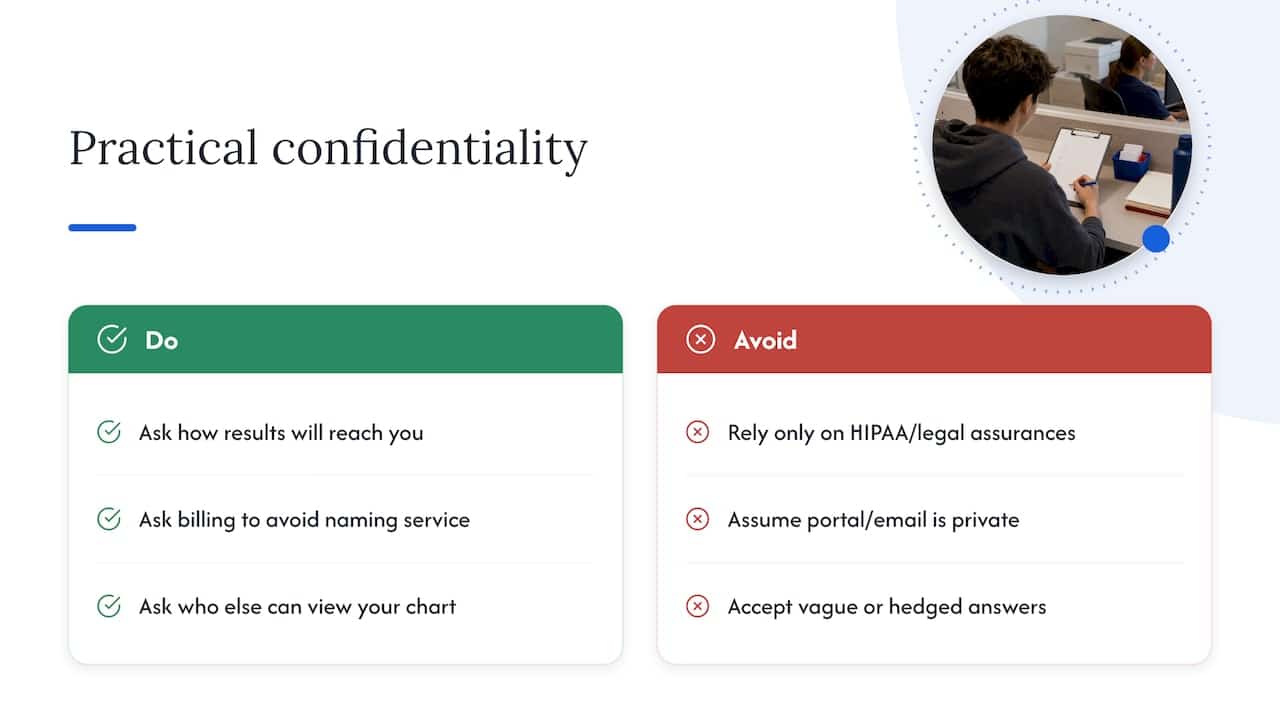
The fix isn’t more legal knowledge. It’s asking two or three direct questions at booking: how will results reach me, can billing avoid naming the specific service, and who else can see my chart. Clinics that answer those questions clearly, without hedging, are worth trusting more than ones that only cite HIPAA and move on. If you take one thing from this, make it that confidentiality is something you build with specific questions, not something you assume because a law exists.
— Lisa
How Your Family Walk-In Clinic supports confidential testing
Confidential STD testing shouldn’t require you to choose between getting care and keeping your privacy, and that’s the balance we aim for at Your Family Walk-In Clinic in Lutz. Our clinic offers STD testing and treatment with secure result delivery, so patients are not waiting on a mailed letter or a voicemail that someone else might see first.
Here’s what you can expect when you reach out:
- Appointments are available throughout the week for testing without a long wait.
- Patients can discuss billing and privacy preferences at registration, before any codes or charges are finalized.
- Secure, opt-in result delivery may be available so patients control how and where they hear back.
Visit our STD Screening and Treatment page to see what’s included, or contact us directly to talk through your confidentiality questions before you book.
This article is general information, not a substitute for advice from a qualified doctor. Consult a qualified healthcare professional about your own circumstances before acting on anything here.
Sources
- CDC: STI treatment guidelines — Adolescents
- AMA Journal of Ethics: Protecting confidentiality of sexually active adolescents
FAQ
Can an STD test be confidential?
Yes, STD testing is protected as confidential medical information under HIPAA once it’s in a clinic’s or lab’s records. The main practical exception involves insurance billing, since an EOB can reveal that testing occurred to the policyholder on the plan.
Can I tell someone about an STD anonymously?
Yes, public health departments run partner notification services, and some use anonymous electronic or text-based tools so a partner can be notified and offered testing without your name being shared. You can ask your clinic or local health department how their partner services program works before you decide.
Are you legally obligated to tell someone you have an STD?
You’re not required to personally notify past partners, though public health reporting of certain infections to health authorities is required of your provider, not you. Separately, clinicians must report specific situations like suspected abuse or imminent danger, which is different from routine partner notification.
Will my parents know if I get an STD test?
Not automatically. All states allow minors to consent to STI testing and treatment without parental permission, but a parent could learn about it indirectly through an insurance EOB if the visit is billed to their plan. Asking the clinic about out-of-pocket pay or generic billing codes before testing is the most reliable way to avoid that.