


A complete blood count (CBC) is a routine blood test that measures your red blood cells, white blood cells, and platelets so a clinician can screen, diagnose, or monitor common conditions. It matters whenever you’re feeling unusually tired, fighting a persistent infection, or your provider is tracking a chronic condition. The rest comes down to understanding what each number on your results page is actually telling you.
TL;DR:
- Most CBCs are influenced by age, sex, altitude, pregnancy, and medications, so always compare results to the reference ranges specific to your lab.
- Abnormal white blood cell counts can indicate infection, autoimmune issues, or bone marrow problems, but short-term fluctuations are often benign.
- Red blood cell indices help classify anemia types, with low MCV indicating iron deficiency and high MCV often associated with B12 or folate deficiency.
- Platelet counts below normal increase bleeding risk, while high counts suggest inflammation or infection, with MPV providing insight into marrow activity.
- Many clinics offer same-day CBC testing to expedite diagnosis and follow-up, especially for urgent concerns like unexplained fatigue or bruising.
Table of Contents
- CBC Test Explained: What It Measures and Why the Differential Matters
- Reading Your CBC: A Line-by-Line Breakdown of Common Values
- Why Normal Ranges Aren’t the Same for Everyone
- What Happens During a CBC and How to Prepare
- When to Worry About Abnormal Results and What Comes Next
- How Clinicians Actually Use the CBC in Daily Practice
- Get Same-Day CBC Testing Without the Wait
- Where to Learn More About CBC Testing
- Sources
- FAQ
CBC Test Explained: What It Measures and Why the Differential Matters
A CBC measures the quantity, size, and health of three cell types: red blood cells, white blood cells, and platelets. Each component tells your provider something different, and together they paint a picture of how well your blood is carrying oxygen, fighting infection, and clotting when needed.
The core components include:
- Red blood cells (RBC): carry oxygen from your lungs to the rest of your body
- Hemoglobin (Hb): the protein inside red cells that actually binds oxygen
- Hematocrit (Hct): the percentage of your blood volume made up of red cells
- White blood cells (WBC): your immune system’s frontline defenders
- Platelets: cell fragments that clump together to stop bleeding
- Red cell indices (MCV, MCH, MCHC, RDW): calculated values that describe the size and hemoglobin content of your red cells, which help classify different types of anemia
A “CBC with differential” breaks the white blood cell count down further, into neutrophils, lymphocytes, monocytes, eosinophils, and basophils. That breakdown adds real diagnostic weight. Elevated neutrophils tend to point toward a bacterial infection, while a lymphocyte-heavy pattern often suggests a viral one. A CBC with differential helps narrow down whether you’re dealing with a virus that needs rest and fluids or a bacterial process that needs treatment. Providers typically order the differential when someone has a fever without an obvious source, unexplained fatigue, or symptoms that suggest an immune or blood disorder rather than a routine illness. If you’ve had recent STD panel testing, you may notice a differential ordered alongside it to rule out a broader infectious process.
Reading Your CBC: A Line-by-Line Breakdown of Common Values
Your lab report lists a column of numbers next to flags like “H” or “L.” Here’s what those flags usually mean and what tends to cause them.
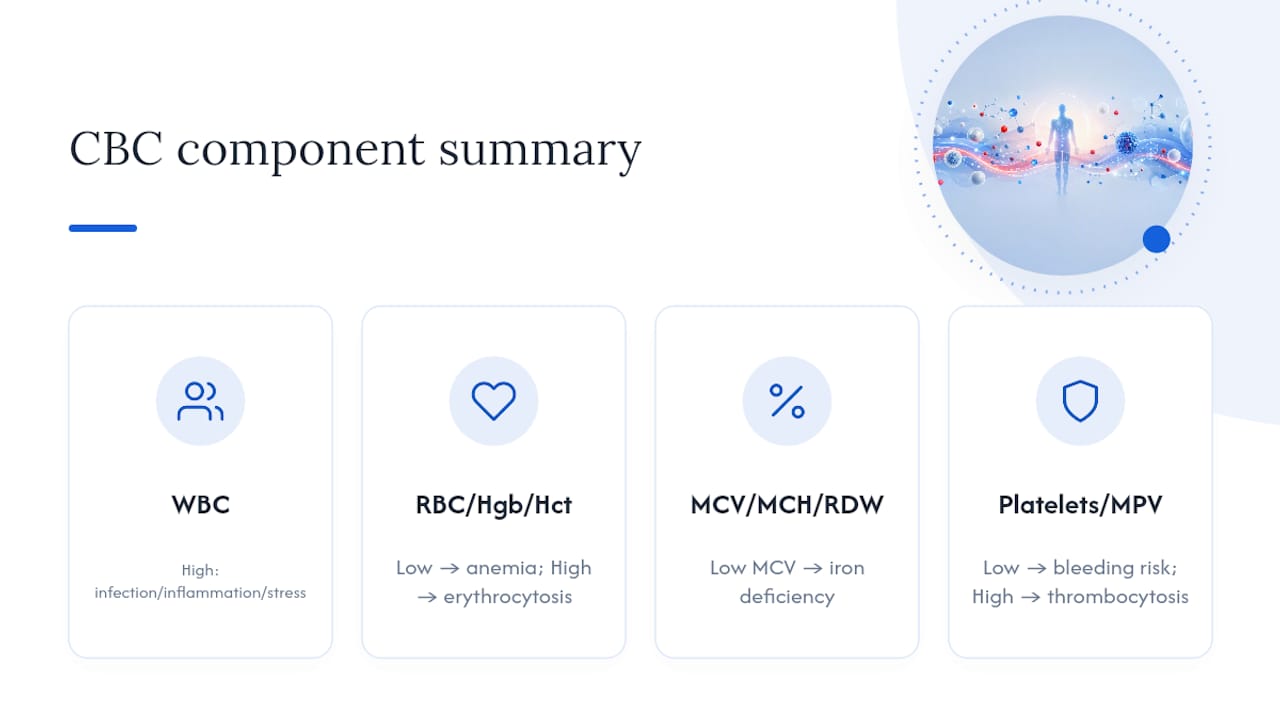
White blood cells. A high WBC count often signals infection, inflammation, or stress on the body, though it can also spike temporarily after intense exercise or during pregnancy. A low count can result from viral infections, certain medications, autoimmune conditions, or bone marrow problems. A single elevated reading during an active cold is rarely alarming. A count that stays high for weeks, or one that’s paired with fever and fatigue, deserves a closer look.
Red blood cells, hemoglobin, and hematocrit. These three numbers tend to move together, which is sometimes called the “rule of three”: hemoglobin is roughly three times the RBC count, and hematocrit is roughly three times the hemoglobin value. When that ratio breaks down, it can point to a lab error or an unusual cell shape rather than a true abnormality. Low values across the board usually mean anemia, caused by iron deficiency, blood loss, chronic disease, or vitamin deficiencies. High values, known as erythrocytosis, can result from dehydration, smoking, living at high altitude, or less commonly, a bone marrow disorder.
MCV, MCH, MCHC, and RDW. These red cell indices help classify anemia by type. A low MCV points toward small red cells, typical of iron deficiency. A high MCV suggests large cells, often tied to vitamin B12 or folate deficiency. RDW measures how much size variation exists among your red cells; a high RDW alongside a low MCV strengthens the case for iron deficiency over other causes.
Platelets and MPV. A platelet count below the normal range is called thrombocytopenia and raises bleeding risk at lower values. A count above the typical upper limit, called thrombocytosis, can be due to infection, inflammation, iron deficiency, or sometimes bone marrow conditions. Mean platelet volume (MPV) adds context: larger platelets suggest the bone marrow is producing new ones quickly, often in response to a low count elsewhere.
Lab artifacts. Not every abnormal number reflects your actual physiology. Automated hematology analyzers can misread clumped platelets, hemolyzed samples, or contaminated specimens, producing spurious counts that don’t match reality. This is exactly why an unexpected or wildly discordant result often triggers a manual review before anyone acts on it.
Why Normal Ranges Aren’t the Same for Everyone
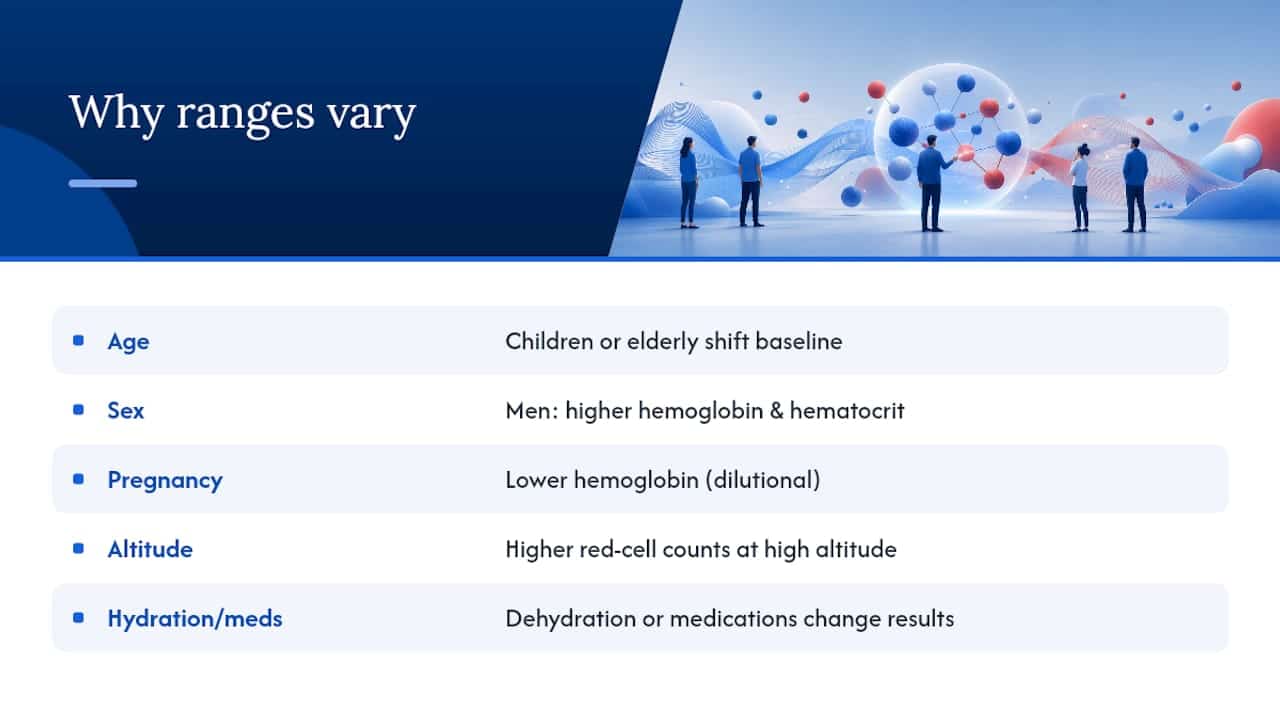
There’s no single universal chart of “normal” CBC values. Reference intervals are set by each individual lab based on their specific instruments and the population they serve, which is why the same blood sample tested at two different labs can come back with slightly different reference ranges printed alongside it.
Common adult examples, according to Mayo Clinic, fall within typical ranges for white blood cells, hemoglobin, hematocrit, platelets, and MCV, though exact values vary by individual labs and patient factors.
These numbers shift for real reasons beyond lab differences. Age changes baseline values, especially in children and older adults. Sex matters too. Men typically run higher hemoglobin and hematocrit than women. Pregnancy naturally lowers hemoglobin due to increased blood volume. Living at high altitude tends to raise red cell counts as your body adapts to lower oxygen availability, and dehydration or certain medications can shift numbers in either direction. Always compare your result to the reference range printed on your own lab report, not a number you found online.
What Happens During a CBC and How to Prepare
A CBC requires a standard blood draw from a vein, usually in your arm, and the process itself takes just a few minutes. A technician cleans the site, inserts a small needle, and collects a vial of blood.
No special preparation is typically needed. If your provider ordered other tests alongside the CBC, like a fasting glucose or lipid panel, you may need to avoid eating beforehand, but the CBC itself doesn’t require fasting. Results often come back the same day at a clinic equipped for on-site lab testing, though some labs take a day or two depending on volume. Risks are minor: a brief sting, occasional bruising at the site, and rarely, lightheadedness during the draw.
When to Worry About Abnormal Results and What Comes Next
One flagged value on a portal doesn’t automatically mean something serious. Electronic systems often highlight results in red even when the deviation is small and clinically unremarkable, so context always matters more than color coding.
Here’s a general framework for how providers typically approach abnormal CBC results:
- Mild, isolated abnormality with no symptoms: often repeated in a few weeks to confirm it wasn’t a fluke or lab artifact.
- Abnormality with symptoms (fatigue, unexplained bruising, recurring fevers): usually prompts follow-up testing rather than a simple repeat.
- Anemia of unclear cause: typically followed by iron studies, vitamin B12 and folate levels, and sometimes a reticulocyte count to see how well your bone marrow is responding.
- Suspected clotting or bleeding issue: often paired with coagulation tests.
- Unexplained or persistent abnormality across multiple cell lines: may lead to a peripheral blood smear review or referral for a bone marrow evaluation.
A peripheral smear lets a trained eye examine your cells directly under a microscope, which can catch things an automated analyzer misses, including certain cell shapes tied to specific blood disorders.
Certain findings warrant faster action rather than a routine recheck: platelet counts low enough to raise spontaneous bleeding risk, severe neutropenia that leaves you vulnerable to infection, or hemoglobin and hematocrit levels low enough to affect oxygen delivery. Your provider will always weigh your CBC against your symptoms, medications, and personal history. A slightly low white count in someone on chemotherapy means something entirely different than the same number in an otherwise healthy adult.
Pro Tip: Bring a list of your current medications and any recent illnesses to your appointment. Several common drugs, from certain antibiotics to blood pressure medications, can shift CBC values without indicating a new health problem.
How Clinicians Actually Use the CBC in Daily Practice
In a walk-in setting, a CBC often helps triage what’s happening in real time. A markedly elevated white count with a fever points toward a bacterial process that may need antibiotics. A low hemoglobin in someone reporting fatigue and heavy periods points toward anemia workup rather than a wait-and-see approach. Same-day CBC testing gives you an answer before you leave, rather than waiting days wondering if that infection is getting worse. It also lets clinicians catch unexpected findings, like unexplained low platelets, before they become urgent.
— Lisa
Get Same-Day CBC Testing Without the Wait
Certain walk-in clinics offer same-day lab draws seven days a week, so you don’t have to sit on a worrying symptom until a specialist appointment opens up weeks out. That’s the real difference between a walk-in clinic model and the typical primary-care wait: you can walk in this morning with fatigue or unexplained bruising and walk out with a CBC drawn, and often a same-day read, plus a provider who can explain exactly what those numbers mean for you.

Walk in during our regular hours with your insurance card or ID, and let our team handle the draw and the follow-up plan together. If your results need a repeat test, a referral, or additional workup like iron studies, we coordinate that on-site rather than sending you elsewhere to start over. Our urgent care services are available seven days a week for anyone who needs bloodwork paired with a real conversation about what it means. If you’re already managing an ongoing condition, our primary care team can build CBC monitoring into your regular visits so nothing slips through the cracks. Schedule your visit today and get answers the same day you ask the question.
Where to Learn More About CBC Testing
- MedlinePlus: Complete Blood Count (CBC) for a plain-language overview of the test and its uses
- StatPearls/NCBI: Normal and Abnormal Complete Blood Count With Differential for clinical detail on interpreting each value
- Mayo Clinic: Complete Blood Count for reference range examples and preparation guidance
Bringing one of these links up during your appointment can help frame a more specific conversation with your provider about your own results.
This article is general information, not a substitute for advice from a qualified doctor. Consult a qualified healthcare professional about your own circumstances before acting on anything here.
Sources
- Complete Blood Count (CBC): MedlinePlus Medical Test
- Normal and Abnormal Complete Blood Count With Differential – StatPearls
- Complete blood count (CBC) – Mayo Clinic
FAQ
When should I actually worry about CBC results?
Worry less about a single mildly flagged value and more about results paired with symptoms like fever, unexplained bruising, extreme fatigue, or shortness of breath. Very low platelet counts, severe neutropenia, or dramatically abnormal hemoglobin levels warrant prompt medical attention rather than a wait-and-see repeat test.
What cancers can a CBC detect?
A CBC can raise suspicion for blood cancers such as leukemia when it shows unusual patterns like extremely high or low white cell counts combined with abnormal platelets or red cells. It doesn’t diagnose cancer on its own; abnormal patterns typically lead to a peripheral smear, additional blood work, or a bone marrow evaluation to confirm a diagnosis.
What are five things a CBC can show signs of?
A CBC can show signs of anemia, infection, immune system disorders, blood clotting problems, and certain blood cancers, according to MedlinePlus. It’s also used to monitor how well your body is tolerating ongoing treatments like chemotherapy.
What is the “rule of three” in a CBC?
The rule of three describes the normal relationship between red blood cell measurements: hemoglobin is roughly three times the RBC count, and hematocrit is roughly three times the hemoglobin value. When that ratio doesn’t hold, it often signals a lab artifact or an unusual red cell shape rather than a true clinical abnormality.
Can I get a CBC done the same day I request one?
Yes, at a walk-in clinic equipped with on-site lab testing, a CBC draw and results can often happen within the same visit or the same day. Some walk-in clinics offer same-day CBC testing seven days a week for patients who need quick answers rather than a multi-day wait.