


If you don’t have documented immunity to measles, mumps, or rubella, get at least one dose of the MMR vaccine now. Certain adults need two doses, spaced at least 28 days apart, to be fully protected.
That single fact resolves most of the confusion around MMR vaccine adults searches. Here’s what matters most before you book a visit:
- Who needs two doses: postsecondary students, healthcare personnel, international travelers, and close contacts of people with weakened immune systems.
- Who’s usually fine with one dose (or none): adults born before 1957 are generally presumed immune, unless they work in healthcare.
- What stops vaccination: pregnancy and severe immunocompromise are the two absolute contraindications, and any two doses should be spaced adequately to count.
Everything below unpacks these rules, plus what a real visit looks like when your records are missing or unclear.
Key Takeaways
Adults without documented immunity should get at least one MMR dose, and higher-risk groups need two doses spaced 28 days apart to reach full protection.
| Point | Details |
|---|---|
| One dose is the floor | Adults born in or after 1957 without evidence of immunity need at least one MMR dose. |
| Two doses for higher-risk groups | Students, healthcare personnel, travelers, and close contacts of immunocompromised people need two doses, 28 days apart. |
| Effectiveness is strong | One dose is about 93% effective against measles; two doses raise that to about 97%. |
| Skip the lab testing | Routine antibody testing is usually unnecessary; an extra MMR dose is safe if you’re already immune. |
| Same-day vaccination is available | Your Family Walk-In Clinic offers walk-in MMR vaccination seven days a week for adults who need to catch up or confirm immunity. |
Table of Contents
- Who Needs One Dose vs. Two Doses of the MMR Vaccine?
- What Happens at an MMR Vaccine Visit for Adults?
- Who Should Avoid the MMR Vaccine or Delay It?
- How Effective Is the MMR Vaccine for Adults, and Does Immunity Fade?
- What If You Don’t Know Your MMR Vaccination History?
- What Side Effects Can Adults Expect From the MMR Vaccine?
- MMR Guidance for Pregnancy, Immunocompromised Adults, and Travelers
- Getting Your MMR Vaccine at Your Family Walk-In Clinic
- What Adults Consistently Get Wrong About MMR
- Skip the Records Hunt, Just Get Vaccinated
- Sources
- FAQ
Who Needs One Dose vs. Two Doses of the MMR Vaccine?
The Centers for Disease Control and Prevention breaks adult MMR eligibility into a few clear categories, and figuring out which one applies to you takes about thirty seconds.
You count as having “evidence of immunity” if you have documentation of two prior MMR doses, laboratory confirmation of immunity, or you were born before 1957. That birth-year cutoff exists because most people born before then were naturally exposed to measles, mumps, and rubella as children, which produced lifelong immunity in the vast majority of cases, according to CDC’s clinical overview. The one exception: healthcare personnel born before 1957 without documented immunity still need vaccination, because their exposure risk is simply too high to leave to a decades-old assumption.
If you don’t meet any of those criteria, here’s how the dosing breaks down:
- One dose is the baseline for most adults born in or after 1957 without evidence of immunity.
- Two doses, at least 28 days apart, are recommended for college and university students, healthcare workers, international travelers, close contacts of immunocompromised people, and some adults living with HIV, per CDC’s measles vaccination guidance.
- Adults vaccinated between 1963 and 1967 may have received an older, inactivated measles vaccine that didn’t provide durable protection. If you’re unsure which version you got, current guidance supports getting one or two doses of the modern MMR.
Pro Tip: If you’re heading to college soon, or you’re a parent helping a student prepare, check vaccine requirements well before move-in day. Many schools now enforce documented MMR immunity for incoming students, and getting it sorted early avoids a scramble during orientation week.
What Happens at an MMR Vaccine Visit for Adults?
The clinical mechanics of an adult MMR shot are straightforward, and knowing them ahead of time makes the visit feel a lot less like a mystery.
The standard adult dose is 0.5 mL, given as a subcutaneous injection, though some formulations like M-M-R II can be given intramuscularly. For adults, the preferred injection site is the posterior triceps area, the back of the upper arm, according to CDC provider guidance. That’s a slightly different spot than the deltoid site typically used for flu shots, so don’t be surprised if a provider positions your arm differently.

If you need a second dose, it has to come at least 28 days (four weeks) after the first. Doses given any sooner don’t count, and you may need to repeat one. On the other hand, any prior dose that met that 28-day minimum stays valid for life. You don’t lose credit for a dose you got years ago.
Before your visit, it helps to bring:
- A photo ID
- Any vaccination records you can find, even partial ones
- A general sense of your pregnancy status, since this changes what’s safe to give you that day
A typical visit involves a quick history review, a short conversation about your risk factors, and the injection itself, usually done and documented within about fifteen minutes.
Who Should Avoid the MMR Vaccine or Delay It?
Two groups have an absolute contraindication to MMR: pregnant people and those with severe immunocompromise. A severe allergic reaction to a vaccine component or to a previous MMR dose also rules out vaccination.
Beyond those hard stops, providers watch for a handful of precautions that might mean delaying, rather than skipping, the shot:
- Recent receipt of antibody-containing blood products, such as immune globulin, which can blunt the vaccine’s effectiveness if given too soon
- Moderate or severe acute illness, where waiting until you’ve recovered is standard practice
- A history of thrombocytopenia (low platelet count), which needs a conversation with your provider first
- Recent tuberculosis testing, since MMR can temporarily affect TB skin test results if timing isn’t coordinated
In practice, screening for these issues is quick. A provider will typically ask about pregnancy status directly, sometimes confirming with a pregnancy test, and walk through a short list of history questions, according to CDC’s adult immunization schedule notes.
Pro Tip: Write down any recent immune globulin treatments, blood transfusions, or plasma products before your visit. That detail changes timing recommendations and is easy to forget when you’re focused on symptoms.
How Effective Is the MMR Vaccine for Adults, and Does Immunity Fade?
One dose of MMR is about 93% effective at preventing measles. Two doses push that number to roughly 97%.
By the numbers: A single MMR dose blocks measles in about 93 out of 100 exposures. A second dose raises that protection to about 97 out of 100, according to CDC data.
For most people, that protection against measles and rubella holds for life. Mumps immunity is the exception. It can wane over the years even after a full two-dose series, which helps explain why mumps outbreaks occasionally crop up on college campuses and in other close-contact settings among people who were vaccinated as kids.
That waning immunity is exactly why health departments sometimes recommend a third MMR dose during active mumps outbreaks for specific, high-exposure groups, rather than as a blanket recommendation for everyone. If you’re an adult weighing whether you need an additional dose, the honest answer is: usually not, unless you’re in a defined risk group or an outbreak is actively unfolding near you.
What If You Don’t Know Your MMR Vaccination History?
This is the situation that trips up more adults than any other, and the good news is that the fix is simpler than most people assume.
Routine lab testing to check your measles, mumps, or rubella antibody levels is generally not necessary for most adults, and it’s often not a cost-effective way to resolve uncertainty, according to a clinical review of screening and vaccination strategies. Getting an extra dose of MMR is safe even if you turn out to already be immune, so in most cases, vaccination is the more practical path forward than tracking down decades-old paperwork.
Here’s a simple way to handle it:
- Check what records you have first, old school forms, immunization apps, or your childhood pediatrician’s office.
- If records are missing or unclear, call a clinic and ask about same-day MMR vaccination rather than scheduling lab work.
- If you’re pregnant or severely immunocompromised, talk to your provider before any vaccination decision, since these are contraindications rather than gray areas.
Pro Tip: Don’t let uncertainty about your childhood shots keep you from acting. An extra MMR dose costs you nothing in safety terms, and it resolves the question faster than most record searches ever will.
What Side Effects Can Adults Expect From the MMR Vaccine?
Most adults experience mild, short-lived reactions. Soreness or redness at the injection site is common, along with a low-grade fever or a faint rash that can appear one to two weeks after the shot as the vaccine’s live components trigger an immune response.
Serious reactions are rare, but worth knowing:
- Anaphylaxis is possible, though uncommon, and typically shows up within minutes of vaccination, which is why clinics ask you to wait briefly after your shot.
- Thrombocytopenia (temporary low platelet count) has been reported rarely and is more of a consideration for people with a prior history of the condition.
- Signs to seek emergency care for: difficulty breathing, facial swelling, hives spreading rapidly, or unusual bruising after vaccination.
Adverse events, even minor ones, get tracked through the Vaccine Adverse Event Reporting System (VAERS), a national safety net that has monitored MMR and other vaccines for decades. That ongoing surveillance is part of why the vaccine’s overall safety profile in adults remains well established.
MMR Guidance for Pregnancy, Immunocompromised Adults, and Travelers
Some situations call for a different playbook than the standard one-or-two-dose rule, and getting these details right matters more than usual.
- Pregnancy: MMR is contraindicated. If you’re not immune and pregnant, the plan is to vaccinate after delivery, before you leave the hospital or at a postpartum follow-up visit.
- Immunocompromised adults: Severe immunosuppression rules out MMR entirely. For adults living with HIV, vaccination may still be appropriate if CD4 counts are at or above 200 cells/mm3 and CD4 percentages are 15% or higher for at least six months, per CDC’s adult immunization notes.
- Outbreak settings and healthcare personnel: Two-dose series are standard for healthcare workers regardless of birth year, and during active mumps outbreaks, health authorities may recommend a third dose for specific exposed populations, according to MMWR outbreak guidance.
- International travelers: Confirm your immunity status before you leave. If you’re unsure, get vaccinated before departure rather than risking exposure abroad. Travelers heading to regions with other vaccine requirements should also review yellow fever vaccine rules for U.S. travelers well ahead of any trip.
Pro Tip: If you’re pregnant and not immune, put a reminder on your phone for your six-week postpartum visit. It’s an easy detail to lose track of during those first exhausting weeks with a newborn.
Getting Your MMR Vaccine at Your Family Walk-In Clinic
Working through eligibility rules is only half the job. The other half is actually getting the shot without losing an afternoon to scheduling headaches.
Your Family Walk-In Clinic offers same-day MMR vaccination for adults, seven days a week, from 8 AM to 8 PM. That schedule matters when you’re trying to sort out a college requirement, a new job’s healthcare screening, or a trip abroad on short notice.
What to bring to your visit:
- A photo ID
- Any vaccination records you can find, even if incomplete
- Awareness of your pregnancy status or any immune-related health conditions, since these affect eligibility
“Adults without evidence of immunity should have at least one MMR dose, and certain groups need a full two-dose series.” That single principle from CDC guidance is the foundation of every adult MMR visit at Your Family Walk-In Clinic, whether you’re a college-bound student, a new healthcare hire, or simply catching up on a shot you never got.
Insurance is accepted, along with Medicaid and self-pay options, and walk-ins are welcome alongside scheduled visits. For questions about coverage or timing, reach out to the clinic directly before you come in.
What Adults Consistently Get Wrong About MMR
The conventional advice on MMR treats vaccination history like a puzzle that has to be solved before you can act. It doesn’t. That’s the biggest misconception this topic keeps generating.
Adults spend an enormous amount of energy hunting down elementary school health forms or calling pediatricians who retired years ago, when the actual clinical answer is simpler: if you’re unsure and you’re not pregnant or severely immunocompromised, an extra dose is safe. The vaccine doesn’t punish you for being already immune. It just works quietly in the background either way.
The other overlooked piece is mumps. Most adults assume childhood vaccination means permanent protection across all three diseases, but mumps immunity is the outlier that fades. That’s not a reason to panic. It’s a reason to pay attention if you’re in a high-exposure environment, like a college dorm or a healthcare unit, during an active outbreak.
The reader’s actual priority should be simple: stop treating uncertainty as a reason to delay, and treat it as a reason to just get the shot.
Skip the Records Hunt, Just Get Vaccinated
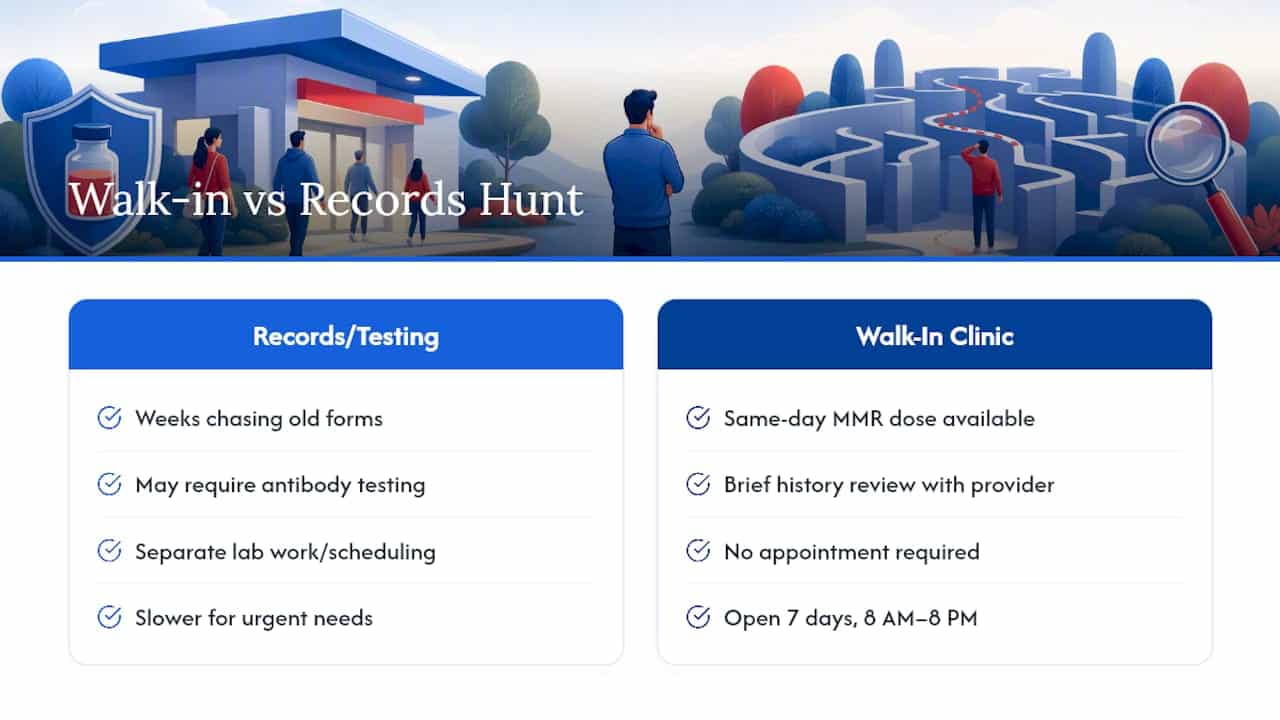
Your Family Walk-In Clinic is the practical alternative to spending weeks chasing down old immunization forms or scheduling separate lab work before you can get vaccinated. Instead of routine antibody testing, which this guide has already shown is usually unnecessary, you can walk in, discuss your history briefly with a provider, and get your MMR dose the same day.

That matters most for people on a deadline: college students facing enrollment requirements, new healthcare hires who need documented immunity fast, or travelers with a trip coming up sooner than they’d like. Your Family Walk-In Clinic is open seven days a week from 8 AM to 8 PM, accepts major insurance plans, Medicaid, and self-pay, and doesn’t require an appointment to be seen.
If you’re ready to resolve your MMR status instead of guessing at it, visit the urgent care clinic open seven days a week to check same-day availability, or explore immunization and screening services for adults in Lutz and the greater Tampa area.
This article is general information, not a substitute for advice from a qualified doctor. Consult a qualified healthcare professional about your own circumstances before acting on anything here.
Sources
- Adult immunization schedule notes (CDC)
- Clinical review: screening and vaccination strategies (PubMed)
FAQ
Should adults get the MMR vaccine?
Yes, if you lack documented evidence of immunity to measles, mumps, or rubella. Adults born before 1957 are generally presumed immune, but everyone else without proof should get at least one dose.
Can adults be vaccinated for MMR even without childhood records?
Yes. Providers generally recommend giving an extra MMR dose rather than pursuing lab testing when vaccination history is unclear, since an additional dose is safe even for someone already immune.
Do adults need to get the MMR vaccine again if they already had two doses?
Usually not. Two documented doses count as lifelong evidence of immunity for measles and rubella, though mumps protection can fade, which is why extra doses are sometimes recommended during active outbreaks.
How long does the MMR vaccine last for adults?
Protection against measles and rubella typically lasts a lifetime after a complete series. Mumps immunity can decline over time, which explains occasional outbreaks among previously vaccinated adults.
What are the main reasons an adult should avoid the MMR vaccine?
Pregnancy and severe immunocompromise are the two absolute contraindications. Adults with a severe allergy to a vaccine component or a prior dose should also avoid it and discuss alternatives with a provider.
Recommended
- Kids going off to college and need vaccines? – Your Family Walk In Clinic
- Are You Afraid to Go to the Doctors Since You Might Get Sick From Other People? – Your Family Walk In Clinic
- Flu Shots – Your Family Walk In Clinic
- The Importance of Yearly Physicals: Prevention, Detection, and Peace of Mind – Your Family Walk In Clinic