


A rapid flu test is usually specific but only moderately sensitive: a positive result is trustworthy, while a negative one may not rule out influenza. Pooled data from a large meta-analysis puts sensitivity around 62.3% and specificity around 98.2%, and the CDC frames the broader range as roughly 50% to 70% sensitive and 95% to 99% specific. In plain terms: trust a positive, question a negative, and let your symptoms and timing guide what happens next.
TL;DR:
- A positive result from a rapid test is highly reliable due to its high specificity of approximately 98.2%, but negative results should be interpreted with caution.
- Test performance varies based on timing, sample collection quality, patient age, and virus subtype, which can influence accuracy and detection rates.
- During high flu activity, negative results are less trustworthy, prompting clinicians to consider clinical symptoms and potential confirmatory testing.
- For hospitalized or high-risk patients, molecular tests are preferred over rapid antigen tests for higher sensitivity and diagnostic certainty.
Table of Contents
- Rapid Flu Test Accuracy: What the Evidence Actually Shows
- Why Rapid Flu Test Sensitivity Varies From One Swab to the Next
- How to Interpret a Positive or Negative Flu Test Result
- Rapid Antigen Test or Molecular Test: Which One Fits Your Situation
- How Your Family Walk-In Clinic Uses Rapid Flu Testing
- What Else Can Cause a False Positive or False Negative
- Do Flu A, Flu B, and Their Subtypes Test Differently
- What Health Authorities Recommend for Rapid Flu Testing
- How Researchers Measure and Report Test Accuracy
- Author Perspective: What Patients Should Take Away
- Need a Flu Test or Treatment Right Now? Here’s How to Get Seen Today
- Sources
- FAQ
Rapid Flu Test Accuracy: What the Evidence Actually Shows
The most-cited figure in this field comes from a meta-analysis published in the Annals of Internal Medicine, which pooled results across dozens of studies and landed on a sensitivity of about 62.3% (95% CI, 57.9% to 66.6%) and a specificity of about 98.2% (95% CI, 97.5% to 98.7%) when compared against RT-PCR or viral culture. The CDC’s own clinician guidance lands in a similar zone, citing sensitivities near 50% to 70% and specificities near 95% to 99%.
Why the spread? Study populations differ. Sensitivity tends to run higher in children than adults, and higher for influenza A than influenza B, which pulls pooled averages in different directions depending on who got tested. The reference standard matters too. Studies comparing rapid tests against RT-PCR often report lower sensitivity than older studies that used viral culture as the benchmark, since PCR itself detects more true infections.
Rapid Flu Test Accuracy at a Glance: Pooled sensitivity sits near 62.3%, meaning roughly 6 in 10 true flu cases test positive. Pooled specificity sits near 98.2%, meaning a positive result is rarely wrong.
That gap between sensitivity and specificity is the single most important thing to understand about how accurate flu tests really are.
Why Rapid Flu Test Sensitivity Varies From One Swab to the Next
Test performance isn’t a fixed number. It shifts based on when you’re tested, how the sample was collected, and which device your clinic uses.
- Timing since symptom onset: sensitivity is highest in the first one to three days of illness and drops off sharply after that. One clinical study found sensitivity fell from about 84% on day 1 to about 52% by day 4 of symptoms.
- Viral load: as your body clears the virus, the amount of antigen in your nose drops, and a 1-log decrease in viral RNA can lower a rapid test’s sensitivity by roughly 5% to 10%, depending on the specific test.
- Specimen type and technique: nasopharyngeal swabs generally capture more virus than shallow anterior nasal swabs, and an inexperienced or rushed swab technique can produce a false negative even when the virus is present.
- Device type: analyzer-based readers and rapid molecular assays tend to outperform visual lateral-flow antigen tests, since machine reading removes the guesswork of interpreting a faint line.
- Patient factors: young children often shed more virus and test positive more reliably than adults; co-infections or illness that has moved into the lower respiratory tract can also reduce what an upper-airway swab picks up.
Pro Tip: If you’re getting tested, try to do it within the first 72 hours of feeling sick. Waiting until day 5 or 6, when symptoms may finally feel bad enough to seek care, is exactly when a rapid test is least likely to catch the virus.
How to Interpret a Positive or Negative Flu Test Result
A positive result is usually the easy call. Because specificity runs near 98%, a positive rapid flu test is rarely a false alarm, and it’s reasonable to act on it: start antiviral treatment if appropriate, isolate, and skip further testing unless your symptoms don’t fit the picture.
A negative result needs more thought.
- High community flu activity: during a heavy flu season, a negative result is less trustworthy, because the odds a false negative slipped through go up when so many people around you are actually infected.
- Classic symptoms with a negative test: fever, cough, and sudden onset in the middle of flu season is a strong enough clinical picture that some clinicians will still treat or retest even after a negative rapid result.
- Testing on day 4 or later: given how much sensitivity drops by then, a late negative carries much less weight than an early one.
- Low prevalence, mild or atypical symptoms: here a negative result is more reliable, since there’s less flu circulating to slip past the test in the first place.
When a negative result would change how you’re managed, whether that means starting an antiviral, keeping a child out of school, or deciding on isolation, confirmatory RT-PCR testing is worth the extra day for results. When the stakes are lower, treating based on symptoms and a positive test (or skipping testing altogether during a confirmed local outbreak) is often the more practical path.
Rapid Antigen Test or Molecular Test: Which One Fits Your Situation
Not every flu test is built the same way, and the right choice depends on who’s being tested and how much a wrong answer would cost.
- Choose a rapid antigen test for outpatient triage. It’s fast, inexpensive, and good enough to guide same-day decisions like starting an antiviral early or knowing whether to keep your child home from school.
- Choose a rapid molecular or RT-PCR test for hospitalized or high-risk patients. When someone is older, immunocompromised, or sick enough to be admitted, the higher sensitivity of molecular testing matters more than speed, since missing a true case has bigger consequences.
- Repeat testing only when it changes the plan. If a first rapid test is negative but suspicion stays high, most guidance supports either a same-visit confirmatory molecular test or a short-interval repeat, always following the specific device’s CLIA-approved instructions for use rather than guessing at timing.
How Your Family Walk-In Clinic Uses Rapid Flu Testing
Rapid antigen testing is often used for same-day flu triage, providing patients with an answer while still in the exam room. When a result doesn’t match your symptoms, or when treatment decisions hinge on certainty, our clinicians can escalate to more sensitive testing rather than relying on a single swab.
If you’re testing for flu, try to come in within the first three days of symptoms, when detection is strongest. Bring a list of your symptoms and their onset dates, along with your insurance card if you have one. We’re open seven days a week from 8 AM to 8 PM with same-day urgent care visits, so you don’t have to wait out a fever wondering whether it’s worth a trip in. High fever, trouble breathing, or symptoms in a very young child or older adult warrant a same-day visit rather than watching and waiting.
What Else Can Cause a False Positive or False Negative
Timing and specimen quality explain most testing errors, but not all of them. Cross-reactivity is one overlooked factor: some rapid antigen tests can react to other respiratory viruses or bacteria in rare cases, producing a false positive, though this is uncommon with FDA-cleared devices when instructions are followed correctly.
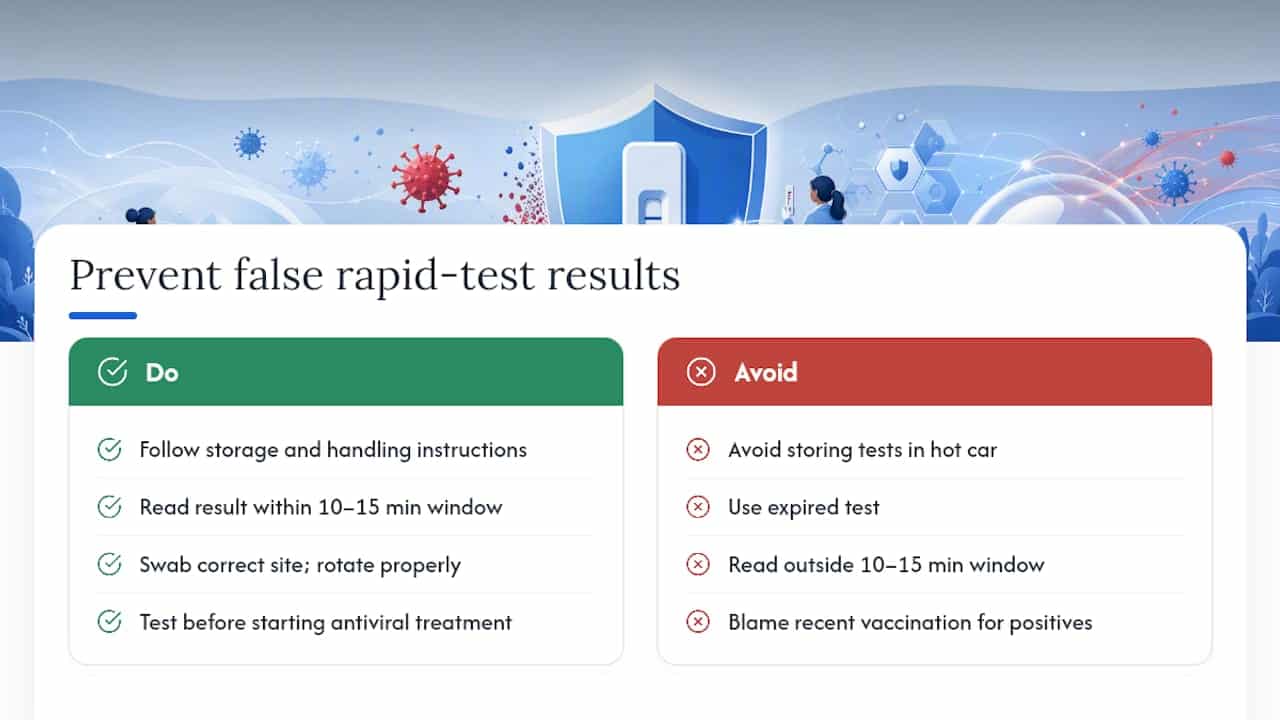
Storage and handling errors matter more than most people assume. A test kept in a hot car, used past its expiration date, or read outside the manufacturer’s specified time window, often a narrow 10 to 15 minute reading period, can generate a false result in either direction. Reading a result too early can miss a faint true positive; reading it too late can produce a false positive as the test strip degrades.
Recent vaccination is not a cause of false positives on antigen tests, since these tests detect viral protein, not antibodies, but people sometimes assume otherwise and second-guess an accurate result. Antiviral treatment started before testing can lower viral load quickly and push a true case into false-negative territory if the swab happens a day or two into treatment.
Operator experience genuinely moves the numbers. A trained clinician swabbing the correct location for the correct number of rotations recovers meaningfully more antigen than a self-administered swab done quickly and shallowly, which is one reason in-clinic testing tends to outperform home testing on paper even when it’s the identical test kit.
Do Flu A, Flu B, and Their Subtypes Test Differently
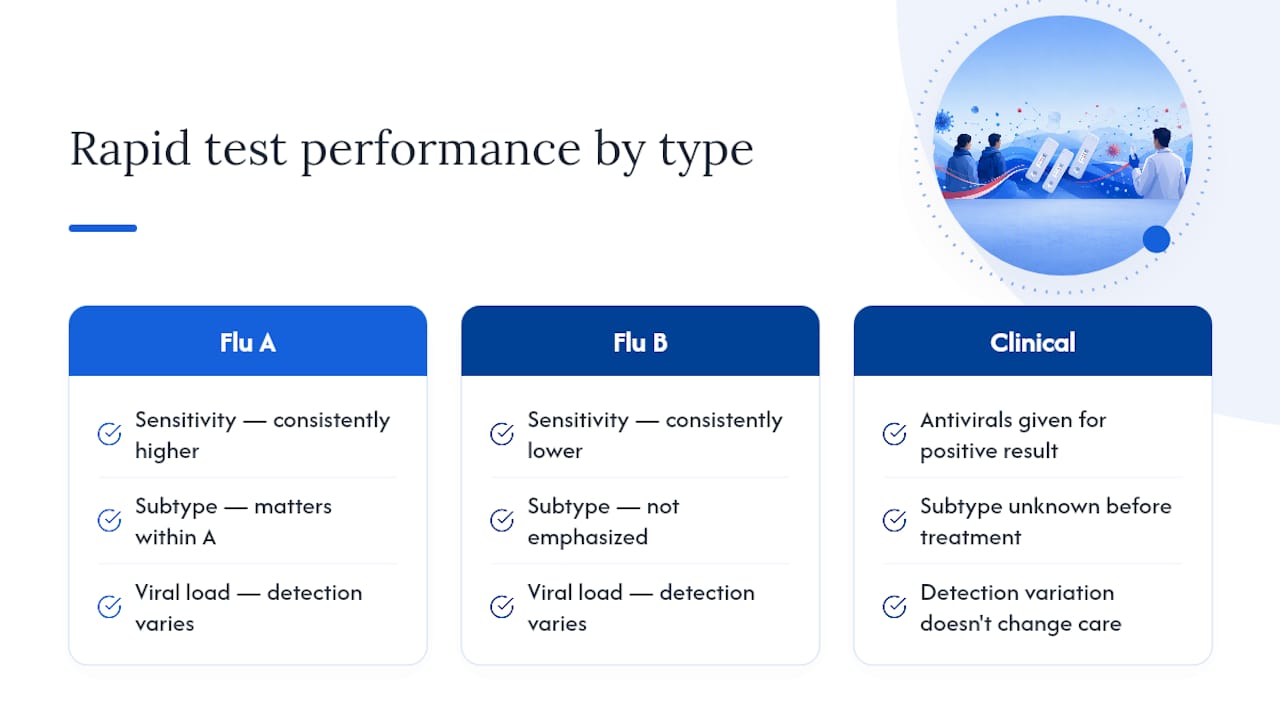
Rapid tests don’t perform identically across every strain of influenza circulating in a given season. The Annals of Internal Medicine meta-analysis found sensitivity was consistently higher for influenza A than influenza B, a pattern that shows up across most individual studies rather than being a quirk of one dataset.
Subtype matters within influenza A itself. A CDC analytical evaluation testing 11 FDA-cleared rapid tests against 23 different circulating flu viruses found detection varied meaningfully by both virus type and how much virus was present in the sample, meaning no single rapid test performs identically against every strain that shows up in a given flu season. This is part of why public health agencies periodically re-evaluate rapid tests as new seasonal strains and antigenic drift variants emerge; a test that performed reliably one season isn’t guaranteed to hold the exact same sensitivity against a mutated strain the next.
For most patients this nuance doesn’t change what to do. You won’t know your specific subtype before treatment decisions are made, and antivirals like oseltamivir are prescribed based on clinical presentation and a positive result, not confirmed subtype. But it’s a useful piece of context if you’ve ever wondered why a rapid test seemed more reliable one year than another. It often isn’t the test that changed. It’s which strain was dominant.
What Health Authorities Recommend for Rapid Flu Testing
The CDC’s clinician guidance is the backbone of most testing protocols in the United States, and it centers on a few consistent recommendations: collect specimens within three to four days of symptom onset, interpret negative results with caution, and use clinical judgment rather than test results alone when the two disagree.
The FDA’s role is different but complementary. It clears and authorizes each rapid influenza diagnostic device individually, meaning not every rapid test on the market has the same analytical limit of detection or performance profile.
For laboratory directors and clinics running point-of-care testing, CDC guidance goes a step further, recommending analyzer-based readers over visual-read tests where available, since machine interpretation reduces the subjective error that comes from a human squinting at a faint line. The consistent thread across CDC, FDA, and professional guidance is that rapid tests are a triage tool meant to inform, not replace, clinical judgment, particularly in patients where a wrong answer changes treatment meaningfully: young children, older adults, pregnant patients, and anyone with underlying respiratory or immune conditions.
How Researchers Measure and Report Test Accuracy
Sensitivity and specificity are the two numbers you’ll see most often, but they only tell part of the story. Sensitivity answers “of everyone who truly has the flu, what percentage did the test catch?” Specificity answers “of everyone who truly doesn’t have the flu, what percentage did the test correctly clear?” Both come from studies comparing test results against a gold standard, usually RT-PCR or viral culture.
Confidence intervals matter more than the headline number. The meta-analysis reporting 62.3% sensitivity actually gives a 95% confidence interval of 57.9% to 66.6%, meaning the true average sensitivity across the studied population most likely falls somewhere in that range rather than landing on the exact midpoint every time.
Positive and negative predictive value are the numbers that matter most to an individual patient, but they aren’t fixed properties of the test itself. They shift with how much flu is circulating in your community. When prevalence is high, a positive result is more likely to be a true positive, but a negative result is less trustworthy; when prevalence is low, that relationship flips. This is why the same test can feel more or less reliable depending on the week you take it, even though the device hasn’t changed at all.
Author Perspective: What Patients Should Take Away
If there’s one thing worth internalizing here, it’s that a rapid flu test is a tool for confirming what you already suspect, not a tool for ruling out what you fear. Trust a clear positive. Question a negative that doesn’t match your symptoms, and don’t let a piece of plastic override your own clinical picture or your doctor’s judgment.
— Lisa
Need a Flu Test or Treatment Right Now? Here’s How to Get Seen Today
Waiting on a home test that might miss an early infection isn’t your only option. Some clinics provide same-day, in-person testing with a clinician who can read your symptoms alongside the result, something a box from the pharmacy can’t do. Many urgent care clinics operate seven days a week with extended hours, and some allow walk-in visits without appointments.
If you’re within the first few days of fever, cough, or body aches, come in for testing while sensitivity is still at its highest. Bring your ID, insurance card if you have one, and a quick note on when your symptoms started, since that single detail helps us decide whether a rapid test, a confirmatory test, or straight-to-treatment is the right call. For anyone with high fever, breathing trouble, or a very young child or older adult with flu symptoms, skip the wait-and-see approach and visit our urgent care today. You can also learn more about our full range of walk-in services in Lutz and Tampa before you come in.
This article is general information, not a substitute for advice from a qualified doctor. Consult a qualified healthcare professional about your own circumstances before acting on anything here.
Sources
- Rapid Influenza Diagnostic Tests | Influenza (Flu) | CDC
- Accuracy of Rapid Influenza Diagnostic Tests: A Meta-analysis (Ann Intern Med)
- Sofia influenza A+B study (community K–12 population) — PMC
- Influenza diagnostic tests (FDA)
FAQ
Can I test negative for the flu but still have it?
Yes.
How soon will a flu test show positive?
Rapid antigen tests give results within 10 to 15 minutes, but they’re most likely to show a true positive when the sample is collected within the first one to three days of symptoms, before viral load starts to drop.
What is a disadvantage of flu rapid test technology?
The main drawback is moderate sensitivity: rapid antigen tests miss a meaningful share of true infections, particularly later in the illness, so a negative result doesn’t fully rule out influenza the way a molecular test would.
What is the most accurate flu test?
Rapid molecular assays and RT-PCR tests are generally more sensitive than standard antigen-based rapid tests, which is why hospitals and high-risk patients often rely on molecular confirmation rather than a rapid antigen result alone.