Yes, you can get primary care in Florida without insurance through community health centers, county health department clinics, volunteer and free clinics, self-pay walk-in and urgent care visits, and membership-based direct primary care. Each option fits a different situation, and when you schedule self-pay care, you have the right to ask for a written Good Faith Estimate before your visit.
TL;DR:
- Medicaid and county health clinics offer sliding-fee primary care, ensuring no one is turned away for inability to pay, with costs typically below $150.
- Free and volunteer clinics operate on income thresholds, often around 300% of the federal poverty level, providing cost-effective care through volunteer providers.
- Self-pay urgent care visits provide quick treatment at higher flat rates, while direct primary care memberships offer predictable monthly costs for ongoing management.
- Requesting a Good Faith Estimate at least three days before a self-pay visit helps prevent surprises, with disputes possible if bills exceed $400 of the estimate.
- Emergency rooms are legally required to stabilize patients but are the most expensive non-emergency option for uninsured individuals.
Table of Contents
- Where to get primary care without insurance in Florida
- Typical costs and how primary care, urgent care, and the ER compare
- How to find sliding-scale clinics and verify eligibility in Florida
- Your billing rights when paying out of pocket
- How direct primary care membership works in Florida
- Practical checklist before, during, and after your visit
- Preventive care options and coverage for uninsured patients
- Prescription assistance and medication costs without insurance
- Managing chronic conditions and follow-up care without insurance
- Dental and mental health resources for uninsured Floridians
- A local clinic’s perspective on serving uninsured patients
- Getting affordable care at Your Family Walk-In Clinic
- Sources
- FAQ
Where to get primary care without insurance in Florida
You have more choices than you might think, and picking the right one depends on your income, how quickly you need to be seen, and whether your issue is ongoing or a one-time concern.
Community health centers and Federally Qualified Health Centers (FQHCs) are often the strongest starting point. These centers, along with county health department clinics, provide primary care on a sliding-fee schedule tied to federal poverty guidelines, and they cannot turn you away for inability to pay. Healthcare notes these centers also handle prenatal care, vaccinations, and referrals to specialists when needed.
Free and volunteer clinics fill a related gap, often relying on volunteer physicians and nurses to serve residents below a set income threshold, commonly around 300% of the federal poverty level under Florida’s Volunteer Health Care Provider Program.
Walk-in clinics and urgent care centers that accept self-pay give you speed and convenience, though they cost more than a sliding-scale visit. Direct primary care memberships and telehealth options round out the list for people who want predictable monthly costs or same-day virtual visits.
- FQHCs and county health clinics: sliding-fee primary care, no one turned away for inability to pay.
- Free and volunteer clinics: income-based eligibility, often income-tested at intake.
- Self-pay walk-in and urgent care: fast access for acute issues, higher flat fees.
- Direct primary care and telehealth: monthly membership or per-visit virtual care for ongoing management.
Typical costs and how primary care, urgent care, and the ER compare
Cost is usually the deciding factor, so it helps to know roughly what you are looking at before you pick a setting.
A sliding-scale visit at an FQHC can run from a nominal co-pay up to $150 or more depending on your income bracket and the services provided. Self-pay walk-in visits for common issues like a cold, minor injury, or infection typically fall in a similar range, with extra charges for labs or x-rays. Direct primary care memberships generally run in the tens of dollars a month for children and $50 to $100 a month for adults, covering routine visits but not hospital or specialist care.
One data point worth remembering: in 2024, about 38.6% of uninsured adults reported skipping needed care because of cost, which underscores why finding an affordable primary care option matters before a small problem becomes a bigger one.
Emergency rooms are required by law to stabilize you regardless of ability to pay under EMTALA, but they are the most expensive setting for non-emergent problems and should be reserved for genuine emergencies.
- Primary care or FQHC visit: lowest cost, best for ongoing management and preventive care.
- Self-pay urgent care: moderate cost, best for same-day acute issues.
- Emergency room: highest cost, reserved for true emergencies.
- Direct primary care: predictable monthly fee, and some plans allow HSA funds toward the membership under IRS limits.
How to find sliding-scale clinics and verify eligibility in Florida
Finding a sliding-scale clinic takes a few phone calls, but knowing what to ask saves you a wasted trip.
- Search the HRSA find-a-health-center tool or your county’s Department of Health page (Hillsborough and Sarasota both publish clear eligibility and pricing details) to locate nearby options.
- Call ahead and ask whether they take walk-ins, what documents they require for sliding-scale intake, and whether labs or vaccines carry separate fees.
- Gather proof of income (a recent pay stub or tax return), a photo ID, and proof of Florida residency such as a utility bill before your visit.
- Ask about language access if English is not your first language, since many FQHCs offer interpretation services.
Our own guide on how to see a doctor without insurance walks through additional steps if you want a broader comparison of local options.
Your billing rights when paying out of pocket
Paying cash does not mean paying blind. Federal rules give uninsured and self-pay patients real protections.
When you schedule a service at least three business days ahead, you can request a Good Faith Estimate that lists the expected items, services, and charges for your visit. If your final bill comes in $400 or more above that estimate, you may be eligible to dispute it through the Patient-Provider Dispute Resolution (PPDR) process. CMS guidance also explains that providers can offer abbreviated estimates in limited situations, so it is worth confirming what your estimate covers before your visit.
- Request your Good Faith Estimate in writing, not just verbally.
- Keep a copy of the estimate and your final bill together.
- Contact CMS or start PPDR if your bill significantly exceeds the estimate.
Pro Tip: Always ask for your Good Faith Estimate at the same time you book your appointment, since providers are not required to chase you down with one later.
How direct primary care membership works in Florida
Direct primary care (DPC) swaps insurance billing for a flat monthly fee, usually $50 to $100 for adults and less for children, covering office visits, basic labs, and ongoing management of chronic conditions.
What DPC typically does not cover: hospital stays, specialist procedures, imaging beyond basics, and prescriptions filled outside the practice, so you still need a plan for those costs.
- Best fit: patients who see a primary care provider often or manage a chronic condition like diabetes or high blood pressure.
- Less ideal fit: patients who qualify for Medicaid or Medicare, since those programs already cover primary care at little or no cost.
- Tax note: some DPC fees may be paid with HSA funds under IRS guidelines, though rules vary by plan.
DPC advocates note the model can increase access through transparent pricing and longer visits, which can help patients manage conditions before they turn into costly ER visits.
Practical checklist before, during, and after your visit
A little preparation prevents most of the billing surprises that catch uninsured patients off guard.
- Before your visit: call ahead, ask for a price or Good Faith Estimate, check sliding-scale eligibility, and gather your proof of income and residency.
- During your visit: confirm your out-of-pocket cost before treatment starts, ask for an itemized receipt, and get any follow-up or referral plan in writing.
- After your visit: compare your final bill to the estimate, keep every record, and ask about charity care or payment plans if the bill is higher than expected.
Pro Tip: Take a photo of your Good Faith Estimate with your phone right after you receive it, so you always have a copy even if the paper one gets lost.
Preventive care options and coverage for uninsured patients
Preventive care is often the most affordable service you can get without insurance, and skipping it tends to cost more later.
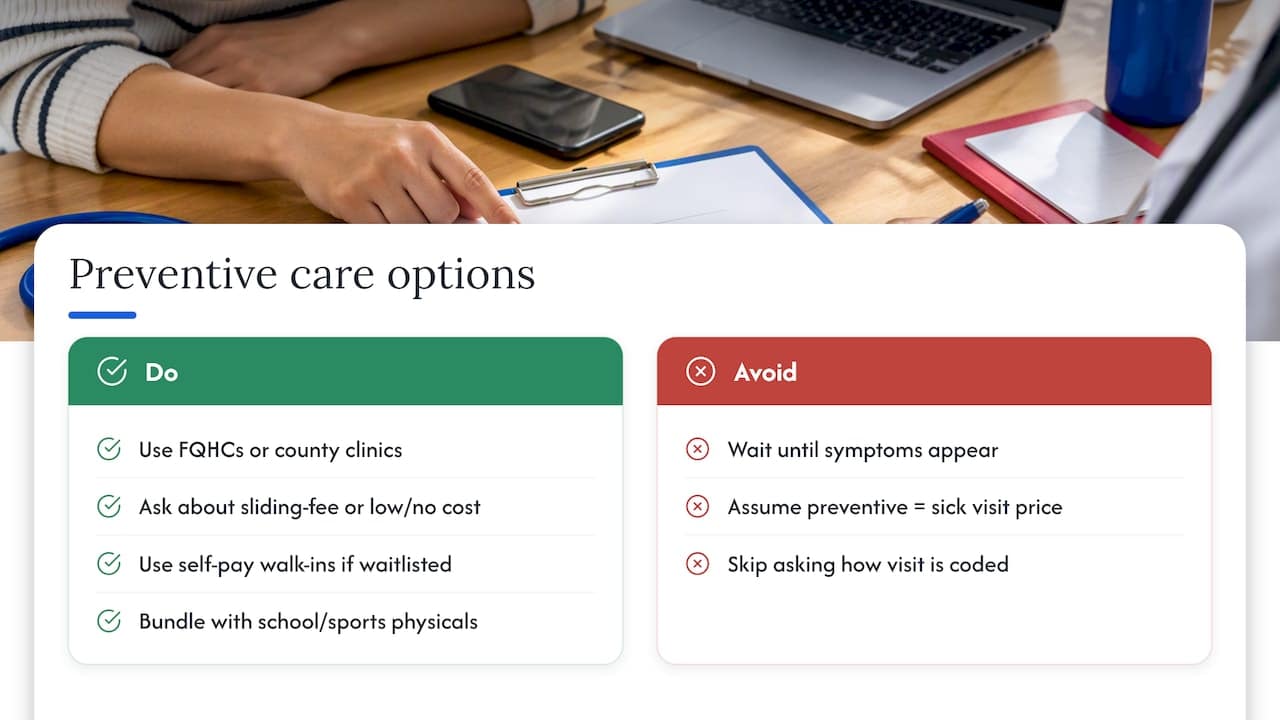
FQHCs and county health department clinics typically include preventive services like blood pressure checks, cholesterol screening, and basic cancer screenings within their sliding-fee structure, so a checkup does not have to wait until something feels wrong. Vaccinations, well-woman exams, and screenings for conditions like diabetes are commonly available at these same locations, often at reduced or no cost depending on your income bracket.
Many community clinics also bundle preventive visits with sports and school physicals, which matters for families with kids heading back to school or into athletics. If a sliding-scale clinic has a waitlist, a self-pay walk-in visit for a wellness exam or screening panel is usually still less expensive than waiting until a preventable issue becomes urgent.
Ask specifically whether your visit qualifies as preventive when you call, since some clinics code and price these visits differently from a sick visit.
Prescription assistance and medication costs without insurance
Medication costs can add up fast without insurance, but several routes can bring the price down.
Many pharmacy chains offer generic drug discount programs that price common medications like blood pressure or diabetes prescriptions at a flat low monthly rate. Manufacturer patient assistance programs exist for many brand-name drugs, particularly for chronic conditions, and typically require an application showing income eligibility. FQHCs and county health department clinics often have relationships with 340B pricing programs, which can lower the cost of medications prescribed on-site.
Before filling a prescription, ask your provider whether a generic equivalent exists and whether the clinic can direct you to a discount card or manufacturer program. A short conversation at the counter can turn a $100 prescription into something closer to a $10 to $20 copay at many pharmacies, though exact pricing depends on the drug and the discount program used.
Managing chronic conditions and follow-up care without insurance
Chronic conditions like diabetes, hypertension, and asthma require consistent follow-up, and going without insurance does not mean going without a plan.
FQHCs and county health department clinics are built for exactly this kind of ongoing care, offering sliding-scale visits for regular monitoring, medication management, and lab work. Direct primary care memberships also work well here, since the flat monthly fee covers the frequent visits a chronic condition often requires without a per-visit bill each time.
Consistency matters more than perfection. Missing follow-up appointments because of cost worries is one of the most common reasons a manageable condition turns into an emergency room visit, which is far more expensive than the checkups that could have prevented it. If cost is the barrier, tell your clinic directly. Many sliding-scale providers can adjust the visit schedule or connect you with prescription assistance so you are not choosing between medication and rent.
Dental and mental health resources for uninsured Floridians
Dental and mental health needs often get pushed aside without insurance, but Florida has dedicated resources for both.
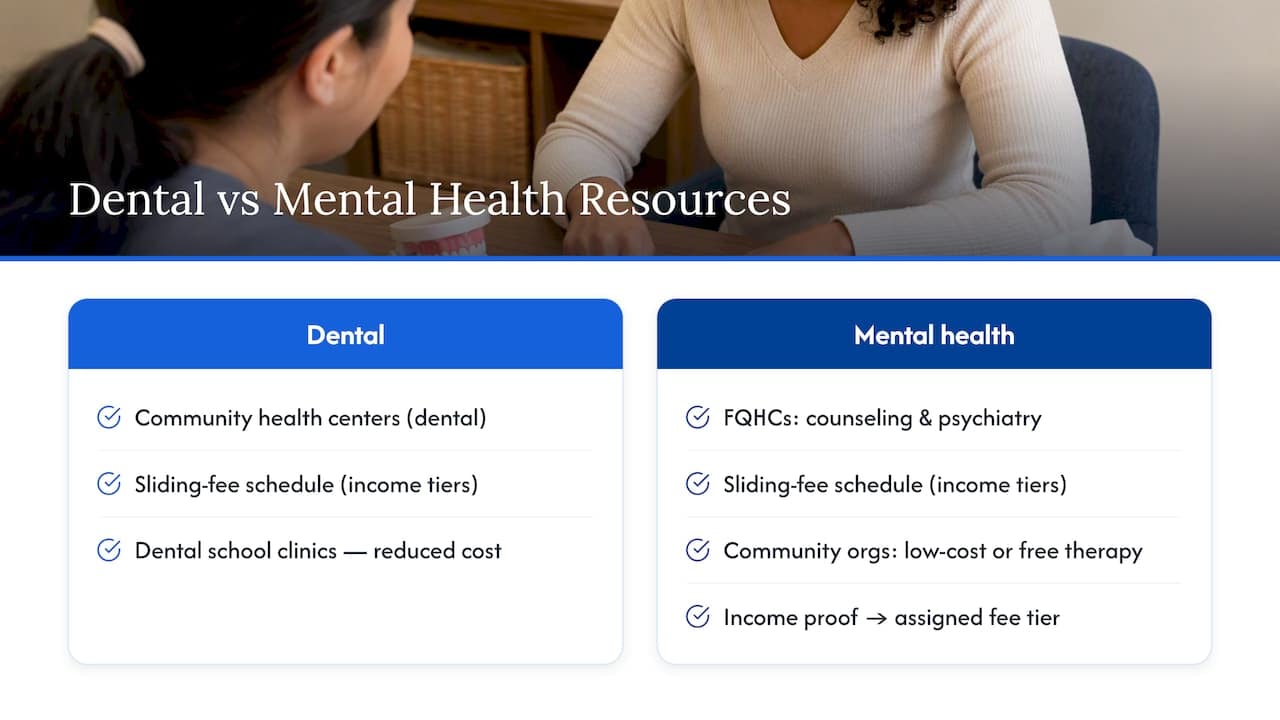
Community health centers frequently include dental services alongside medical care, priced on the same sliding-fee schedule. Dental schools affiliated with Florida universities also offer reduced-cost cleanings and procedures performed by supervised students, which can be significantly cheaper than a private practice.
For mental health, many FQHCs offer counseling and psychiatric services on a sliding scale, and some community organizations specialize in low-cost or free therapy. Sliding-scale pricing models used by behavioral health providers, similar to the approach described by the SF Therapy Collective, show how income-based fees typically work: you provide proof of income, and the clinic assigns a fee tier accordingly. Asking directly about sliding-scale therapy or counseling when you contact a clinic is often the fastest way to find an affordable option near you.
A local clinic’s perspective on serving uninsured patients
At Your Family Walk-In Clinic in Lutz, we see uninsured patients every week for urgent care, primary care, immunizations, and same-day visits. We’re open seven days a week from 8 AM to 8 PM, which matters when a health concern does not wait for a weekday appointment slot. Families often ask how Medicaid rules affect urgent care timing, and our guide on the 48-hour Medicaid urgent care rule breaks that down. You can also tour our clinic to see how a same-day, family-focused visit works before you book.
— Lisa
Getting affordable care at Your Family Walk-In Clinic
If you have weighed the FQHC waitlist, the free clinic’s income cutoffs, and the ER’s price tag, a same-day self-pay visit can be the simplest path when you need to be seen this week. Your Family Walk-In Clinic offers urgent care and a primary care provider for adults and children, along with immunizations, sports and school physicals, and STD screening and treatment, all without a long wait for an appointment slot.
To book a self-pay visit, call ahead to ask about the visit cost, bring a photo ID, and let the front desk know if you want an itemized receipt for your records. Our services and pricing overview lists what we offer so you know what to expect before you arrive. We’re one local option among the public and nonprofit resources described above, and we’re here seven days a week if same-day care fits what you need.
- Urgent care: same-day treatment for colds, injuries, and infections.
- Primary care: ongoing checkups and chronic condition management.
- Immunizations and physicals: vaccines, sports physicals, and school physicals for the whole family.
Schedule a visit through our primary care page to see current availability.
This article is general information, not a substitute for advice from a qualified doctor. Consult a qualified healthcare professional about your own circumstances before acting on anything here.
Sources
- Costs and eligibility | Florida Department of Health in Sarasota
- Know your medical bill rights when not using insurance | CMS
- Volunteer Health Care Provider Program annual report | Florida Department of Health
FAQ
Can I see a primary care doctor without insurance in Florida?
Yes, you can see a primary care doctor without insurance through FQHCs, county health department clinics, free clinics, or a self-pay walk-in visit. Sliding-scale clinics base your fee on income and will not deny care for inability to pay, as Florida county health department pages confirm.
How much does it cost to see a doctor in Florida without insurance?
Costs vary by setting: a sliding-scale FQHC visit may cost a nominal amount up to around $150 depending on income, while a direct primary care membership runs $50 to $100 a month for adults. Always request a Good Faith Estimate before a scheduled self-pay visit so you know the expected charge in advance.
Is it cheaper to go to primary care or urgent care without insurance?
Primary care, especially through a sliding-scale FQHC, is generally the lower-cost option for ongoing or non-urgent needs. Self-pay urgent care costs more but is appropriate when you need same-day treatment for an acute issue that cannot wait for a primary care appointment.
What happens if you don’t have health insurance in Florida?
You remain eligible for care at community health centers, county health clinics, free clinics, and self-pay providers, and emergency rooms are required to stabilize you under EMTALA regardless of ability to pay. Without insurance, uninsured adults are more likely to delay care due to cost, with about 38.6% reporting skipped care in 2024, so seeking out sliding-scale or membership-based primary care early can help avoid bigger bills later.