


For many people, online therapy works about as well as in-person therapy. Reviews of randomized trials comparing the two formats keep finding little or no difference in symptom relief, satisfaction, or how many people stick with treatment. The format matters less than the match: the right approach, a trained therapist who guides the work, and a setup that fits your life.
If you are weighing a video visit against a drive across Tampa, this guide explains what the studies found, where the evidence is strongest, and how to decide what fits you or your child.
TL;DR
- Therapist-guided remote cognitive behavioral therapy (CBT) is probably similarly effective to in-person CBT, based on a review of 54 randomized trials.
- For adults with PTSD, mood disorders, and anxiety disorders, telemedicine matched in-person treatment on efficacy, satisfaction, working alliance, and dropout.
- Guidance from a real therapist matters: guided programs outperform unguided ones and keep more people engaged.
- Some situations call for in-person or urgent care. Knowing which ones helps you choose well.
- You can book in-office or virtual therapy at our Lutz clinic, and we can help you pick the format.
Table of Contents
- What the research says about online therapy
- Online vs. in-person therapy: how they compare
- Which conditions respond best to online treatment
- What makes online therapy work for you
- When in-person or urgent care is the better step
- How to tell if online therapy fits you
- Online therapy for kids, teens, and families
- Start with a clinic that offers both options
- FAQ
- Sources
What the research says about online therapy
The strongest answer comes from systematic reviews, which pool many trials. A review of 54 randomized controlled trials found moderate-certainty evidence that therapist-guided remote CBT makes little to no difference compared with in-person CBT, across a range of mental health and physical (somatic) conditions. The authors concluded that remote CBT is probably similarly effective.
A second review looked at psychiatric care more broadly. It pooled 20 trials and found no significant difference between telemedicine and in-person treatment for efficacy, patient satisfaction, and attrition. The adults in those studies were receiving individual outpatient treatment for PTSD, mood disorders, and anxiety disorders. The review also found that the working alliance, the bond and shared sense of purpose between you and your therapist, was comparable.
That last point answers a common worry. Many people assume a screen makes it harder to feel understood. In the trials, patients rated the relationship in video sessions about the same as in the office.
What “effective” means in these studies
Researchers usually measure effectiveness in four ways:
- Symptom change: scores on standard questionnaires for depression, anxiety, or trauma symptoms before and after treatment.
- Satisfaction: how patients rate their care.
- Working alliance: how strong the therapist-patient relationship feels.
- Attrition: how many people drop out before finishing.
When a review says online and in-person care are comparable, it means they performed similarly on these measures, on average. It does not mean every person will respond the same way, which is why the rest of this guide covers fit.
Online vs. in-person therapy: how they compare
Depression has been studied a lot. A meta-analysis of video-based psychotherapy found it roughly comparable in efficacy to in-person services, with no significant difference in dropout. Another systematic review of 12 randomized trials looked at less common conditions and found no significant differences in symptom severity, client satisfaction, or working alliance between telehealth and face-to-face sessions.
Here is how the findings line up in plain terms:
| Question | What reviews found | Source |
|---|---|---|
| Remote CBT vs. in-person CBT | Little to no difference when a therapist guides it | 54-trial review |
| Adults with PTSD, mood, anxiety disorders | Comparable efficacy, satisfaction, alliance, dropout | 20-trial review |
| Depression | Video therapy roughly comparable to in-person | Meta-analysis |
| Less common conditions | No significant differences in symptoms or alliance | 12-trial review |
The pattern is consistent. When the treatment itself is a well-studied approach and a trained clinician delivers it, the screen is not the deciding factor.
Where small differences show up
A 2023 meta-analysis of telepsychiatry found a few condition-specific differences. Telepsychiatry showed better symptom improvement for depressive disorders, while face-to-face treatment was better for eating disorders. Dropout also varied by condition in that review: lower for mild cognitive impairment through telepsychiatry, higher for substance misuse.
This is useful, not discouraging. It tells you that for some needs, such as eating disorders or substance use, an in-person or more structured plan is worth discussing with a clinician before you start.
Which conditions respond best to online treatment
An umbrella review pulled together 87 meta-analyses covering 1,683 randomized trials of internet-based interventions. It found moderate effects for anxiety disorders and PTSD, and relatively small effects for depression, addiction, suicidal ideation, stress, and OCD.
Another umbrella review, published in 2024, concluded that internet-delivered CBT can reduce symptoms across a wide range of psychiatric and physical conditions, with small-to-moderate effects compared with control conditions. A 2024 systematic review of transdiagnostic treatments, which target shared features of depression and anxiety, reported large within-group reductions in symptom severity for adults. The added benefit over active comparison treatments was smaller, which is expected when the comparison is itself a real treatment.
In practical terms:
- Anxiety and panic: among the best-supported uses of online CBT.
- PTSD: strong evidence, including for adults treated by video.
- Depression: good evidence that video therapy performs comparably to in-person care.
- Stress and sleep-related worries: helpful, with generally smaller effects in the research.
- Teens and children: often delivered with a parent involved. See our guides on teletherapy for kids and online therapy for teens.
What makes online therapy work for you
The research points to a few factors you can control.
Therapist guidance
The umbrella review mentioned above found that guided internet-based programs were more effective than unguided ones, and were linked to lower dropout and higher adherence. A self-paced app or course can be a good tool, but a live clinician who adjusts the plan to you does a different job. That is the difference between downloading a program and being in treatment.
A treatment with evidence behind it
Most of the trials tested structured methods, especially CBT. Ask your therapist what approach they use, what a typical course looks like, and how you will both know it is working. Our guide on how to choose a therapist lists questions worth asking.
A setup that lets you focus
Sessions go better with a private room, a stable connection, and a few minutes beforehand to settle. Our online therapy preparation checklist walks through the details, and the first session guide explains what happens in the first hour.
Consistency
Therapy tends to work through repetition: regular sessions and practicing skills between them. The convenience of a video visit helps here, because there is no commute, no waiting room, and it is easier to keep a weekly slot. Daily habits can support the work too. Movement, for example, is one piece, and an evidence-based look at walking for mental health can help you build a routine alongside your sessions.
When in-person or urgent care is the better step
Online therapy is a strong option for many people, and good care also means matching the format to the situation. A 2022 evidence brief from the Department of Veterans Affairs found that telehealth mental health care is generally comparable to in-person care, but that there is not yet enough evidence for firm conclusions on conditions such as substance use disorders or serious mental illness. The brief also notes that studies vary in populations, interventions, and outcomes, particularly beyond PTSD.
A review of less common conditions similarly reported no includable evidence yet for telehealth in schizophrenia and bipolar disorders. That reflects a gap in research, not proof that telehealth fails. But it is a reason to have a clinician help you pick the setting.
Here is how we suggest thinking about it:
- Thinking about harming yourself, or in immediate danger: call 911 or go to the nearest emergency room. You can also call or text 988, the national Suicide and Crisis Lifeline. Do not wait for a therapy appointment.
- Physical symptoms along with distress: chest pain, fainting, severe sleep loss, or a medication reaction need a medical exam. Our urgent care is open seven days a week from 8 AM to 8 PM.
- Complex or severe conditions, such as eating disorders, active substance use, psychosis, or bipolar disorder: talk with a clinician about a plan that may include in-person visits, medical monitoring, or both.
- No private space or reliable internet at home: an in-office session may serve you better.
- Mild to moderate anxiety, low mood, stress, or trauma symptoms: online therapy is a well-supported place to start.
Researchers also note that the trials cannot hide the format from patients and therapists, so blinding is not possible. That is a built-in limit of any study comparing the two formats. It is one reason the better question is not “which is best?” but “which helps this person most?” The authors of the depression meta-analysis say further research should clarify which patients benefit most from each mode.
How to tell if online therapy fits you
Use these questions as a quick check.
- Can you talk freely? You need a place where no one overhears you. A parked car or a bedroom with the door closed can work.
- Is your connection steady enough for video? A phone on Wi-Fi is usually fine.
- Do you do well with talking and reflecting on screen? Most people adapt within a session or two.
- Is your main concern one the research supports? Anxiety, depression, PTSD, and stress have the most evidence.
- Do you want flexibility? Evening visits, no travel, and fewer missed days of school or work all make it easier to keep going.
- Would you rather start in the office and move online later? That is a reasonable path as well. Many people use both.
After a few sessions, check in with yourself and your therapist. Ask: Am I sleeping, working, or functioning better? Do I feel heard? Are we working on clear goals? If the answer is no after a fair trial, adjust the plan, whether that means a different approach, a different therapist, or a change of format.
Online therapy for kids, teens, and families
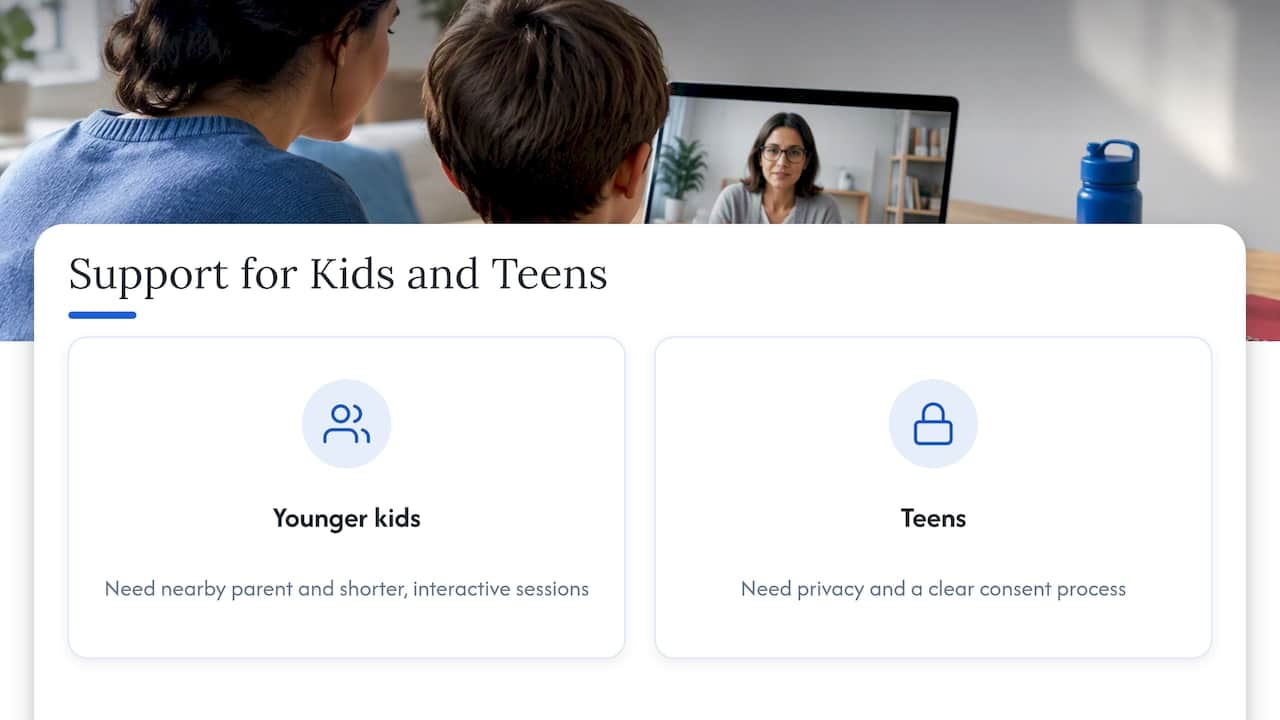
Families often ask us whether video therapy suits children. It can, with the right structure. Younger children usually need a parent nearby and shorter, more interactive sessions. Teens tend to be comfortable with video but need privacy and a clear consent process. We cover the details in our guides on safety and consent for teen online therapy and CBT for teen anxiety.
If you are worried about a teen’s mood, a depression screening is a helpful first step, and a positive result is the start of a conversation, not a label. For whole-family concerns, see how family therapy can help, and for loss, our page on grief counseling for teens.
Our perspective
We see online therapy as a real treatment, not a second-best option. The studies point the same way: when a trained clinician delivers a well-studied approach, a video visit can help as much as an office visit for many common concerns.
What we care about most is that you get care you will actually keep attending. In our experience, the barriers are rarely about whether therapy works. They are about the drive, the childcare, the missed school, and the worry of walking into a clinic. A virtual session removes several of those at once.
That is why we offer both in-office and virtual therapy for adults and children at our Lutz clinic, alongside primary care and urgent care. If your needs change, you do not have to start over somewhere new. Our clinicians have more than 25 years of experience, and we would rather talk through the right format with you than push one.
Lisa
Start with a clinic that offers both options
Your Family Walk-In Clinic in Lutz provides therapy and counseling for adults and children, in the office or by video, along with primary care for the physical side of your health. We are open seven days a week from 8 AM to 8 PM, we accept major health insurance plans and Medicaid, and self-pay is available.

Not sure which format suits you? Contact us through our main site and we will help you choose a starting point. If you would like to see where you would be seen, you can tour our clinic.
FAQ
Is online therapy as effective as in-person therapy?
For many common conditions, yes. A review of 54 trials found that therapist-guided remote CBT probably works about as well as in-person CBT. Results vary by condition and person, so the best format is the one you will attend consistently and that fits your needs.
Does online therapy work for anxiety and depression?
Yes, the evidence is good for both. Reviews found moderate effects for anxiety disorders and PTSD, and video therapy for depression is roughly comparable to in-person care. Working with a live therapist tends to improve results over unguided programs.
Who should not rely on online therapy alone?
If you are in crisis or thinking about harming yourself, call 911 or 988 right away. If you have a complex condition such as an eating disorder, active substance use, or psychosis, talk with a clinician about whether in-person visits or medical monitoring should be part of your plan. Research on telehealth for serious mental illness and substance use is still limited.
How do I know if my therapist is a good fit online?
Look for a clear treatment approach, goals you set together, and a sense that you are heard. The working alliance in video therapy was comparable to in-person care in the trials, so you can reasonably expect to feel connected. If you do not after a few sessions, say so and adjust.
Can children and teens do therapy online?
Often, yes, with a parent involved and attention to privacy and consent. Our guide to teletherapy for kids explains how sessions are structured at different ages.
Sources
- Therapist-guided remote versus in-person cognitive behavioral therapy: systematic review
- Psychiatric treatment conducted via telemedicine versus in-person
- Teletherapy versus in-person psychotherapy for depression: meta-analysis
- Telehealth versus face-to-face psychotherapy for less common mental health conditions
- Telepsychiatry versus face-to-face treatment: systematic review and meta-analysis
- Assessing the effectiveness of internet-based interventions: umbrella review
- Internet-delivered cognitive behaviour therapy: umbrella review
- Internet-delivered transdiagnostic psychological treatments: systematic review
- VA Evidence Brief: Safety and Effectiveness of Telehealth Mental Health Care
- Walking for mental health: an evidence-based plan