
The STD tests recommended for you depend on your age, your anatomy, the kind of sex you have and your personal risk. Nearly everyone ages 13 to 64 should be tested for HIV at least once. Sexually active women under 25 should be screened for chlamydia and gonorrhea. Many other people need testing more often, or for more infections. This guide explains who is on which list, what the tests involve and how to get them done without a long wait.
Most sexually transmitted infections (STIs, also called STDs) cause no symptoms at first. That is why testing is based on who you are and what you do, not on how you feel. If you are unsure where you fit, that is a normal place to start, and a provider can help you sort it out.
TL;DR
- Everyone ages 13 to 64 should be tested for HIV at least once, according to the CDC.
- Sexually active women under 25, and older women at increased risk, should be screened for chlamydia and gonorrhea.
- Pregnant women should be screened for syphilis, HIV and hepatitis B at the first prenatal visit.
- Tests use blood, urine or swabs, and many infections show no symptoms, so a normal feeling does not mean a negative result.
- We offer STD screening and treatment in Lutz, seven days a week from 8 AM to 8 PM, with same-day appointments.
Table of Contents
- Who should be screened, and how often
- Which tests, and what samples they use
- Hepatitis C and other tests people overlook
- When to test after a possible exposure
- Pregnancy and testing
- Teens, parents and confidentiality
- Can you test at home?
- What testing costs, and how to lower the bill
- Getting tested at Your Family Walk-In Clinic
- Our perspective: test on a schedule, not on a scare
- FAQ
- Sources
Who should be screened, and how often
The CDC publishes screening recommendations that providers across the country follow. In plain terms, they look like this:
| Who you are | Recommended screening |
|---|---|
| Anyone ages 13 to 64 | HIV, at least once |
| Sexually active women under 25 | Chlamydia and gonorrhea |
| Women 25 and older at increased risk | Chlamydia and gonorrhea |
| Sexually active men who have sex with men (MSM) | Testing yearly, or every 3 to 6 months depending on risk, at the sites of exposure |
| Pregnant women | Syphilis, HIV and hepatitis B at the first prenatal visit; hepatitis B in each pregnancy |
| Transgender and gender-diverse people | Screening matched to the anatomy you have and the sex you have |
These are baselines. Your own history can add tests or shorten the time between them.
What counts as increased risk
The CDC lists these risks for women age 25 and older: a new partner, more than one partner, a partner who has other partners or has an STI, and inconsistent condom use outside a mutually monogamous relationship.
The CDC’s How to GYT page adds more reasons to talk about testing:
- Vaginal, anal or oral sex without a condom
- A partner who has an STI
- A past STI or HIV diagnosis
- Certain substance-use situations
- Exchanging sex for money, housing or other needs
- A partner who may have other partners
If any of these fit, ask for testing. You do not need symptoms, and you do not need to justify the request.
Why a conversation matters
The CDC encourages an open and honest conversation with your provider about STI testing, because many infections have no symptoms. A 2025 academic review found that opt-out screening, where patients are told testing will be done unless they decline, finds more infections than relying on patients to describe their sexual behavior. In other words, routine testing catches what a conversation alone can miss. You can also ask your provider which tests you are receiving and which ones are not being done and why. The CDC says patients should be told this.
Which tests, and what samples they use
There is no single “STD test.” Each infection has its own test, and the sample depends on the infection and on where you may have been exposed. The CDC says tests may use blood, urine, or swabs from the vagina, throat or rectum.
MedlinePlus gives a useful breakdown of what each sample can detect:
| Sample | Commonly used for |
|---|---|
| Blood | HIV, syphilis, hepatitis B, sometimes herpes |
| Urine | Trichomoniasis, chlamydia, sometimes gonorrhea |
| Swab | HPV, chlamydia, gonorrhea, herpes |
How testing works for men
Men often assume testing means an uncomfortable exam. For many tests it does not. MedlinePlus says a clinician may swab the penis or the urethra (the tube that carries urine out of the body), while a urine sample in a cup is used for tests where that applies. If you have a sore or blister, it may be examined or swabbed too.
Testing beyond the genitals
The CDC recommends testing at other sites for MSM, such as the throat or rectum, based on the sex you have. Testing at these sites is also an emerging practice for women. If you have oral or anal sex, say so. A urine test alone can miss an infection in the throat or rectum.
What a clinic visit usually includes
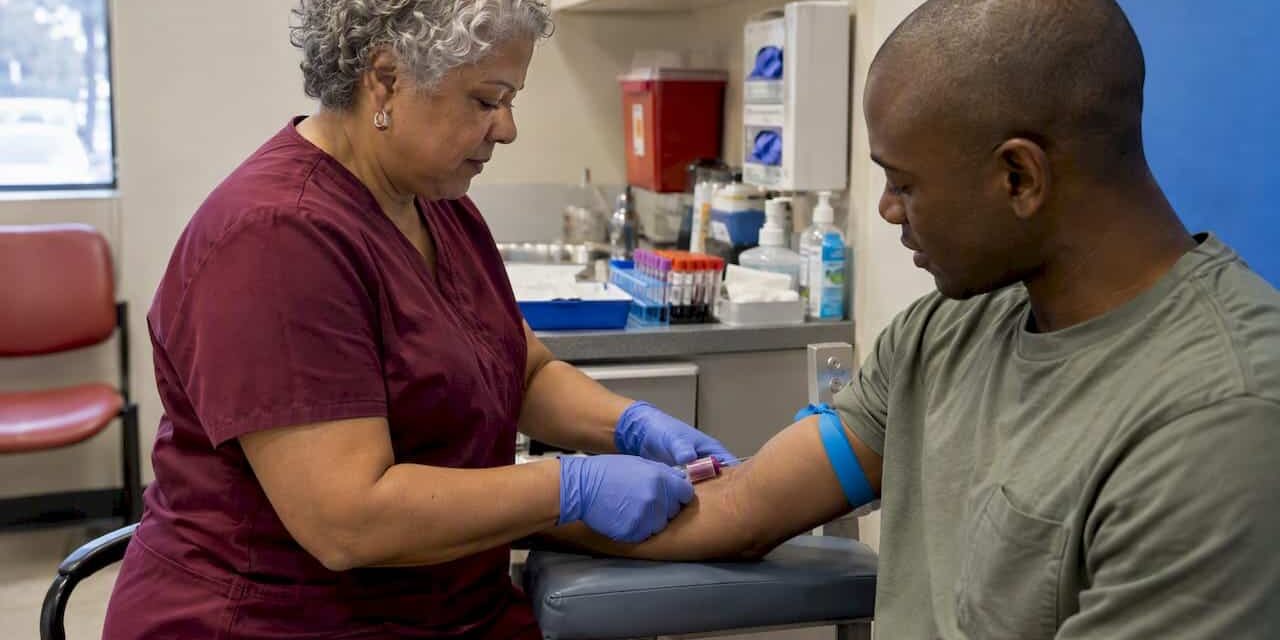
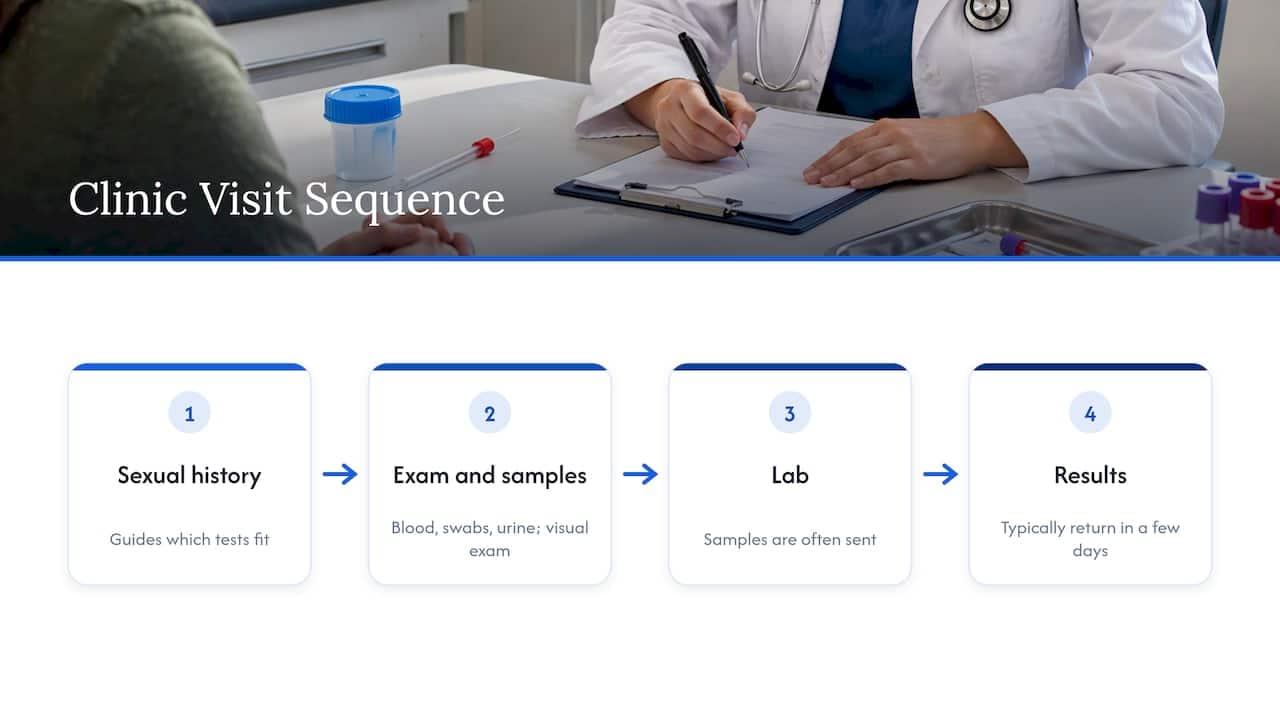
The American Sexual Health Association describes a typical visit as possibly including a visual genital exam, blood collection, swabs and a urine sample. Samples are often sent to a lab, and results typically come back in a few days. The clinician uses your sexual history to decide which tests fit you. Testing is usually quick and easy.
To see how panels are put together, read our guide to STD panel tests and how to choose one.
Hepatitis C and other tests people overlook
HIV, chlamydia, gonorrhea and syphilis get most of the attention. Hepatitis B and hepatitis C are easy to forget because they often cause no symptoms for years. In pregnancy, the CDC recommends screening for hepatitis B at the first prenatal visit and for hepatitis C except where local prevalence is below 0.1%. Outside pregnancy, our page on hepatitis C screening age covers who needs testing and when.
HPV and herpes are different. They are common, but routine screening of people with no symptoms is not part of the baseline list above. If you have a sore, a blister or a wart, tell the provider. A swab of the sore can be used to test for herpes.
When to test after a possible exposure
Tests cannot always detect an infection right away. The gap between exposure and a reliable result is called the window period, and it differs by infection. Federal HIV testing guidance advises that if you test within 3 months of a possible exposure, a repeat test after the 3-month mark should be considered. A provider can give you exact timing for the infection you are worried about.
A practical way to think about it:
- Soon after exposure: get tested if you have symptoms or want a baseline, and treatment can begin if something is found.
- After the window period: retest to confirm a negative result.
- Ongoing: follow your routine schedule based on your risk.
We lay out the details in when to test for STDs and in our guide to the STD window period. Do not wait for a perfect testing date if you have symptoms. Come in, and the provider can plan follow-up testing with you.
Pregnancy and testing
If you are pregnant, screening protects you and your baby. The CDC recommends that pregnant women be screened at the first prenatal visit for syphilis, HIV and hepatitis B, and that hepatitis B screening be repeated in each pregnancy. If you think you may be pregnant and have been exposed to an infection, tell your provider so testing is not delayed.
Teens, parents and confidentiality
CDC guidance says adolescents should talk with a provider about their sexual history and STI testing, and the provider can decide which tests are appropriate. Teens can consent to STI testing in all 50 states and the District of Columbia, though the age varies by state.
The CDC also says teens should get clear information about their state’s confidentiality and consent rules. If billing cannot protect privacy, staff should explain the risk and the options, such as paying out of pocket or going to a confidential health center.
Parents can help by making the visit feel safe, not by demanding details. If you are a Florida teen or parent, these pages explain the practical side:
Can you test at home?
Yes, for some infections. The CDC notes that FDA-approved self-tests and self-collection kits exist. Self-test results may take minutes, while samples you mail in can take days. The CDC advises discussing testing and results with a healthcare provider.
Home kits are a reasonable first step if you cannot get to a clinic, but they cover only certain infections. A positive result needs confirmation and treatment, and a negative result does not cover infections the kit does not test for. An in-person visit lets a provider match tests to your history and treat you the same day if needed.
What testing costs, and how to lower the bill
Cost is one of the top reasons people put off testing. The CDC says confidential, free or low-cost testing is available at many clinics, and you can use its Get Tested website to find options near you. The same page says that if you are uncomfortable speaking with your regular provider, specialized clinics can offer confidential testing.
We do not publish a fixed price for STD screening, and your cost depends on which tests you need and how you pay. We accept major health insurance plans, Medicaid and self-pay. If you are paying yourself, call before your visit and ask what the tests you want will cost. These pages go deeper on the money side:
Getting tested at Your Family Walk-In Clinic
Our STD screening and treatment service is built for people who want answers without a long wait. We are open seven days a week from 8 AM to 8 PM in Lutz, Florida, and we offer same-day appointments. Our providers have more than 25 years of experience, and we see adults and teens in a welcoming, non-judgmental setting.
Here is what a visit looks like:
- You tell us about your symptoms, your partners and the kind of sex you have. Share what you can. The more accurate the history, the better the test choice.
- The provider recommends the tests that fit your age, anatomy and risk.
- You give a urine sample, a blood sample, swabs, or a combination.
- If something is found, we can discuss treatment and what to tell partners.
- We plan any repeat testing that the window period calls for.
If you have other health needs, we can often handle them in the same trip through our primary care and lab work services. To see the full list of what we offer, visit our services page.
Our perspective: test on a schedule, not on a scare
Patients often come in after a worrying moment: a condom broke, a partner mentioned a diagnosis, something looks different. We are glad you come in, and we never judge the reason. But the best testing habit is one that does not wait for a scare.
At our clinic, we see the same pattern again and again. People assume that no symptoms means no infection, and that is the belief that lets chlamydia, gonorrhea, syphilis and HIV go unnoticed. The CDC’s own guidance says many infections have no symptoms, and we take that seriously with every patient.
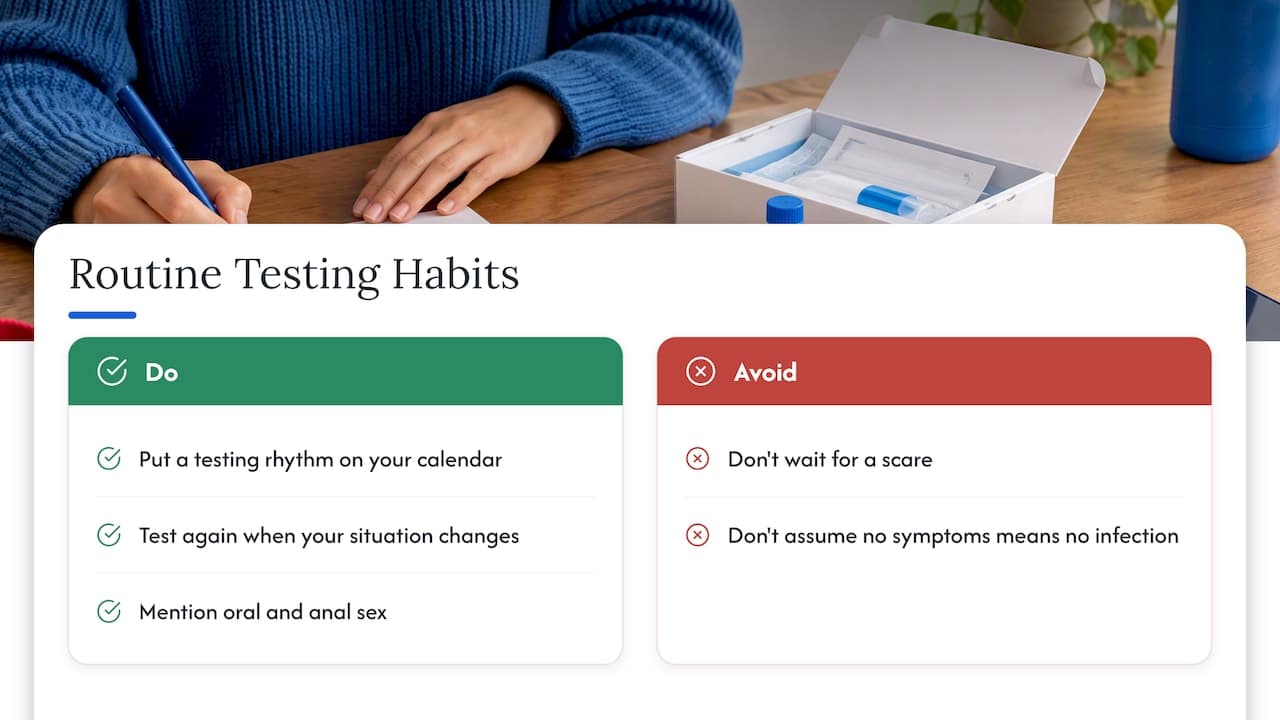
So our advice is simple. Pick a testing rhythm that matches your life, and put it on your calendar the way you would a dental cleaning. If your situation changes, such as a new partner, more than one partner, or a partner who tells you they have an infection, test again. And tell us everything relevant, including oral and anal sex. It changes which swabs we use, and it is never a reason for judgment here.
If you are nervous, that is normal. Most visits are short, and the hardest part is walking in the door.
— Lisa
FAQ
What STD tests are recommended for most adults?
The CDC recommends HIV testing at least once for everyone ages 13 to 64. Sexually active women under 25 should be screened for chlamydia and gonorrhea, as should older women at increased risk. Beyond that, your provider will add tests, such as syphilis or hepatitis, based on your history.
How long do STD test results take?
It depends on the test and the lab. The American Sexual Health Association says samples are often sent to a laboratory, with results received in a few days. Home self-tests can give a result in minutes, while mailed-in samples can take days.
Can I be tested for STDs without insurance?
Yes. We accept self-pay patients, and the CDC says low-cost or free confidential testing is available at many clinics. Call us ahead of your visit to ask about the cost of the specific tests you need.
Do I need symptoms to get tested?
No. Many infections cause no symptoms, and screening exists to find them early. If you have had sex without a condom, have a new or multiple partners, or a partner with an STI, you have good reason to be tested.
Sources
- Getting Tested for STIs, CDC
- STI Screening Recommendations, CDC
- How to GYT, CDC
- STI and HIV Infection Risk Assessment, CDC
- Updates on Testing, Treatment, and Prevention of Sexually Transmitted Infections, PMC
- Sexually Transmitted Infection (STI) Tests, MedlinePlus
- What You Should Know About STI Testing, ASHA
- Revised Guidelines for HIV Counseling, Testing, and Referral, CDC
- STI Testing, Healthy Youth Parent Resources, CDC
- For Providers: Teens Visiting a Health Clinic, CDC