

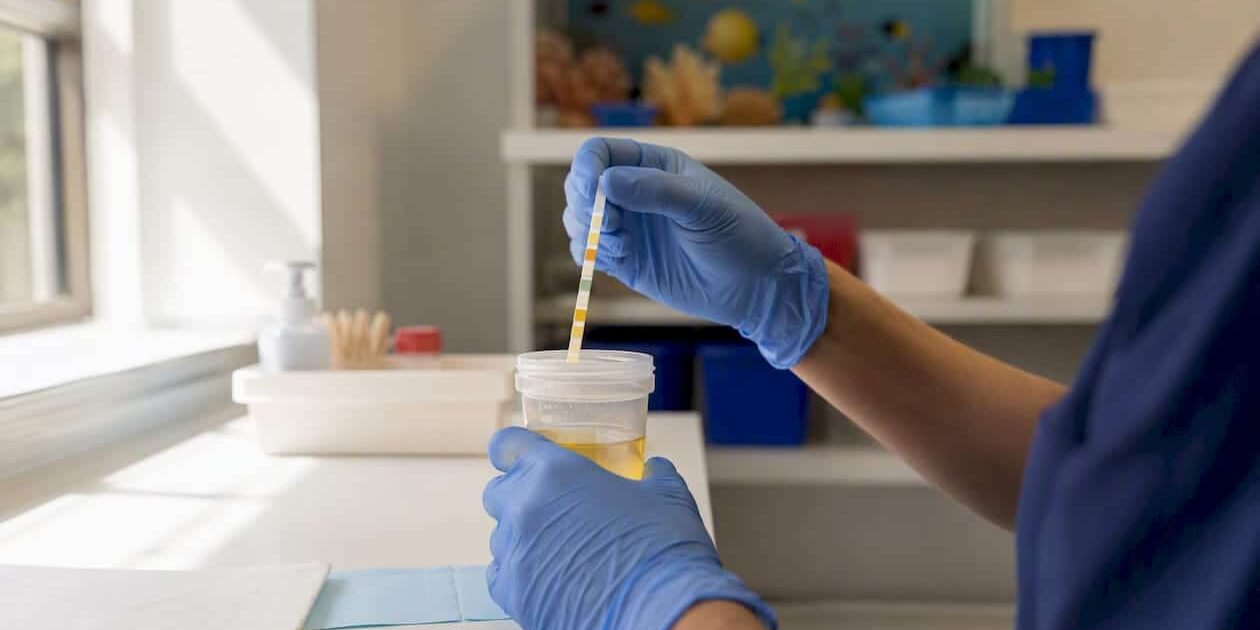
A urinalysis can quickly show whether the most common signs of a urinary tract infection are present — specifically nitrite, leukocyte esterase (LE), and pyuria — but results only tell the full story when read alongside your symptoms and guideline-based thresholds. According to CDC guidance, UTI symptoms include dysuria (painful urination), frequency, urgency, suprapubic pain, and blood in the urine. The NCBI clinical guidance is clear: UTI is primarily a clinical diagnosis, and urine testing is a tool to support that diagnosis, not replace it.
Here is what your urinalysis report should show if a UTI is suspected:
- Nitrite: Positive result suggests bacteria that convert urinary nitrate to nitrite (most commonly E. coli)
- Leukocyte esterase (LE): Positive result indicates white blood cells in the urine, a sign of inflammation or infection
- WBCs (pyuria): More than 5–10 white blood cells per high-power field on microscopy confirms pyuria
- Bacteria on microscopy: Visible bacteria support an active infection
- Blood/hematuria: Red blood cells are common in UTI but not specific to it
- Specific gravity and color: Concentrated, dark urine can affect result accuracy
A urine culture, ordered separately, identifies the exact organism and guides antibiotic selection. The IDSA and AAFP both recommend culture for men, pregnant patients, and anyone with a suspected kidney infection.
Key Takeaways
Urinalysis for UTI is most reliable when dipstick results, microscopy findings, and your symptoms are interpreted together rather than in isolation.
| Point | Details |
|---|---|
| Most predictive markers | Positive nitrite plus positive leukocyte esterase together strongly suggest bacterial UTI. |
| Dipstick sensitivity range | Dipstick sensitivity for pyuria is 80–90%, but specificity is roughly 50% in some settings. |
| When culture is required | Order a urine culture for men, pregnant patients, suspected pyelonephritis, recurrent UTIs, or treatment failures. |
| Asymptomatic bacteriuria | Do not treat bacteria in urine without symptoms, except in pregnancy or before urologic procedures. |
| Your Family Walk-In Clinic | Same-day urinalysis, urine culture ordering, and UTI treatment are available seven days a week in Lutz, Florida. |
Table of Contents
- What does a urinalysis check for in a suspected UTI?
- How to collect a urine sample correctly
- How to interpret your dipstick and microscopy results
- When do you need a urine culture, and what do results mean?
- What causes false positives and false negatives on a urinalysis?
- When should you see a clinician, and what are the red flags?
- How do clinical guidelines shape the UTI diagnostic process?
- A note from Your Family Walk-In Clinic on how we handle suspected UTIs
- Your Family Walk-In Clinic provides same-day UTI evaluation in Lutz
- Sources
- FAQ
What does a urinalysis check for in a suspected UTI?
A standard urinalysis has two components: a dipstick chemical panel and urine microscopy. Together, they give clinicians a rapid picture of what is happening in your urinary tract.
Dipstick components and what they detect
The dipstick is a chemically treated strip dipped into your urine sample. Each color-changing pad tests for a different substance:
- Leukocyte esterase: An enzyme released by white blood cells. A positive result signals pyuria, meaning your immune system is responding to something in the urinary tract. LE can be positive in noninfectious inflammation too, so it is not specific to bacterial UTI alone.
- Nitrite: Most gram-negative bacteria (like E. coli, which causes the majority of UTIs) convert dietary nitrate to nitrite. A positive nitrite result is highly specific for infection, but a negative result does not rule it out — organisms like Enterococcus and Staphylococcus saprophyticus do not reduce nitrate, so they will not trigger a positive nitrite even when present.
- Blood (hemoglobin): Detects red blood cells or free hemoglobin. Hematuria appears in most UTIs but also in kidney stones, trauma, and menstrual contamination.
- Protein: Mild proteinuria can accompany infection; significant proteinuria points toward kidney disease.
- Specific gravity and color: Highly concentrated urine can produce false positives; very dilute urine can produce false negatives, particularly for LE.
What microscopy adds
When the dipstick raises concern, or when the clinical picture is unclear, microscopy examines the urine under a lens. Key findings include:
- Pyuria (WBCs): The standard threshold is more than 5–10 WBCs per high-power field. Pyuria is the most consistent microscopic finding in UTI.
- Bacteria: Visible rods or cocci on an unspun specimen support active infection.
- Red blood cells (RBCs): Common in cystitis; RBC casts suggest glomerulonephritis, not UTI.
- White blood cell casts: These point to upper tract involvement (pyelonephritis or interstitial nephritis) rather than simple bladder infection.
A meta-analysis of urine testing methods found that combining dipstick, microscopy, and culture gives the most reliable diagnosis, and that automated urinalysis methods can aid early detection but require confirmation by microscopy or culture.
Pro Tip: Use the dipstick as a quick triage tool when symptoms are straightforward. Add microscopy when the dipstick result conflicts with your symptoms, or when you need to distinguish upper from lower tract infection.
How to collect a urine sample correctly
The quality of your sample directly affects the accuracy of your results. Contamination is the most common reason a urinalysis or culture gives misleading information, and it is almost entirely preventable with proper technique.
Clean-catch midstream technique (step-by-step)
- Wash your hands thoroughly before handling the collection cup.
- Open the sterile cup without touching the inside of the lid or container.
- For women: Spread the labia and clean the urethral opening front to back with the provided antiseptic wipe. Use a fresh wipe for each pass.
- For men: Retract the foreskin if present and clean the tip of the penis with an antiseptic wipe.
- Begin urinating into the toilet, then — without stopping the stream — move the cup into position and collect the midstream portion.
- Remove the cup before the stream ends and seal it immediately.
- Label the cup with your name and the time of collection.
- Deliver the sample to the lab or clinic within one hour at room temperature, or refrigerate it for up to four hours if transport is delayed.
Special situations
Children: Young children who cannot cooperate with clean-catch technique should have a catheterized specimen collected by a clinician. Bag specimens attached to the perineum are not acceptable for diagnosing UTI in adults or older children because contamination rates are too high.
Patients with an indwelling Foley catheter: The sample must be drawn from the catheter port using a sterile syringe, not from the drainage bag. Bag urine is colonized with environmental organisms and will produce a false-positive culture.
Avoid these common mistakes that contaminate your sample:
Collecting the first or last part of the stream instead of the midstream; using a urine bag for an adult specimen; failing to clean the urethral area before collection; transporting the sample unrefrigerated for more than one hour; or collecting a sample within 24–48 hours of starting antibiotics, which can suppress bacterial growth and produce a false-negative culture.
How to interpret your dipstick and microscopy results
Result patterns matter more than any single positive or negative marker. Here is how clinicians read common combinations:
- Nitrite positive + LE positive: Strong evidence of bacterial UTI. Most clinicians will treat based on this pattern plus compatible symptoms.
- Nitrite positive + LE negative: Possible early infection or a nitrate-reducing organism present in low numbers. Microscopy or culture adds clarity.
- LE positive + nitrite negative: Pyuria without nitrite is common when the causative organism does not reduce nitrate (Enterococcus, Pseudomonas, Staphylococcus saprophyticus). It also appears in noninfectious inflammation. Culture is the next step.
- Pyuria with sterile culture: Consider STIs (chlamydia, gonorrhea), interstitial cystitis, recent antibiotic use, or tuberculosis of the urinary tract.
- Hematuria without pyuria: Think kidney stones, trauma, or bladder pathology rather than infection.
- Negative dipstick with classic symptoms: A negative dipstick does not always rule out UTI. According to ACEP guidance, women with dysuria and urinary frequency but no vaginal symptoms have a very high probability of acute cystitis, and many clinicians treat empirically without waiting for test results.
Understanding test performance
NCBI clinical guidance reports that dipstick urinalysis for pyuria has a sensitivity of 80–90% but a specificity of roughly 50% in some settings. In practical terms:
- A positive LE is common in UTI but also appears in other conditions, so it rules in infection only when symptoms support it.
- A negative LE plus negative nitrite plus no pyuria on microscopy carries a high negative predictive value, meaning UTI is unlikely in most patients with that combination.
- Specificity improves when both LE and nitrite are positive together.
The takeaway: a negative dipstick is reassuring but not definitive. A positive dipstick in an asymptomatic patient is often asymptomatic bacteriuria, not an infection requiring treatment.
When do you need a urine culture, and what do results mean?
Urinalysis tells you whether infection is likely. A urine culture tells you what organism is present and which antibiotics will work against it.
When to order a culture
Per Cleveland Clinic Journal of Medicine guidance, a urine culture is not required for most uncomplicated cystitis cases in otherwise healthy, non-pregnant women. Culture is recommended in these situations:
- Men with any UTI symptoms (UTI in men is considered complicated until proven otherwise)
- Pregnant patients at any stage of pregnancy
- Suspected pyelonephritis (kidney infection) with fever, flank pain, or systemic illness
- Recurrent UTIs (two or more in six months, or three or more in a year)
- Treatment failure after a standard antibiotic course
- Immunocompromised patients (diabetes, HIV, transplant recipients)
- Before urologic procedures that involve mucosal disruption
Many labs use a reflex culture protocol: if the dipstick shows positive LE, positive nitrite, or microscopy reveals 10 or more WBCs per high-power field, the lab automatically processes a culture from the same sample. This approach, supported by CDC stewardship guidance, reduces unnecessary cultures and catches cases that need them.
How to read colony counts
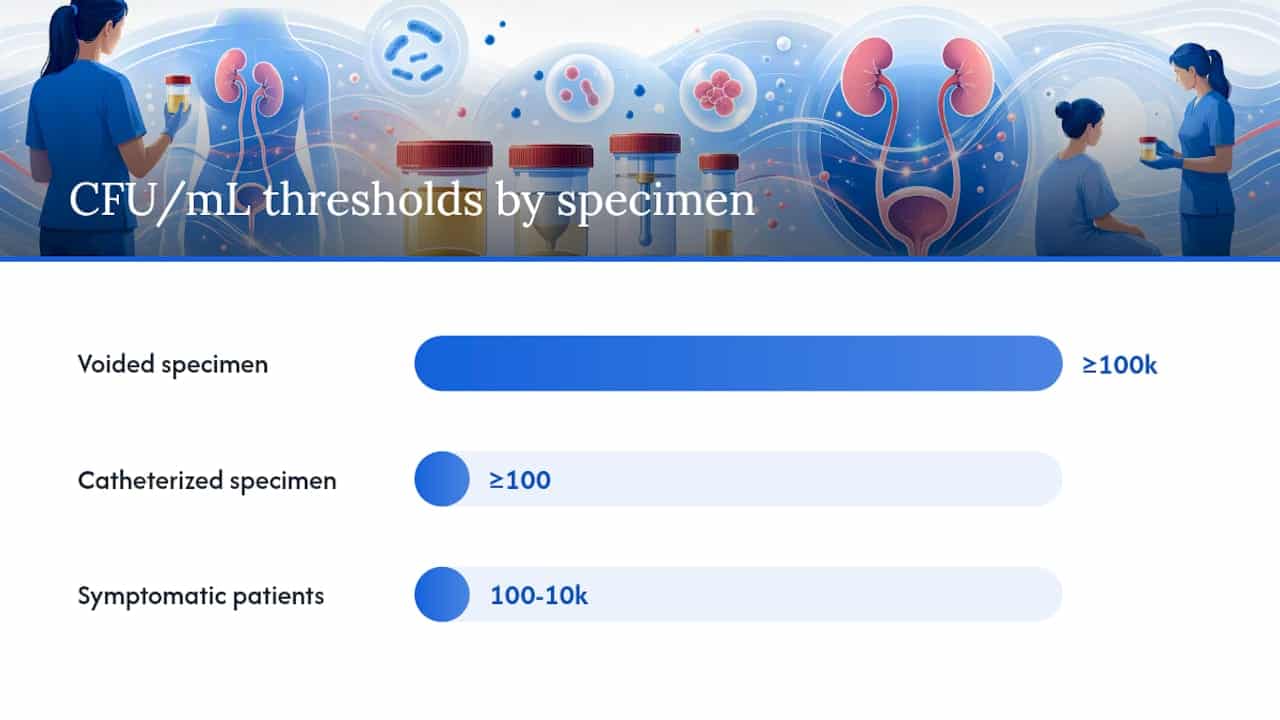
Labs report culture results in colony-forming units per milliliter (CFU/mL). The traditional threshold for a positive culture is 100,000 CFU/mL or more from a voided specimen. However, symptomatic patients can have clinically significant infections at lower counts, sometimes as low as 100–10,000 CFU/mL, particularly with organisms like Staphylococcus saprophyticus or in catheterized specimens.
| Specimen type | Threshold suggesting infection | Clinical note |
|---|---|---|
| Voided (clean-catch) | ≥100,000 CFU/mL | Lower counts may be significant in symptomatic patients |
| Catheterized specimen | ≥100 CFU/mL | Lower threshold reflects reduced contamination risk |
Culture results also include a sensitivity panel listing which antibiotics inhibit the organism. Your clinician uses this to confirm or adjust the antibiotic prescribed empirically.
How long does a urine culture take?
Most cultures require 24–48 hours for preliminary results and up to 72 hours for a complete sensitivity panel. If your symptoms are significant, your clinician will typically start an empiric antibiotic while the culture processes, then adjust if the sensitivity panel shows resistance.
What causes false positives and false negatives on a urinalysis?
Even a well-collected sample can produce misleading results. Knowing the common pitfalls helps you and your clinician interpret results more accurately.
False negatives (UTI present but test looks normal)
- Organisms that don’t reduce nitrate: Enterococcus, Pseudomonas, and Klebsiella species produce negative nitrite results even in active infection.
- Very early infection: Bacterial counts may be too low to trigger a positive dipstick.
- Dilute urine: Drinking large amounts of fluid before the test dilutes WBCs and bacteria below detectable thresholds.
- Recent antibiotic use: Even a single dose can suppress bacterial growth enough to produce a false-negative culture.
False positives (test looks abnormal but no UTI)
- Contamination: Vaginal discharge, menstrual blood, or skin bacteria from poor collection technique are the most common culprits.
- Recent sexual activity: Can introduce urethral bacteria and white blood cells.
- Certain foods and medications: Beets and some medications can discolor urine and affect dipstick readings.
Pyuria without bacteriuria: a common source of confusion
White blood cells in the urine do not automatically mean bacterial infection. CDC guidance notes that pyuria has noninfectious causes including sexually transmitted infections (chlamydia, gonorrhea), interstitial cystitis, recent catheterization, and tubular kidney disease. Pyuria alone should not trigger antibiotic treatment without supporting symptoms and a positive culture.
Asymptomatic bacteriuria (ASB) is bacteria in the urine without symptoms. Treating ASB in most patients does not improve outcomes and increases the risk of antibiotic resistance and future symptomatic infections. CDC stewardship guidance is explicit: routine screening and treatment for ASB is discouraged except in pregnant patients and patients scheduled for urologic procedures that cause mucosal disruption. If your urine culture is positive but you have no symptoms, talk to your clinician before starting antibiotics.
When should you see a clinician, and what are the red flags?
Most uncomplicated UTIs can be evaluated and treated at an urgent care clinic the same day. Some situations require faster action.
Red flags that need immediate evaluation
- Fever above 101°F with urinary symptoms
- Flank or back pain (possible kidney infection)
- Nausea, vomiting, or inability to keep fluids down
- Confusion or altered mental status, especially in older adults
- Signs of sepsis: rapid heart rate, low blood pressure, extreme fatigue
- Pregnancy with any UTI symptoms
- Immunocompromise (chemotherapy, organ transplant, uncontrolled diabetes)
Go to an emergency room or call 911 if you have high fever, severe flank pain, confusion, or signs of sepsis. These findings suggest pyelonephritis or urosepsis, which require IV fluids and antibiotics, not an outpatient prescription. For persistent or worsening urinary symptoms without these red flags, a same-day urgent care visit is the right next step.
What to expect at your visit
Your clinician will take a brief history covering your symptoms, their duration, any recent UTIs, and your current medications. A physical exam follows, which may include abdominal or flank palpation. From there:
- A urinalysis is collected and processed on-site in most urgent care settings.
- A urine culture is ordered if your situation falls into one of the higher-risk categories above.
- STI testing may be recommended if pyuria is present but culture is negative, or if your symptoms could suggest chlamydia or gonorrhea.
- Imaging (ultrasound or CT) is considered for suspected kidney stones, abscess, or structural abnormality.
Empiric antibiotic treatment, meaning treatment started before culture results return, is appropriate when symptoms are classic and the dipstick supports infection. Your clinician will adjust the antibiotic if the culture sensitivity panel shows resistance.
How do clinical guidelines shape the UTI diagnostic process?
Guidelines from the CDC, IDSA, and AAFP share a consistent message: UTI is a clinical diagnosis first, and testing should be driven by symptoms, not routine screening.
The IDSA and CDC both caution against ordering urine tests in patients without symptoms. Testing asymptomatic patients frequently uncovers asymptomatic bacteriuria, and treating it increases the risk of future symptomatic infections and antibiotic resistance. The NCBI clinical guidance reinforces this: diagnosis should be based on history and targeted testing, not reflexive urine testing for every patient who mentions urinary symptoms.
What makes a UTI “complicated”?
A complicated UTI is one that carries a higher risk of treatment failure or serious outcomes. Factors that shift a UTI into the complicated category include:
- Male sex
- Pregnancy
- Structural or functional urinary tract abnormality (kidney stones, neurogenic bladder, urinary stent)
- Recent urinary tract instrumentation or surgery
- Immunosuppression (HIV, transplant, high-dose steroids)
- Hospital-acquired infection
- Organisms known to carry antibiotic resistance
Complicated UTIs almost always require a urine culture, a longer antibiotic course, and closer follow-up. For male patients specifically, prostate cancer screening and urologic evaluation may be relevant if recurrent infections suggest an underlying structural issue.
Culture stewardship in practice
Many clinics and hospitals now use reflex culture protocols tied to specific UA findings, rather than ordering cultures on every urine sample. This approach, recommended by CDC stewardship guidance, reduces unnecessary antibiotic exposure while ensuring cultures are processed when they genuinely add clinical value.
A note from Your Family Walk-In Clinic on how we handle suspected UTIs
At Your Family Walk-In Clinic, we perform on-site urinalysis the same day you walk in, seven days a week from 8 AM to 8 PM. Our clinicians follow CDC and IDSA guidelines, which means we do not automatically prescribe antibiotics based on a positive dipstick alone. We look at your full picture: your symptoms, your history, and your test results together.
When a urine culture is indicated, we order it at the time of your visit and follow up with you on results and any antibiotic adjustments. We also offer same-day STI testing when symptoms suggest a possible co-infection, and pregnancy testing when relevant. Our goal is to get you the right diagnosis and the right treatment, without unnecessary antibiotics or unnecessary delays.
Your Family Walk-In Clinic provides same-day UTI evaluation in Lutz
Burning when you urinate, running to the bathroom every 20 minutes, or noticing blood in your urine — these symptoms deserve a same-day answer, not a three-day wait for an appointment.

Your Family Walk-In Clinic offers urgent care seven days a week in Lutz, Florida, with on-site urinalysis, urine culture ordering, STI testing, and prescription management all available during a single visit. Walk-ins are always welcome. We accept most major insurance plans, Medicaid, and self-pay. Bring a photo ID and a list of any current medications. Our experienced clinical team will collect your sample, run your urinalysis, and discuss results with you before you leave. If a culture is needed, we will contact you with results and next steps within 24–72 hours.
Ready to be seen today? Visit us at Your Family Walk-In Clinic in Lutz or walk in any day between 8 AM and 8 PM.
Sources
The following authoritative resources support the guidance in this article:
- Urinary Tract Infection Diagnosis & Management — NCBI Bookshelf (UNC/clinical guidance excerpt)
- Meta-analysis comparing urine testing methods — PMC article
- Diagnosing Lower Urinary Tract Infections – ACEP Now
- Does my patient need to be screened or treated for a urinary tract infection? | Cleveland Clinic Journal of Medicine
- About urinary tract infections | CDC
This article is general information, not a substitute for advice from a qualified doctor. Consult a qualified healthcare professional about your own circumstances before acting on anything here.
FAQ
What indicates a UTI in a urinalysis?
The most telling findings are a positive leukocyte esterase, a positive nitrite, and pyuria (more than 5–10 white blood cells per high-power field on microscopy). When two or more of these are present alongside symptoms like dysuria and urinary frequency, bacterial UTI is likely.
What urine test is required for a UTI?
A dipstick urinalysis is the standard first-line test. A urine culture is added for men, pregnant patients, suspected kidney infections, recurrent UTIs, or treatment failures, per Cleveland Clinic Journal of Medicine guidance.
What should you avoid before a UTI urine test?
Avoid urinating for at least one hour before collection so the sample is concentrated enough to detect bacteria and white blood cells. Do not collect a sample within 24–48 hours of starting antibiotics, and follow the clean-catch technique carefully to prevent contamination from vaginal discharge or skin bacteria.
Can a urinalysis be normal and still have a UTI?
Yes. ACEP guidance notes that women with classic symptoms are often treated empirically even when the dipstick is negative.
When should you go to urgent care for UTI symptoms?
Seek same-day care for any urinary symptoms that are persistent, worsening, or accompanied by fever, flank pain, nausea, or vomiting. At Your Family Walk-In Clinic, you can walk in any day from 8 AM to 8 PM for on-site urinalysis and same-day treatment in Lutz, Florida.