

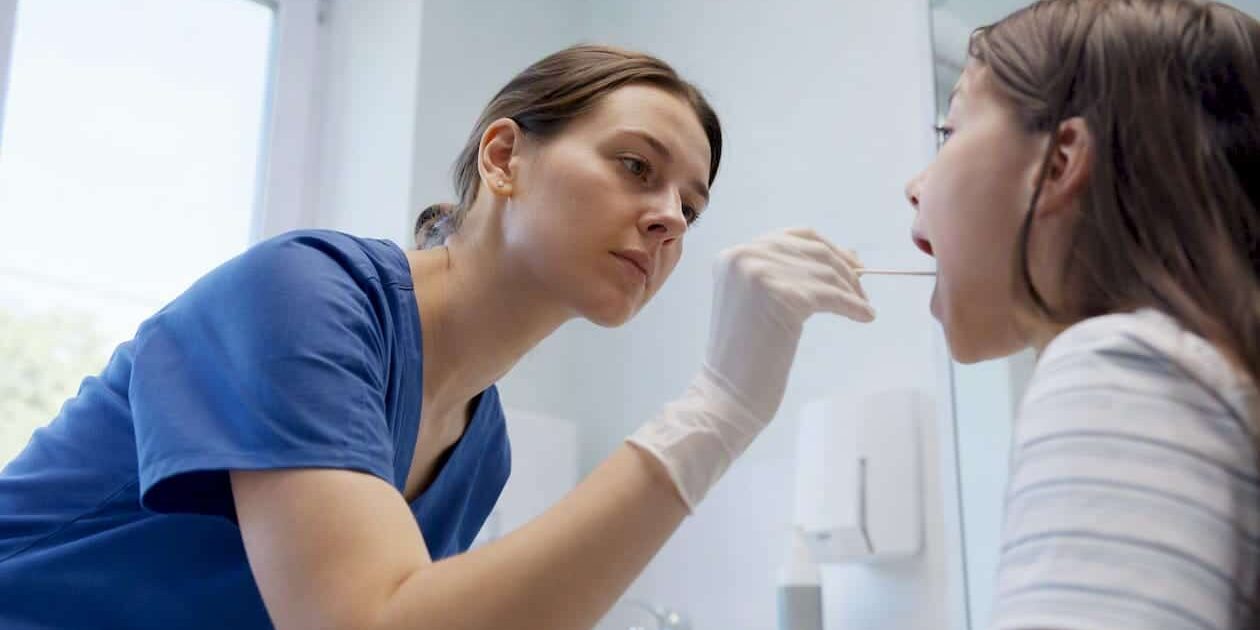
A strep throat test tells you whether group A Streptococcus bacteria are causing your sore throat, so your clinician can decide whether antibiotics are the right call. Two tests are commonly used: a rapid antigen detection test (RADT) that delivers results quickly, and a throat culture that takes longer but is considered the gold standard. According to CDC guidance and IDSA recommendations, testing is the only reliable way to distinguish bacterial strep from a viral sore throat.
Seek testing if you or your child experiences any of the following:
- Sudden, severe sore throat with fever at or above 101°F
- Painful or difficult swallowing
- Swollen, tender lymph nodes in the neck
- White patches or pus on the tonsils
- A known strep exposure in your household
Key Takeaways
Strep throat testing requires a clinician-collected swab to reliably detect group A Streptococcus, and the type of test, timing of results, and follow-up steps all depend on your age and clinical presentation.
| Point | Details |
|---|---|
| Two main test types | Rapid antigen tests return results quickly; throat cultures take longer and are considered the gold standard. |
| Children need follow-up culture | A negative rapid test in a child age 3 or older should be confirmed with a throat culture per CDC guidance. |
| Positive test means antibiotics | Penicillin or amoxicillin is first-line; your clinician selects the right option based on your allergy history. |
| Return to school/work timing | You are typically no longer contagious after 24 hours on appropriate antibiotics and once fever-free. |
| Your Family Walk-In Clinic | Offers same-day strep testing seven days a week in Lutz, FL, with no appointment required. |
Table of Contents
- What strep throat testing involves: the two main test types
- What happens during the throat swab procedure
- When you or your child should get tested for strep
- How to interpret your test results and what to do next
- How accurate are strep tests, and what affects the results?
- Where you can get a strep test in the U.S.
- What the clinic experience actually teaches you about strep testing
- Same-day strep testing at Your Family Walk-In Clinic in Lutz
- Sources
- FAQ
What strep throat testing involves: the two main test types
According to MedlinePlus, both a rapid antigen test and a throat culture use the same swab procedure, but they differ significantly in speed, sensitivity, and when clinicians choose one over the other.
| Test Type | How It Works | Turnaround Time | Best Used When |
|---|---|---|---|
| Rapid Antigen Detection Test (RADT) | Detects strep antigens directly at point of care | 10–20 minutes | First-line for most patients; fast results guide same-day treatment |
| Throat Culture | Lab grows bacteria from swab sample | 24–48 hours | Confirmatory test; gold standard for accuracy |
| Molecular/PCR Test | Detects strep DNA | 1–4 hours (varies by lab) | Available in some settings; high sensitivity, useful when RADT is negative but suspicion remains high |
The RADT is the go-to first step for most visits. It is highly specific, meaning a positive result is reliable. However, CDC clinical guidance notes that RADTs have variable sensitivity, so a negative result does not always rule out strep. That is why clinicians factor in age, symptoms, and clinical presentation when deciding whether to follow up with a culture.
A 2020 validation study referenced in clinical literature found that about 37.6% of patients presenting with a sore throat tested positive for streptococcal pharyngitis. Among those with at least one viral symptom, the positivity rate dropped to 28.3%, and to 23.2% in patients with all three viral symptoms. These numbers illustrate why pretest probability matters when interpreting a negative rapid test.
What happens during the throat swab procedure
The swab itself takes less than 30 seconds, though knowing what to expect makes it much easier.
- Check-in and symptom review. A clinician or medical assistant reviews your symptoms, temperature, and any known exposures before the swab.
- Positioning. You tilt your head back slightly and open your mouth as wide as you comfortably can.
- Tongue depressor placed. The clinician gently holds your tongue down to access the back of your throat.
- Swab collected. A sterile swab is rubbed firmly across both tonsils and the back of the throat. This is the part that may trigger a brief gag reflex.
- RADT run in-office. The swab is processed immediately for a rapid result. If a culture is also needed, a second swab or the same sample may be sent to the lab.
- Results and next steps discussed. For a rapid test, your clinician reviews results with you before you leave.
Professional swabbing is required to reach the correct anatomical sites. MedlinePlus confirms that self-swabbing at home is unreliable because most people cannot adequately reach the tonsils and posterior pharynx on their own. Home strep test kits exist but are not a substitute for a clinician-collected swab.
Telehealth can help you triage symptoms and determine whether an in-person visit is warranted, but it cannot perform the swab. If your telehealth provider suspects strep, they will direct you to a clinic for testing.
Pro Tip: For children who gag easily, practice deep breathing before the appointment and bring a small comfort item. Letting a child hold the tongue depressor briefly beforehand can reduce anxiety. For adults, focusing on a fixed point on the ceiling and exhaling slowly during the swab often shortens the gag response.

When you or your child should get tested for strep
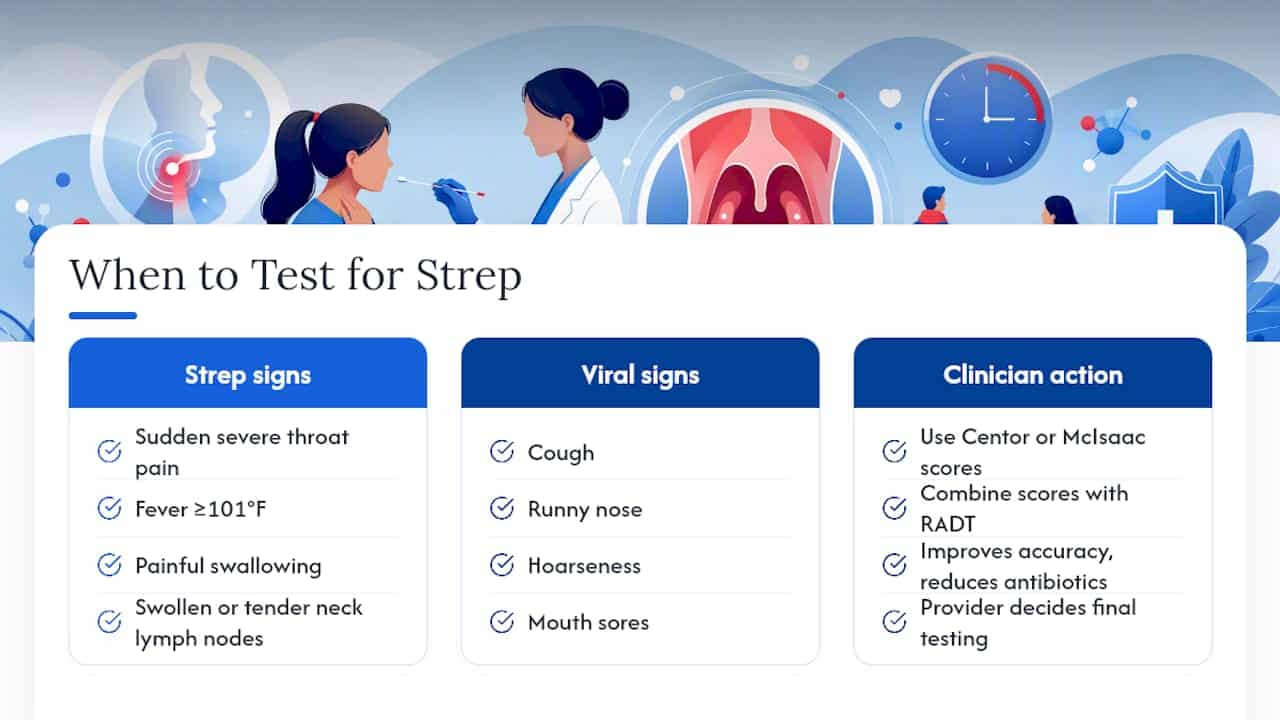
Not every sore throat needs a test. Symptoms that commonly prompt strep throat testing include sudden onset of severe throat pain, fever at or above 101°F, painful swallowing, swollen or tender lymph nodes in the neck, tonsillar exudates (white patches), and petechiae on the soft palate.
Symptoms that point more toward a viral cause include cough, runny nose, hoarseness, and mouth sores. Their presence lowers the probability of strep, but even with viral symptoms present, strep cannot be ruled out by symptoms alone. Clinicians use structured tools to make that call.
Clinicians often apply the Centor or McIsaac scoring systems to estimate the likelihood of strep before ordering a test. Combining these clinical decision rules with RADT improves diagnostic accuracy and reduces unnecessary antibiotic prescribing. You do not need to calculate your own score; your provider does this as part of the visit.
Age matters in testing decisions. Children older than 3 are more susceptible to complications like rheumatic fever from untreated strep, so clinicians take a more aggressive testing approach with them. Children under 3 rarely develop strep pharyngitis and are generally not tested unless there is a compelling household exposure. Adults with low clinical suspicion and viral symptoms may not need a test at all, though the final call always rests with the clinician. If you are unsure whether your symptoms warrant a visit, this guide on vital health symptoms not to ignore can help you decide.
How to interpret your test results and what to do next
If your rapid test or culture is positive, group A strep is confirmed and antibiotics are indicated. First-line treatment is typically penicillin or amoxicillin. For patients with a penicillin allergy, alternatives include cephalexin, macrolides, or clindamycin, depending on allergy type and clinician judgment. All prescribing decisions are made by your provider based on your full clinical picture.
If your rapid test is negative, the next step depends on your age:
- Children and adolescents (age 3 and older): A negative RADT should be followed by a throat culture, per CDC testing guidance. This is because the stakes of a missed diagnosis are higher in younger patients, and culture can detect infections the rapid test missed.
- Adults: Routine follow-up culture after a negative RADT is generally not recommended unless clinical suspicion remains high.
Contagion and return to school or work: You are typically no longer contagious after a day or so of appropriate antibiotic treatment, provided you are also fever-free without the use of fever-reducing medication. Most clinicians advise staying home for at least that 24-hour window. Follow your provider’s specific guidance, since individual circumstances vary.
On antibiotic stewardship: Most sore throats are viral, and antibiotics do nothing for viral infections. Testing before prescribing protects you from unnecessary side effects and helps reduce antibiotic resistance in the broader community.
How accurate are strep tests, and what affects the results?
Sensitivity and specificity are the two numbers that define a test’s performance. Sensitivity measures how often a test correctly identifies a true infection (avoiding false negatives). Specificity measures how often a test correctly rules out infection in someone who does not have it (avoiding false positives).
Throat culture is the gold standard because its sensitivity is higher than the RADT’s. RADTs are highly specific, so a positive rapid test is trustworthy. Their sensitivity is more variable, which is why a negative rapid test in a child still warrants a follow-up culture.
A 2020 study cited in clinical literature found an overall strep positivity rate of 37.6% among sore throat patients, dropping to 23.2% in those with all three viral symptoms. When the pretest probability is that low, even a specific test can produce a misleading result, which is why clinician judgment remains central to the process.
Practical factors that can reduce accuracy include:
- Poor swab technique: Not reaching the tonsils and posterior pharynx is the most common cause of false negatives.
- Testing too early: Antigen levels may be too low in the first 24 hours of illness.
- Prior antibiotic use: Antibiotics taken before the swab can suppress bacterial growth and reduce test sensitivity.
- Carrier state: Some people carry strep without active infection; a positive test in someone with viral symptoms may reflect carriage rather than disease.
- Sample handling delays: For cultures sent to an external lab, transport time and temperature can affect bacterial viability.
Where you can get a strep test in the U.S.
Testing is available at several types of facilities, and the right choice depends on your symptoms, schedule, and whether you have an established provider.
- Primary care office: Best for patients with an existing relationship who can get a same-day or next-day appointment. Offers continuity and access to your full medical history.
- Walk-in or urgent care clinic: Ideal for same-day testing without an appointment. Most run RADTs on-site and can send cultures to a lab if needed. Open evenings and weekends at many locations.
- Retail clinic (pharmacy-based): Convenient for mild symptoms during business hours. Staffed by nurse practitioners or physician assistants; typically runs RADTs.
- Emergency department: Reserved for severe symptoms such as difficulty breathing, inability to swallow, or signs of a peritonsillar abscess. Wait times are longer and costs are higher.
- Telehealth: Can assess symptoms and advise on urgency, but cannot perform the swab. Use it to decide whether an in-person visit is needed, not to replace it.
| Site Type | Typical Wait | Best For | After-Hours Access |
|---|---|---|---|
| Primary care | Low to moderate | Established patients, follow-up care | Limited |
| Walk-in/urgent care | Low to moderate | Same-day testing, no appointment needed | Yes, evenings and weekends |
| Retail clinic | Low | Mild symptoms, convenience | Limited |
| Emergency department | High | Severe or complicated symptoms | Yes, 24/7 |
| Telehealth | Very low | Symptom triage only | Yes |
Insurance coverage for strep testing varies by plan. Most major insurers and Medicaid cover rapid strep tests and cultures when medically indicated. Self-pay patients should ask about cash-pay rates upfront, as walk-in clinics often offer transparent pricing. Your Family Walk-In Clinic accepts major insurance plans, Medicaid, and self-pay, and offers same-day urgent care seven days a week.
What the clinic experience actually teaches you about strep testing
Same-day strep testing removes one of the most frustrating parts of being sick: waiting to find out whether you need antibiotics. At Your Family Walk-In Clinic, patients with sore throat symptoms are seen quickly, swabbed by experienced clinicians, and given results before they leave. That matters because starting antibiotics even a few hours earlier can shorten how long you feel sick and how long you are contagious.
A few things patients find helpful to know before arriving: bring your insurance card and a list of any medications you are currently taking, since prior antibiotic use affects test interpretation. If you are bringing a child, having a caregiver present helps keep the child calm during the swab. Arriving well-hydrated makes the throat exam easier for both the clinician and the patient.
You can book online or call ahead, though walk-ins are always welcome. The clinic is open from 8 AM to 8 PM, seven days a week, so you are not limited to weekday business hours. For patients who want ongoing care after an acute visit, primary care services are also available at the same location.
Same-day strep testing at Your Family Walk-In Clinic in Lutz
When your throat hurts and you need answers today, Your Family Walk-In Clinic offers same-day strep testing with no appointment required. Rapid results are available in-office, and the clinical team can order a follow-up culture when your child’s age or clinical picture calls for one. The clinic accepts most major insurance plans, Medicaid, and self-pay, with transparent pricing for patients paying out of pocket.
If you or your child has a high fever, severe difficulty swallowing, or symptoms that feel like they are getting worse quickly, do not wait. Book your visit online or walk in any day of the week between 8 AM and 8 PM. The team at Your Family Walk-In Clinic has over 25 years of experience caring for families in the Lutz and Tampa area, and they are ready to help you get the right diagnosis and the right treatment, fast.
Sources
The following sources informed this article and are available for further reading:
- Strep A Test: MedlinePlus Medical Test
- Testing for Strep Throat or Scarlet Fever | Group A Strep
- Streptococcal Pharyngitis – StatPearls – NCBI Bookshelf
FAQ
What are the first warning signs of strep throat?
The most common early signs are a sudden, severe sore throat, fever at or above 101°F, and painful swallowing, often without cough or runny nose. Swollen lymph nodes in the neck and white patches on the tonsils frequently appear within the first day or two.
Can I test myself for strep throat at home?
Over-the-counter home strep test kits exist, but they are not a reliable substitute for a clinician-collected swab. Professional swabbing reaches the tonsils and posterior pharynx correctly, which is required for an accurate result.
How long does it take to get strep test results?
A rapid antigen test returns results in about 10–20 minutes at the point of care. A throat culture sent to a lab typically takes 24–48 hours.
Can a rapid strep test give a false positive?
RADTs are highly specific, so false positives are uncommon. False negatives are the more frequent concern, which is why children age 3 and older with a negative rapid test should receive a follow-up throat culture per CDC guidance.
Where can I get a strep test in the Tampa area without an appointment?
Your Family Walk-In Clinic in Lutz offers same-day strep testing seven days a week from 8 AM to 8 PM, with no appointment needed. The clinic accepts major insurance plans, Medicaid, and self-pay.
This article provides general health information and is not a substitute for professional medical advice. Always consult a qualified healthcare provider for diagnosis and treatment decisions.
Recommended
- The Imperative Call: Why STD Testing is Crucial for Your Health – Your Family Walk In Clinic
- Same-Day UTI Treatment & STD Testing in Lutz | Women’s & Men’s Care
- STD Tests Lutz (813) 793-8555 – STD Screening & Testing Clinic – 33558
- Are You Afraid to Go to the Doctors Since You Might Get Sick From Other People? – Your Family Walk In Clinic