


A UTI is a bacterial infection of the urinary tract, usually caused by E. coli, while a yeast infection is a fungal overgrowth of Candida albicans on the vulva and vagina. If your symptoms are moderate to severe, get tested at a clinic; if they’re mild and match a classic yeast pattern, safe over-the-counter treatment is reasonable, and the CDC and health organizations recommend confirming with testing when you’re unsure.
TL;DR:
- The majority of uncomplicated UTIs are caused by E. coli, making early empirical antibiotic treatment effective in most cases.
- Classic yeast infection symptoms include intense external itching and cottage cheese-like discharge, while UTIs mainly cause internal burning and urinary urgency.
- Confirmatory testing, such as urinalysis or microscopy, is essential when symptoms are severe, recurrent, or atypical to avoid ineffective or harmful self-treatment.
- Both infections can occur simultaneously, especially after antibiotic use, which disrupts natural vaginal flora and promotes Candida overgrowth.
- Red flag symptoms like fever, chills, or back pain require urgent medical evaluation instead of home remedies or outpatient testing.
Table of Contents
- What Causes a UTI Versus a Yeast Infection?
- UTI Symptoms Vs Yeast Infection Symptoms: What You’ll Actually Feel
- How Doctors Diagnose These Infections
- Treatment for UTI Compared to Yeast Infection Treatment
- The Fastest Way to Tell UTI From Yeast Infection
- Can You Have Both at Once, and When Should You Get Care Fast?
- What to Expect at a Same-Day Clinic Visit
- Where to Verify This Information
- Getting the Right Answer Beats Guessing Every Time
- Sources
- FAQ
What Causes a UTI Versus a Yeast Infection?
A UTI starts when bacteria, most often E. coli, travel into the urethra and bladder. The CDC notes that E. coli drives roughly 80 to 90 percent of uncomplicated UTI cases, which is why doctors often start treatment before culture results even come back. A yeast infection develops when Candida albicans, a fungus that normally lives quietly in the vagina, multiplies out of control. The World Health Organization attributes most vulvovaginal candidiasis cases to this same species).
The risk factors diverge sharply, and knowing yours can point you toward the right answer before you even see a clinician.
- UTI risk factors: sexual activity, holding urine too long, catheter use, diabetes, and age-related changes in bladder function.
- Yeast infection risk factors: recent antibiotic use, hormonal shifts (pregnancy, birth control, menstruation), uncontrolled diabetes, and tight or damp clothing that traps moisture.
- The antibiotic connection: antibiotics prescribed for a UTI kill off protective bacteria along with the harmful kind, which can let Candida flourish unchecked.
If you’re immunosuppressed or manage diabetes, both infections tend to hit harder and clear slower, so your management plan may look different from a typically healthy adult’s.
UTI Symptoms Vs Yeast Infection Symptoms: What You’ll Actually Feel
The fastest way to tell these apart is asking where the discomfort lives. A UTI announces itself from the inside, a yeast infection from the outside.
UTI symptoms women (and men) commonly report:
- Urinary urgency, a sudden and frequent need to go
- Burning or stinging during urination, felt internally
- Cloudy, dark, or strong-smelling urine
- Pressure or aching low in the pelvis (suprapubic area)
- Occasionally, blood-tinged urine
Yeast infection symptoms:
- Intense itching on the vulva, often the loudest complaint
- Redness and swelling of the vulvar tissue
- Thick, white discharge often compared to cottage cheese
- Stinging when urine touches irritated external skin, not from within the urethra
Both conditions can cause burning, which fuels a lot of the confusion between “UTI symptoms vs STD” or vaginal infections. The distinction that matters most: burning inside the urethra during urination points to a UTI, while itching and irritation on the vulva’s surface points to yeast. One clinical resource frames it simply as internal urethral pain versus external vulvar stinging, and that single detail resolves most uncertainty at home. Underlying the confusion is a numbers story worth knowing. E. coli accounts for 80 to 90 percent of uncomplicated UTIs, while Candida albicans accounts for a similar majority of yeast infections, according to the WHO. Two very different organisms, two very different treatment paths.
How Doctors Diagnose These Infections
Guessing costs you time. Confirming the cause takes minutes and changes what happens next.
For suspected UTIs, clinicians start with a urinalysis, a quick dipstick test that checks for white blood cells, nitrites, and blood in your urine. When symptoms are severe, recurrent, or don’t respond to a first round of antibiotics, a urine culture identifies the exact bacteria and which antibiotics will actually work against it.
For suspected yeast infections, the standard tool is a wet mount or KOH prep, where a sample is examined under a microscope after a potassium hydroxide solution is added. The KOH step measurably increases how easily Candida shows up under the microscope compared to saline alone. Fungal culture or molecular testing gets added for recurrent or treatment-resistant cases.
- Recurrent symptoms after treatment
- Pregnancy
- Diabetes or immune suppression
- Symptoms that don’t fit either pattern cleanly
Conditions like bacterial vaginosis and certain STIs can mimic both UTI and yeast symptoms, and distinguishing among vaginitis causes often requires microscopy or lab testing rather than a guess based on symptoms alone.
Treatment for UTI Compared to Yeast Infection Treatment
Antibiotics cure UTIs. Antifungals cure yeast infections. Using one for the other’s problem doesn’t just fail, it can make things worse.
- UTI treatment: empiric antibiotics chosen based on local resistance patterns and symptom severity, with most people feeling meaningfully better within one to two days of starting the right drug.
- Yeast infection treatment: topical azole creams or suppositories over three to seven days, or a single oral dose of fluconazole for uncomplicated cases.
- Recurrent yeast infections: may require longer induction courses plus maintenance antifungal therapy, especially if a resistant Candida species is involved.
- Empiric antibiotic selection for complicated UTI: the Infectious Diseases Society of America recommends weighing severity, resistance risk, patient-specific factors, and local antibiogram data before choosing a drug.
Taking antibiotics for a suspected UTI when you actually have a yeast infection accomplishes nothing for the itching and can trigger a second infection by wiping out protective bacteria. Pregnancy adds another layer of caution, since some antifungal regimens and antibiotics aren’t appropriate during certain trimesters.
Pro Tip: If you’ve had more than one antibiotic course this year and now notice new itching or discharge, tell your clinician before you reach for an OTC antifungal. Recent antibiotic use is one of the most common yeast infection triggers, and mentioning it helps them treat the right problem the first time.
The Fastest Way to Tell UTI From Yeast Infection
Run through these five checkpoints before deciding your next move.
- Urinary urgency or frequency? Yes points toward UTI.
- Discharge present? Thick, white, and curd-like points toward yeast; none or minimal discharge points toward UTI.
- Intense external itching? Yes points strongly toward yeast infection.
- Recent antibiotic course? Raises your yeast infection risk significantly.
- Fever, chills, or flank pain? These are red flags requiring same-day evaluation, not home treatment.
If your pattern says classic, mild yeast infection with no fever and no urinary symptoms, OTC antifungal treatment is a reasonable first step. If you have urinary urgency, visible blood, or any red flag from the list above, skip the guessing and get tested.
Can You Have Both at Once, and When Should You Get Care Fast?
Yes, you can have both simultaneously, and it’s more common than most people expect. Antibiotics prescribed for a UTI disrupt your natural vaginal flora, which opens the door for Candida to overgrow while you’re still treating the bacterial infection. This is the real answer to “can a UTI feel like a yeast infection”: not exactly, but treating one can directly cause the other within days.
Certain symptoms mean you shouldn’t wait for an appointment:
- Fever or chills
- Flank or back pain, which can signal the infection has reached your kidneys
- Persistent nausea or vomiting
- Visible blood in urine
- Pregnancy with any urinary or vaginal symptoms
- Symptoms that return within weeks of finishing treatment
Mild, classic symptoms with no fever can usually wait for a same-day or next-day visit. Anything with fever, flank pain, or pregnancy involved deserves urgent evaluation, and severe systemic symptoms belong in an emergency setting rather than a wait-and-see approach.
What to Expect at a Same-Day Clinic Visit
A typical visit starts with a short history: when symptoms began, whether you’ve had similar episodes before, and any recent antibiotic use. That’s followed by a focused exam and, in most cases, a urinalysis performed on-site, with wet mount microscopy or a culture added when the picture isn’t clear-cut.
Before your visit, make a mental note to mention:
- Any antibiotics you’ve taken in the past month
- Whether you’re pregnant or trying to conceive
- Diabetes or other chronic conditions
- How many similar episodes you’ve had this year
Some clinics offer same-day UTI testing and treatment alongside STD screening, which matters because vaginal symptoms sometimes trace back to a cause other than yeast or bacteria. Testing settles the question faster than another week of guessing.
Where to Verify This Information
For deeper reading beyond this guide, the CDC’s clinical overview of UTIs, the WHO’s candidiasis fact sheet, and the American Family Physician review of vaginitis all offer clinician-level detail. None of these replace an individual evaluation, so treat them as background, not a diagnosis.
Getting the Right Answer Beats Guessing Every Time
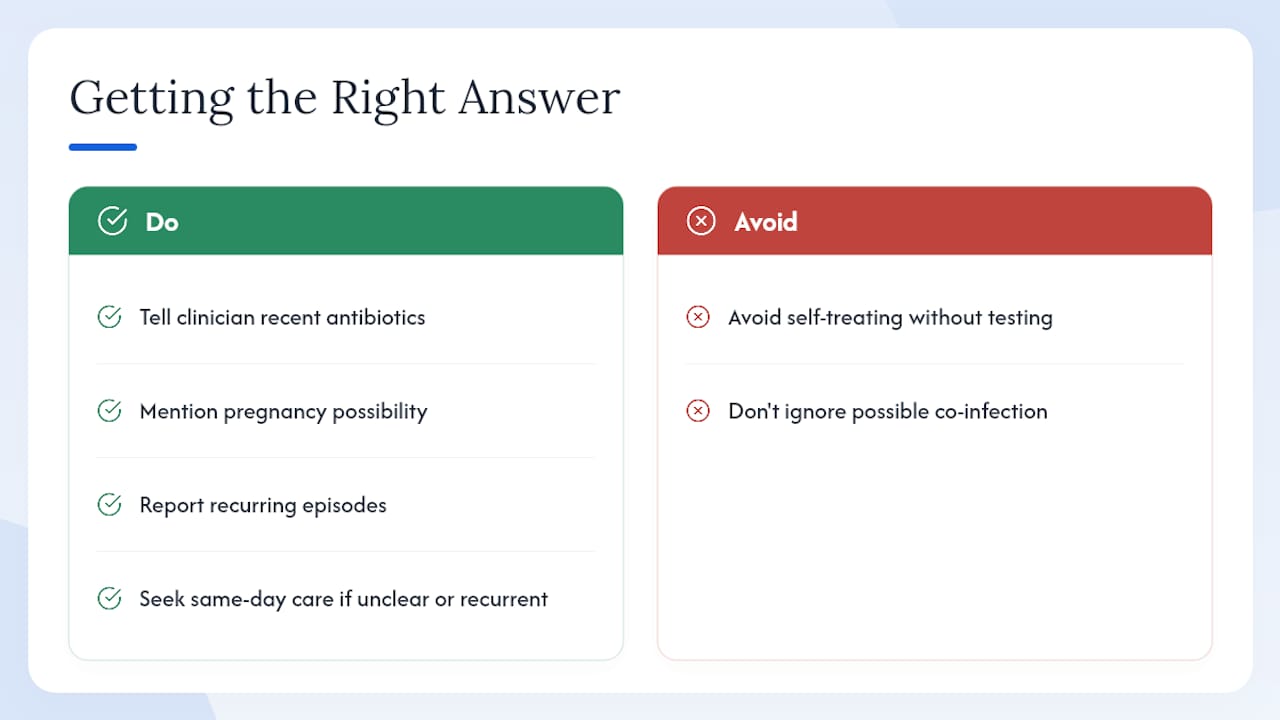
Most people want a shortcut for telling a UTI from a yeast infection, and the location-of-pain rule genuinely gets you most of the way there. What the internet undersells is how often the two conditions travel together, particularly after a course of antibiotics, and how much that overlap trips up self-treatment. Treating presumed yeast with an antifungal when you actually have a resistant UTI strain, or vice versa, doesn’t just waste a week. It can let a bladder infection creep toward your kidneys while you wait to see if the cream works.
The practical habit worth building: mention every recent antibiotic, every pregnancy possibility, and every recurring episode when you talk to a clinician, even if it feels repetitive. That context is often what separates a same-day fix from a second visit. If your symptoms don’t fit neatly into one bucket, or if this is a repeat performance, same-day urgent care exists precisely for that gray area between “probably fine” and “I should really get this checked.”
— Lisa
This article is general information, not a substitute for advice from a qualified doctor. Consult a qualified healthcare professional about your own circumstances before acting on anything here.
Sources
- CDC — Clinical overview of urinary tract infections
- IDSA — Practice guideline for complicated urinary tract infections
- American Family Physician — Vaginitis overview
FAQ
How Do I Check Myself for a Yeast Infection?
Look for thick, white, cottage cheese-like discharge paired with intense external itching and redness around the vulva; if you also have fever, unusual odor, or urinary symptoms, those point away from a simple yeast infection and toward something that needs testing.
Can You Tell a Yeast Infection Through Pee?
Not directly. Yeast infections cause external stinging when urine touches irritated skin, but they don’t change the urine itself the way a UTI does, so cloudy or foul-smelling urine points toward a bacterial infection instead.
Will UTI Medicine Help a Yeast Infection?
No. Antibiotics target bacteria, not fungus, and taking them for a yeast infection can actually make things worse by killing off protective bacteria and letting Candida grow even more.
How Do You Flush Out a UTI as Soon as Possible?
Drinking water and urinating frequently can ease mild discomfort, but home measures don’t cure a bacterial infection. The CDC’s clinical guidance and most urgent care protocols point to prompt antibiotic treatment as the step that actually resolves symptoms and prevents the infection from spreading to your kidneys.