


If your infant under 3 months has a rectal temperature of 100.4°F (38.0°C) or higher, get medical care right away. For older children, call 911 or head to the emergency room for trouble breathing, unresponsiveness, or a seizure. Otherwise, persistent fever or worsening symptoms in a child who still interacts and drinks fluids usually calls for same-day urgent care instead.
TL;DR:
- Immediate evaluation is necessary for infants under 3 months with a rectal temperature of 100.4°F or higher, while older children need urgent care for persistent or worsening symptoms.
- Emergency room visits are required for severe signs such as trouble breathing, unresponsiveness, seizures, or a rash spreading quickly, regardless of age.
- Use rectal thermometers for infants and older children who can hold still; avoid less accurate methods like armpit or pacifier thermometers for tracking fever trends.
- At home, offer fluids often, dress lightly, and give appropriate doses of acetaminophen or ibuprofen, avoiding aspirin and cold medicines under age 6.
- Children with chronic health conditions or recent febrile seizures should be evaluated sooner, even if their fever seems manageable.
Table of Contents
- Quick fever checklist for parents
- Urgent care vs emergency department vs calling your pediatrician: how to choose now
- Age-based thresholds and how to take a child’s temperature
- Home care and medication safety: what to do before you go
- Special situations that lower the threshold for urgent care
- Clinic perspective: how we handle pediatric fevers
- Getting your child seen quickly and what to bring
- FAQ
- Sources
Quick fever checklist for parents
When you are tired, worried, and trying to decide what to do next, a short checklist beats a long article. Use this one to sort out what needs emergency care, what needs same-day urgent care, and what you can manage at home for now.
Go to the ER or call 911 if your child has:
- Trouble breathing or breathing that looks labored
- Blue or gray lips, tongue, or face
- Unresponsiveness or extreme difficulty waking up
- A seizure, a stiff neck, or a sudden purple or spreading rash
No urine output for 8 hours is one of the clearest dehydration warning signs tied to fever, and it means your child needs prompt evaluation rather than another night of watchful waiting.
Choose urgent care when your child is fussy or tired but still responsive, and has persistent fever along with ear pain, sore throat, repeated vomiting, or signs of mild dehydration. At home, take an accurate temperature, offer fluids often, dress your child lightly, and give an appropriate dose of acetaminophen or ibuprofen if age allows. If your pediatrician’s office is open, a quick call can help you decide whether a visit is even needed.
Urgent care vs emergency department vs calling your pediatrician: how to choose now
Urgent care clinics handle same-day, non-life-threatening illness: fevers with an earache, a sore throat, mild vomiting, or symptoms that need a quick exam and maybe a strep or flu test. Emergency rooms exist for conditions that could threaten a child’s life or cause lasting harm, like trouble breathing, a new seizure, or a severe allergic reaction. Urgent care is generally faster and less expensive than the ER for the conditions it is built to treat.
A simple behavior check helps when the fever number alone does not: if your child can walk, talk, and play, even briefly, an ER visit usually is not necessary. A child’s behavior often matters more than the exact number on the thermometer, and a playful child who perks up after medicine is typically less concerning than a listless one with a lower reading.
A few common scenarios make the decision clearer:
- A 4-day fever in a child who is eating, playing, and alert: same-day urgent care.
- A new seizure, even a brief one: emergency room, every time.
- A fever with an earache and a cranky but consolable toddler: urgent care or a same-day pediatrician slot.
- A fever with stiff neck, confusion, or a spreading rash: emergency room without delay.
If your pediatrician’s office is closed, call the on-call line first. Many practices can triage over the phone and tell you whether urgent care is the right next step, which can save you an unnecessary trip and a long wait.
Age-based thresholds and how to take a child’s temperature
Fever thresholds shift with age because younger immune systems carry more risk. For infants younger than 3 months, a rectal temperature of 100.4°F (38.0°C) or higher means immediate evaluation, no waiting period attached.

For children, the American Academy of Pediatrics advises prompt medical attention if fever lasts more than 72 hours in a child 2 years or older, and sooner, within 24 to 48 hours, for a child under 2.
How you measure matters as much as the number itself:
- Rectal thermometers are the most reliable choice for infants and babies under a year old.
- Oral or ear (tympanic) thermometers work well for older children who can hold still.
- Axillary (armpit) readings and pacifier thermometers run least accurate and are best used only for a quick check.
- Stick with one method so you can track whether the fever is rising or falling over time, since switching methods can shift the reading.
Home care and medication safety: what to do before you go
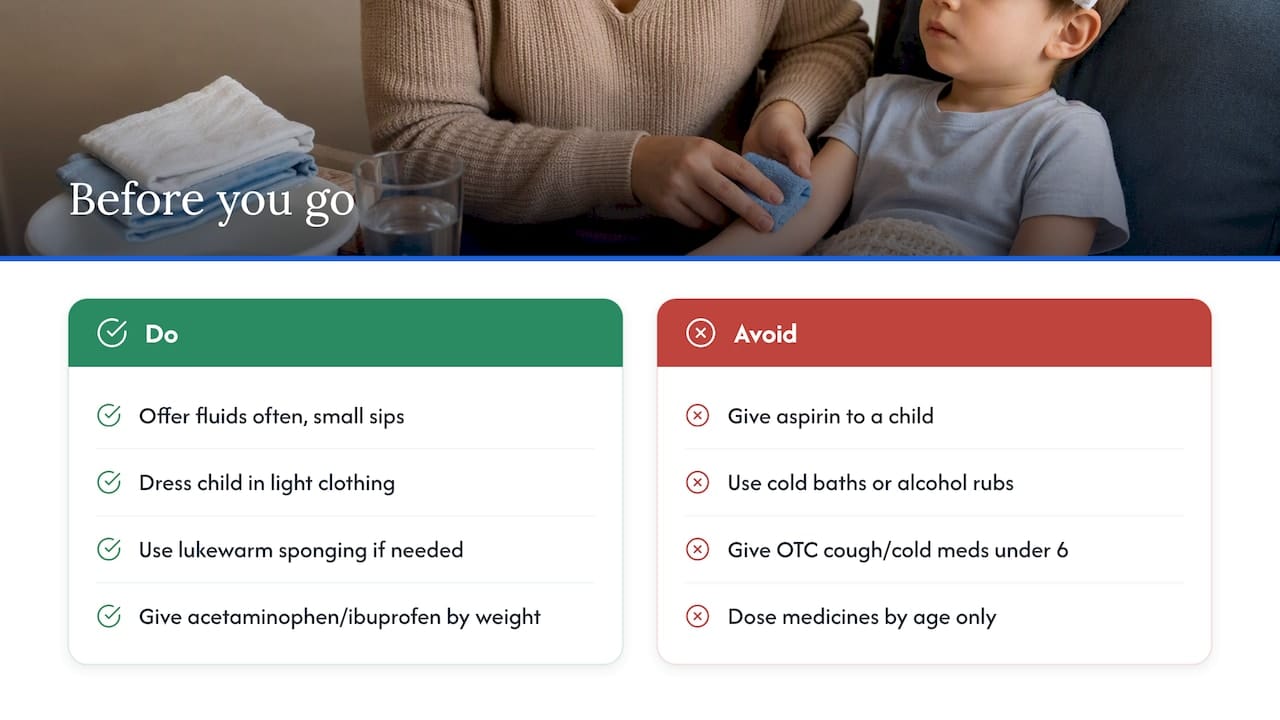
Most fevers in children respond well to simple care at home while you watch for the signs above. Offer fluids often, even in small sips, and dress your child in light clothing rather than bundling, which can trap heat in. Lukewarm sponging can help some children feel more comfortable, but avoid cold baths or alcohol rubs, which can cause shivering and raise the fever instead of lowering it.
Give acetaminophen or ibuprofen at a dose matched to your child’s weight, not just their age, and check the label or ask your pharmacist if you are unsure. Never give aspirin to a child with a fever, and skip over-the-counter cough and cold medicines for children under 6, since they are not recommended for that age group.
If fever keeps returning soon after medicine wears off, or climbs despite correct dosing, that pattern on its own is a reason to call your pediatrician or head to urgent care rather than waiting it out another day.
Pro Tip: Keep a simple fever log, noting the time, temperature, medicine and dose given, and how your child is acting. It speeds up triage and helps the clinician decide what tests or treatment your child needs.
Special situations that lower the threshold for urgent care
Some children need evaluation sooner, even with a fever that would otherwise seem manageable. Kids with asthma, diabetes, a weakened immune system, heart disease, or sickle cell disease face higher risk from fever and infection, so check in with a provider earlier rather than later.
If your child has a febrile seizure, lay them on their side, clear the area of hard objects, and do not put anything in their mouth. Once the seizure stops, have them evaluated, especially if it is their first one or it lasts more than a few minutes.
A low fever in the day or two after a vaccine is common and usually resolves on its own. Call your provider if it climbs high, lasts beyond 48 hours, or comes with unusual symptoms. For infants and very young children, the lower threshold described earlier still applies: when in doubt, get them seen.
Clinic perspective: how we handle pediatric fevers
Fevers rarely wait for business hours, which is why some clinics offer extended hours for same-day urgent care. A typical fever visit includes a history of symptoms, a physical exam, and rapid testing for strep or flu when indicated, along with hydration guidance and a prescription if one is warranted — learn more about the process in a pediatric blood draw. If your child shows any of the emergency warning signs covered above, we will direct you to the nearest emergency room without delay.
— Lisa
Getting your child seen quickly and what to bring
A fever at 7 PM on a Saturday should not mean a long emergency room wait when your child just needs a same-day exam. Same-day urgent care at Your Family Walk-In Clinic is available every day of the week, and you can call ahead or book online before you arrive.

Bring your fever log if you kept one, a list of any medications already given with doses and times, your child’s insurance card, and a form of ID. If flu is suspected, same-day treatment is available under our 48 Hour Rule, since antivirals work best when started early. Walk in or schedule your visit and get your child checked without the ER wait.
This article is general information, not a substitute for advice from a qualified doctor. Consult a qualified healthcare professional about your own circumstances before acting on anything here.
FAQ
Should I take my child to urgent care for a fever?
Urgent care is a good choice when your child has a persistent fever alongside symptoms like earache, sore throat, or repeated vomiting, but still remains interactive and responsive. If your child shows any emergency warning signs, such as trouble breathing or unresponsiveness, go to the emergency room instead.
How do I reduce a 104°F fever in a child?
Offer fluids, dress your child lightly, and give a weight-appropriate dose of acetaminophen or ibuprofen rather than relying on cold baths or alcohol rubs. A fever this high in an infant under 3 months, or one that does not respond to medicine, needs prompt medical evaluation.
My toddler has a 102°F fever. Should I be concerned?
For a child between 1 and 2 years old, a fever like this calls for monitoring over 24 to 48 hours rather than immediate alarm, as long as your toddler is still drinking fluids and acting mostly like themselves. Contact your pediatrician or seek urgent care if the fever persists past that window or your toddler becomes increasingly lethargic.
When should I be concerned about my child’s fever?
Be concerned right away if your infant is under 3 months old with a rectal temperature of 100.4°F or higher, or if any child shows warning signs like difficulty breathing, a stiff neck, or unresponsiveness. For older children without those signs, concern grows if the fever lasts more than 72 hours or behavior clearly worsens.
Sources
- Healthychildren
- Fever (patient education) – American Academy of Pediatrics (AAP)
- Signs and symptoms of flu – CDC
- Febrile seizures – MedlinePlus