


The most commonly used, evidence-based child therapies fall into a few clear categories: cognitive behavioral therapies (including trauma-focused CBT), play-based therapies for younger children, family and parent-child approaches, DBT for teens, and trauma-focused options like EMDR. The right choice depends on your child’s age, the specific problem you’re seeing, and whether you as the parent need to be part of the sessions. Whatever you choose, ask about the therapist’s specific training and keep your pediatrician in the loop.
TL;DR:
- Play therapy and parent-led behavior programs are most effective for children under age 7, especially those processing experiences through play rather than speech.
- For children aged 7 to 12, cognitive behavioral therapy gains effectiveness as they develop reflective thinking, but parental involvement remains important.
- Adolescents aged 13 and older are suitable for talk therapy, trauma processing like EMDR, and DBT skills training, with confidentiality considerations increasing with age.
- Parental involvement improves outcomes substantially across conditions such as anxiety and depression, with techniques ranging from brief coaching to full family sessions.
- Choosing a therapist with specific training and experience in your child’s age and issues, and understanding session formats and insurance logistics, can save time and improve treatment fit.
Table of Contents
- What Are the Main Types of Child Therapy?
- How Age Changes Which Therapy Works
- Does Parent Involvement Actually Change Outcomes?
- What to Ask Before Choosing a Therapist
- What Happens in the First Few Sessions?
- Our Perspective on Getting Kids Started Quickly
- Ready to Get Your Child Started With Therapy?
- Where to Learn More
- Sources
- FAQ
What Are the Main Types of Child Therapy?
Every therapy type approaches a child’s mind and behavior differently, and knowing the basics helps you ask smarter questions during a first phone call.
Cognitive Behavioral Therapy (CBT) works by helping kids notice the connection between their thoughts, feelings, and actions. It’s typically used with school-age children and up, since it requires some ability to reflect on one’s own thinking. A CBT session for anxiety might include naming worry thoughts, testing whether they’re realistic, and practicing calm-down skills between sessions. Common evidence-based therapy types include CBT, play therapy, and TF-CBT, and CBT remains the most researched approach for childhood anxiety and mild depression.
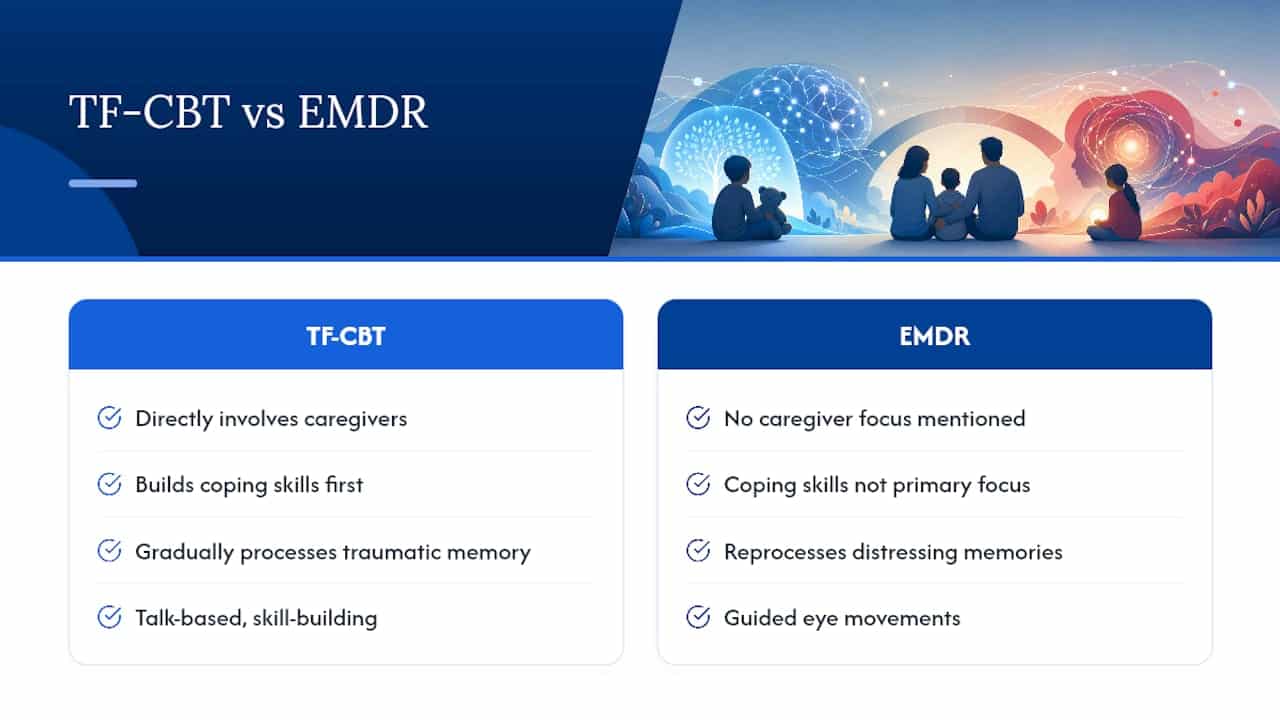
Trauma-Focused CBT (TF-CBT) and EMDR both target trauma, but they work differently. TF-CBT builds coping skills first, involves caregivers directly in sessions, and moves gradually toward processing the traumatic memory. EMDR uses guided eye movements to help the brain reprocess distressing memories, and generally requires specialized practitioner certification, making it more common with older children and teens who can follow the structured protocol.
Play therapy is often the entry point for preschoolers who can’t yet talk through their feelings the way adults do. A session might look like unstructured play with dolls, sand, or art supplies, while the therapist observes and gently reflects what the child is working through. Not every licensed therapist offers this. Many practitioners who specialize in play therapy do not see children younger than 7 because it demands specific training beyond a general counseling degree.
Parent-Child Interaction Therapy (PCIT) and family therapy shift the focus onto the relationship, not just the child. A therapist coaches you in real time, often from behind a one-way mirror or via an earpiece, while you practice new responses to your child’s behavior. This approach fits best when defiance, tantrums, or strained family dynamics are the main concern.
DBT skills groups teach teens concrete tools for managing intense emotions, tolerating distress, and reducing risky behaviors like self-harm. Sessions usually combine individual therapy with a structured group component.
Creative and occupational therapies round out the list. Art and music therapy give kids a nonverbal outlet, while occupational therapy addresses sensory processing or developmental delays that talk therapy alone won’t touch.
How Age Changes Which Therapy Works
A therapy that works beautifully for a 15-year-old can fall flat for a 4-year-old, and vice versa. Developmental stage should guide the choice, not just the diagnosis.
- Under age 7: Play-based approaches and parent-led behavior programs tend to work best, since young children process experiences through play rather than conversation.
- Ages 7 to 12: Talk therapies like CBT start to gain real traction as kids develop the reflective thinking needed to examine their own thoughts, though parent involvement still matters.
- Age 13 and up: Teens can engage with talk therapy, DBT skills training, and trauma processing like EMDR, and confidentiality becomes a bigger factor in how sessions run.
These are general guidelines, not hard cutoffs. A child with a developmental delay or autism may need play-based or sensory approaches well past age 7, and pediatricians stress that treating children as small adults is a mistake that leads to mismatched care.
Does Parent Involvement Actually Change Outcomes?
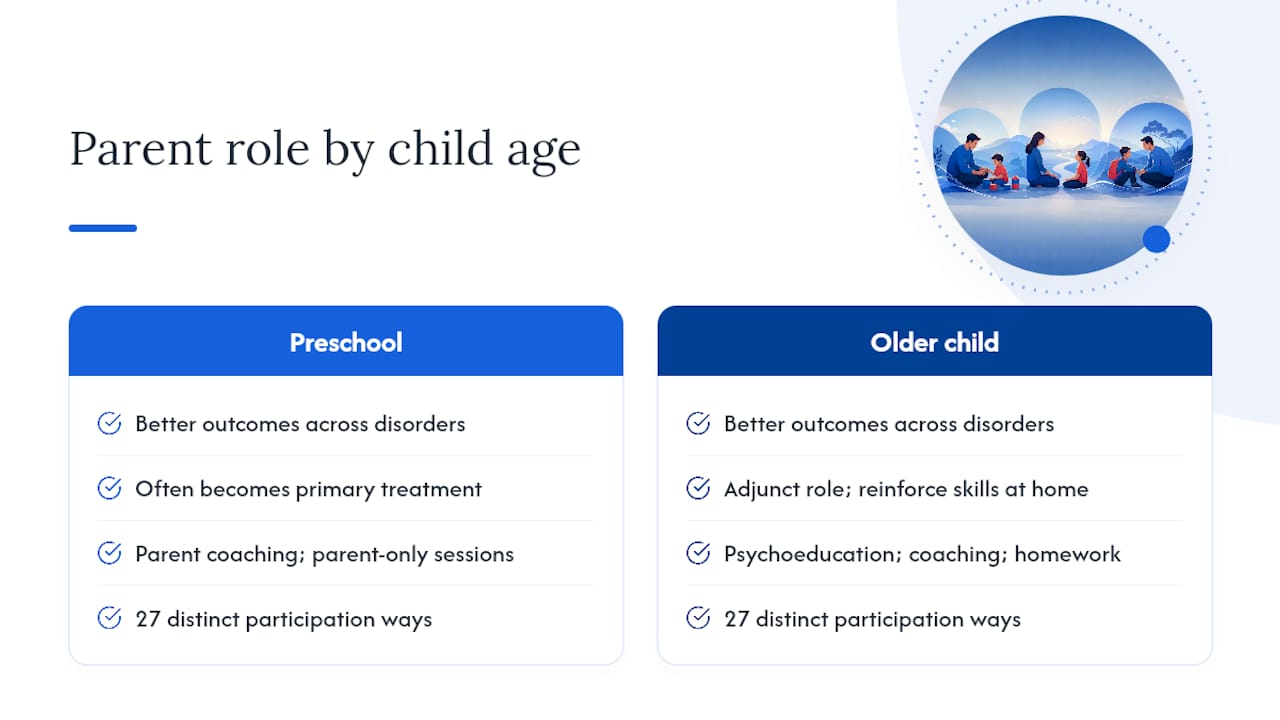
Yes, and the research on this point is fairly consistent. Parental involvement in child therapy is linked to significantly better outcomes across anxiety, ADHD, depression, and PTSD compared to treatment that leaves parents out entirely. That same research catalogs 27 distinct ways parents can participate, ranging from brief phone check-ins to full family sessions.
Involving caregivers isn’t a nice add-on to child therapy. For many conditions, it’s the mechanism that makes the treatment work at all.
In practice, this looks like psychoeducation about your child’s diagnosis, coaching sessions where you practice new responses, homework assignments between visits, and sometimes parent-only sessions when the child is very young. For preschoolers with behavior problems, clinician surveys show parent coaching often becomes the primary treatment rather than a supplement to it. For older kids, you’re more likely to be an adjunct, reinforcing skills at home rather than sitting in every session.
Pro Tip: Ask upfront how much homework the therapy involves for you, not just your child. A program that expects daily practice at home requires a real time commitment, and knowing that before you start prevents drop-off three weeks in.
What to Ask Before Choosing a Therapist
A few pointed questions during that first phone call can save you months of mismatched treatment.
- Licensing and specialization. Ask whether they hold an LPC, LCSW, PhD, or PsyD, and whether they have specific training in child-focused modalities like PCIT, TF-CBT, or EMDR.
- Experience with your child’s age and issue. A therapist skilled with teen anxiety isn’t automatically equipped for a 5-year-old’s tantrums. Ask for examples of similar cases.
- Format and logistics. Confirm session length, frequency, whether telehealth is offered, and how parent sessions fit into the schedule.
- Red flags. Be cautious of anyone who discourages coordination with your pediatrician or school, or who promises guaranteed results in a fixed number of sessions.
Our own guide to choosing a therapist walks through these questions in more depth if you want a printable checklist.
What Happens in the First Few Sessions?
The first visit is mostly about building trust, not diving into deep work. Intake typically involves a developmental history, screening tools, and consent forms, followed by goal-setting with you and, when appropriate, your child.
- Young children often spend early sessions playing while the therapist observes and builds rapport.
- Older kids and teens move faster into skills practice, but still need a session or two to feel comfortable opening up.
- Meaningful progress usually shows up gradually over several weeks, not overnight, and consistency between sessions speeds things along.
- Check your insurance benefits before the first appointment. Mental health coverage sometimes differs from standard medical coverage, so confirming in-network status avoids a surprise bill.
Preparing your child for what to expect also helps. Our guide to preparing for a first therapy session covers simple ways to explain the visit without creating unnecessary anxiety.
Our Perspective on Getting Kids Started Quickly
Delays between “something feels off” and “we’re getting help” can weigh on a family. Same-day availability and extended hours can help avoid waiting weeks just to get a first conversation started. Our team, including therapist Emily Gilbert, works with children and teens, including grief counseling, and coordinates directly with pediatric providers and schools when a child’s care needs that kind of continuity.
— Lisa
Ready to Get Your Child Started With Therapy?
Finding the right therapist shouldn’t require weeks of phone tag before your child even gets a first appointment. Some clinics offer same-day scheduling seven days a week, from morning to evening, so you can get a child-focused intake on the calendar with less delay.

Bring your child’s insurance card, a list of current concerns or behaviors you’ve noticed, and any relevant school or pediatrician notes to the first visit. Many clinics accept various insurance plans and self-pay, and can refer you to specialists if your child needs a more specific modality like PCIT or EMDR that falls outside general counseling. If your family also needs a wellness exam, physical, or other primary care service while you’re establishing care, we can often handle both in the same visit. Call or book online today to get your child’s first therapy appointment scheduled, or reach out with questions about whether a therapy program fits your child’s needs.
Where to Learn More
For deeper reading, the CDC’s guidance on treating children’s mental health offers practical, vetted resources for families. Always verify a clinician’s license and confirm your insurance coverage before your first appointment.
This article is general information, not a substitute for advice from a qualified doctor. Consult a qualified healthcare professional about your own circumstances before acting on anything here.
Sources
- Involving parents in child mental health treatments — PubMed
- Yale Child Study Center guidance
- Types of behavioral therapy — Northwestern Counseling
- Treating children’s mental health with therapy — CDC
FAQ
What Are the 7 Types of Therapy?
There’s no single official list of seven, but commonly cited approaches include CBT, TF-CBT, play therapy, family therapy, DBT, EMDR, and occupational or creative therapies like art and music therapy. Which ones apply to your child depends on their age and the specific concern you’re addressing.
What Is the 3-3-3 Rule for Children?
The 3-3-3 rule is a grounding technique, not a formal therapy type: a child names three things they can see, three sounds they can hear, and three things they can touch. It’s often taught in CBT or anxiety-focused sessions as a quick way to interrupt escalating worry.
How Do I Explain Therapy to a 9-Year-Old?
Keep it simple and low-stakes: describe therapy as a place to talk about feelings or practice new skills with someone whose job is to help kids, not as a punishment or sign that something is wrong with them. Answering their specific questions honestly, without overexplaining, tends to reduce first-visit anxiety more than a long speech.
What Are the Four Major Types of Therapy?
If you’re grouping by broad category, most clinicians point to cognitive behavioral approaches, play-based/expressive therapies, family and parent-child interventions, and trauma-focused therapies like TF-CBT and EMDR. Your Family Walk-In Clinic’s therapy program draws on several of these depending on what your child needs.
How Much Does Child Therapy Cost at Your Family Walk-In Clinic?
Current pricing for therapy and related services is available directly on our services and pricing page. We accept major insurance plans, Medicaid, and self-pay to help make sessions accessible for your family.