


An annual physical exam is a routine visit with a primary care provider. Its purpose is to check your overall health, catch problems early and plan prevention while you feel well. A typical visit covers your vital signs, a review of your health history, screening discussions, vaccines and any blood work that fits your age and risks. You do not need to be sick to book one. If you live in Lutz or the Tampa area, we offer wellness exams seven days a week, 8 AM to 8 PM, with same-day appointments.
This guide explains what happens in the exam room, what you can do beforehand, how often adults need a physical and where Medicare’s yearly wellness visit fits in.
TL;DR
- A physical is a prevention visit: vital signs, health history, screening discussions, vaccine updates and, when appropriate, lab tests.
- Many adults do well with a regular schedule, but the right timing depends on your age, health history and medicines. Ask your provider what is best for you.
- Bring a list of medications, supplements, allergies and questions. Ask ahead of time whether you need to fast for blood work.
- New symptoms or a chronic condition may need their own visit type, even if they are discussed at the same appointment.
- Medicare’s yearly wellness visit is a different service from a physical exam.
Table of Contents
- What an annual physical exam is
- What happens during the visit
- How often adults should get a physical
- How age and health history change the exam
- A checkup is not the same as a sick visit
- How to prepare
- Vaccines at your physical
- Physical exam vs. Medicare’s yearly wellness visit
- Questions to ask your provider
- Book your physical in Lutz
- FAQ
- Sources
What an annual physical exam is
For most adults, an annual physical means a checkup with a primary care provider to maintain wellness and prevent illness. JAMA’s patient guide on routine checkups notes that such a visit does not always include a hands-on physical examination, and it does not always have to happen every single year.
MedlinePlus gives the reasons to see a provider even when you are healthy: to screen for disease, lower your risk of future problems, encourage healthy habits, update vaccinations and build a relationship with someone who knows your history. That last point matters more than it sounds. When you are sick at 7 PM on a Tuesday, a provider who already knows you can act faster and with more context.
What happens during the visit
Every provider has a slightly different flow, but most visits follow the same steps.
- Check-in and history. A staff member confirms your medications, allergies, past conditions and family history. Updates since your last visit matter most.
- Vital signs. Expect blood pressure, heart rate, weight and height. JAMA lists these as standard parts of a checkup.
- Conversation with your provider. You talk about sleep, diet, activity, mood, alcohol or tobacco use, and anything that worries you.
- Physical exam, when appropriate. This may include listening to your heart and lungs, checking your head and neck, and examining your abdomen. Your provider decides what fits your situation.
- Screening and vaccine review. Your provider talks through cancer and other screenings that match your age and medical history, plus blood tests, immunizations and depression screening where appropriate.
- Plan. You leave knowing what is normal, what to follow up on and when to come back.
Do you have to undress?
It depends on what your provider needs to examine. You usually keep most of your clothing on for the conversation and vital signs. For parts of the exam, such as listening to your heart and lungs or checking your abdomen, you may be asked to change into a gown or move clothing aside. Privacy is part of the process. You can ask your provider to explain each step before it happens and to stop or skip anything you are uncomfortable with.
Screening, not just a head-to-toe scan
A physical is not a single “full body checkup” test. It is a set of choices made with you. The U.S. Preventive Services Task Force publishes Grade A and B recommendations for screening specific conditions. Examples include:
- High blood pressure in adults 18 and older
- Colorectal cancer in adults 45 to 75
- Type 2 diabetes in adults 35 to 70 who are overweight or have obesity
The American Heart Association recommends blood pressure screening for all adults. It says cholesterol screening is generally advised every 4 to 6 years for normal-risk adults, starting at age 20. For more on how we approach these, see our guide to common health screenings recommended by Tampa primary care providers and our page on blood pressure screening.
How often adults should get a physical
The honest answer is that it depends on you. JAMA says yearly visits matter most for adults 65 or older and for people with chronic illnesses or long-term medicines. Younger adults without symptoms should ask their provider about the best schedule. MedlinePlus also says recommendations are based on age and sex, so ask your provider how often you should come in.
A simple way to think about it:
| Your situation | What to discuss with your provider |
|---|---|
| Healthy adult, no symptoms | A schedule that fits your age, sex and family history |
| Taking long-term medication | A regular visit to review the medication and any needed lab work |
| Chronic condition such as high blood pressure or diabetes | Ongoing visits to monitor the condition |
| Age 65 or older | Yearly visits, with added checks for older adults |
| New or worsening symptoms | A visit for the symptom itself, not only a checkup |
If you have not seen a provider in years, you do not need to wait for a calendar date. Come in and start the record.
How age and health history change the exam
Age and medical history guide which screening tests and blood measurements make sense. JAMA notes that older adults may receive extra assessments, including fall risk, hearing, memory and advance directives. A 25-year-old, a 45-year-old and a 70-year-old can all have a good physical and walk out with very different to-do lists.
Family history shapes things too. If a parent had heart disease or colon cancer early, tell your provider. That can change when a screening begins.
A checkup is not the same as a sick visit
This trips up many patients. According to JAMA, chronic illnesses and new symptoms are not inherently part of a preventive checkup. They may require a separately billed acute or evaluation-and-management visit, although both can sometimes be addressed in the same appointment.
In practice, this means:
- If you come in for a preventive physical and mention a knee that has hurt for three weeks, your provider may address it or ask you to schedule a second visit.
- Your insurance may process the preventive portion and the problem-focused portion differently.
- Telling the front desk when you book helps us plan the right amount of time.
If the problem cannot wait, our urgent care is open the same hours as the rest of the clinic.
How to prepare
A little preparation makes the visit shorter and more useful.
- Write down your medications, supplements and allergies. Include doses and anything you take only occasionally.
- List your questions. Put the most important one first so it does not get lost.
- Gather your history. Note past surgeries, family conditions and the dates of recent screenings or vaccines.
- Ask about fasting. Not every blood test needs it. If your provider asks you to fast, follow the instructions you were given, and ask whether water is allowed. Our article on what you can drink before a blood test covers the details.
- Bring your insurance card and photo ID. If you have vaccine records, bring them.
- Wear comfortable clothing that is easy to move in and change.
Never stop a prescribed medicine to prepare for a visit unless your provider tells you to. If you are unsure whether to take a morning pill before fasting labs, call us and ask.
Vaccines at your physical
Updating immunizations is one of the main reasons to go. Adults may need a flu shot every season, and other vaccines depend on age and health conditions. Our adult vaccine schedule guide lays out the recommendations by age, and you can look at our flu shot page if that is what you need now. If you are looking for old records, read how to get immunization records in Florida.
Physical exam vs. Medicare’s yearly wellness visit
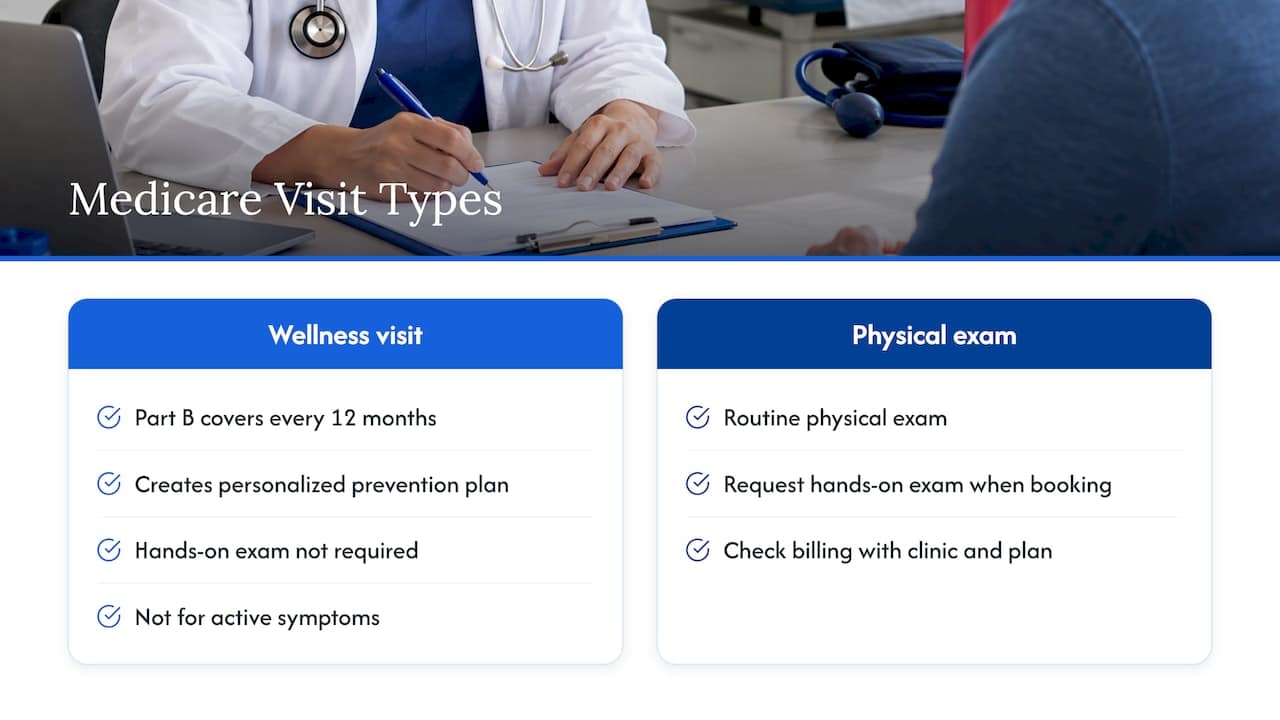
If you are on Medicare, the terms get confusing quickly. Medicare.gov explains that Part B covers a yearly Wellness visit once every 12 months. The visit is a conversation to create or update a personalized prevention plan, and it is not a routine physical exam. It also says to schedule specific health concerns separately.
The American Medical Association reported in January 2024 that the Annual Wellness Visit has no requirement for a hands-on exam such as listening to your heart and lungs. It focuses on health maintenance, preventive-care recommendations and screenings, not active symptoms or chronic-condition follow-up.
For a closer look at what providers must record during that visit, the AWV documentation requirements show how structured it is compared with a traditional exam.
The practical takeaway: do not assume the two are interchangeable. If you want a hands-on exam, tell the front desk when you book. Ask the clinic and your plan how each visit will be billed before your appointment.
Our perspective
At Your Family Walk-In Clinic, we see the same pattern every week. People put off a physical because it feels like a big commitment, then arrive with a problem that a simple screening could have flagged sooner. We built our model to remove those barriers: same-day appointments, hours from 8 AM to 8 PM every day of the week, and care for adults and children in one welcoming place.
A physical works best when it is a conversation, not a checklist. We want to know what worries you, what runs in your family and what you would like to change. Our providers bring more than 25 years of experience to that conversation, and we aim to explain every step in plain language so you never feel rushed or judged.
We also like that one visit can cover several needs. Depending on your situation, that may mean a wellness exam, lab work, an immunization and a plan for follow-up, all handled in the same clinic where you can come back if something changes. That continuity is the real value of having a primary care provider.
Lisa
Questions to ask your provider
A physical goes better when you leave with answers. Consider asking:
- Which screenings are right for me this year, and why?
- Do I need blood work, and should I fast?
- Are my vaccines up to date?
- Are my blood pressure and weight where they should be for my age?
- Do any of my medications need review?
- When should I come back?
If mood, stress or sleep are on your mind, say so. Depression screening is a normal part of a checkup, and we also offer therapy and counseling, in the office or virtually.
Book your physical in Lutz
We provide wellness exams, lab work, immunizations, screenings and medication refills for adults, along with care for children. We accept major health insurance plans, Medicaid and self-pay. We do not publish a fixed price for each service, so call (813) 792-8555 and our team will explain what applies to you before you come in.

You can see everything we offer on our services page, learn about our primary care providers, or tour the clinic first. For a deeper look at why regular visits matter, read the importance of yearly physicals.
If you need a school or sports clearance instead, our sports and school physicals page has what you need.
FAQ
What is included in an annual physical exam?
Most visits include blood pressure, heart rate, height and weight, a review of your health history and medications, and a talk about screenings and vaccines. Your provider may add blood tests, depression screening and a hands-on exam depending on your age and risks. The exact mix is tailored to you.
What should you not do before an annual physical exam?
Do not skip the preparation your provider gave you. If you were told to fast for blood work, follow those instructions and ask whether water is allowed. Do not stop prescribed medication on your own. If you are unsure about food, drink, alcohol or exercise beforehand, call the clinic and ask.
Do you take your clothes off for an annual physical?
Not entirely, in most cases. You may be asked to change into a gown or move clothing aside for parts of the exam, such as listening to your heart and lungs. You can ask your provider to explain each step and to stop at any point.
Is a Medicare wellness visit the same as a physical?
No. Medicare describes the yearly Wellness visit as a prevention-planning conversation, not a routine physical exam. Ask the clinic how your visit will be billed so you know what to expect.
Can I bring up a health problem during my physical?
Yes, and you should. Your provider may be able to address it during the visit or ask you to schedule a separate appointment, as JAMA explains. Mention it when you book so we can set aside enough time.
Sources
- Routine Checkups for Adults, JAMA Patient Information
- Physical exam frequency, MedlinePlus Medical Encyclopedia
- A and B Recommendations, U.S. Preventive Services Task Force
- Heart-Health Screenings, American Heart Association
- Yearly “Wellness” visits, Medicare.gov
- What doctors want patients to know about Medicare annual wellness visits, American Medical Association