


Postpartum depression is treatable, and talk therapy is one of the main ways it is treated. The two approaches with the strongest backing are cognitive behavioral therapy (CBT) and interpersonal therapy (IPT). Most people start by seeing a primary care provider or a mental health professional, and you do not have to wait until you feel “bad enough” to ask. This guide explains how each therapy works, what sessions are like, how long treatment usually lasts, and how to take the first step.
TL;DR
- CBT and IPT are the two evidence-based talk therapies for perinatal depression, according to the National Institute of Mental Health.
- Therapy often runs about 12 to 16 weekly sessions, though some people need a few weeks and others need longer.
- Therapy can be combined with medication. If you are nursing, talk with your provider about the baby’s exposure first.
- Start with a primary care provider or mental health professional. If you have thoughts of hurting yourself or others, call your ob-gyn, another health care professional, or emergency services right away.
- We offer in-office and virtual therapy for adults in Lutz, open seven days a week.
Table of Contents
- Baby blues or postpartum depression?
- Why treating it early matters
- The main types of postpartum depression therapy
- What therapy for new moms looks like
- How long does treatment take?
- Postpartum anxiety therapy
- Therapy and medication: how they can work together
- Take care of your body too
- What you can do alongside treatment
- How to get started
- Perspective
- Therapy options at Your Family Walk-In Clinic
- Frequently asked questions
- Sources
Baby blues or postpartum depression?
Many new parents feel tearful, anxious, or overwhelmed in the first days after birth. The baby blues usually get better within a few days or one to two weeks without treatment, according to ACOG.
If your symptoms last longer than that, or they make it hard to care for yourself or your baby, it is time to talk with a professional. Signs that deserve attention include:
- Sadness, emptiness, or hopelessness most of the day
- Constant worry, racing thoughts, or feeling on edge
- Trouble bonding with your baby
- Losing interest in things you used to enjoy
- Sleep problems that are not explained by the baby’s schedule
- Feeling like a failure as a parent
None of this is a character flaw. It is a health condition, and you can treat it the way you would treat any other one. Partners can experience postpartum depression too, and the steps below apply to them as well.
Why treating it early matters
Untreated perinatal depression can have serious effects on both the parent and the baby. The good news is that with proper treatment, most women feel better and their symptoms improve, as the NIMH explains. Asking for help is part of caring for your baby, not a sign that you are failing at it.
The main types of postpartum depression therapy
The NIMH names CBT and IPT as the evidence-based therapies for perinatal depression. Both are structured, time-limited, and focused on your current life rather than years of history.
Cognitive behavioral therapy (CBT)
CBT helps you notice and change unhelpful thoughts and behaviors. In the postpartum period those thoughts often sound like “I am a terrible mother” or “everyone else is managing better than I am.” Your therapist helps you test those thoughts against reality and replace them with more balanced ones.
The Association for Behavioral and Cognitive Therapies (ABCT) describes CBT as a very effective treatment for postpartum depression and anxiety, often delivered over 12 to 16 sessions. The same fact sheet reports that about one-third of mothers using CBT overcome postpartum anxiety and depression.
In practice, CBT tends to include:
- Identifying thoughts, feelings, and behaviors that keep the cycle going
- Small homework tasks between sessions, such as scheduling a short walk
- Practical skills for worry, sleep, and handling stress
Interpersonal therapy (IPT)
IPT focuses on your relationships and your support system. It aims to improve communication, build social support, and develop realistic expectations, which matters a great deal when your roles at home, at work, and with your partner have all just changed.
The Scottish NHS describes the reasoning this way: interpersonal distress can contribute to the emergence and maintenance of mental health problems. The same source describes IPT as a time-limited treatment, typically delivered by trained practitioners over 12 to 16 weekly sessions of about 45 to 50 minutes.
CBT or IPT: which fits you?
Both are well supported, so the better question is which feels more natural to you right now.
| If this sounds like you | You may lean toward |
|---|---|
| Your mind is stuck on harsh or looping thoughts | CBT |
| You feel isolated, or your relationships are under strain | IPT |
| You are anxious and want concrete tools for worry | CBT |
| You are adjusting to a new role and want support with expectations | IPT |
You do not need to decide alone. A good therapist will explain the approach, adjust it to you, and change course if it is not helping.
What therapy for new moms looks like
In talk therapy, you discuss your feelings and learn how to manage them, as ACOG describes it. That is the whole idea, and it is less intimidating than it sounds.
A typical course goes like this:
- First visit. You talk about what you have been feeling, how long it has lasted, and what your days look like. The therapist asks about sleep, appetite, support at home, and your safety.
- Setting goals. Together you choose what to work on first, such as sleep, worry, or feeling connected again.
- Weekly sessions. Sessions are usually about 45 to 50 minutes. You practice skills and review what happened during the week.
- Checking progress. Your therapist tracks your symptoms over time and adjusts the plan.
- Wrapping up. As you feel better, sessions space out and you make a plan for handling hard days.
You can talk about the things that are hard to say out loud: resentment, intrusive worries, guilt, or feeling no connection with the baby. A good therapist hears these without judgment.
How long does treatment take?
ACOG says therapy may last a few weeks, a few months, or longer. For structured CBT or IPT, plan on roughly 12 to 16 weekly sessions as a starting point, as the ABCT and NHS sources above describe.
Many people notice some relief before the course ends. How fast you improve depends on how severe your symptoms are, how much sleep and support you have, and whether you also take medication.
Postpartum anxiety therapy
Postpartum depression often comes with anxiety, and anxiety can happen on its own. You might feel constant dread, check on the baby again and again, or lie awake while the baby sleeps. CBT is used for both. The ABCT fact sheet covers postpartum depression and anxiety together, and the approach is similar: identify the unhelpful thoughts, understand how they drive your feelings and behavior, and practice new responses.
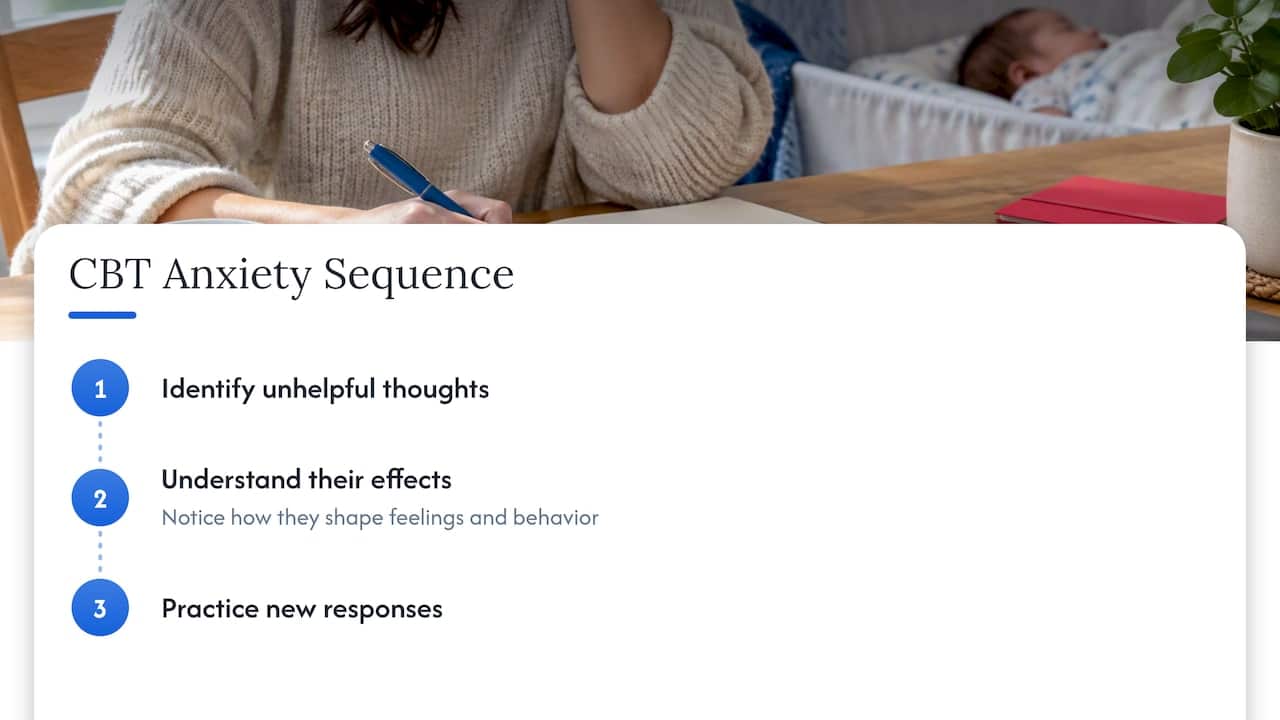
If worry is the main thing you notice, say so at your first appointment so the plan can target it.
Therapy and medication: how they can work together
Treatment for perinatal depression may combine therapy and medication, according to the NIMH. Some people do well with therapy alone. Others benefit from both, especially when symptoms are more severe.
What to know about medication:
- Antidepressants can treat perinatal depression alone or with psychotherapy. They usually take 4 to 8 weeks to work, per the NIMH.
- The FDA has approved zuranolone, an oral medication for postpartum depression in adults, taken for 14 days, as ACOG notes.
- Side effects of antidepressants are often temporary and fade after a short time. Call a health care professional about severe or unusual side effects that affect your daily life.
- If your depression gets worse soon after you start a medication, or you have thoughts of hurting yourself or others, call your ob-gyn, another health care professional, or emergency medical services right away.
If you are breastfeeding
Tell your health care provider that you are nursing. The NIMH advises weighing the risks and benefits of each treatment option while keeping the baby’s exposure to medication as low as possible. Do not stop or start a medication on your own. Your prescriber and your baby’s pediatrician can work out a plan together.
One more point from the research: coordination among maternity care and mental health providers helps assure safe management of treatment, as a consensus bundle on maternal mental health describes. In plain terms, it helps when your therapist, your prescriber, and your ob-gyn know about each other.
Take care of your body too
Recovery from birth is physical as well as emotional, and ongoing discomfort can wear down your mood and sleep. If cramping is part of your day, this guide on postpartum cramp relief covers drug-free options. Mention persistent or severe pain to your provider rather than waiting it out.
What you can do alongside treatment
Self-help does not replace therapy, but it supports it. The ABCT suggests practical steps such as scheduling activities like exercise or social time, getting out of the house, and seeking extra help with the baby or household duties.
A few ways to put that into practice:
- Pick one small activity a day, such as a ten-minute walk, and put it on the calendar.
- Say yes when someone offers to hold the baby, cook, or fold laundry.
- Tell your partner or a trusted friend which tasks would help most.
- Protect one stretch of sleep when you can, even if it means handing off a feeding.
- Keep your therapy appointments on the schedule like any other medical visit.
How to get started
The NIMH advises that if you think you have perinatal depression, you start by making an appointment with a health care provider, such as a primary care doctor or a mental health professional. You can begin in whichever place feels easiest.
Before your first visit, it helps to jot down:
- When the symptoms started and how they have changed
- Your sleep, appetite, and energy
- Any medications or supplements you take, and whether you are nursing
- Questions you want answered
- Your insurance information, if you plan to use it
When you need help right away
Call emergency services or go to the nearest emergency room if you have thoughts of hurting yourself or your baby, or if you are seeing or hearing things that are not there or feel confused. If you are unsure where to turn for treatment referrals, the SAMHSA National Helpline is a free, confidential service open around the clock, in English and Spanish. To decide between a clinic visit and the emergency room for physical symptoms, see our guide on when to go to a walk-in clinic vs. the ER.
Perspective
Parents tell us the hardest part is not the treatment. It is picking up the phone. A new baby leaves almost no room in the day, and many parents assume that feeling this way is just part of the job.
That is why we built our clinic around flexibility. We are open seven days a week from 8 AM to 8 PM, we offer both in-office and virtual therapy, and we see adults and children under one roof. A parent can book a therapy visit without arranging a separate trip across town, and our team has more than 25 years of combined experience behind that care.
Our advice is simple: if something feels off, say so early. You do not need a perfect description of your symptoms. A conversation with a primary care provider or a therapist is enough to begin. You can read more about our counseling approach on our therapy page.
Lisa
Therapy options at Your Family Walk-In Clinic
We offer therapy and counseling for adults and children, both in the office in Lutz and by virtual session. If distance, childcare, or a rough night makes travel hard, a virtual visit can be easier to fit in. Our article on online therapy effectiveness looks at what the research shows about therapy delivered online.
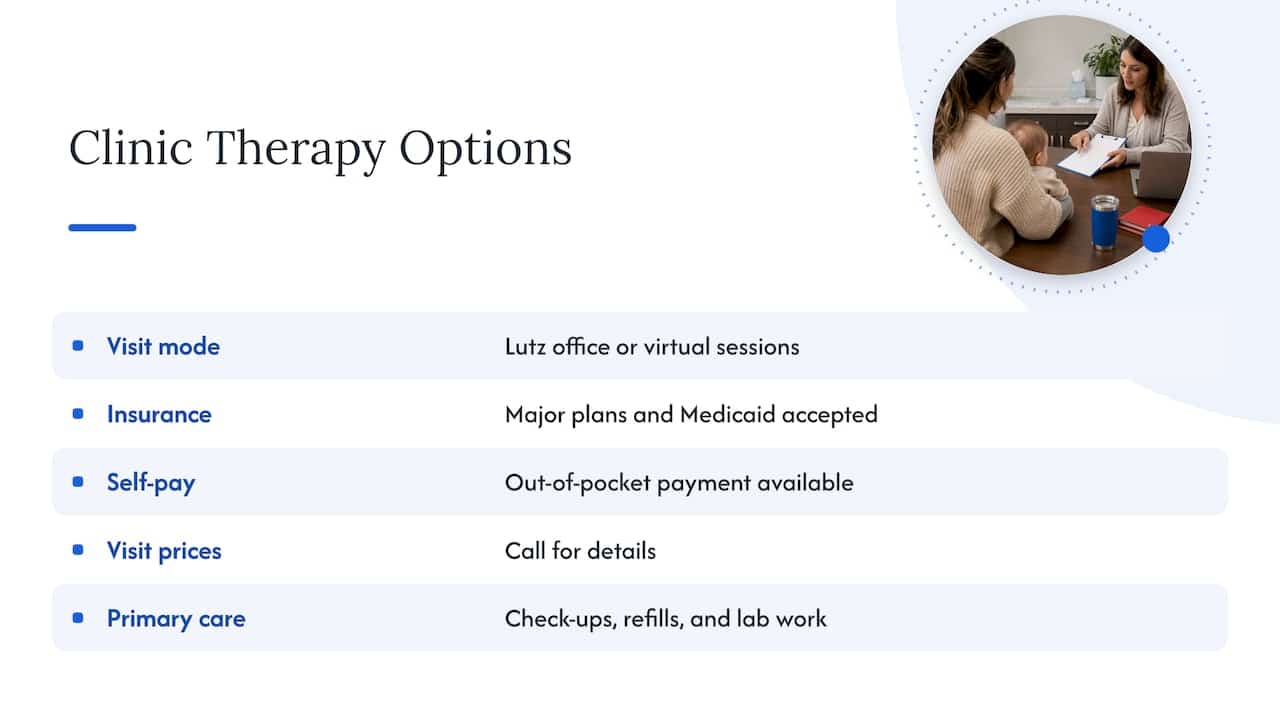
We accept major health insurance plans and Medicaid, and you can also pay out of pocket. We do not publish prices, so call or contact us for details on your visit.
If you also need a check-up, medication refill, or lab work, our primary care team can see you at the same clinic. For a first step, visit our clinic site to see hours and services and to book.
If you want to meet us first, you can tour the clinic and see what a visit feels like.
Frequently asked questions
What type of therapy is best for postpartum depression?
CBT and IPT are the two evidence-based talk therapies named by the NIMH for perinatal depression. Neither is universally better. CBT targets unhelpful thoughts and behaviors, while IPT targets relationships and support. Your therapist can help you choose based on what you are struggling with most.
Can I do therapy online?
Yes. Our clinic offers virtual therapy sessions as well as in-office visits. Many new parents find a video session easier because there is no travel and no need to arrange childcare for the commute. Ask the clinic which format suits your situation.
Will I need medication?
Not necessarily. Treatment may involve therapy, medication, or both, and the right mix depends on your symptoms. If you are nursing, tell your provider so the two of you can weigh the benefits and risks and keep the baby’s medication exposure low.
How soon will I feel better?
It varies. ACOG notes that therapy may last a few weeks, a few months, or longer, and antidepressants usually take 4 to 8 weeks to work, per the NIMH. Most women feel better with proper treatment. If you feel worse at any point, contact your provider rather than waiting.
Sources
- Perinatal Depression, National Institute of Mental Health
- Postpartum Depression, ACOG
- Postpartum Depression and Anxiety fact sheet, ABCT
- Interpersonal Psychotherapy for common mental health problems in the perinatal period, NHS Scotland Matrix
- Consensus Bundle on Maternal Mental Health, PubMed Central
- SAMHSA National Helpline