
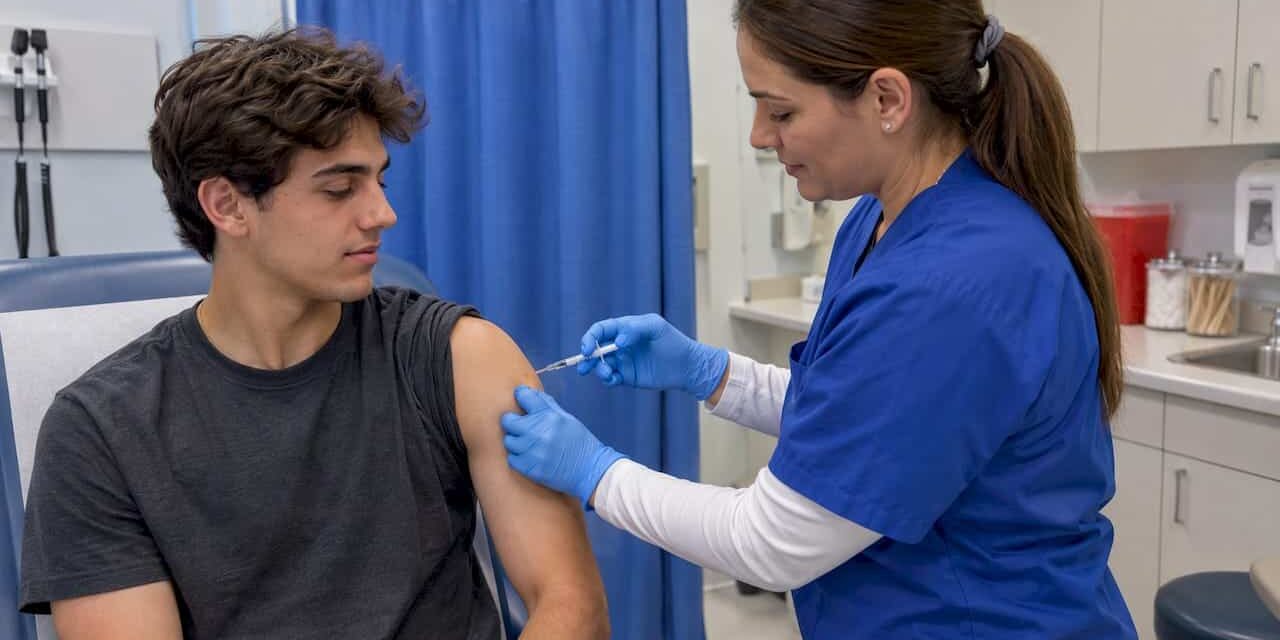
If you are heading to college, you most likely need a MenACWY meningitis vaccine, and many schools require proof of it before you move in. The CDC lists first-year college students living in residence halls among the adults for whom MenACWY vaccination is recommended. A second vaccine, MenB, is a separate decision to make with a healthcare provider. This guide explains the difference, the timing, how state rules work, and what to do if your records are missing.
TL;DR
- MenACWY is the vaccine most colleges ask for. It protects against serogroups A, C, W and Y.
- If your first dose was at ages 11 to 12, you need a booster at 16 or later. If your first dose came at 16 or older, you generally do not need a booster.
- MenB protects against a different serogroup. It is decided through a conversation with your provider, with ages 16 to 18 preferred.
- Requirements depend on your state and your school, so check your college’s health portal early.
- Can’t find your records? Your provider, your state immunization registry, or your old schools can often help.
Table of Contents
- Why colleges ask for a meningitis vaccine
- Do you need the vaccine for college?
- MenACWY vs. MenB: what is the difference?
- Timing: when to get vaccinated and whether you need a booster
- How state and college requirements differ
- How to check whether you are already vaccinated
- Side effects and safety
- When MenB first became available
- A practical checklist before move-in
- Our perspective
- Get your college vaccines handled in Lutz
- FAQ
- Sources
Why colleges ask for a meningitis vaccine
Meningococcal disease is rare, but it is serious and it moves fast. Colleges pay attention to it because of how campus life works. Researchers who reviewed the topic note that students live in close quarters and share social behaviors that raise the risk of spreading the bacteria. Outbreaks are also costly to contain and can spread from a campus into the surrounding community.
The same review reports that from 2009 to 2013, 75% of college-related meningococcal outbreaks were caused by serogroup B. That is one reason MenB gets so much attention on campuses, even though the overall risk for any one student stays low.
In practical terms, a requirement protects you and the people around you. It also keeps a school from having to manage an outbreak among thousands of students who share dining halls, dorm floors and group housing.
Do you need the vaccine for college?
The short answer: probably yes for MenACWY, and it depends for MenB.
The CDC recommends meningococcal vaccination for all preteens and teens, and for children and adults at increased risk. The CDC also notes that many colleges require proof of MenACWY vaccination within 5 years before you start school. That five-year window matters. A dose you received at age 11 may count as “on record” but still be too old for your school’s rule.
Whether you are required to have it comes down to three things:
- Your state. Some states mandate it by law for all colleges, some only for students in campus housing, and some leave it to each school.
- Your school. Even where the state has no rule, a college can set its own.
- Your housing. Many schools apply the rule only to students living on campus, while others apply it to everyone enrolled.
The fastest way to know is to open your school’s student health or immunization page and read the checklist. Most have a form your provider can complete.
MenACWY vs. MenB: what is the difference?
These are two different vaccines, and getting one does not cover you for the other.
| MenACWY | MenB | |
|---|---|---|
| Protects against | Serogroups A, C, W and Y | Serogroup B |
| Who gets it | All adolescents, with doses at ages 11 to 12 and 16 | Adolescents and young adults through shared clinical decision-making, ages 16 to 18 preferred |
| Commonly required by colleges | Yes, in many states and schools | Rarely, though some schools require or recommend it |
| Booster | At 16 if the first dose was at 11 to 12 | Not routine for healthy people |
The CDC’s vaccine recommendations describe MenACWY as recommended for all adolescents. For MenB, they describe a decision made together with a provider rather than a universal rule. Two MenB vaccines are licensed in the U.S. for people aged 10 through 25.
What “shared clinical decision-making” means for MenB
MenB is not on the same footing as MenACWY because the overall disease burden among healthy teens and young adults is low. CDC’s evidence review says that low burden lowers the overall benefit of routine MenB vaccination, which is why the recommendation is for individual decisions.
The Minnesota Department of Health takes a similar view. It says MenB is not routinely recommended for college students because incidence is very low, but it also says students ages 16 to 23 should talk with a healthcare provider about the vaccine, and that some colleges require it.
So the useful question is not “Is MenB required?” It is “Does MenB make sense for me?” Questions worth raising with your provider:
- Does my school require or recommend it?
- Will I live in a dorm or other close housing?
- Has there been a campus outbreak where I am going?
- Do I have a health condition that raises my risk?
If an outbreak of serogroup B happens on your campus, MenB vaccination can become a recommendation for people at risk there. The CDC also recommends both MenACWY and MenB for adults with certain risk factors, including complement deficiency, a missing or damaged spleen, complement-inhibiting medicines, or routine occupational exposure to the bacteria. If any of those apply to you, tell your provider.
Timing: when to get vaccinated and whether you need a booster
The CDC schedule is built around the years when risk is highest. MenACWY is recommended at ages 11 to 12, with a booster at 16, because protection decreases over time.
Here is how that plays out for a typical incoming student:
- First dose at 11 or 12, no booster yet: you need a booster at 16 or older. Many parents miss this one, because the first shot happened years ago and nothing prompted a second.
- First dose at 16 or older: you generally do not need a booster. The CDC says teens whose first MenACWY dose comes at or after age 16 do not need one.
- MenB: healthy adolescents vaccinated with MenB do not need routine boosters, though a booster may be recommended for people at increased risk during an outbreak, according to the CDC’s recommendations.
A good rule: count back. If your last MenACWY dose was more than five years before the first day of classes, check whether your school will accept it. If you got it at 16 and you start college at 18, you are usually fine.
Try not to leave this for move-in week. Some schools set a deadline for submitting records, and some states have a rule about how long before the semester the dose must be given.
How state and college requirements differ
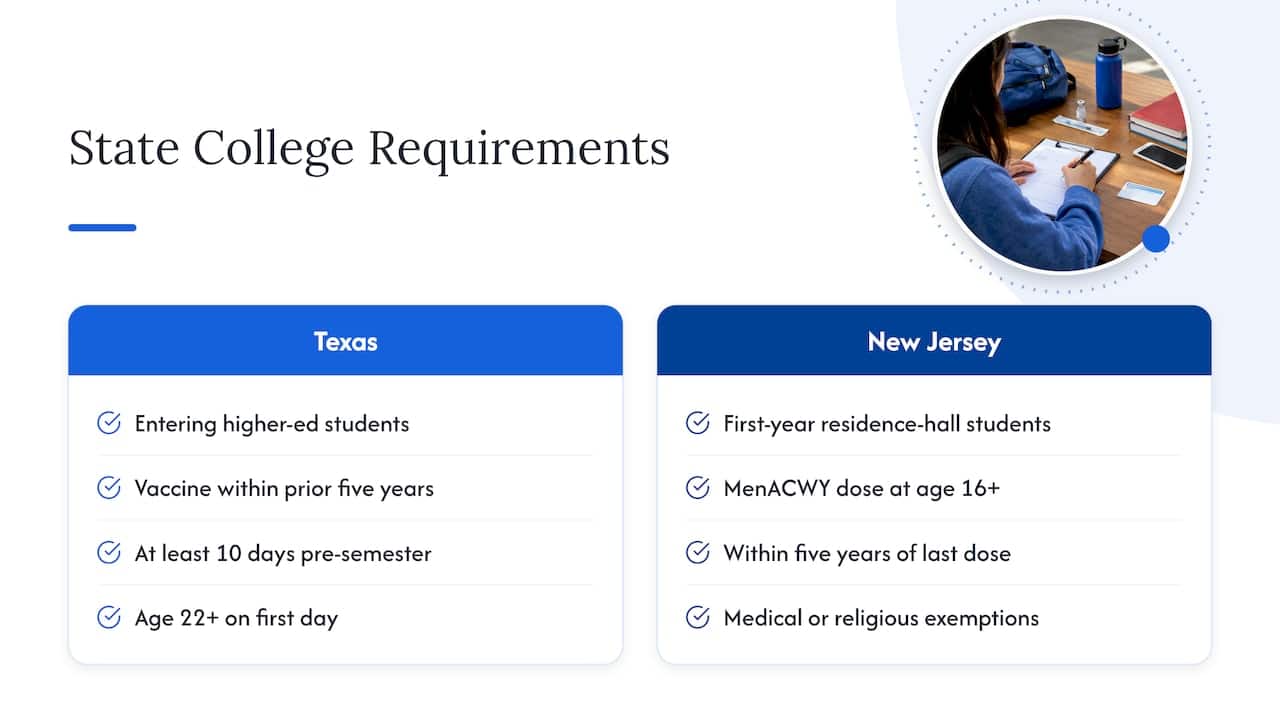
There is no single national mandate. As of February 2025, at least 22 states require meningococcal vaccination for college students, according to the National Conference of State Legislatures. The details vary a lot, and two examples show how.
Texas. Entering higher-education students must show a bacterial-meningitis vaccination received during the preceding five years and at least 10 days before the first semester. The state lists exemptions, including being 22 or older on the first day, online-only enrollment, military service, and qualifying medical or conscientious exemptions, on the Texas Higher Education Coordinating Board page.
New Jersey. First-year students living in residence halls need a MenACWY dose on or after age 16 and within five years of their last dose, according to the state’s implementation guidance for colleges. New Jersey allows medical exemptions written by a physician or nurse practitioner and religious exemptions, but not philosophical ones.
The lesson is not to memorize these two states. It is that the dose date, the age at the dose and your housing status can each change the answer. Always use the state health department or your college’s own page as the final word.
Out-of-state students
The rule that applies is generally the one for the state where your college is, not where you live. A Florida student attending school in Texas follows the Texas rule. If you are planning to go out of state, look at that state’s requirement as well as your school’s checklist.
How to check whether you are already vaccinated
Many families assume the shot was given at the 11 to 12 checkup, and it often was. But “I think so” will not satisfy a school form. Here is how to confirm.
- Ask your pediatrician or primary care provider. Their office can print your immunization history.
- Check your state immunization registry. The California Department of Public Health calls using a registry to look up vaccine history highly recommended. Registries differ by state, so search for yours.
- Contact previous schools. Students who cannot find records may be able to get them through a provider, a registry or previous schools, according to New Jersey guidance.
- Look at military, camp or sports forms. Old physical forms sometimes list vaccine dates.
If you live in Florida, our guide on how to get immunization records in Florida walks through the options for parents and adults.
If no record turns up, some states require revaccination. New Jersey, for example, says students without records must be revaccinated to attend college. That is not a bad outcome. It is a short appointment.
Side effects and safety
Most people have mild reactions, such as redness or soreness where the shot was given. The Minnesota Department of Health says the risk of serious problems is extremely small, and vaccination is safer than getting the disease.
To make the appointment go smoothly:
- Tell the provider about any severe allergic reaction you have had to a vaccine or its ingredients.
- Mention if you are sick with a moderate or severe illness, or pregnant, so the provider can decide on timing.
- Eat beforehand and sit for a few minutes after the shot, especially if you tend to feel faint with needles.
- Use a cold compress or move your arm gently if it is sore.
If you have trouble breathing, swelling of the face or throat, or a fast heartbeat after a vaccine, call 911. For questions about your own health history, your primary care provider is the right person to ask.
When MenB first became available
Since MenB comes up in many college conversations, a little history helps. The FDA licensed the first MenB vaccine, Trumenba, in October 2014, and a second, Bexsero, in January 2015, as the CDC’s 2015 report describes. Before that, no MenB vaccine was licensed in the U.S. During a 2013 to 2014 university outbreak in New Jersey, the FDA authorized investigational use of Bexsero. That is part of why campuses treat serogroup B so carefully.
It also means that if you were vaccinated as a young child, you would not have received MenB. Teens and young adults have had the option only since 2014 to 2015.
A practical checklist before move-in
- Read your school’s immunization requirements and note the deadline.
- Check your state’s rule if you are going out of state.
- Find your records, or request them from your provider or registry.
- Count your MenACWY dose dates: age at first dose, and whether it falls within five years.
- Book a visit for any missing dose or booster, and talk about MenB.
- Ask your provider to complete the school form, and keep a copy.
- Review other vaccines at the same time. Our college vaccine guide for families covers what else schools often ask for, and the adult vaccine schedule shows what to keep up with after you graduate. MMR is another common question, and our page on whether adults need the MMR vaccine can help.
Our perspective
Every August we hear the same thing from parents: “We thought this was done.” A teen got a shot at 11, nobody mentioned a second one, and now a college form is due in a week.
That is why we treat the college vaccine visit as a records check first and a shot second. We look at what has been given, when it was given and what your school actually asks for. Then we talk through MenACWY, the booster, and whether MenB makes sense for your situation.
Our clinic is built for exactly this kind of timing problem. We are open seven days a week from 8 AM to 8 PM, we offer same-day appointments, and we see both adults and children, so a parent and a student can often handle things in one trip. You do not have to wait on a long scheduling queue to get a form completed.
Our providers have more than 25 years of experience, and we want students to leave knowing what they got, why, and what comes next. If your records are missing, we will help you figure out the path forward instead of sending you away.
Lisa
Get your college vaccines handled in Lutz
If you are a student or parent in Lutz or the Tampa area, we can review your records, talk through MenACWY and MenB, and help you with school paperwork. We offer immunizations, wellness exams, physicals and more, and we accept major insurance plans, Medicaid and self-pay. Call ahead to confirm which vaccines we have on hand for your visit.
Need a physical for a college sport at the same time? Ask about our sports and school physicals. If you get sick before you leave for campus, our urgent care is open every day too.
FAQ
Is the meningitis vaccine required for college?
It depends on your state and your school. At least 22 states require meningococcal vaccination for college students, and many schools have their own rules even where the state does not. Check your college’s health portal for the exact requirement.
Do I need MenB for college?
Usually it is a personal decision rather than a requirement, though some colleges require or recommend it. The CDC recommends deciding with your provider, with ages 16 to 18 preferred. Talk to your provider about your housing, your school’s policy and any health conditions.
Do I need a booster if I got vaccinated at age 11 or 12?
Yes, in most cases. The CDC recommends a MenACWY booster at age 16 for those who had their first dose at 11 to 12. If your first dose came at 16 or older, you generally do not need one.
What if I can’t find my vaccination records?
Start with your pediatrician or primary care provider, then your state immunization registry and any previous schools. If nothing turns up, your provider can tell you whether revaccination makes sense, and some states require it.
Why do colleges require meningitis vaccines?
Students live close together, and the bacteria spread through close contact. Outbreaks are serious and expensive to contain, so schools use vaccine requirements to lower the chance of one starting.
Sources
- Meningococcal disease and vaccination in college students
- Recommended Vaccines for Adults | Meningococcal | CDC
- Meningococcal Vaccination | CDC
- Recommended Vaccines for Preteens and Teens | CDC
- Meningococcal Vaccine Recommendations | CDC
- Grading of Recommendations: MenB in young adults | CDC
- Meningococcal Disease and the Vaccine: What College Students Need to Know | Minnesota Department of Health
- State Vaccine Requirements for College Entry | NCSL
- Bacterial Meningitis | Texas Higher Education Coordinating Board
- Institutes of Higher Education Implementation Guidance | New Jersey Department of Health
- Implementation of Meningococcal Vaccine Requirements | New Jersey Department of Health
- Immunization requirements for college | California Department of Public Health
- Use of Serogroup B Meningococcal Vaccines in Persons Aged 10 Years or Older | CDC MMWR
- First Use of a Serogroup B Meningococcal Vaccine in the US