


Family therapy improves communication, reduces the intensity and frequency of conflict, and strengthens a family’s ability to handle stress together, whether that stress is a teenager’s behavior, a parent’s illness, or a loved one’s substance use. Research supports both symptom relief and better day-to-day family functioning. Below, you will find the concrete benefits, what the evidence actually shows, what sessions look like, and how to get started.
TL;DR:
- Family therapy produces small but meaningful improvements in communication, conflict resolution, and family functioning within a few months.
- Structured goals and real-time coaching help change interaction patterns, but progress depends on consistent practice and specific, measurable targets.
- Most benefits are seen when therapy addresses behavioral issues, substance use, eating disorders, or depression, with better outcomes when family involvement is active and defined.
- Early progress often includes reduced arguments and better follow-through on treatment plans, with fewer emergency visits and hospitalizations over time.
- It is less effective in crisis situations requiring urgent individual care or when family members are uncomfortable with initial tension or uncomfortable topics.
Table of Contents
- Family Therapy Benefits You Can Expect Session by Session
- What the Research Says About Family Therapy Outcomes
- Who Family Therapy Helps Most
- Inside a Family Therapy Session
- Preparing for Your First Family Therapy Appointment
- How Long Family Therapy Takes and What Progress Looks Like
- When Family Therapy Isn’t the Right First Step
- Where Your Family Walk-In Clinic Fits Into This Picture
- Why I Think Families Underestimate the Work Involved
- Ready to Book Family Therapy? Here’s What to Have Ready
- Sources
- FAQ
Family Therapy Benefits You Can Expect Session by Session
The biggest shift most families notice first is in how they talk to each other. A therapist trained in systemic work will slow down a heated exchange, teach turn-taking, and coach family members to state a need without an accusation attached to it. If a teenager says “you never listen to me” and a parent fires back “that’s not true,” the session stalls. A therapist redirects: “Tell your mom what you needed her to hear.” That small correction, repeated across sessions, becomes a habit families carry home.
Conflict resolution works the same way, through structure rather than willpower. Families often walk in with the same argument on a loop, missed curfews, chores, screen time, and no agreed process for resolving it. A therapist helps the family set ground rules for disagreement (no interrupting, no bringing up unrelated grievances) and walks them through mediated problem-solving on a specific issue. According to SAMHSA, this kind of structured support benefits the whole family unit, not just the person identified as having the problem.
Family therapy also does real clinical work beyond communication. When one family member is managing a mental health condition or recovering from substance use, therapy sessions built around that person’s treatment plan improve adherence and can lower relapse risk, according to SAMHSA’s guidance on family involvement in recovery. Families learn to recognize early warning signs together instead of leaving one person to monitor everything alone. Cleveland Clinic notes that family therapy is linked to improvements in both emotional and physical health outcomes for many participants, which is a wider payoff than most people expect walking in.
Secondary benefits tend to surface a few weeks in, once the primary conflict has cooled:
- More consistent parenting between two caregivers who previously disagreed on discipline
- Better co-parenting communication after a separation or divorce
- Fewer crisis-driven calls to a pediatrician or emergency room because problems get addressed earlier
- Reduced caregiver burnout when responsibility for a sick or struggling family member is shared more evenly
- A shared vocabulary for naming problems, which cuts down on the guessing and resentment that build when nobody names the issue directly
Pro Tip: Ask your therapist to help you set one small, measurable goal per session, such as “we will both use a calm voice during Sunday’s check-in,” instead of chasing a vague goal like “communicate better.” Specific goals are easier to know you have actually hit.
What the Research Says About Family Therapy Outcomes
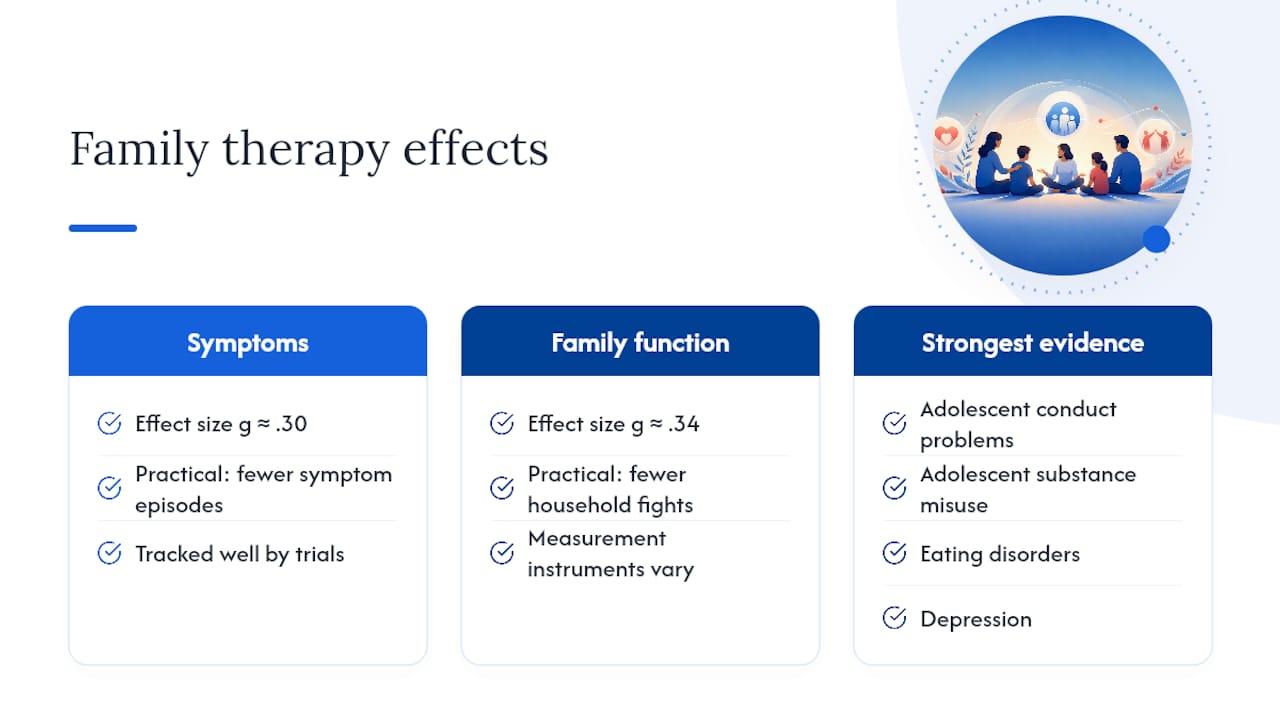
The clearest evidence comes from a multilevel meta-analysis of systemic family therapy, which found small but statistically meaningful effects on both individual symptoms and on how well the family system functions as a whole. The PMC review reports comparable effect sizes for symptom improvement (g ≈ .30) and for family functioning (g ≈ .34), meaning therapy helps on two fronts at once rather than fixing one person while leaving the household dynamic unchanged.
Family therapy is not measured by a single outcome. The same body of research shows it moves the needle on symptoms and on the relationships surrounding those symptoms, which is closer to how families actually experience their problems in the first place.
The conditions with the strongest evidence base include adolescent conduct problems, adolescent substance misuse, eating disorders, and depression. Manualized approaches like Family-Based Treatment for eating disorders often show more consistent results than looser, non-systemic approaches, because the format gives parents a defined, active role in recovery rather than a passive one. SAMHSA’s clinical summary echoes this, framing family involvement as protective against relapse across several behavioral health conditions.
What does a “small to moderate” effect actually mean at your kitchen table? It does not mean dramatic overnight change. It means a family fighting three times a week might drop to once a week within a few months, or a teenager who shut down completely starts answering in full sentences again. These are the increments therapy research is built to detect, and they are also the increments that make daily life livable.
The honest caveat: studies in this field use different instruments to measure “family functioning,” which makes results harder to compare cleanly across trials, and few studies track family-system change with the same rigor they apply to individual symptoms. Program evaluations cited in NCBI’s review of family-involved treatments also point to a practical upside beyond symptoms: some family interventions reduce outpatient visits and emergency-level interventions, which matters for families juggling both a mental health issue and its cost.
Who Family Therapy Helps Most
Family therapy fits a wider range of situations than most people assume before their first call. It is built for systems under strain, not just for one “problem person” in the household.
Common profiles that benefit include:
- Parents of teenagers with escalating behavioral issues, truancy, or conduct problems at school
- Families supporting a member with a substance use disorder, where relapse risk drops when the whole household understands its role
- Couples experiencing relational distress that is spilling over into parenting or extended-family conflict
- Caregivers of a relative with a chronic illness who need a shared plan for medical adherence and emotional support
- Families adjusting to a new diagnosis, disability, or major life transition that has scrambled everyone’s routines
Presenting issues typically include communication breakdown, long-running estrangement between a parent and adult child, bullying or school-related conflict, and struggles getting a family member to stick with a medical or psychiatric treatment plan. Systematic reviews confirm family therapy has been applied and studied across this entire range, from childhood behavioral disorders to chronic illness adjustment in adults.
If one person is in acute crisis, individual therapy or urgent care usually comes first, with family sessions added once that person is stable. For most other situations, starting family and individual therapy at the same time gives the best of both, personal support alongside relationship repair.
Inside a Family Therapy Session
The first session is mostly assessment, not treatment. A therapist maps out family structure (who lives where, who plays what role, recent stressors) and asks each person, briefly, what they hope changes. Goals get set collaboratively, not handed down from the therapist.
From there, sessions typically follow this rhythm:
- Check-in on the goal from last time. Did the family try the communication technique or the agreed household rule?
- A live enactment. The therapist asks family members to talk through a real disagreement in the room, then interrupts to coach a better pattern in real time.
- Skill-building. This might be boundary work, role clarification (who decides what), or structured listening exercises.
- Homework assignment. A small, specific task to practice before the next visit, such as a weekly family check-in or a scripted way to raise a complaint.
Sessions generally run 50 to 60 minutes and happen weekly or every other week, tapering as the family stabilizes. Multi-family formats, where several households work through similar issues together in one room, are common for conditions like eating disorders and substance use, and they add peer accountability that one-family sessions cannot replicate.
Pro Tip: Expect early sessions to feel a little uncomfortable. NAMI’s guidance on family therapy notes this discomfort is normal and usually a sign the room is finally addressing something the family had been avoiding, not a sign therapy is going poorly.
One thing worth knowing upfront: the therapist’s job is to stay neutral. They are not a judge assigning blame, and they are not there to referee who is “right.” A therapist who consistently sides with one family member has stopped doing family therapy.
Preparing for Your First Family Therapy Appointment
A little preparation makes the first session far more productive. Before you go in, gather what you need and decide, as a family, who is actually attending.
- Verify your insurance coverage or confirm self-pay costs ahead of time so money isn’t a distraction during intake
- Bring photo ID and a current medication list if any family member takes psychiatric or other regular medication
- Write down one or two specific goals in plain language, such as “reduce the daily arguing about screen time”
- Decide in advance whether the whole household attends or just the people most involved in the presenting issue
- Prepare a short, honest answer to “what have you already tried” so the therapist isn’t starting from zero
When you’re screening a potential therapist, ask directly about their experience with systemic or family-based approaches, their licensure, how they handle confidentiality among family members, and whether telehealth sessions are available for scheduling flexibility. Our guide to choosing a therapist walks through these questions in more depth.
Watch for red flags: a therapist who promises a quick fix, who visibly takes one family member’s side session after session, or who discourages you from also following up with a physician or psychiatrist when medical issues are in play. Family therapy works alongside medical care, not as a replacement for it.
How Long Family Therapy Takes and What Progress Looks Like
Most families notice communication improve first, often within four to eight sessions, before deeper shifts in family functioning show up. That sequence tracks with the research: symptom relief and relational change move on related but separate timelines, so faster talking-to-each-other progress does not always mean the underlying pattern has fully shifted yet.
Concrete markers of real progress include fewer arguments escalating to yelling or slammed doors, family members initiating a hard conversation instead of avoiding it, and better follow-through on a medical or behavioral treatment plan. Program data reviewed by NCBI also links successful family interventions to fewer emergency-level healthcare contacts over time, a useful outside marker beyond how sessions feel.
If progress stalls after a reasonable number of sessions, that’s a signal to add individual therapy for the person carrying the heaviest symptom load, revisit medication with a physician, or check in with the treating therapist about adjusting the approach rather than assuming therapy has failed.
When Family Therapy Isn’t the Right First Step
Family therapy is not built for every moment. If someone in the household is in acute crisis, actively suicidal, or facing an immediate medical emergency, that needs urgent individual care first. Family sessions can follow once the person is stable, not instead of that care.
Sessions can also get uncomfortable before they get better. Bringing a long-avoided issue into the room sometimes escalates tension short-term, and a skilled therapist will manage that pace rather than let it spiral, but families should expect some friction as part of the process, not a sign something has gone wrong.
Confidentiality works differently in family sessions than in individual therapy. What one family member shares may come up in front of others, and therapists are bound by mandatory reporting laws around abuse or imminent harm regardless of who is in the room. Ask your therapist to walk through these limits at intake, before anyone shares something they assumed was private.
Where Your Family Walk-In Clinic Fits Into This Picture
A local family medical clinic provides therapy services with a patient-centered approach. Same-day appointments can help families in crisis avoid long waits for an intake slot. Collaborative therapist Emily Gilbert works with families in-office and via telehealth, and short-term follow-up after early sessions helps keep momentum going instead of losing it between widely spaced visits. If you’re weighing your options, reach out to ask about availability.
Why I Think Families Underestimate the Work Involved
Most people walk into family therapy expecting insight to fix things. It doesn’t. What fixes things is repetition, the same corrected conversation pattern practiced in session after session until it becomes automatic instead of effortful. Professor Peter Stratton’s framing of systemic therapy as mobilizing a family’s own internal resources gets at something important: the therapist isn’t the one doing the healing. The family is, with better tools.
That’s why I push families toward small, measurable goals over vague ones. “Communicate better” cannot be tracked. “Use a calm voice during the Sunday check-in” can. If your family is stuck, that specificity is where to start, and asking for help sooner rather than later tends to make the whole process shorter.
— Lisa
Ready to Book Family Therapy? Here’s What to Have Ready
Your Family Walk-In Clinic offers family therapy both in-office and through telehealth, with same-day scheduling for families who need to talk to someone sooner rather than later. That flexibility matters most in the exact moment therapy feels most urgent: right after a blowup, not three weeks from now when the intake calendar finally opens up.
When you call or book online, have your insurance information, a photo ID, and one or two specific goals for the family ready to share. Deciding beforehand who will attend the first session also speeds up intake. Visit the therapy services page to learn more about scheduling with Emily Gilbert, or if a family member also needs urgent medical attention alongside counseling support, our urgent care services are open seven days a week from 8 AM to 8 PM. Call or book online today to get a same-day appointment on the calendar.
Sources
- Family Therapy: What It Is, Techniques & Types – Cleveland Clinic
- Family Interventions: Basic Principles and Techniques – PMC
- Family Therapy Can Help – SAMHSA Library (PDF)
This article is general information, not a substitute for advice from a qualified doctor. Consult a qualified healthcare professional about your own circumstances before acting on anything here.
FAQ
Which of the Following Is a Benefit of Family Therapy?
Improved communication, reduced conflict escalation, and better adherence to medical or behavioral treatment plans are among the most well-documented benefits, according to both Cleveland Clinic and SAMHSA.
Why Is Family-Based Therapy Important?
It treats problems as patterns within the whole household rather than issues belonging to one person, which research links to improvements in both individual symptoms and overall family functioning.
How Does Family Systems Therapy Help?
It changes how family members interact in real time through techniques like enactments and structured communication training, rather than relying on insight alone to produce change.
What Are the Goals of Family Therapy?
Goals typically include improving communication, resolving specific recurring conflicts, supporting treatment adherence for a medical or behavioral condition, and strengthening the family’s overall ability to cope with stress together.