


Yes, get Tdap during every pregnancy, ideally between 27 and 36 weeks gestation. The CDC, ACIP, and ACOG all agree on this recommendation, and the evidence behind it is strong. Getting Tdap between 27 and 36 weeks of pregnancy lowers the risk of whooping cough in babies younger than 2 months old by 78% — a statistic that reflects real protection during the most dangerous window of a newborn’s life.
Here is what you need to know right now:
- Get Tdap in every pregnancy, even if you received it recently or during a prior pregnancy.
- The optimal window is 27–36 weeks, with earlier in that range preferred to maximize antibody transfer to your baby before birth.
- Postpartum vaccination protects you, but it does not pass immediate antibodies to your newborn — that transfer only happens before delivery.
- Tell your prenatal provider at your next visit, or book a same-day appointment at a clinic that offers immunizations.
The vaccine works by prompting your immune system to produce antibodies that cross the placenta and give your newborn a head start against whooping cough before they are old enough to receive their own DTaP series.
Key Takeaways
Tdap during pregnancy, given at 27–36 weeks, is the single most effective way to protect your newborn from whooping cough before they can receive their own vaccine series.
| Point | Details |
|---|---|
| Optimal timing | Receive Tdap between 27–36 weeks of every pregnancy, as early in that window as possible. |
| 78% protection | Maternal Tdap at 27–36 weeks reduces whooping cough risk in infants under 2 months by 78%. |
| Every pregnancy rule | Prior Tdap vaccination does not protect a subsequent newborn; antibodies wane within months to a year. |
| Safety confirmed | Systematic reviews and FDA-approved surveillance show no consistent link to adverse pregnancy outcomes. |
| Your Family Walk-In Clinic | Offers same-day Tdap immunizations in Lutz, FL, seven days a week, with insurance and self-pay options. |
Table of Contents
- Why Tdap during pregnancy protects your newborn
- Who should get Tdap during pregnancy and when
- Is Tdap safe during pregnancy? What the evidence shows
- Which Tdap vaccines are used in the U.S. and what to know before your visit
- What to expect at your Tdap appointment
- What to do if you missed Tdap during pregnancy
- Get your Tdap vaccine at Your Family Walk-In Clinic
- What the conventional advice on Tdap in pregnancy gets wrong
- Tdap immunizations, available now at Your Family Walk-In Clinic
- Sources
- FAQ
Why Tdap during pregnancy protects your newborn
Newborns cannot receive their first DTaP dose until 2 months of age. That gap leaves them completely unprotected against pertussis (whooping cough) during the weeks when the disease is most likely to be fatal or require hospitalization. Pertussis in early infancy can cause prolonged coughing fits, oxygen deprivation, and pneumonia — and infants under 2 months account for the majority of pertussis-related deaths in the United States.
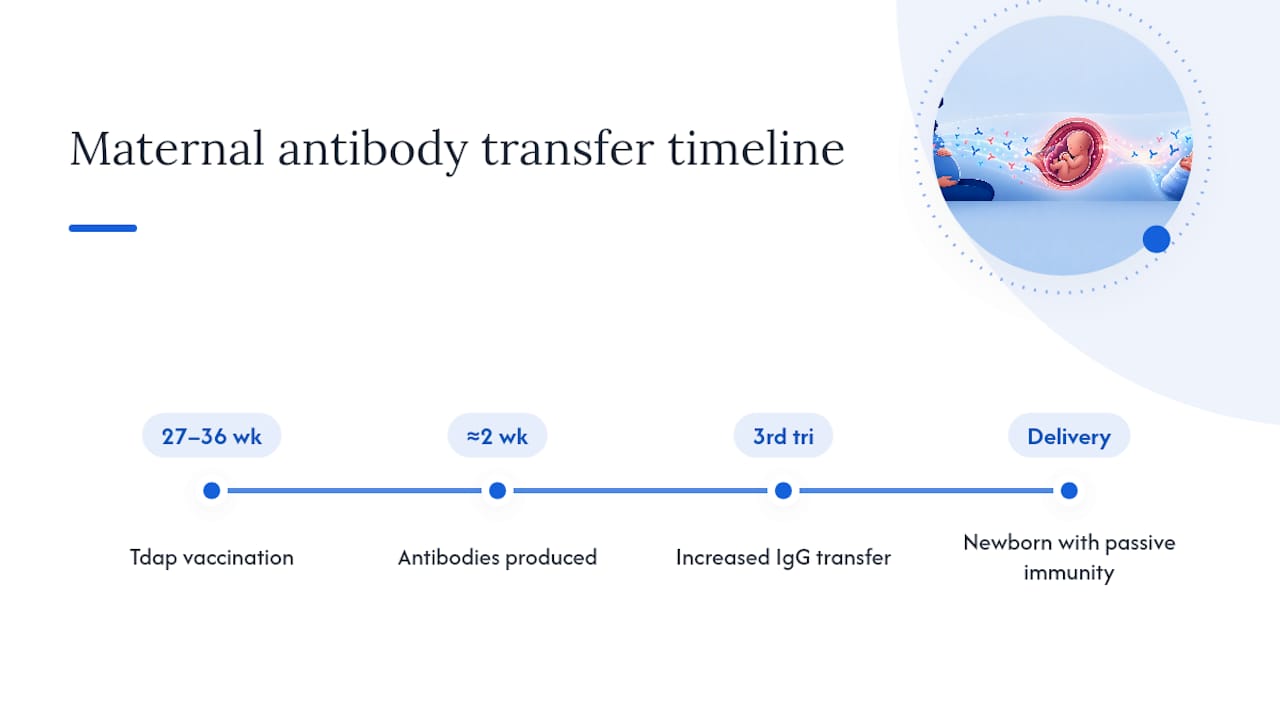
Maternal vaccination closes that gap through passive immunity. After you receive Tdap, your body produces anti-pertussis antibodies within about two weeks. Those antibodies are then transported across the placenta to your baby via a process that accelerates in the third trimester. Placental IgG transport increases substantially in late pregnancy, which is the physiologic reason the 27–36 week window exists — it gives your antibodies time to peak and then transfer in meaningful quantities before delivery.
CDC surveillance data show that infant pertussis rates declined after the “every pregnancy” recommendation took effect, and vaccinated mothers’ infants have lower rates of hospitalization compared to infants of unvaccinated mothers.
Who should get Tdap during pregnancy and when
The answer is straightforward: every pregnant person, every pregnancy, regardless of prior vaccination history. The CDC recommends a single dose of Tdap during every pregnancy, preferably during the early part of gestational weeks 27 through 36.
Why every pregnancy — even if you were recently vaccinated
Maternal anti-pertussis antibodies wane over months to a year after vaccination. A Tdap dose you received before or during a previous pregnancy may not produce antibody levels high enough to protect a subsequent newborn. The “every pregnancy” rule is rooted in this antibody kinetics reality, not in a conservative overcaution.
ACOG’s 2026 maternal immunization schedule recommends discussing vaccines at the first prenatal encounter and advises Tdap as early as possible in the 27–36 week window for each pregnancy. Bringing it up early builds confidence and gives you time to schedule without rushing.
Step-by-step timing guide
- At your first prenatal visit: Ask your provider to flag Tdap on your prenatal care plan and confirm your vaccination history.
- At 27 weeks: Schedule Tdap if you have not already received it during this pregnancy. Earlier in the window is better.
- Before delivery: Confirm the vaccine was documented in your medical record and request a printed copy to bring to the hospital.
- If you deliver preterm (before 27 weeks): Receive Tdap as soon as possible after delivery and prioritize household vaccination immediately.
- Exception — wound management: If you need a tetanus-containing vaccine for wound care during pregnancy, do not delay — give Tdap when indicated regardless of gestational age.
Pro Tip: Ask your OB or midwife to co-administer Tdap with your flu shot at the same visit. Both are recommended in pregnancy and can be given together safely, saving you an extra trip.
Is Tdap safe during pregnancy? What the evidence shows
Safety is the question most pregnant people ask first, and the evidence is reassuring. Both Tdap vaccines used in the United States, Boostrix (GlaxoSmithKline) and Adacel (Sanofi), are FDA-approved for use in pregnancy and have not produced safety signals in post-market surveillance systems including VAERS and V-safe.
A review of multiple studies found no convincing evidence linking prenatal Tdap vaccination to increased risk of adverse pregnancy outcomes, including stillbirth or preterm birth. An independent evidence review by the Vaccine Integrity Project at CIDRAP reaffirms that maternal Tdap protects infants during their highest-risk period, consistent with the findings of large observational cohort studies.
ACIP’s 2012 recommendation to vaccinate during every pregnancy was based on modeling showing that prenatal vaccination prevents more infant cases, hospitalizations, and deaths than postpartum vaccination alone. That modeling has since been supported by real-world surveillance data.
Common side effects vs. serious reactions
Most side effects are mild and resolve within a day or two:
- Local reactions: soreness, redness, or swelling at the injection site (most common)
- Systemic reactions: mild fatigue, low-grade fever, or headache
- Serious reactions: severe allergic reactions (anaphylaxis) are extremely rare; seek emergency care immediately if you develop hives, difficulty breathing, or facial swelling after vaccination
The benefit of protecting your newborn from a potentially life-threatening illness far outweighs the temporary discomfort of a sore arm.
Which Tdap vaccines are used in the U.S. and what to know before your visit
Two Tdap vaccines are available in the United States: Boostrix and Adacel. Both are FDA-approved for use in adults and adolescents, and both are used in pregnancy. Neither is specifically preferred over the other for pregnant patients — whichever your clinic or pharmacy has in stock is appropriate.
Tdap differs from DTaP (the childhood series) in that it contains lower doses of the diphtheria and pertussis antigens, making it suitable for adults. When comparing Tdap vs. Td (tetanus-diphtheria only), Tdap is the preferred choice during pregnancy because it adds pertussis protection that Td does not provide.
Contraindications and precautions
- Absolute contraindication: a severe allergic reaction (anaphylaxis) to a prior dose of Tdap, DTaP, or any component of the vaccine.
- Precaution: a history of encephalopathy within 7 days of a prior pertussis-containing vaccine with no other identifiable cause.
- Not a contraindication: prior Tdap within 1–2 years. You should still receive Tdap during this pregnancy.
Co-administration and documentation
Tdap can be given at the same visit as the flu vaccine, COVID-19 vaccine, or RSV vaccine — no spacing is required between inactivated vaccines. Ask your provider to document the vaccine in your electronic medical record and request a printed copy. Alert your pediatrician before delivery so they can coordinate your infant’s DTaP schedule from the start.
Pro Tip: If you received Tdap earlier in this pregnancy for wound management or another clinical reason, do not repeat the dose in the 27–36 week window. One dose per pregnancy is the standard recommendation.
What to expect at your Tdap appointment
Tdap is given as a single intramuscular injection, typically in the upper arm. The visit itself takes about 15 minutes, including a brief post-injection observation period. You do not need to fast or prepare in any special way.

Managing side effects at home
Soreness at the injection site is the most common reaction. A cool compress applied for 15–20 minutes can reduce local discomfort. Acetaminophen is generally considered safe in pregnancy for mild fever or discomfort — confirm with your provider before taking any medication.
Cost and insurance coverage
Most insurance plans, including Medicaid, cover Tdap during pregnancy with no out-of-pocket cost under the Affordable Care Act’s preventive care provisions. Call your insurer before your appointment to confirm coverage and ask whether you need to visit an in-network provider. If you are uninsured, ask the clinic about self-pay rates; many walk-in clinics offer transparent pricing.
When to call your provider: Contact your OB or the clinic immediately if you develop hives, difficulty breathing, or swelling of the face or throat after vaccination. Mild soreness and low-grade fever are expected and do not require a call.
What to do if you missed Tdap during pregnancy
Missing the 27–36 week window is not ideal, but it is not the end of your options. Here is what to do:
- If you are still pregnant and past 36 weeks: Receive Tdap as soon as possible before delivery. Even a dose given late in pregnancy provides some antibody transfer.
- If you have already delivered without receiving Tdap: Get vaccinated postpartum as soon as possible. Postpartum vaccination protects you and may reduce the chance you transmit pertussis to your infant, but it does not confer immediate passive immunity to the newborn — that window has passed.
- Cocooning strategy: Anyone who will be in close contact with your newborn should be up to date on Tdap. This includes partners, grandparents, older siblings, and regular caregivers. Anyone who has never received Tdap as an adult, or whose last Tdap was more than 10 years ago, should get vaccinated at least two weeks before meeting the baby.
- Prioritize household vaccination immediately: Do not wait until after the baby arrives to arrange this. Two weeks are needed for full antibody development.
- Schedule your infant’s DTaP series: Your baby’s own protection begins at 2 months with the first DTaP dose. Make sure your pediatrician has your vaccination record so they can coordinate the infant schedule.
Cocooning alone is not as protective as maternal vaccination during pregnancy, but it meaningfully reduces the pool of people who could transmit pertussis to your newborn in those early weeks.
Get your Tdap vaccine at Your Family Walk-In Clinic
Your Family Walk-In Clinic in Lutz, Florida offers immunizations, including Tdap, seven days a week from 8 AM to 8 PM. No long wait, no appointment required — walk in when it fits your schedule, or call ahead to confirm availability.

The clinic accepts major insurance plans, Medicaid, and self-pay, and the team can help you verify coverage before your visit. Bring your insurance card, a photo ID, and any prior vaccination records you have. The flu shots service page shows the range of immunizations the clinic provides, and the same team handles Tdap for pregnant patients with the same same-day efficiency.
If you are in the Tampa area and want to get your Tdap dose without scheduling weeks out, walk in or book a same-day visit at Your Family Walk-In Clinic. The staff will document your vaccine, provide a printed record, and answer any questions you have about timing, side effects, or next steps for your newborn’s care.
What the conventional advice on Tdap in pregnancy gets wrong
Most articles about Tdap in pregnancy do a reasonable job of stating the recommendation. Where they fall short is in explaining why the “every pregnancy” rule exists, and why that distinction matters for the patient sitting in the exam room who just got Tdap 18 months ago and feels like she is being over-vaccinated.
The answer is antibody kinetics, and it is worth stating plainly: the antibodies your body produced during your last pregnancy have likely waned to levels too low to protect a new newborn. Pregnancy does not reset your immunity — it depletes it. Vaccinating again during this pregnancy is not redundant; it is the only reliable way to ensure your baby is born with meaningful antibody levels.
The second gap in conventional advice is the framing of postpartum vaccination as a reasonable fallback. It is not equivalent. Postpartum Tdap protects you and may reduce your chance of transmitting pertussis to your infant, but it does not give your newborn the passive immunity they need in the first weeks of life. The window for that transfer closes at delivery. Framing postpartum vaccination as “almost as good” understates the real difference in protection during the highest-risk period.
What you should prioritize: get Tdap between 27 and 36 weeks, document it, and make sure every close contact is vaccinated before your baby comes home. Those two steps together give your newborn the strongest possible start.
Tdap immunizations, available now at Your Family Walk-In Clinic
Pregnant and need Tdap this week? Your Family Walk-In Clinic offers the same-day access that prenatal schedules actually require. Open every day from 8 AM to 8 PM in Lutz, Florida, the clinic provides Tdap immunizations without the weeks-long wait of a specialist referral.
The clinic accepts major insurance plans and Medicaid, and the staff can walk you through coverage before your dose. Bring your insurance card and any prior vaccine records. You will leave with a printed vaccination record to share with your OB and pediatrician. For families in the Tampa area, this is the practical, no-hassle path to getting this done on your schedule. Visit the clinic or book your same-day appointment today.
This article is general information, not a substitute for advice from a qualified doctor. Consult a qualified healthcare professional about your own circumstances before acting on anything here.
Sources
The recommendations and evidence in this article draw from the following primary sources:
- Tdap Vaccination for Pregnant Women | Whooping Cough
- ACOG Releases 2026 Maternal Immunization Schedule | ACOG
- Tdap vaccination during pregnancy and risk of … – PMC
FAQ
Is Tdap really necessary during pregnancy?
Yes. Tdap during pregnancy is the most effective way to protect your newborn from whooping cough before they can receive their own vaccine at 2 months. The CDC, ACIP, and ACOG all recommend it for every pregnancy.
What happens if I don’t get Tdap while pregnant?
Your newborn will not receive the maternal antibodies needed to protect them against pertussis in their first weeks of life. Infants under 2 months are at the highest risk of severe disease, hospitalization, and death from whooping cough.
Why do I need Tdap in every pregnancy if I already got it before?
Anti-pertussis antibodies wane within months to a year after vaccination. A prior dose does not reliably protect a subsequent newborn, which is why one Tdap dose per pregnancy is recommended regardless of your vaccination history.
Can I refuse the Tdap vaccine during pregnancy?
You can decline any vaccine, but the evidence strongly supports receiving it. Skipping Tdap leaves your newborn unprotected during the weeks when whooping cough is most dangerous, and postpartum vaccination does not replace the passive immunity that prenatal vaccination provides.
Where can I get Tdap in the Lutz or Tampa area?
Your Family Walk-In Clinic in Lutz, Florida provides Tdap immunizations seven days a week from 8 AM to 8 PM, with same-day availability, insurance billing, and printed vaccine records for your prenatal and pediatric care team.