


Yes, you can get a doctor appointment without insurance, and you have more options than you might expect. The fastest path to affordable care is to call a local walk-in clinic or community health center, ask directly for the self-pay or cash rate, and bring a photo ID and proof of income if you want to apply for a sliding-scale discount.
Here are four steps you can take right now:
- Call a Federally Qualified Health Center (FQHC) near you. These clinics are legally required to offer sliding-fee schedules based on your income, so no one is turned away for inability to pay.
- Use HRSA’s Find a Health Center tool to locate the nearest FQHC or community health center by zip code.
- Consider a walk-in urgent care clinic or telehealth visit for non-emergency issues. Many clinics post cash prices upfront, and telehealth appointments often cost less than an in-person visit.
- Ask for the cash or self-pay rate before you book. Prices vary widely, and simply asking the question can save you a significant amount.
What to say when you call:
“I don’t have insurance. Do you offer a self-pay or cash rate? Do you have a sliding-scale fee program? What do I need to bring to qualify?”
What to have ready:
- Government-issued photo ID
- Proof of income (recent pay stub, tax return, or benefit letter) if applying for sliding-scale pricing
- A list of any current medications
- Previous medical records, if available
Key resources to contact:
- HRSA Find a Health Center for FQHCs near you
- National Association of Free & Charitable Clinics (NAFC) for free clinic directories
- Your Family Walk-In Clinic in Lutz, FL: (813) 792-8555
Key Takeaways
Getting a doctor appointment without insurance is possible at every level of urgency, from free community health centers to same-day walk-in clinics, as long as you know where to call and what to ask.
| Point | Details |
|---|---|
| Cost ranges vary widely | Primary care self-pay runs $40–$300 (avg. $171); telehealth costs $40–$90; urgent care $100–$200. |
| FQHCs offer sliding-scale fees | Federally Qualified Health Centers must offer income-based discounts, including free care at or below the poverty level. |
| Always ask for the cash rate | Cash-pay discounts of 20–40% are common; get the amount confirmed before your visit. |
| EMTALA protects you in emergencies | Any Medicare-funded hospital must stabilize you regardless of insurance status or ability to pay. |
| Your Family Walk-In Clinic | Open 7 days a week in Lutz, FL, with same-day self-pay visits for urgent care, primary care, and more. |
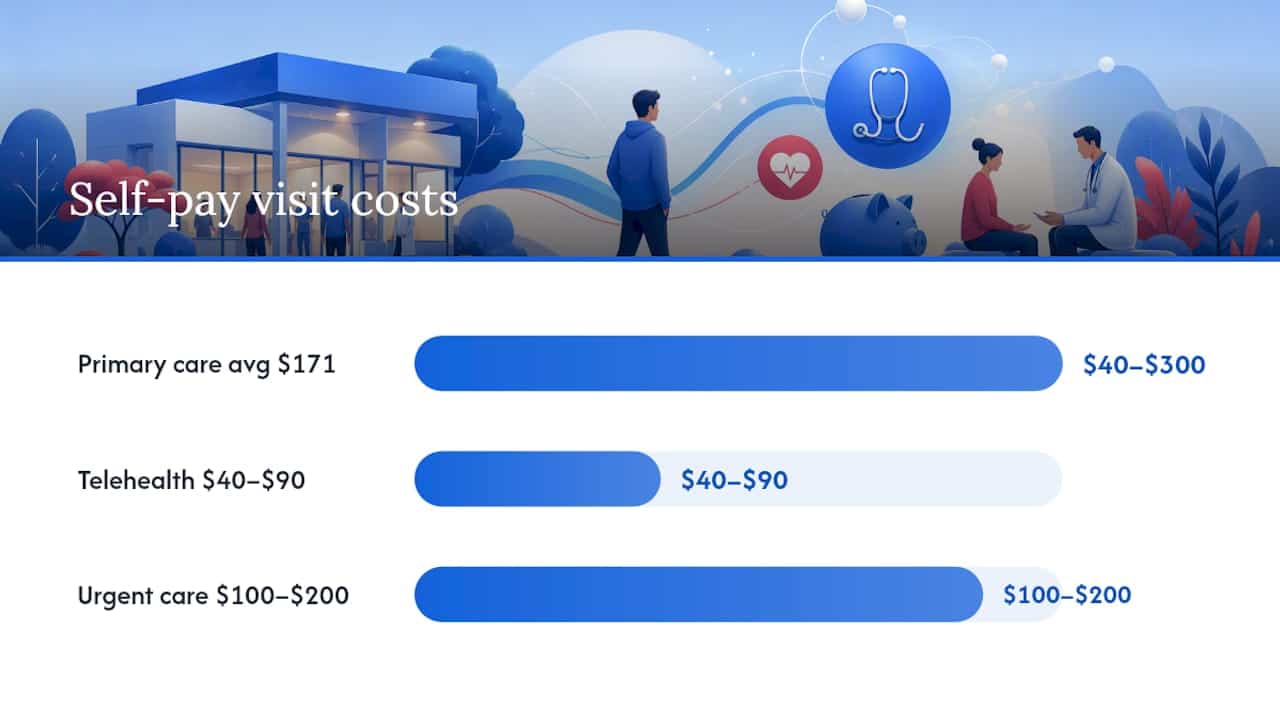
Table of Contents
- How much does a doctor visit cost without insurance?
- Where can you find low-cost medical care without insurance?
- How do you find and schedule a doctor appointment without insurance?
- How can you reduce and manage medical costs without insurance?
- When should you go to the ER, and what are your rights?
- Why a local walk-in clinic is a practical option for uninsured patients
- What uninsured patients actually need to hear
- Affordable same-day care at Your Family Walk-In Clinic
- Sources
- FAQ
How much does a doctor visit cost without insurance?
The honest answer: it depends on where you go and what you need, but the range is wide enough that choosing the right type of provider matters a great deal.
Primary care visits without insurance typically range from about $40 to $300, with a national average around $171. Telehealth visits tend to run $40 to $90, making them one of the most cost-effective options for routine concerns. Specialist initial consultations start higher, often $150 to $400 or more, and emergency room visits for moderate, non-life-threatening problems can reach $1,200 to $3,500.
Cost callout: Price variation between providers in the same city can exceed 200–300%, and asking for a cash-pay discount typically saves 20–40% off the standard rate. Shopping around before you book is one of the most effective ways to reduce your bill.
| Visit Type | Typical Self-Pay Range | Common Additional Costs |
|---|---|---|
| Telehealth (primary care) | $40–$90 | Prescription fees, follow-up visit |
| In-person primary care | $40–$300 (avg. $171) | Labs, imaging, specialist referral |
| Urgent care / walk-in | $100–$200 | X-rays, rapid tests, wound care |
| Specialist initial consult | $150–$400+ | Diagnostic tests, follow-up visits |
| ER (non-life-threatening) | $1,200–$3,500+ | Facility fee, physician billing, labs |
Several factors push a visit toward the higher end of these ranges. Visit complexity is billed on a five-level scale (Evaluation and Management codes 1 through 5), and a level-4 or level-5 visit for a complex problem costs significantly more than a level-2 routine check. Hospital-affiliated outpatient offices also add a facility fee on top of the physician charge, which can double the total bill compared to an independent office or walk-in clinic. Geography plays a role too: urban Florida markets like Tampa tend to have higher base rates than rural areas, though more providers also means more room to compare prices.
Add-on costs are where bills grow unexpectedly. A basic blood panel, urinalysis, or rapid strep test can add $30 to $150 to a primary care visit. Imaging is more significant: a chest X-ray typically runs $100 to $250 at an independent facility, while an MRI without contrast can reach $400 to $1,000 or more. Asking whether a lower-cost test is clinically appropriate before agreeing to imaging is always reasonable.
Where can you find low-cost medical care without insurance?
Not all affordable care options are equal, and the right choice depends on what you need and how quickly you need it.
Federally Qualified Health Centers (FQHCs)
FQHCs are the strongest safety-net option for uninsured patients. These centers are required by federal law to maintain sliding-fee schedules, meaning your cost is calculated based on your household income and size. Patients at or below the federal poverty level can qualify for a full discount, effectively free care. FQHCs provide primary care, preventive services, immunizations, some lab work, and behavioral health services. Use the HRSA Find a Health Center tool to locate one near you in the Tampa Bay area.
The main limitation: FQHCs focus on primary and preventive care. If you need a specialist or advanced imaging, they will refer you out, and that referral may not carry the same sliding-scale protection.
Free and charitable clinics
Free clinics, listed through the National Association of Free & Charitable Clinics (NAFC), are staffed largely by volunteer providers and serve patients who cannot afford care. Services vary by clinic, but many offer primary care, basic labs, and prescription assistance. Appointments may require advance scheduling and income verification.
County public health departments
Florida’s county health departments, operated through the Florida Department of Health, offer low-cost services including immunizations, STD testing, family planning, and some primary care. Fees are typically income-based. Hillsborough County residents can access services through the Hillsborough County Health Department.
Urgent care and walk-in clinics
For non-emergency issues, urgent care clinics are often faster and less expensive than a hospital-affiliated office. Many post cash prices publicly or will quote them over the phone. Services like minor illness treatment, wound care, X-rays, and rapid lab tests are handled on-site, usually without an appointment.
Telehealth
Telehealth is a practical, lower-cost option for many routine concerns: respiratory infections, skin conditions, UTIs, medication questions, and mental health check-ins. At $40 to $90 per visit, it is one of the most affordable ways to see a licensed provider without leaving home.

Hospital charity care
If you receive care at a nonprofit hospital and cannot pay, you have the right to apply for financial assistance. Nonprofit hospitals must publish financial assistance policies under Section 501® of the Internal Revenue Code and may reduce or forgive bills for eligible patients. This applies retroactively in many cases, so even a bill you have already received may be reducible.
Quick finder resources:
- HRSA Find a Health Center — locate FQHCs by zip code
- NAFC free clinic directory — find free and charitable clinics
- Healthcare — overview of safety-net options
- Florida Department of Health — county health department listings by county
How do you find and schedule a doctor appointment without insurance?
The process is straightforward once you know what to ask and where to look.
Step 1: Search for providers. Start with the HRSA Find a Health Center tool for FQHCs, the NAFC directory for free clinics, and your county health department’s website. For walk-in or urgent care, a basic search for clinics in your area will surface options, and many now list self-pay prices on their websites.
Step 2: Call before you go. When you reach the front desk, be direct: “I’m uninsured and paying out of pocket. Do you offer a self-pay or cash rate? Do you have a sliding-scale program, and what do I need to bring to apply?” Getting the price confirmed before your visit prevents billing surprises. Ask whether labs, imaging, or other services are billed separately from the office visit.
Step 3: Understand the timeline. Urgent care and walk-in clinics typically accept same-day patients with little or no wait for scheduling. FQHCs may have a wait of several days to a few weeks for a new patient appointment, though many offer same-day sick visits. Telehealth appointments are often available within hours.
Step 4: Gather your documents. Bring the following to your first visit:
- Government-issued photo ID
- Proof of income (pay stub, tax return, or benefit award letter) for sliding-scale applications
- A written list of current medications, including dosages
- Any previous records or test results relevant to your concern
- A list of questions you want answered during the visit
Pro Tip: Tell your provider you are uninsured before any tests are ordered. Clinicians can sometimes choose lower-cost, clinically appropriate alternatives when they know you are paying out of pocket — for example, ordering an ultrasound instead of an MRI when both would give adequate information for your situation.
How can you reduce and manage medical costs without insurance?
Cost management starts before you walk in the door and continues well after the visit.
Ask for the discounted amount confirmed in writing or by email before your appointment. This is standard practice, and any reputable clinic will accommodate the request.
During the visit: be transparent about your status. Telling your provider you are uninsured and paying out of pocket can change which tests are ordered. A clinician who knows you are self-pay may choose a less expensive diagnostic path that is equally appropriate for your situation. You can also ask directly: “Is there a lower-cost alternative to this test that would still give you the information you need?”
After the visit: request an itemized bill. If you receive a large bill, request an itemized statement to check for duplicate services or incorrect coding. Billing errors are common, and a single corrected code can reduce a bill by hundreds of dollars. Review each line item and ask the billing department to explain any charge you do not recognize.
Apply for financial assistance at nonprofit hospitals. Under Section 501®, nonprofit hospitals must have a written financial assistance policy. The key is to ask for it by name.
Pro Tip: When you call the billing department, say: “I’d like to apply for your financial assistance program” or “Can you send me your charity care application?” Many billing teams will default to offering a payment plan unless you specifically request the financial assistance application. These are different programs, and charity care can reduce or eliminate the bill entirely.
Additional cost-reduction tactics:
- Request a payment plan if you cannot pay in full. Most providers will arrange interest-free installments.
- Apply for Medicaid simultaneously if you think you might qualify. Some Florida hospitals require a Medicaid application as part of the charity care process, and retroactive Medicaid coverage can eliminate a bill entirely for eligible patients.
- Ask about generic prescriptions. Generic drugs cost a fraction of brand-name equivalents. GoodRx, Mark Cuban’s Cost Plus Drugs, and NeedyMeds are three tools that can reduce prescription costs significantly for uninsured patients.
- Separate lab and imaging costs. Labs drawn at an independent facility like LabCorp or Quest Diagnostics typically cost less than the same tests run through a hospital lab. Ask your provider to send orders to an independent facility.
- For diabetes-related supplies, resources like low-cost insulin management tools can help stretch a tight budget further.
The No Surprises Act requires providers to give uninsured patients a good faith estimate for scheduled services. If your final bill exceeds the estimate by $400 or more, you have the right to dispute it through the federal patient-provider dispute resolution process.
When should you go to the ER, and what are your rights?
Some symptoms require an emergency room regardless of cost. Go to the ER immediately for:
- Chest pain, pressure, or tightness
- Difficulty breathing or shortness of breath at rest
- Signs of stroke: sudden facial drooping, arm weakness, or slurred speech
- Severe abdominal pain
- Head injury with loss of consciousness
- Uncontrolled bleeding
- High fever in an infant under three months
For everything else, urgent care or a walk-in clinic is usually faster, less expensive, and equally appropriate.
Your legal protection in an emergency: Under the federal Emergency Medical Treatment and Labor Act (EMTALA), any hospital that receives Medicare funding must provide a medical screening examination and stabilizing treatment to anyone who arrives with an emergency medical condition, regardless of their ability to pay or insurance status. Do not delay going to the ER for a true emergency because of cost concerns. EMTALA protects you. Once you are stable, you can apply for charity care or Medicaid to address the bill.
The cost difference between settings is substantial. Urgent care for a non-emergency issue typically costs $100 to $200, while an ER visit for a moderate, non-life-threatening problem often runs $1,200 to $3,500 or more. That gap makes choosing the right setting one of the highest-leverage decisions an uninsured patient can make.
For scheduled services, the CMS No Surprises Act good faith estimate factsheet explains your rights to a written cost estimate and how to dispute a bill that significantly exceeds it.
Why a local walk-in clinic is a practical option for uninsured patients
Your Family Walk-In Clinic in Lutz, Florida, is built around the kind of access that works for uninsured patients: no appointment required, transparent pricing, and a full range of services under one roof.
Services available at Your Family Walk-In Clinic:
- Urgent care for illness and minor injuries
- Primary care for adults and children
- Immunizations and flu shots
- STD testing and treatment
- Health screenings and lab work
- Sports and school physicals
- In-office and virtual therapy and counseling
The clinic is open seven days a week, 8 AM to 8 PM, including weekends. Same-day appointments are available, and walk-ins are welcome. For uninsured patients, the clinic’s services and pricing page outlines what to expect for a self-pay visit.
Walk-in clinics like this one typically cost less than hospital-affiliated outpatient offices because there is no separate facility fee layered on top of the physician charge. You pay for the visit and any services rendered, not for the overhead of a hospital system.
What to expect when you arrive:
- Brief triage to assess your concern
- Evaluation by an experienced provider (the clinical team has over 25 years of combined experience)
- On-site basic lab work and rapid testing when needed
- Referral guidance if specialist care is required
- Clear explanation of charges before you leave
To ask about self-pay rates or book a same-day visit, call (813) 792-8555 or visit the clinic contact page.
What uninsured patients actually need to hear
The advice that gets left out of most articles on this topic is simple: ask every question you have about cost before the visit starts, not after. Patients who feel embarrassed to bring up money often end up with bills they could have avoided or reduced. There is nothing unusual about asking a clinic what a visit costs, whether a sliding-scale program exists, or whether a cheaper test would work just as well.
At Your Family Walk-In Clinic, we see uninsured patients regularly, and the approach is the same every time: be upfront about what you need, ask about the cash rate, and let the team help you figure out the most affordable path to the care you need. Same-day availability means you do not have to wait days to be seen, and transparent pricing means no surprises when you check out.
Affordable same-day care at Your Family Walk-In Clinic
Uninsured patients in the Tampa Bay area have a direct, practical option: walk into Your Family Walk-In Clinic in Lutz any day of the week, 8 AM to 8 PM, and ask for the self-pay rate at the front desk. No referral, no insurance card, no long wait.
The clinic handles urgent care, primary care, lab work, immunizations, STD testing, physicals, and therapy, all in one location. For uninsured patients, the self-pay pricing is straightforward, and the team can discuss payment options before your visit begins. Walk-in urgent care is available seven days a week, so a busy schedule or a weekend illness is not a barrier to getting seen.
Book your urgent care visit online, or call (813) 792-8555 to ask about cash rates and same-day availability. First-time patients can also take a virtual tour of the clinic to know what to expect before they arrive.
Sources
These resources are free to use and can help you find affordable care or understand your rights as an uninsured patient.
- It’s 2026 and You’re Uninsured. Now What? – KFF Health News
- Findahealthcenter
- Cms
- Florida Hospital Charity Care 2026: Income Limits, How to Apply | BenefitsUSA Blog
This article is general information, not a substitute for advice from a qualified doctor. Consult a qualified healthcare professional about your own circumstances before acting on anything here.
FAQ
Can you get a doctor appointment without insurance?
Yes. Walk-in clinics, FQHCs, free clinics, and telehealth providers all see uninsured patients. Call ahead, ask for the self-pay or cash rate, and bring a photo ID and proof of income if you want to apply for a sliding-scale discount.
How much is a regular doctor’s visit without insurance in Florida?
Primary care visits without insurance typically range from $40 to $300, with a national average around $171. Telehealth visits usually cost $40 to $90, and urgent care visits run $100 to $200 for most non-emergency concerns.
Can you see a doctor in Florida without insurance?
Yes. Florida has FQHCs, county health departments, free clinics, and walk-in urgent care clinics that all serve uninsured patients. Your Family Walk-In Clinic in Lutz accepts self-pay patients seven days a week with same-day availability.
How do you reduce a medical bill if you have no insurance?
Ask for the cash-pay rate before your visit, request an itemized bill afterward to check for errors, and ask specifically for the hospital’s financial assistance application if you receive a large bill. Nonprofit hospitals are required under Section 501® to have written financial assistance policies and may reduce or forgive bills for eligible patients.