


The main difference is age. Internal medicine doctors (internists) care for adults, while family medicine doctors care for patients from newborns to older adults. According to the American College of Physicians, internists see patients 18 and older, and family physicians see every age. If you have children, or you want one practice for the whole household, family-centered primary care is the simpler fit. At Your Family Walk-In Clinic in Lutz, we see adults and children seven days a week, 8 AM to 8 PM, with same-day appointments.
TL;DR
- Both family doctors and internists are primary care physicians. Both handle checkups, prevention, and ongoing conditions like high blood pressure.
- Internal medicine is adults only. Family medicine covers newborns through seniors, so one doctor can care for parents and kids.
- Family medicine training is broad and outpatient-focused. Internal medicine training goes deep on adult organ systems and complex illness.
- The best choice depends on who needs care, what conditions you manage, and how easily you can get an appointment.
- We care for adults and children in Lutz, accept major insurance plans, Medicaid, and self-pay, and offer same-day visits.
Table of Contents
- What primary care means, and who provides it
- Family medicine vs. internal medicine at a glance
- Who each doctor treats
- How the training differs
- Do family doctors treat children?
- High blood pressure and cholesterol: primary care handles both
- How to choose a primary care doctor
- When a family doctor or internist is not the right first stop
- Our perspective
- Care for your whole family in Lutz
- FAQ
- Sources
What primary care means, and who provides it
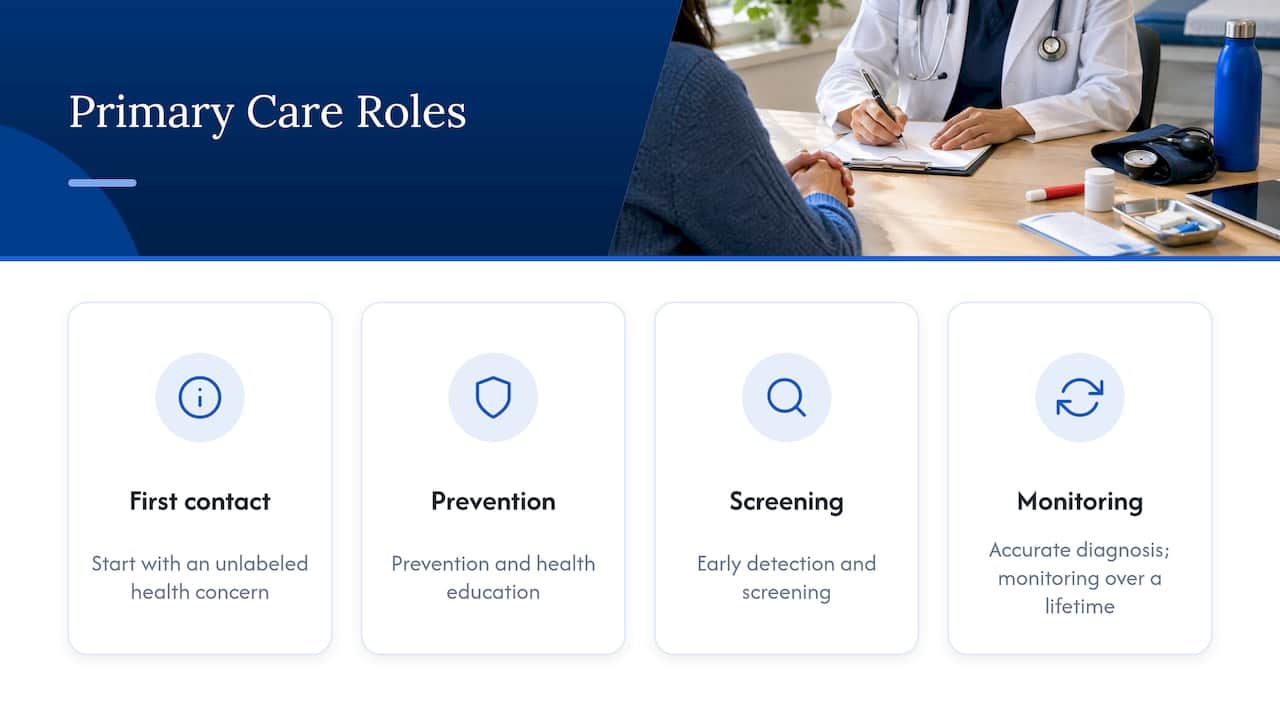
Primary care is your first point of contact for health concerns. The AAFP’s primary care policy describes a primary care physician as a specialist in family medicine, general internal medicine, general pediatrics, geriatrics, or combined internal medicine-pediatrics. That physician is where you start with a health concern that has no label yet. The same policy says primary care plays a central role in reducing the burden of chronic conditions through prevention, health education, early detection, screening, accurate diagnosis, and continuous monitoring over a lifetime.
So when you compare a family doctor with an internist, you are not comparing a “real” doctor with a lesser one. You are comparing two kinds of primary care physician. MedlinePlus lists several types of primary care provider you can choose from: family practitioners, pediatricians, geriatricians, internists, obstetricians/gynecologists, nurse practitioners, and physician assistants.
The question is which one matches the people who need care.
Family medicine vs. internal medicine at a glance
| Family medicine | Internal medicine | |
|---|---|---|
| Patients | Newborns, children, adults, older adults | Adults 18 and older |
| Training focus | Broad: pediatrics, obstetrics, geriatrics, prevention, outpatient care | In-depth adult medicine, organ systems, complex diagnosis |
| Typical procedures | Skin procedures, joint injections, obstetrics | More complex internal diagnostics |
| Best known for | Whole-family continuity | Managing multiple or complex adult conditions |
| One doctor for parents and kids? | Yes | No |
The patient populations and procedure examples in the table come from the AAFP’s comparison of the two fields. The age ranges match the ACP infographic.
Who each doctor treats
Family medicine: every age
The AAFP says family physicians are trained to care for patients of all ages, from newborns to older adults, and are often the first point of contact in the health care system. That means one doctor can handle your child’s ear infection, your teenager’s sports physical, your own blood pressure check, and your parent’s medication review.
The ACP describes family medicine as built around the family as a social unit, rather than around a specific patient population, organ system, or type of intervention. In practice, that gives a family doctor context. They know your household, your history, and how things connect.
Internal medicine: adults
The ACP says internal medicine physicians are specialists who apply scientific knowledge and clinical expertise to the diagnosis, treatment, and compassionate care of adults, from health through complex illness. They are trained to solve diagnostic problems and manage long-term illnesses.
One detail causes confusion. WebMD notes that internists treat adults over 18, though some treat people over 16. Check the age policy of any internist before you book for a teenager.
It also helps to know that many family medicine patients are adults too. The ACP points out that although internists focus on adults, many patients seen by family physicians are adults. For a healthy adult living alone, the day-to-day experience can look very similar either way.
How the training differs
Both doctors complete medical school and residency. The residency is where the paths split.
According to the ACP, family medicine residency covers a broader range of patient care, including pediatrics, obstetrics, and geriatrics, with an emphasis on preventive medicine and outpatient practice. Internal medicine residency provides at least three years of specialty training covering the entire human body and its organ systems in depth.
The ACP adds that internal medicine training includes significant experience in the internal medicine subspecialties, plus areas such as psychiatry, dermatology, ophthalmology, office gynecology, nonoperative orthopedics, palliative medicine, sleep medicine, and geriatrics. Family medicine training is typically based in dedicated outpatient training centers, with a minimum number of encounters with children and older adults.
What that means for you:
- Family medicine prepares a doctor for the full mix of problems that walk into an outpatient office: a child’s rash, a sprained ankle, a prenatal question, a diabetes follow-up.
- Internal medicine prepares a doctor for the adult who has several conditions at once, or whose symptoms are hard to explain.
Neither training is better in the abstract. They are built for different patients.
Do family doctors treat children?
Yes. This is the most common question on the topic, and it is the clearest dividing line. Family physicians care for children as well as adults. Internists do not treat young children, because their training and practice are focused on adults.
For a parent, that matters in a few specific ways:
- One office for everyone. You schedule, fill out forms, and keep records in one place.
- Continuity as kids grow up. A teenager can stay with the same practice into adulthood instead of switching to a new doctor at 18.
- Shared family context. A doctor who treats both you and your child can see patterns, such as asthma, allergies, or a family history of heart disease.
- School and sports paperwork. Physicals, immunization updates, and forms are handled under one roof. Our Sports Physical Requirements guide explains what Florida student-athletes need.
If your household is adults only, either specialty can serve you well. If it includes children, family-centered care removes a layer of coordination.
High blood pressure and cholesterol: primary care handles both
Two of the most common reasons adults look for a primary care doctor are hypertension and high cholesterol. Both are managed in primary care, by family physicians and internists alike.
The AAFP hypertension guideline names all primary care clinicians, including family physicians, as its target audience. It covers adults with hypertension, with or without cardiovascular disease. It strongly recommends treating adults with hypertension to a standard target of less than 140/90 mm Hg, to reduce the risk of death from all causes and from cardiovascular disease. It also recommends considering a lower target of less than 135/85 mm Hg to reduce the risk of heart attack. Your own target should be set by your clinician, based on your health history.
These conditions are usually silent for years, which is why routine visits matter. A primary care visit for either condition typically includes:
- A blood pressure check, repeated over time rather than judged from one reading.
- A review of family history, medications, diet, activity, and smoking status.
- Lab work, such as a lipid panel for cholesterol.
- A plan for follow-up, lifestyle changes, and medication when it is needed.
Our pages on blood pressure screening and common health screenings recommended by Tampa primary care providers explain what to expect. If you also manage blood sugar, see how diabetes management works in primary care.
If you have severe chest pain, trouble breathing, weakness on one side of the body, or a sudden severe headache, call 911 instead of booking a routine visit.
How to choose a primary care doctor
The label on the door matters less than whether the practice fits your life. Work through these questions in order.
1. Who needs care?
List everyone in the household. If children are on the list, a family medicine practice that sees all ages keeps your care in one place. If you are the only patient and an adult, you have more options.
2. What do you manage?
Write down ongoing conditions: blood pressure, cholesterol, diabetes, asthma, anxiety, thyroid problems. Primary care is built to coordinate these. A practice that also offers lab work, screenings, and medication refills on site saves you trips.
3. Is the practice easy to reach?
A good doctor you cannot see is not much help. Check hours, how quickly you can get a same-day visit, and whether the practice handles sick visits and routine care together. We are open seven days a week from 8 AM to 8 PM, so a cough on Sunday does not turn into an ER trip.
4. Does it accept your coverage?
Confirm that the practice accepts your plan before you book. We accept major health insurance plans and Medicaid, and we also see self-pay patients. Our guides on primary care without insurance and low-cost clinic care in Florida cover options if you are uninsured.
5. Do you feel heard?
The relationship is the point. Choosing the perfect primary care provider walks through the factors in more detail. After the first visit, ask yourself whether the provider listened, explained things plainly, and left room for your questions. You can also tour our clinic to see the space and meet the team.
When a family doctor or internist is not the right first stop
Primary care is not for every situation. Some problems need an emergency department right away: signs of a stroke or heart attack, severe bleeding, serious breathing trouble, or a major head injury. Call 911 for those.
For the many problems in between, such as a cut that needs stitches, an ear infection, a urinary tract infection (UTI), or a sprain, you do not need to wait for a routine appointment. Our urgent care handles these on a walk-in basis. Our guide on symptoms you should not ignore helps you decide how fast to be seen.
Our perspective
Parents tell us the hardest part of healthcare is not the medicine. It is the logistics. One child needs a physical for school, another has an earache, and a parent has been putting off a blood pressure check for a year. When each person needs a different office, the one who loses out is usually the adult.
That is why we built our clinic around the whole family. We care for adults and children, with same-day appointments and hours from 8 AM to 8 PM every day of the week. Our providers bring over 25 years of experience, and our model is designed to combine flexibility with expertise.
We also think primary care should be easy to start. You can come in for a checkup, immunizations, lab work, screenings, a sports physical, or a sick visit, and for sensitive needs like STD testing, you will find a respectful, non-judgmental setting. Therapy and counseling are available for adults and children, in the office or by virtual session.
If you are weighing a family doctor against an internist, start with who in your household needs care. If the answer is more than one generation, we would be glad to be your starting point.
Lisa
Care for your whole family in Lutz
Our primary care team sees adults and children for checkups, medication refills, lab work, immunizations, screenings, wellness exams, and ongoing conditions. Sports and school physicals, urgent care, STD screening and treatment, and counseling are in the same place, so one visit can often cover more than one need. You can see the full list on our services page.
We accept major health insurance plans, Medicaid, and self-pay. To book a same-day visit or ask which service fits you, contact the clinic.
FAQ
What is the difference between a family doctor and an internist?
A family doctor treats patients of every age, from newborns to older adults. An internist treats adults only, typically 18 and older. Both are primary care physicians who handle prevention, checkups, and ongoing conditions. Family medicine training is broader, while internal medicine training goes deep on adult illness.
Do family doctors treat children?
Yes. Family physicians are trained to care for patients of all ages, including infants, children, and teenagers, according to the AAFP. That lets a parent and child share one practice. At our clinic, we see both adults and children, with same-day appointments.
Which is better, family medicine or internal medicine?
Neither is better in general. Each fits different patients. If you want one doctor for the whole household, or you have kids, family medicine fits naturally. If you are an adult with several complex conditions, internal medicine is built for that. For most families in Lutz, a family-centered practice is the simplest start.
Can a family doctor manage high blood pressure and cholesterol?
Yes. The AAFP hypertension guideline is written for all primary care clinicians, including family physicians. Cholesterol is managed in primary care with lab work, lifestyle guidance, and medication when needed. Your clinician sets your personal targets based on your history.
Is primary care the same as internal medicine?
No. Primary care is a role, and internal medicine is one specialty that fills it. Family medicine, pediatrics, and geriatrics can fill it too, as the AAFP’s primary care policy explains. Internal medicine is the primary care route for adults only.
Sources
- About Internal Medicine, American College of Physicians
- Internal Medicine or Family Medicine infographic, American College of Physicians
- Internal Medicine vs. Family Medicine, American College of Physicians
- What Does a Family Physician Do?, American Academy of Family Physicians
- Primary Care policy, American Academy of Family Physicians
- Blood Pressure Targets in Adults With Hypertension, American Academy of Family Physicians
- Choosing a primary care provider, MedlinePlus
- Internist: What They Do and When to See One, WebMD