


The single most important rule when you choose a therapist: prioritize both a strong personal fit and a clinician who uses evidence-based methods with clear, measurable goals. Research from the American Psychological Association confirms that the therapeutic relationship predicts outcomes as reliably as the specific technique used, so neither fit nor clinical rigor can be sacrificed for the other.
Start here before you book anything:
- Verify licensure. Look up your prospective therapist on your state’s licensing board website to confirm their credential is active and in good standing.
- Match to your main concern. Confirm the therapist has direct experience treating your specific issue, whether that is depression, trauma, relationship conflict, or anxiety.
- Confirm an evidence-based approach. Ask whether they use a named, research-supported method such as Cognitive Behavioral Therapy (CBT), Dialectical Behavior Therapy (DBT), or EMDR.
- Expect clear progress measurement. A good therapist can tell you, by the third session, what symptoms they are tracking and how you will both know treatment is working.
Psychology making a short list and booking brief intro calls with two or three therapists before committing. Your reaction after that first call tells you a great deal.
Key Takeaways
Choosing the right therapist comes down to verifying credentials, confirming an evidence-based approach, and using the third-session checkpoint to assess whether treatment is on track.
| Point | Details |
|---|---|
| Prioritize fit and method equally | A strong therapeutic relationship predicts outcomes as reliably as the specific technique used. |
| Verify licensure before booking | Use your state licensing board’s public lookup tool to confirm any therapist’s credential is active. |
| Use the third-session checkpoint | By around the third session, your therapist should be able to name what symptoms they are tracking and how you will both know treatment is working. |
| Know your lower-cost options | University clinics, sliding-scale networks, and telehealth can reduce cost without sacrificing evidence-based care. |
| Your Family Walk-In Clinic | Offers in-office and virtual therapy in Lutz, FL, seven days a week, with insurance and superbill options. |
Table of Contents
- 1. What credentials do different therapists actually hold?
- 2. Which treatment approaches have the strongest evidence?
- 3. Where should you actually look for a therapist?
- 4. What questions should you ask a potential therapist?
- 5. How do you know if therapy is actually working?
- 6. How do costs, insurance, and billing actually work?
- 7. What are the red flags that tell you to switch therapists?
- 8. How should you prepare for your first session?
- 9. What to do if care feels unsafe or unethical
- The part of therapist selection most guides skip
- Therapy services close to home in Lutz and Tampa
- Sources
- FAQ
1. What credentials do different therapists actually hold?
Understanding who you might meet helps you ask the right questions from the start. Provider types vary in training, scope, and what they can offer.
- Psychiatrist (MD or DO): A medical doctor who can prescribe medication. Most psychiatrists focus on medication management rather than weekly talk therapy, though some do both.
- Psychologist (PhD or PsyD): Doctoral-level training in assessment and psychotherapy. Cannot prescribe medication in most U.S. states.
- Licensed Clinical Social Worker (LCSW): Master’s-level training with supervised clinical hours; provides therapy and often coordinates community resources.
- Licensed Professional Counselor (LPC): Master’s-level therapist; title and scope vary slightly by state, but LPCs are trained to provide individual, group, and family counseling.
- Licensed Marriage and Family Therapist (LMFT): Master’s-level training with a focus on relational and family systems; well-suited for couples and family work.
- Supervised trainee (intern or associate): A graduate student or post-degree clinician working toward full licensure under a licensed supervisor. Sessions are often lower cost.
To verify any license, visit your state’s licensing board website. Most states maintain a public lookup tool where you can enter a name or license number and confirm the credential is active. The Association for Behavioral and Cognitive Therapies (ABCT) notes that evidence-based clinicians can typically name the specific manuals or protocols they use, which is a useful verification step beyond the license check itself.
Pro Tip: If you are considering a supervised trainee, ask who supervises them, how often supervision occurs, and whether the supervisor reviews your case directly. Weekly individual supervision by a licensed clinician is the standard you want to hear.
Cultural competence is part of credentials too. Asking a therapist about their experience working with people who share your background, identity, or lived experience is not only appropriate, it often speeds progress. The APA explicitly recommends asking about this during your initial contact.
2. Which treatment approaches have the strongest evidence?
Knowing the major evidence-based modalities helps you match a therapist’s methods to your specific needs. The National Institute of Mental Health provides condition-specific summaries you can consult to see which therapies have research support for your situation.
| Modality | Primary uses | Typical format |
|---|---|---|
| Cognitive Behavioral Therapy (CBT) | Depression, anxiety, OCD, phobias, PTSD | Skills-based, structured, often 12–15 sessions |
| Dialectical Behavior Therapy (DBT) | Borderline personality, self-harm, emotional dysregulation | Skills groups plus individual sessions |
| EMDR | PTSD, trauma, phobias | Trauma-focused, phase-based |
| Acceptance and Commitment Therapy (ACT) | Anxiety, chronic pain, depression | Values-based, mindfulness-integrated |
| Exposure and Response Prevention (ERP) | OCD, specific phobias | Graduated exposure, behavioral |
| Emotionally Focused Therapy (EFT) | Couples conflict, attachment issues | Relational, emotion-focused |
| Structural/Systemic Family Therapy | Family conflict, adolescent behavioral issues | Family sessions, systems-focused |
When medication is part of your care, a psychiatrist handles prescribing while a therapist handles the psychotherapy. These roles can work in parallel, and your primary care provider can often coordinate referrals to both. For couples or family work, look specifically for an LMFT or a therapist with documented training in relational modalities like EFT or Gottman Method, since individual therapy training does not automatically translate to effective couples work.
3. Where should you actually look for a therapist?
The search channel you use shapes the quality of your options. Each route has real trade-offs.
- Insurer portal or Employee Assistance Program (EAP): Start here if cost is a concern. Filter by specialty and confirm the provider is currently accepting new patients before calling, since directories often lag behind actual availability.
- Professional directories (Psychology Today, TherapyDen, Open Path Collective): Useful for filtering by modality, population specialty, and sliding-scale availability. Read the full profile, not just the photo.
- Primary care referral: Your PCP often knows local clinicians personally and can match you based on your history. This is one of the most reliable routes, and Mental Health America recommends it as a practical starting point alongside insurer lists.
- University training clinics: Graduate programs in psychology, social work, and counseling operate low-cost clinics staffed by supervised trainees. Fees are often on a sliding scale and wait times can be shorter than private practice.
- Community mental health centers: Serve patients regardless of ability to pay; often accept Medicaid. Best for individuals with limited income or complex needs requiring case management.
- Telehealth platforms: Expand access, especially in rural areas or for people with scheduling constraints. Check that the therapist is licensed in your state, since interstate practice rules are strict and vary. Telehealth works well for anxiety, depression, and mild-to-moderate concerns; it may be less appropriate for severe dissociation, active psychosis, or crisis-level presentations.
When filtering your initial list, check for: specialty match, insurance acceptance or sliding-scale availability, current openings, and the modality they use.
4. What questions should you ask a potential therapist?
Treat the intro call as a consultation. You are entitled to ask direct questions, and a good therapist will welcome them. NAMI recommends viewing this as “shopping around” and treating a lack of transparent answers as a warning sign in itself.
Treatment approach and experience:
- What evidence-based methods do you use for my concern?
- Can you name the specific protocol or manual you follow?
- How much experience do you have treating [your specific issue]?
- Have you worked with clients from my background or community?
- How do you handle it if your approach is not working?
Progress and goals:
6. How will we set goals together?
7. What symptoms or behaviors will you track?
8. How will we know when treatment is complete?
9. Do you assign practice or homework between sessions?
10. How often will we review progress formally?
Logistics and cost:
11. What is your session fee, and do you offer a sliding scale?
12. Do you accept my insurance, and what is my likely out-of-pocket cost?
13. Can you provide a superbill for out-of-network reimbursement?
14. What is your cancellation policy?
15. How do you handle after-hours crises or urgent concerns between sessions?
Cultural competence:
16. What training have you had in working with [your population or identity]?
17. How do you approach cultural or identity factors in treatment?
Listen for answers that are specific, collaborative, and honest about limits. Vague responses like “I use a holistic approach” or “we will just see how it goes” without any named method or measurable outcome are worth probing further. A therapist who cannot explain their approach clearly in plain language is unlikely to explain your treatment plan clearly either.
Pro Tip: For a quick phone script, try: “I am looking for a therapist with experience in [your concern]. Do you use CBT or another evidence-based approach, and are you currently accepting new patients?” That one question filters out a large portion of poor fits immediately.

5. How do you know if therapy is actually working?
Fit and progress are two separate things, and both need a checkpoint. Here is a practical timeline:
| Session range | Expected clinician actions | Sample measures |
|---|---|---|
| Session 1 | Intake assessment, rapport building, confidentiality review | Clinical interview, symptom history |
| Sessions 2–3 | Collaborative goal setting, treatment plan shared with you | PHQ-9 (depression), GAD-7 (anxiety) |
| Sessions 4–8 | Early progress review, plan adjustment if needed | Symptom counts, behavior logs, re-scored PHQ-9/GAD-7 |
| Sessions 9+ | Ongoing monitoring, skill consolidation, discharge planning | Repeated standardized measures, functional goals |
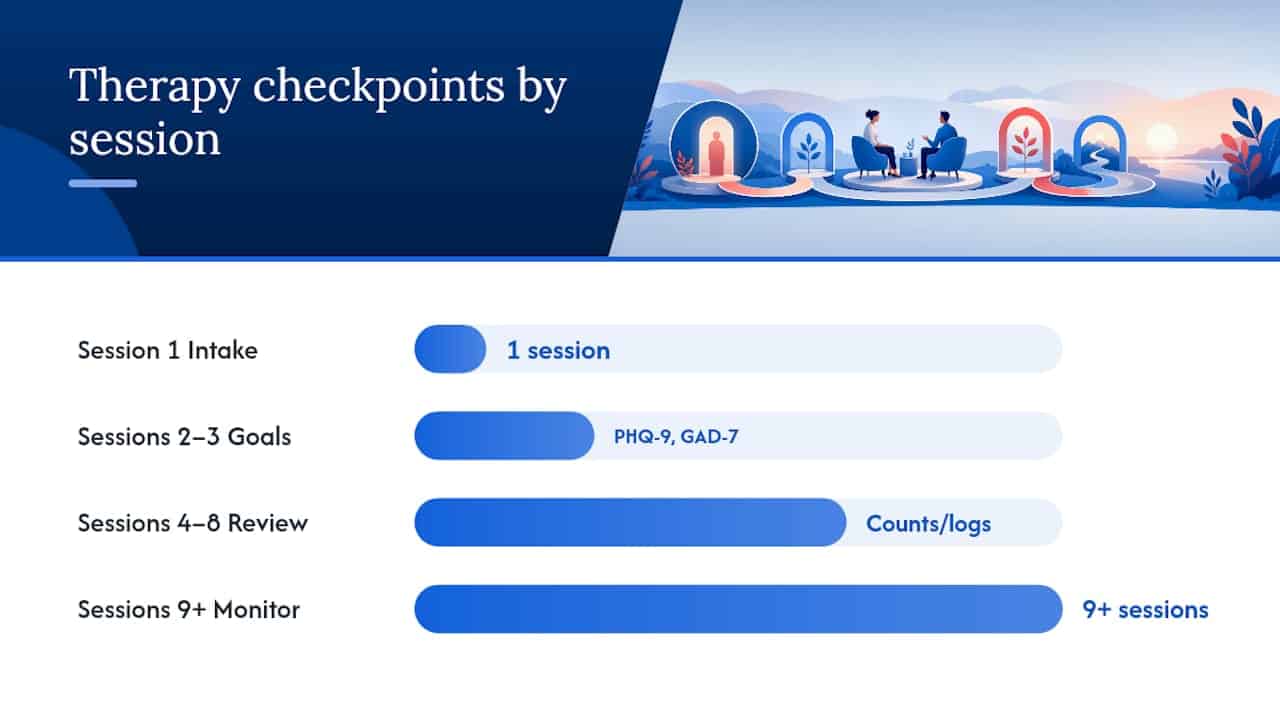
The PHQ-9 and GAD-7 are brief, validated questionnaires that many clinicians use to track depression and anxiety severity over time. A score that is not moving after six to eight sessions is a concrete signal worth discussing openly. ABCT notes that most evidence-based programs include a clear plan for when treatment might be considered complete, typically tied to symptom reduction and functional improvement rather than a fixed number of sessions.
Pro Tip: If you feel stuck, say so directly: “I have not noticed much change yet. Can we talk about what we are measuring and whether the approach needs adjusting?” A competent therapist will welcome that conversation. Defensiveness or dismissal in response is itself a red flag.
6. How do costs, insurance, and billing actually work?
Therapy billing has more options than most people realize. Ask these questions before your first paid session:
- What is the fee per session, and is there a separate intake or assessment fee?
- Do you offer a sliding scale, and how is it determined?
- Are you in-network with my insurance plan?
- If you are out-of-network, can you provide a superbill so I can seek reimbursement?
- What is your cancellation policy and fee?
- Does my insurance have a session limit per year?
If cost is a barrier, ABCT identifies university training clinics, community mental health centers, sliding-scale networks, and telehealth as viable lower-cost alternatives. Open Path Collective, for example, connects clients with therapists offering reduced fees. Sessions with supervised trainees at university clinics often cost significantly less than private practice rates.
Insurance coverage for mental health services varies by plan. Some plans cover a set number of sessions per year; others require a diagnosis code before authorizing payment. Calling your insurer before your first appointment, rather than after, prevents billing surprises. Ask specifically: “Is outpatient mental health covered, what is my copay, and is there a session limit?”
7. What are the red flags that tell you to switch therapists?
Some signs point to a poor fit; others point to an ethical violation. Know the difference.
Ethical violations (report to the state licensing board):
- Romantic or sexual contact of any kind
- Sharing your confidential information without your consent
- Pressuring you to purchase products, services, or investments
- Practicing outside their licensed scope or in a state where they are not licensed
Signs of poor fit or inadequate care:
- Cannot name the treatment approach they use or explain why it fits your concern
- Dismisses your questions about progress or goals
- Consistently redirects sessions away from your stated concerns
- Never discusses how or when treatment might end
- You feel worse, not better, after several months with no explanation or plan adjustment
To exit safely: you do not need a reason to stop. You can simply say, “I have decided to work with a different provider.” Request a copy of your records and ask for a referral if you want one. If you believe an ethical violation occurred, file a complaint with your state’s licensing board. Most boards have an online complaint form, and the process is confidential.
If you are in immediate distress, call or text 988 (Suicide and Crisis Lifeline) or go to your nearest emergency room. You do not need to wait for a scheduled appointment.
8. How should you prepare for your first session?
Walking in prepared makes the first session more productive for both of you.
- Bring your insurance card and a photo ID.
- Write a brief symptom timeline: when symptoms started, what makes them better or worse, and any prior treatment.
- List current medications and dosages, including supplements.
- Note any prior assessments or records you want the therapist to have.
- Bring an emergency contact name and number.
A simple goal statement helps orient the session: “I want to reduce my anxiety enough to [specific goal, e.g., return to work without panic attacks] within [timeframe].” That one sentence gives the therapist a concrete target and signals that you expect measurable progress.
Expect the first session to cover intake paperwork, a review of confidentiality limits (what the therapist is legally required to report, such as imminent danger to self or others), and an initial assessment of your concerns. You will likely not dive deep into treatment on day one, and that is normal.
9. What to do if care feels unsafe or unethical
If something feels wrong, take these steps in order:
- Document the incident. Write down dates, what was said or done, and any witnesses.
- Contact the provider directly if it is safe to do so, and request a written response.
- File a complaint with your state licensing board. Search “[your state] + [license type, e.g., LCSW] + licensing board” to find the complaint portal. Most boards accept online submissions and keep complainant information confidential during investigation.
- Contact your insurer if billing fraud is involved.
- Consult an attorney if you believe you have experienced malpractice or significant harm.
For immediate safety concerns, call 988 or 911. Therapy confidentiality has legal limits: therapists are mandated reporters and must break confidentiality when there is credible risk of harm to you or others, or when child or elder abuse is suspected. You have the right to request a copy of your records at any time; federal law under HIPAA gives you that access, typically within 30 days of a written request.
The part of therapist selection most guides skip
Most advice on finding a therapist focuses on credentials and directories. What gets less attention is this: a technically qualified therapist who makes you feel judged, rushed, or unheard will produce worse outcomes than a slightly less credentialed therapist with whom you feel genuinely safe.
The research on this is consistent. APA’s guidance frames therapy explicitly as a relationship, not a service transaction, and that framing changes how you should evaluate your options. The question is not just “Is this person licensed and trained?” It is “Can I tell this person the truth without editing myself?”
That said, fit without structure is not enough either. A warm therapist who never sets goals, never measures progress, and never explains their approach is offering comfort, not treatment. The third-session checkpoint exists precisely because it forces both parties to name what is being worked on and how you will know it is working. Skipping that conversation is where therapy drifts into indefinite, expensive support without a clear endpoint.
My recommendation: go into the search expecting to try two or three therapists before you find the right one. NAMI’s guidance normalizes this explicitly. Treat the first session as a consultation, not a commitment, and bring your questions written down so you do not forget them when the conversation gets personal.
Therapy services close to home in Lutz and Tampa
If you are in the Lutz or Tampa area and want a transparent, clinic-backed starting point, Your Family Walk-In Clinic offers therapy services for adults and children, both in-office and virtually. Emily Gilbert, a collaborative therapist at the clinic, works with patients on a range of mental health concerns in a supportive, patient-centered setting.

The clinic accepts major insurance plans and can discuss superbill options for out-of-network reimbursement. Your Family Walk-In Clinic is open seven days a week, 8 AM to 8 PM, which means you can schedule a therapy intake without rearranging your workweek. Call (813) 793-8555 or book online to get started.
Sources
- How do I choose a therapist? | American Psychological Association
- Ten Questions to Ask Your Psychotherapist | NAMI: National Alliance on Mental Illness
- How Do I Choose a Therapist? – ABCT
- Psychology
- Psychotherapies | National Institute of Mental Health
- Choosing a provider | Mental Health America
To verify any U.S. therapist’s license, search “[your state] + [license type] + licensing board” and use the public lookup tool on the official state government site.
This article is general information, not a substitute for advice from a qualified doctor. Consult a qualified healthcare professional about your own circumstances before acting on anything here.
FAQ
How do you choose a therapist who is right for you?
Start by clarifying your main concern, then filter for a therapist with direct experience in that area who uses a named evidence-based method. Book brief intro calls with two or three candidates and use your gut reaction after each call alongside their answers to your questions about approach and progress measurement.
What is a red flag in a therapist?
The clearest red flags are an inability to name their treatment approach, dismissiveness when you ask about goals or progress, and any boundary violation such as romantic contact or sharing your information without consent. A therapist who cannot explain what they are doing and why is not practicing evidence-based care.
When should you quit therapy?
Consider switching if you have had six to eight sessions with no measurable symptom change and your therapist has not adjusted the plan or explained the lack of progress. Leaving a poor fit is not failure; NAMI explicitly frames shopping around as a normal and recommended part of the process.
What is the “two-year rule” for therapists?
There is no universal clinical standard called the two-year rule. Some clinicians use the phrase informally to suggest that long-term therapy lasting beyond roughly two years should have a clear rationale and ongoing measurable goals. If your therapy has continued for an extended period without a defined endpoint or progress review, that conversation is worth initiating directly with your therapist.
Recommended
- Choosing the Perfect Primary Care Provider: Key Factors to Consider – Your Family Walk In Clinic
- Therapy Lutz (813) 793-8555 | Emily Gilbert: Your New Collaborative Therapist | Your Family Walk-in Clinic
- Lutz Urgent Care Clinic | Walk In Clinic Tampa | Medical Clinic | Your Family Walk-in Clnic
- Lutz Family Heath Care | Family Practice Tampa | Your Family Walk-in Clinic