


A panic attack is a sudden surge of intense fear that peaks within minutes. “Anxiety attack” is the everyday phrase for a wave of worry or dread that usually builds more slowly and can last hours or days. Both feel real and both can be treated. If you are not sure which one you are having, or this is your first episode, a same-day visit with a provider is a sensible next step. At Your Family Walk-In Clinic in Lutz, we are open seven days a week from 8 AM to 8 PM.
TL;DR
- A panic attack comes on abruptly, peaks within minutes and usually fades within about an hour. Anxiety tends to build around a worry and linger.
- “Anxiety attack” is not a formal medical term. Doctors define the panic attack, and the same physical symptoms can show up in both.
- Panic attacks are not medically dangerous, but chest pain, trouble breathing or a first severe episode deserve a medical check to rule out a heart, lung or other physical cause.
- Repeated attacks, or fear of the next one, are treatable. Cognitive behavioral therapy (CBT) is considered the gold standard.
- Call 911 for chest pain that may be a heart problem or breathing trouble that is not easing.
Table of Contents
- Why the two terms get mixed up
- Panic attack vs. anxiety: side-by-side
- What a panic attack feels like
- What an anxiety episode looks like
- What causes them
- How common this is
- When panic attacks become panic disorder
- What to do during an attack
- Panic attack, asthma attack or something else?
- When to see a provider
- How panic and anxiety are treated
- Our perspective
- Same-day care for families in Lutz
- FAQ
- Sources
Why the two terms get mixed up
People use “anxiety attack” and “panic attack” for the same experience: a racing heart, tight chest, shaky hands and a feeling that something is very wrong. That is understandable, because the body runs the same alarm system in both.
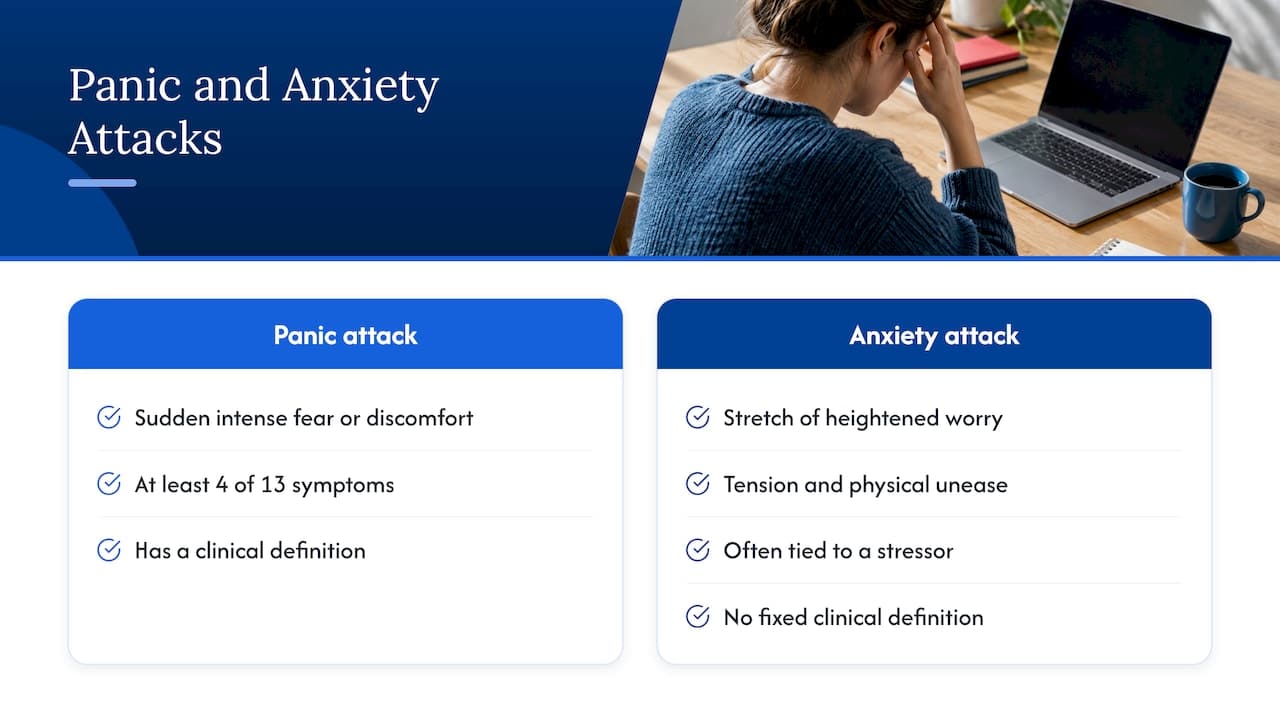
The terms differ in how doctors use them. A panic attack has a clinical definition. The Merck Manual describes it as a sudden onset of intense fear or discomfort with at least 4 of 13 listed symptoms. Anxiety attack is the lay term. It usually describes a stretch of heightened worry, tension and physical unease, often tied to a stressor, that does not have a fixed definition.
So the useful question is not which label is correct. It is what the episode looked like: how fast it started, how intense it got, how long it lasted and what set it off.
Panic attack vs. anxiety: side-by-side
| Panic attack | Anxiety (“anxiety attack”) | |
|---|---|---|
| Onset | Abrupt, sometimes with no clear trigger | Gradual, often builds around a specific worry |
| Intensity | Overwhelming, mostly physical | Mild to severe, often more mental and muscular tension |
| Duration | Peaks within minutes, usually gone in under an hour | Can last hours or days |
| Typical feelings | Fear of losing control, of dying or of impending doom | Dread, restlessness, racing thoughts, irritability |
| Triggers | May come “out of the blue” or from a feared situation | Usually linked to stress, a deadline, a health worry or a relationship problem |
| Aftermath | Exhaustion, fear of another attack | Ongoing tension, trouble sleeping or concentrating |
These are patterns, not rules. Some people have anxiety that spikes sharply, and some panic attacks follow an obvious stressor. A provider can sort out what is happening when the pattern is unclear.
What a panic attack feels like
The National Institute of Mental Health (NIMH) describes a panic attack as a sudden surge of overwhelming anxiety and fear. Physical symptoms can include:
- Pounding or racing heart
- Sweating and chills
- Trembling
- Trouble breathing
- Weakness or dizziness
- Tingling or numb hands
- Chest pain
- Stomach pain or nausea
Emotionally, many people feel out of control or afraid they are dying. An attack can last a few minutes to an hour, sometimes longer.
The Merck Manual adds a reassuring point: panic attacks are not medically dangerous. They feel frightening because the body is reacting as if there were a threat, not because it is being damaged.
What an anxiety episode looks like
Anxiety is slower and often more tied to your thoughts. You may notice:
- A steady sense of worry that is hard to switch off
- Muscle tension, headaches or a tight jaw
- Restlessness or feeling on edge
- Trouble falling or staying asleep
- Stomach upset
- Difficulty concentrating
These symptoms can ramp up before a big event, during a stressful week or after bad news, and then stay at a simmer for hours or days. Anxiety can also build into a full panic attack, which is one reason the two are so often confused.
What causes them
There is rarely one cause. The National Institutes of Health notes that anxiety disorders can result from a mix of genetics, brain chemistry, biology and environment, and that trauma or stressful surroundings may raise the likelihood of generalized anxiety disorder.
For panic attacks, overbreathing can play a part. The Association for Behavioral and Cognitive Therapies (ABCT) says persistent overbreathing may contribute to some attacks but does not explain all of them. Fast breathing blows off carbon dioxide, which can cause lightheadedness and tingling. Those sensations then feel alarming, and the alarm speeds up the breathing further.
How common this is
If this has happened to you, you are in large company. The ABCT reports that 6 to 12% of the general population has an unexpected surge of fear or panic at some point in a given year. It also reports that 2% to 6% of people have panic disorder in any 6-month period, as many as 14 million Americans.
When panic attacks become panic disorder
One panic attack does not mean you have a disorder. According to the Merck Manual, panic disorder requires at least one attack followed by a month or more of persistent worry about more attacks, or a change in behavior such as avoiding places where one happened.
NIMH describes this as a cycle: the attacks themselves are not life-threatening, but fear of the next one can lead to ongoing anxiety and avoidance, which can make the disorder worse than the attacks did. If you have started rearranging your day to avoid a store, a drive, a classroom or a meeting, that is the sign to get care rather than wait it out.
What to do during an attack
You cannot always stop an attack on command, but you can ride it out more steadily. Harvard Health suggests grounding techniques:
- Breathe slowly with a hand on your belly. Feel the hand rise and fall rather than your chest.
- Shift your focus. Look at one object, do a simple task, or repeat a mantra or a song in your head.
- Picture a safe, peaceful place. Guided imagery gives your mind something calm to hold.
- Remind yourself it will pass. Peak intensity is short, even when it feels endless.
Step-by-step routines such as anxiety self-help exercises can give you more to practice on calm days, so the skills are familiar when you need them.
For a child or teen, stay close, speak slowly and keep instructions short. Ask them to name five things they can see. Avoid telling them to “just calm down.”
Panic attack, asthma attack or something else?
This is the question that sends many parents and adults to urgent care, and it is a fair one. A panic attack and an asthma flare can both cause shortness of breath and a tight chest. A heart problem can cause chest pain that feels like panic.
The Merck Manual warns that a cluster of chest pain, shortness of breath, sweats and shakes can and often should lead to a general medical evaluation. That applies especially if you have an existing medical condition or have never been checked before. It also notes that people with panic disorder often worry about a heart, lung or neurologic problem and make repeated visits to primary care or the emergency department.
A few practical points:
- Wheezing, a known asthma history or a trigger such as smoke, a cold or exercise points toward asthma. Use your prescribed quick-relief inhaler as directed and get care if it does not help. If your child has asthma, our guide on asthma flare treatment and follow-up explains what to expect.
- Chest pressure with pain spreading to the arm, jaw or back, or pain with exertion, needs emergency care. Call 911.
- A first episode, a severe one or one that does not match your usual pattern should be examined, even if you suspect anxiety.
- Breathing that is not improving, blue lips, fainting or confusion is an emergency. Call 911.
We lay out other situations that call for same-day or emergency care in our guide to when to go to urgent care and in symptoms you should not ignore.
When to see a provider
NIMH advises seeking professional help when anxiety starts to cause problems at school, at work or with friends and family. It suggests starting with a health care provider such as a primary care doctor, psychiatrist, psychologist or clinical social worker.
Consider booking a visit if:
- You have had a panic attack for the first time
- Attacks keep coming back
- You fear the next attack or avoid places because of it
- Worry is hurting your sleep, grades, job or relationships
- Your child is having stomachaches, school refusal or sudden fear episodes with no clear cause
A first visit usually has two goals: rule out physical causes and talk through what you are feeling. Bring a note of when the episodes happen, how long they last and what you were doing before. It helps to also bring a list of your medications and any caffeine, nicotine or supplement use.
How panic and anxiety are treated
The good news is that treatment works. Per the American Psychiatric Association’s practice guideline for panic disorder, initial treatment with an SSRI, SNRI, tricyclic antidepressant, a benzodiazepine (as monotherapy only when there is no co-occurring mood disorder) or CBT is strongly supported by trials, with no evidence that one is superior to the others. The acute phase lasts about 12 weeks. The right choice depends on your preferences, other health conditions, risks and access, which is a decision to make with your provider.
NIMH calls CBT the “gold standard” psychotherapy for panic disorder. It teaches different ways of thinking, behaving and reacting to the feelings during or before an attack. The ABCT outlines four core parts:
- Learning what the physical symptoms of anxiety actually are, to correct misinterpretations
- Breathing and relaxation training
- Repeated, gradual exposure to feared situations you have been avoiding
- Repeated exposure to feared body sensations, such as the dizziness of overbreathing
The ABCT says these treatments eliminate panic attacks in most clients, with benefits lasting 2 years after treatment, whereas panic often returns when medication is stopped. If you are weighing therapy styles, our comparison of CBT vs. DBT can help. Parents of teenagers can read about a 12-week CBT approach for teen anxiety.
Our perspective
Most people who walk in with “an anxiety attack” are really asking two questions: is my body okay, and what do I do about this feeling? We think both deserve an answer on the same day.
That is why we pair medical care with therapy. You can be seen for the physical side, such as a racing heart or chest tightness, and then talk about what comes next, including counseling for adults and children, in the office or by virtual session.
We also like to start with the person, not the label. Whether you call it panic or anxiety, a calm conversation with an experienced provider, no long wait and no judgment, is often the first relief. Our team has more than 25 years of experience caring for families in Lutz and the Tampa area.
If you or your child is struggling, you do not need to wait for a crisis to ask for help.
Lisa
Same-day care for families in Lutz
If you are unsure whether what you felt was panic, anxiety or something physical, we can see you the same day. Our urgent care team can evaluate sudden symptoms like chest discomfort or shortness of breath. Our primary care providers can follow up on recurring episodes. We also offer therapy and counseling for adults and children, in the office or virtually. We are open seven days a week, 8 AM to 8 PM, and we see both adults and children.

Walk in or visit Your Family Walk-In Clinic to learn more. We accept major health insurance plans and Medicaid, and self-pay patients are welcome.
FAQ
Is an anxiety attack the same as a panic attack?
Not exactly. A panic attack is a defined medical event with sudden onset and a peak within minutes. “Anxiety attack” is a common phrase for a longer build-up of worry and physical tension. They share many symptoms, so it is normal to confuse them.
How long does a panic attack last?
NIMH says an attack can last from a few minutes to an hour, sometimes longer. The Merck Manual gives a similar range of minutes to an hour. Anxiety, by contrast, can hang around for hours or days.
Can a panic attack hurt me?
The Merck Manual states that panic attacks are not medically dangerous. Still, chest pain and trouble breathing can also come from heart or lung conditions. A first episode, a severe one or one that feels different from your usual pattern should be checked, and emergency symptoms call for 911.
How do I know if it is asthma or a panic attack?
Both can make it hard to breathe. Wheezing, a history of asthma or a known trigger suggest asthma, and your rescue inhaler should be used as prescribed. If you are not sure, or breathing does not improve, get medical care right away.
Should my child see someone for panic attacks?
Yes, if episodes repeat, your child avoids school or activities, or you cannot tell whether the symptoms are physical. A provider can check for medical causes first and then discuss counseling and CBT, which fit children and teens as well as adults.