

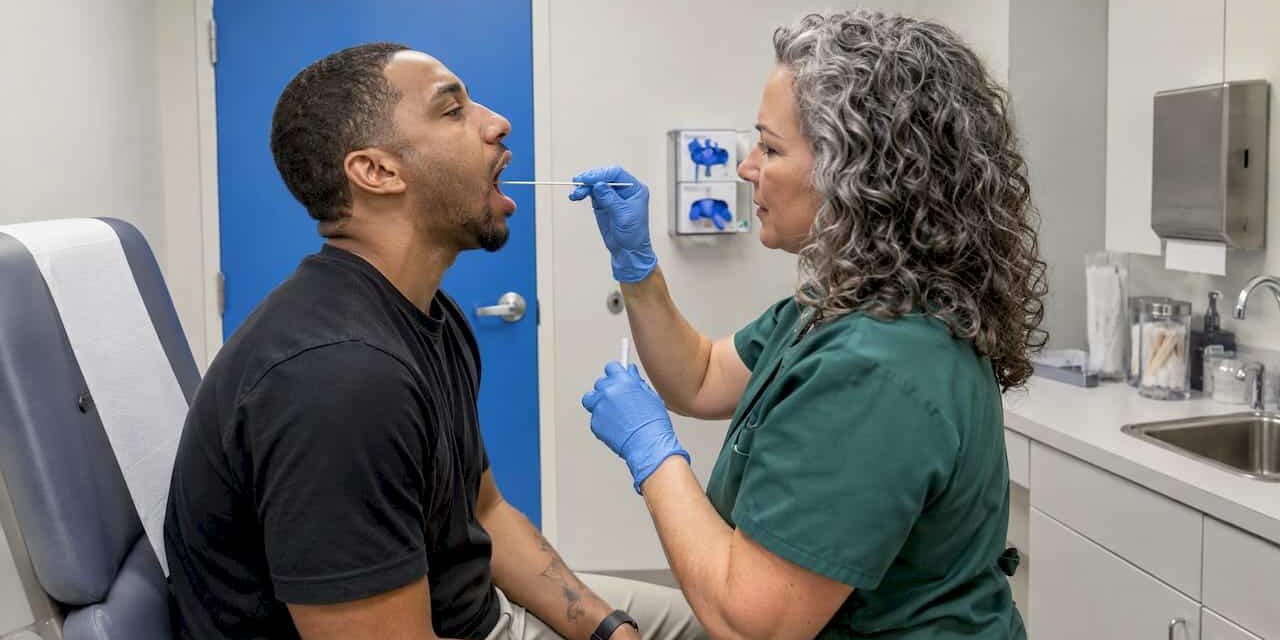
Most throat gonorrhea causes no symptoms at all. When it does, the main sign is a sore throat that looks and feels like any other. The CDC’s STI Treatment Guidelines say the majority of gonococcal infections of the pharynx are asymptomatic. So the only reliable way to know is a test, and if you have had oral sex with a new partner or a partner who may have an STD, a quick throat swab gives you a clear answer. At Your Family Walk-In Clinic in Lutz, STD screening and treatment are available seven days a week, 8 AM to 8 PM.
If you are reading this because your throat hurts and you are worried, take a breath. Gonorrhea is a bacterial infection that is treatable, and most sore throats have other causes. This guide explains what throat gonorrhea can feel like, how it differs from strep, how testing works and what happens if the result is positive.
TL;DR
- Most throat gonorrhea has no symptoms. When symptoms occur, the usual one is a sore throat.
- You cannot tell throat gonorrhea from strep or a cold by how it feels. A throat swab is the way to find out.
- Symptoms, if any, usually start 1 to 14 days after sexual contact, but you can carry and pass on the infection without ever noticing them.
- Throat gonorrhea is treated with a single antibiotic injection, and the CDC advises a follow-up test 7 to 14 days later to confirm it is gone.
- Same-day STD testing is available in Lutz, and you can tell the provider about oral sex so the right sites are tested.
Table of Contents
- Why throat gonorrhea often goes unnoticed
- Throat gonorrhea symptoms: what you might notice
- Gonorrhea sore throat or strep: how to tell
- How you get throat gonorrhea
- Who should get tested for throat gonorrhea
- How an oral gonorrhea test works
- When to test after possible exposure
- Treatment for throat gonorrhea
- Can oral gonorrhea clear on its own?
- Get tested in Lutz
- FAQ
- Sources
Why throat gonorrhea often goes unnoticed
Gonorrhea is caused by a bacterium called Neisseria gonorrhoeae. It most often infects the genital tract, but it can also settle in the throat, rectum and eyes. In the throat, doctors call it pharyngeal gonorrhea or oral gonorrhea. The terms mean the same thing.
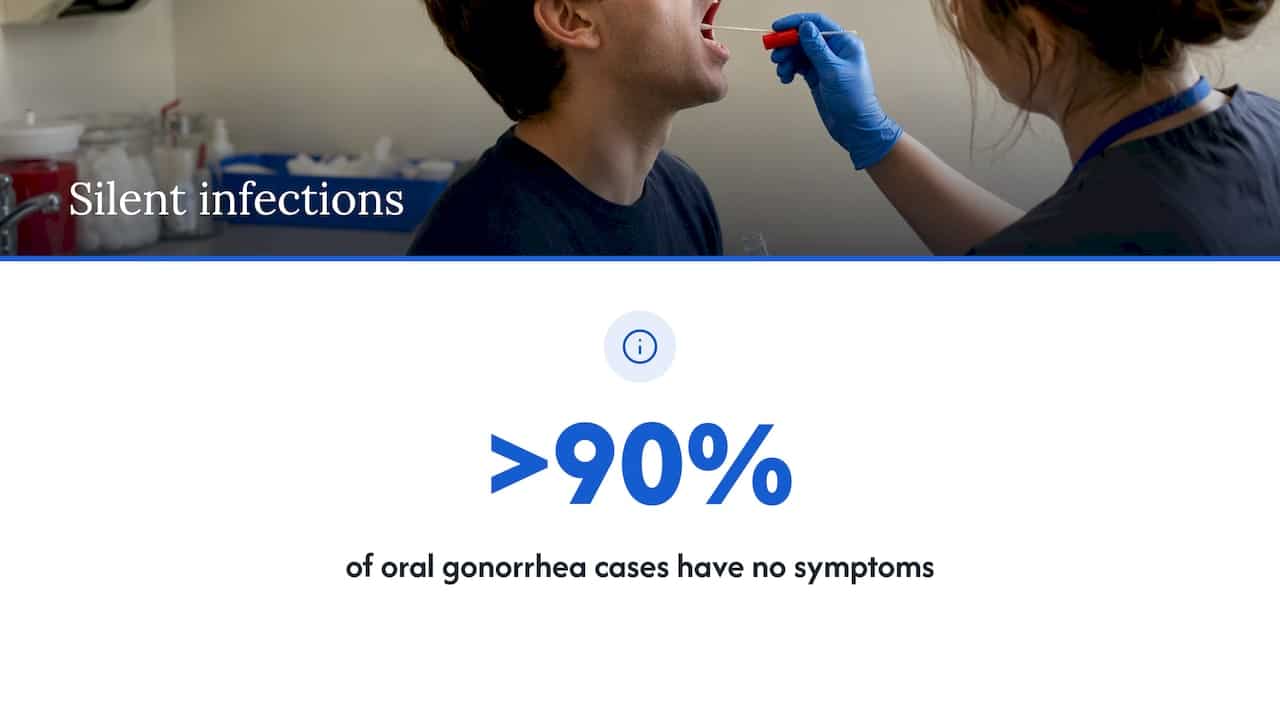
The World Health Organization notes that throat infections often have no symptoms. The American Sexual Health Association (ASHA) goes further and says that over 90% of oral gonorrhea cases have no symptoms. That is the central fact about this infection: feeling fine does not mean you are clear.
This matters for two reasons. First, you may never think to get tested. Second, the CDC describes these silent infections as a major source of community transmission, because people pass the bacteria on without knowing they have it. Testing is as much about protecting your partners as about your own comfort.
Throat gonorrhea symptoms: what you might notice
When throat gonorrhea does cause symptoms, they are mild and easy to mistake for something else. According to the WHO, they can include redness, pain and a sore throat. The Merck Manual says the same: the infection usually causes no symptoms, but the throat may be sore.
Possible signs include:
- A sore or scratchy throat that does not improve after several days
- Redness at the back of the throat
- Pain when swallowing
- Swollen lymph nodes in the neck (the tender lumps under the jaw)
- White patches or spots on the tonsils or throat, which can look like strep
If you are searching for a “sore throat from gonorrhea,” know that there is no feature that sets it apart. There is typically no unusual discharge, odor or color that points to gonorrhea in the mouth. ASHA states that oral gonorrhea may cause a sore throat similar to strep throat.
How soon do symptoms appear?
The WHO says symptoms generally begin 1 to 14 days after sexual contact with an infected person. Since many people never develop any, a normal throat two weeks later is not proof of a negative result. For a closer look at timing, see our guide to the STD window period.
Gonorrhea in other places
Throat infection often travels with infection elsewhere. Genital gonorrhea can cause burning with urination or discharge. Our guide to gonorrhea symptoms in men covers those signs. The CDC tells providers to ask anyone with genital or rectal gonorrhea about oral sex, and to test the throat if oral exposure is reported.
Gonorrhea sore throat or strep: how to tell
You cannot tell by looking or by how it feels. Both can cause a red, painful throat, swollen glands and white spots. Strep throat often comes with fever and a sudden start, and a cold usually brings a runny nose and cough, but none of these rules gonorrhea in or out.
What separates them is your recent history and a test:
| Situation | What it suggests | What to do |
|---|---|---|
| Sore throat with cough, runny nose, congestion | Likely a cold or other virus | Rest, fluids, see a provider if it worsens |
| Sudden sore throat, fever, white spots, no cough | Could be strep | Get a strep test |
| Sore throat after oral sex with a new partner or a partner with an STD | Could be gonorrhea or another STD, or an unrelated cause | Get an STD test that includes the throat |
| No symptoms, but oral sex with a possible exposure | Could still be infected | Get tested |
The CDC says a specific microbiologic diagnosis should be performed for people at risk for or suspected of having gonorrhea. In plain terms, a lab test, not a guess.
If your throat is very painful, you have trouble swallowing or breathing, or you have a high fever, do not wait for an STD result. Come in for urgent care the same day, or go to an emergency room if you cannot breathe comfortably.
How you get throat gonorrhea
Throat gonorrhea spreads through oral sex with an infected partner. The Merck Manual says it may develop after unprotected oral sex with an infected partner. ASHA notes that gonorrhea is one of the most common oral STIs and that giving oral sex to a partner with a penis carries a higher chance of transmission than other oral contact, and that throat gonorrhea is common, especially among men who have sex with men.
Anyone who has oral sex can get it, whatever their gender or orientation. A condom or dental dam used during oral sex lowers the chance of passing it on. Having gonorrhea once does not make you immune, so you can be infected again after treatment if a partner is not treated.
Who should get tested for throat gonorrhea
The CDC says people who have had oral or anal sex should talk with their healthcare provider about throat and rectal testing. It is especially worth raising if any of these apply to you:
- You had oral sex with a new partner, or with a partner who has or may have an STD
- A partner tells you they tested positive for gonorrhea or another STD
- You have multiple or anonymous partners
- You were diagnosed with genital or rectal gonorrhea and also had oral sex
- You are a man who has sex with men. The CDC advises yearly testing for syphilis, chlamydia and gonorrhea, and every 3 to 6 months with multiple or anonymous partners.
- You are a sexually active woman under 25. The CDC recommends gonorrhea and chlamydia testing every year, and the same for some women 25 and older with new or multiple partners or a partner with an STI.
Routine STD panels often check only a urine sample. If oral sex is part of your history, say so, because a urine test will not find an infection that is only in the throat. Our guides to recommended STD tests and STD panel tests explain what each one covers.
While you are being tested for STDs, it is also a good time to ask about other routine screening. Some adults do not realize they can ask about hepatitis B screening without disclosing risk, and a provider can tell you which tests fit your situation.
How an oral gonorrhea test works
The test is quick and not painful. ASHA describes it as a throat swab similar to the one used to diagnose strep throat. A clean oropharyngeal specimen collection swab is wiped across the back of the throat and tonsils for a few seconds. You may gag briefly. The swab then goes to a lab.
The CDC says two kinds of lab tests can detect infection in the throat: culture and a nucleic acid amplification test (NAAT). A NAAT looks for the bacteria’s genetic material and is the more common choice. The CDC notes that FDA-cleared pharyngeal swabs are available for men and women, and that patient-collected throat swabs are a reasonable alternative to swabs collected by a provider.
What to expect:
- Tell the provider about oral sex. This is how the right sites get tested. You will not be judged. The question is routine medical history.
- Swab collection. It takes seconds.
- Results. The lab reports back in a few days. Ask the clinic how you will be contacted.
- Treatment if positive. Same-visit or next-day treatment is the usual goal.
If you worry about privacy, read our guide on STD testing consent in Florida, which explains how teens can avoid insurance statements. Adults without insurance can also read about STD testing costs without insurance.
When to test after possible exposure
Testing too early can miss an infection, and the best timing depends on your exposure. A longer explanation is in our guide on when to test for STDs. The practical advice:
- If you have symptoms or a partner has tested positive, come in now. Do not wait.
- If you had a possible exposure and feel fine, talk to a provider about the right time to test. The WHO’s 1 to 14 day symptom range is a useful guide to how soon the bacteria can show up.
- If you are having ongoing sex with new or multiple partners, test on a regular schedule, as the CDC guidance above describes.
Until you have a result, avoid oral, vaginal and anal sex, or use barrier protection consistently. That protects your partners if you do have an infection you cannot feel.
Treatment for throat gonorrhea
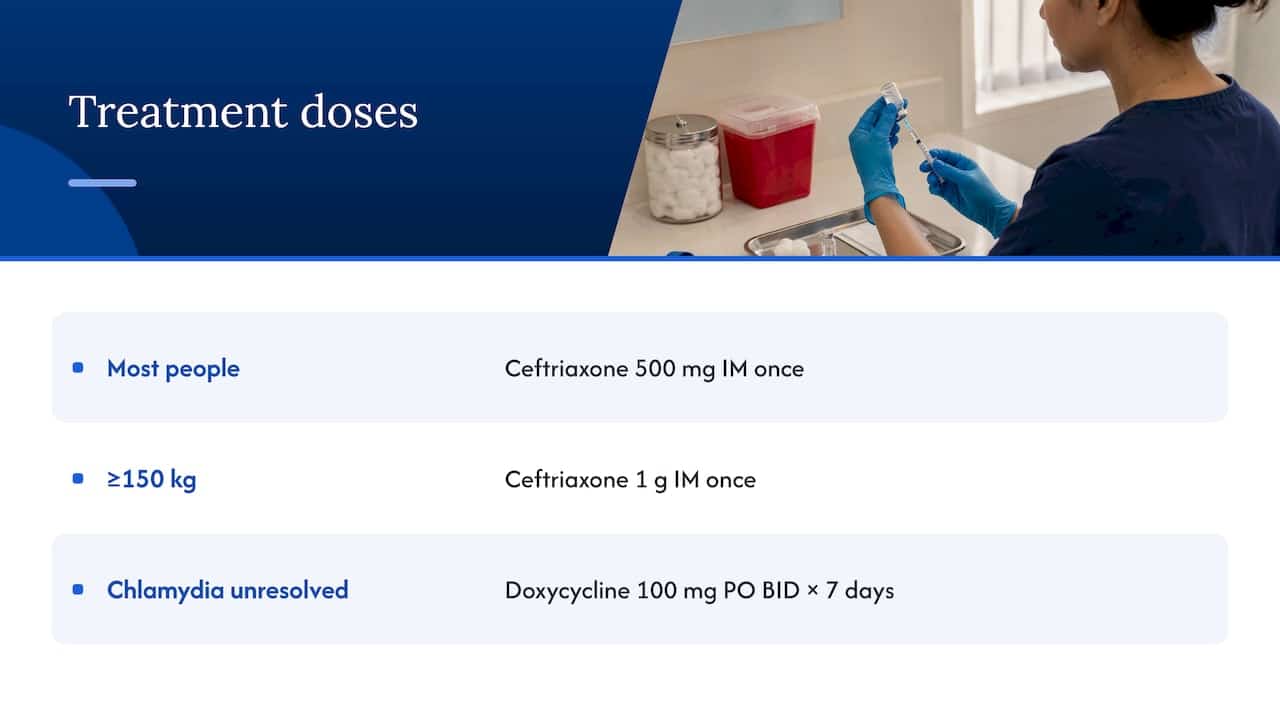
Throat gonorrhea is curable. The CDC’s clinical care page says the only recommended treatment for uncomplicated genital, rectal and throat gonorrhea is a single intramuscular injection of ceftriaxone 500 mg. People weighing 150 kg or more receive 1 g. If a chlamydia infection has not been ruled out, the CDC’s guidelines add doxycycline 100 mg by mouth twice daily for 7 days.
The throat is the hardest site to clear. A 2023 peer-reviewed review explains that throat infections consistently have lower cure rates than genital infections, likely because drug levels at the throat vary. Katzman and Neu’s 2025 review adds that no reliable alternatives exist for pharyngeal gonorrhea. That is why finishing the full treatment as prescribed, and following up, matters.
The follow-up test
Unlike genital gonorrhea, throat gonorrhea needs a test of cure. The Rhode Island Department of Health’s 2026 guidelines state that all cases of pharyngeal gonorrhea should have a test of cure 7 to 14 days after treatment. The Colorado health department notes that testing at 7 days may produce false positives, which is why the window runs to 14 days and why a positive NAAT is followed by a confirmatory culture before retreatment.
Also:
- Tell your partners. Rhode Island’s guidance covers partners from the 60 days before symptoms began, and partners should be tested and treated even if they feel fine.
- Wait to have sex. Avoid sexual contact until you and your partners have finished treatment.
- Plan a retest. Reinfection is common when a partner is untreated.
Can oral gonorrhea clear on its own?
It should not be left to. One peer-reviewed study followed 112 men and found that untreated throat infection lasted a median of about 16 weeks. That is months during which the infection can be passed to others, usually without any sign. Throat gonorrhea rarely causes complications in the person who carries it, according to the CDC, but the risk to partners, including genital infections that can lead to serious problems such as infertility and ectopic pregnancy in women, is the reason to treat it rather than wait.
Our view at the clinic
We meet many patients who come in only because a partner called with news. They feel fine, and they are surprised to learn that a throat can carry gonorrhea silently. We want you to know that this is common and that nothing about it calls for shame.
The most useful thing you can do is give your provider the full picture, including oral sex. Tests are only as good as the sites they sample, and a urine test alone leaves the throat unchecked. We offer STD screening and treatment for adults and teens in a private, welcoming setting, and same-day visits mean you do not need to sit with worry for days.
Because we are a family clinic open seven days a week, you can also handle related needs in one place: a strep test for the sore throat, a wellness exam, and follow-up care after treatment. Our approach is simple. Test the right sites, treat promptly, and make follow-up easy to keep.
Lisa
Get tested in Lutz
If you have a sore throat after a possible exposure, or no symptoms but a reason to wonder, our team can help you the same day. Your Family Walk-In Clinic offers STD screening and treatment for adults and teens, with same-day appointments from 8 AM to 8 PM, seven days a week. We accept major insurance plans and Medicaid, and self-pay is available. Call (813) 793-8555 or walk in. Let your provider know about oral sex so your testing covers the throat.

You can also see our full list of clinic services, or visit urgent care if your throat pain is severe.
FAQ
Can you have throat gonorrhea without a sore throat?
Yes, and it is the most common situation. The CDC says most throat infections have no symptoms. You can carry and pass on the bacteria without any sign, which is why testing after possible exposure matters more than waiting to feel ill.
How do I know if it is gonorrhea or a regular sore throat?
You cannot tell from symptoms alone. Both can cause redness, pain and swollen glands. Your sexual history and a throat swab tell the difference. If you have had oral sex with a new or possibly infected partner, ask for an STD test that includes the throat.
What is a pharyngeal gonorrhea test?
It is a swab of the back of the throat, similar to a strep test, sent to a lab for a NAAT or culture. It takes only seconds and is not painful, though it may make you gag briefly. Results usually come back within a few days.
Can oral gonorrhea clear up without treatment?
It may eventually, but not reliably. In one study of men, untreated throat infection lasted about 16 weeks on average. During that time you can pass it to partners. A single antibiotic injection treats it, followed by a test 7 to 14 days later.
Does a negative urine test rule out throat gonorrhea?
No. A urine test checks the urinary tract only. Throat infection needs a throat swab. Tell your provider about oral sex so the right sites are tested.
Sources
- CDC: Gonococcal Infections Among Adolescents and Adults, STI Treatment Guidelines
- CDC: Clinical Treatment of Gonorrhea
- CDC: Getting Tested for STIs
- World Health Organization: Gonorrhoea fact sheet
- ASHA: Oral Sex and STIs
- Merck Manual Consumer Version: Gonorrhea
- Rhode Island Department of Health: STI Treatment Guidelines, 2026
- Colorado Department of Public Health and Environment: Gonorrhea for Health Care Providers
- The Management of Gonorrhea in the Era of Emerging Resistance (PMC, 2023)
- Updates on Testing, Treatment, and Prevention of Sexually Transmitted Infections (PMC, 2025)
- The Staying Power of Pharyngeal Gonorrhea (PMC, 2021)
- Oropharyngeal specimen collection swab
- Hepatitis B screening for U.S. adults