


Mono and strep throat can look almost identical in the first days: a painful throat, fever, swollen glands and feeling worn out. The difference that matters is the cause. Strep is a bacterial infection that needs antibiotics. Mono is a viral infection that does not, and it can keep you tired for weeks. You can’t reliably tell them apart by looking in the mirror, so a throat swab or a blood test is how you know. If you or your child has a severe sore throat with fever, a same-day visit gets you an answer instead of days of guessing.
TL;DR
- Strep comes on suddenly, usually without cough or runny nose, and is treated with antibiotics. Mono builds more slowly, brings deep fatigue, and is treated with rest and fluids.
- Most sore throats are caused by common viruses and improve on their own, usually within about a week.
- A rapid strep swab gives results in the visit. Mono is confirmed with blood tests, and early tests can miss it.
- If you take amoxicillin for what turns out to be mono, a rash can appear. Testing first avoids that.
- Mono means skipping contact sports for a period, which matters for students with a season or a sports physical coming up.
Table of Contents
- Mono vs. strep at a glance
- What strep throat looks like
- What mono looks like
- Where the symptoms overlap
- What about a plain viral sore throat?
- Why a test matters
- When to get tested for strep
- When to get tested for mono
- The tests, and how accurate they are
- Treatment: what changes between the two
- Contagion: how long and how to protect others
- Students and athletes: mono and contact sports
- When a sore throat needs urgent attention
- Our view
- Get seen the same day in Lutz
- FAQ
- Sources
Mono vs. strep at a glance
| Strep throat | Mono (mononucleosis) | Common viral sore throat | |
|---|---|---|---|
| Cause | Group A Streptococcus bacteria | Usually Epstein-Barr virus (EBV) | Cold or flu viruses |
| Onset | Sudden | Gradual | Gradual, with cold symptoms |
| Throat | Severe pain, red tonsils, often white patches | Sore, swollen tonsils, sometimes with exudate | Mild to moderate pain |
| Cough or runny nose | Usually absent | Not typical | Often present |
| Fatigue | Can occur | Marked, can last weeks | Mild |
| Swollen glands | Tender glands at the front of the neck | Neck glands, often at the back too | Sometimes one or two |
| Treatment | Antibiotics | Rest, fluids, pain relief | Rest, fluids, pain relief |
| Typical age | Children and teens | Teens and young adults | Any age |
The sections below explain each column and where they overlap.
What strep throat looks like
The CDC’s clinical guidance describes typical strep pharyngitis as fever, pain with swallowing, a sudden start, tender swollen glands at the front of the neck, tiny red spots on the roof of the mouth, and red, enlarged tonsils with or without white patches. The same guidance notes that people with strep typically do not have a cough, runny nose, hoarseness, mouth ulcers or pink eye.
That last list is useful. The CDC says that cough, runny nose, hoarseness and pink eye point toward a virus instead of strep. If your child has a sore throat plus a stuffy nose and a cough, a cold virus is the more likely cause.
Strep is most common in school-age children. A child who wakes up with a sudden painful throat and a fever, and no cold symptoms, is the classic picture.
What mono looks like
Mono is most often caused by the Epstein-Barr virus, which spreads through saliva. The AHRQ Pharyngitis Clinician Guide says it most commonly affects adolescents and young adults and usually brings fever, a sore throat with exudate (a white or yellow coating on the tonsils), fatigue and swollen neck glands that can last for a month.
What sets mono apart is how you feel overall. Strep hits the throat hardest. Mono tends to leave you exhausted, achy and unable to keep up with school, work or practice. Glands at the back of the neck are a clue as well: a UK clinical guideline reviewing published research found that swollen glands at the back of the neck were the exam finding that most strongly predicted mono.
The same review found that sore throat and fatigue are common in mono but not specific to it. Many other illnesses cause both. That is why symptoms alone cannot settle the question.
Where the symptoms overlap
Both illnesses can cause:
- Sore throat and trouble swallowing
- Fever
- Swollen, tender neck glands
- Red, swollen tonsils, sometimes with white patches
- Headache and tiredness
The Merck Manual’s comparison table shows how much the pictures blur: strep often brings severe throat pain, fever and tender neck glands, while viral throat infections more often come with a runny nose or cough and may bring little or no fever. A UK review also found that about 1 in 13 people who went to a clinician with a sore throat turned out to have mono, so it is not rare.
What about a plain viral sore throat?
Most sore throats are neither strep nor mono. The CDC states that viruses like those behind colds and flu are the most common cause of sore throat, and most get better on their own within a week. When clear viral symptoms are present, a provider can often diagnose a viral sore throat from your history and an exam, without a strep test.
This is good news for you: antibiotics do nothing for a viral infection. The CDC is clear that viral pharyngitis should not be treated with antibiotics.
Why a test matters
Guessing wrong has real costs in both directions. Untreated strep needs antibiotics to clear. Antibiotics taken for mono or a virus do not help, and with mono they can cause a problem of their own.
The amoxicillin rash
MedlinePlus explains that a pink, measles-like rash can occur with mono, and it is more likely if you take ampicillin or amoxicillin for a throat infection. It also says antibiotics should typically not be given without a test showing a strep or other bacterial infection. The UK guideline adds that the rash usually appears after amoxicillin is given for what was presumed to be strep.
If a rash shows up during treatment, call the provider who prescribed the medicine before you take another dose.
When to get tested for strep
Clinicians often use the Centor criteria, a simple point score. The AHRQ guide lists the points: fever of 100.4°F or higher, tonsil exudates, tender front neck glands, and no cough each add one point. Age adds one point for ages 3 to 14, none for 15 to 44, and subtracts one at 45 or older. A score of 0 to 1 means no testing is needed. A score of 2 to 3 means a strep test, and 4 to 5 means testing or treatment.
The IDSA’s 2025 guideline update emphasizes using a scoring system to identify people with a low chance of strep, so they can skip unnecessary testing. It does not apply to children under 3. It also says people at higher risk should be strongly considered for testing even with a low score, including anyone with:
- A household member with strep
- A past diagnosis of rheumatic fever
- Signs of a complicated infection, such as an abscess in the throat, scarlet fever or toxic shock syndrome
In practice, get tested if the throat pain is severe, the start was sudden, there is a fever, and there is no cough or runny nose. Our guide on when to get tested for strep walks through this in more detail.
When to get tested for mono
Think of mono if a sore throat comes with marked fatigue, swollen glands (especially at the back of the neck, armpits or groin) and the person is between 15 and 24. The American Family Physician review recommends testing people with fever, sore throat, fatigue, enlarged tonsils and swollen glands, especially at ages 15 to 24. It says initial testing should include a complete blood count with differential and a rapid heterophile antibody test.
Also consider mono when a strep test comes back negative and the sore throat, fever and exhaustion keep going past a few days. A negative strep result means strep is unlikely. It does not tell you what is causing the illness.
The tests, and how accurate they are
Strep tests
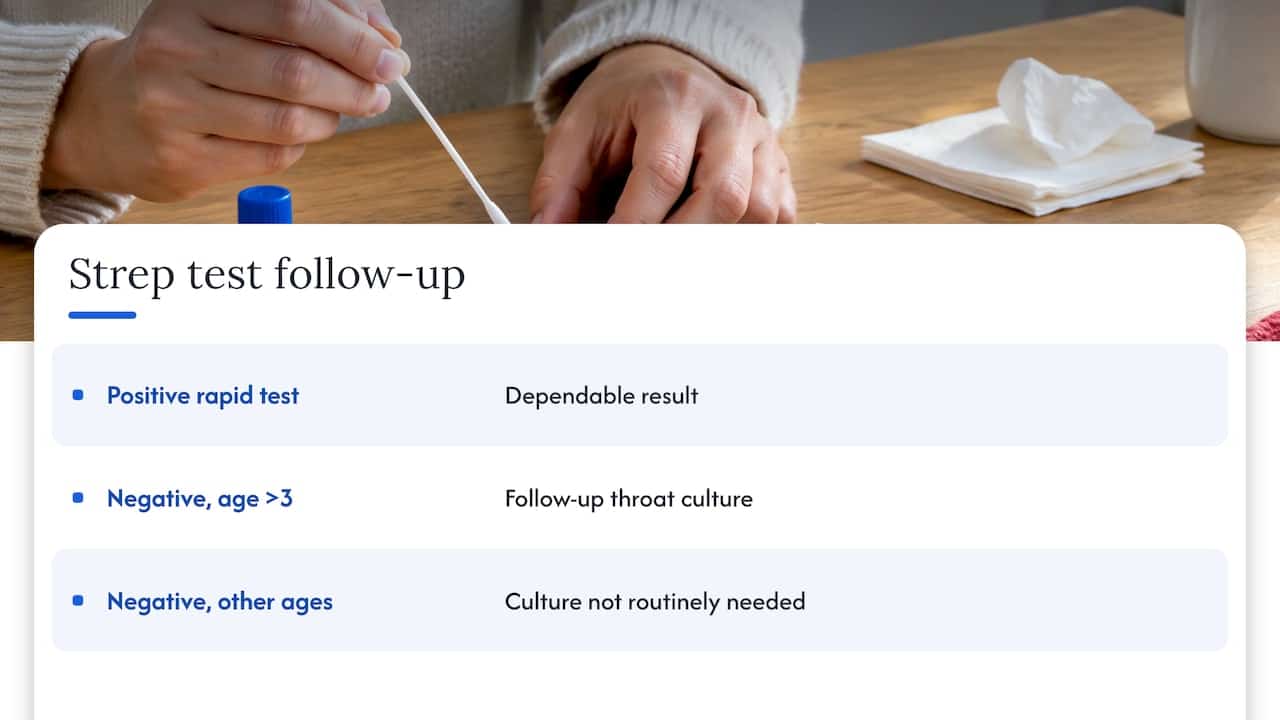
The CDC says a provider can confirm strep with either a rapid antigen test or a throat culture. Rapid tests are highly specific but vary in sensitivity compared with a culture, and the culture is considered the gold standard. In plain terms: a positive rapid test is dependable, while a negative one can occasionally miss strep.
For that reason, the CDC advises that children older than 3 whose rapid test is negative should have a follow-up throat culture. For other ages, a culture after a negative rapid test is not routinely needed, because acute rheumatic fever (a rare strep complication affecting the heart and joints) is very rare in those groups.
The swab itself takes a few seconds and can make you gag. See what happens during the throat swab and how to read your results if you want to know what to expect.
Mono tests
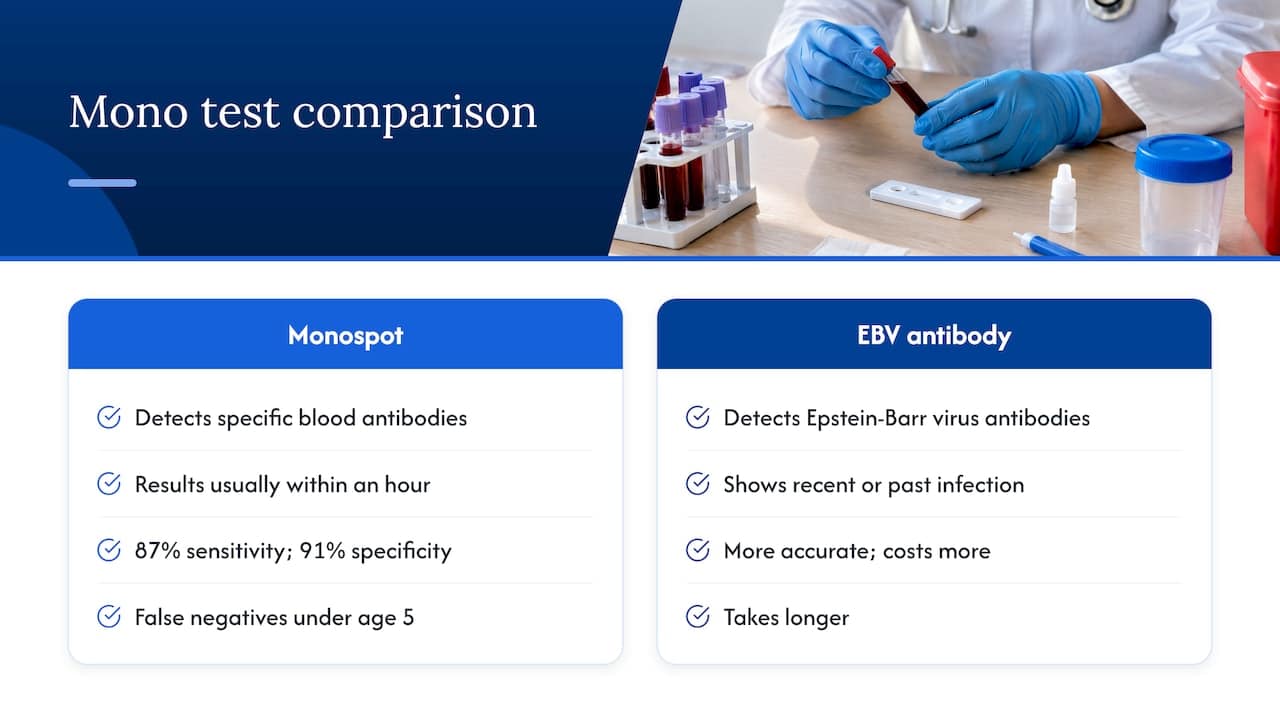
MedlinePlus describes two main mono tests. The Monospot test looks for specific antibodies in the blood, and results are usually ready within an hour, but it has a high rate of false negatives. The EBV antibody test looks for antibodies to Epstein-Barr virus, and different types show a recent or a past infection.
The American Family Physician review puts numbers on it: the heterophile antibody (Monospot) test has 87% sensitivity and 91% specificity. It can read falsely negative in children under 5 and in adults during the first week of illness. EBV-specific antibody testing is more accurate but costs more and takes longer.
This means a negative mono test in the first week does not always close the case. If symptoms continue, repeat or more specific testing can be done.
Treatment: what changes between the two
Strep
The CDC names penicillin or amoxicillin as the antibiotic of choice, and says anyone with a positive rapid test or culture needs antibiotics. The AHRQ guide lists oral penicillin V or amoxicillin for 10 days as preferred, with 10 days of clindamycin or 5 days of azithromycin for severe penicillin allergy. Finish the full course even when you feel better.
Most people feel better within 24 to 48 hours of starting antibiotics, according to Family Doctor, which also advises calling your doctor if symptoms are not improving after 48 hours.
Mono
The American Family Physician review states that mono treatment is supportive, and that antivirals and corticosteroids are not routinely recommended. Supportive means rest, fluids and fever or pain relief your provider recommends. Fatigue can linger for weeks, so plan a gradual return to school or work.
Viral sore throat
Rest, fluids and time. A provider can tell you which pain relievers suit your age and health.
Contagion: how long and how to protect others
Strep. Family Doctor says you are generally less contagious after 12 to 24 hours of appropriate antibiotics and once the fever is gone. Many schools and child care centers follow this window for return.
Mono. It spreads through saliva by direct or indirect contact. The Maryland Department of Health notes the contagious period is prolonged and may last a year or more, and some people become long-term carriers. General school exclusion is not routinely recommended. The WHO points out that because EBV is so common, and many people carry it without knowing, the most practical step is not sharing items that touch the mouth, such as cups, water bottles, utensils and toothbrushes.
Students and athletes: mono and contact sports
Mono can enlarge the spleen, an organ in the upper left abdomen, and a hard hit can rupture it. The AHRQ guide advises avoiding contact sports for about 6 weeks from the start of symptoms. The American Family Physician review gives a shorter figure: current guidelines recommend no athletic activity for three weeks from onset, with shared decision-making between patient and clinician on when to return. Because sources differ, ask your provider to set the timing for your situation.
If your teen has a sports physical coming up and was recently diagnosed with mono, tell the provider at the visit. Our page on Florida sports physical requirements explains what student-athletes need.
When a sore throat needs urgent attention
Go to the emergency room or call 911 for trouble breathing, trouble swallowing your own saliva, drooling, a muffled voice, a stiff neck, or severe pain on one side of the throat. Sudden, severe belly pain on the upper left side in someone with mono also needs emergency care right away, since it can signal a spleen injury.
For a sore throat with a fever, a child who is refusing fluids, or symptoms that are not improving after a few days, a same-day visit is the right level of care. Our guide on choosing a doctor, urgent care or the ER for a sore throat lays out the decision step by step, and the page on strep throat urgent care explains what a visit involves.
Our view
Parents often arrive convinced they know which one it is. The truth is that a sore throat with fever and swollen glands can be strep, mono or a plain virus, and the three need very different handling.
We think the best first step is a same-day visit where a provider examines the throat, asks about cough, runny nose, fatigue and exposures, and decides which test fits. That keeps your child from taking antibiotics they do not need, and keeps a strep infection from being missed.
Our providers have more than 25 years of experience, and we care for adults and children under one roof, seven days a week. When a family comes in together with sore throats, or a teen comes in tired and feverish before a season starts, we would rather sort it out in one visit.
Lisa
Get seen the same day in Lutz
If you are trying to work out whether it is strep, mono or a virus, our urgent care in Lutz is open seven days a week from 8 AM to 8 PM, with same-day appointments for adults and children. We accept major health insurance plans and Medicaid, and self-pay patients are welcome. For follow-up care after a diagnosis, our primary care providers can see the whole family.

See all of our services, including lab work, or visit our home page to plan your visit.
FAQ
Can you have strep and mono at the same time?
Yes. Strep bacteria can be present in the throat while mono is also causing illness, and some people carry strep without being sick from it. This is one reason a provider looks at the whole picture instead of relying on a single result. If you improve on antibiotics but stay exhausted, mono may be the reason.
Does mono cause a rash?
It can. MedlinePlus notes that a pink, measles-like rash can occur with mono, and it is more likely if you take amoxicillin or ampicillin. If a rash appears while you are taking an antibiotic, contact the prescriber before the next dose.
How long does mono last compared with strep?
Strep usually improves within a couple of days of starting antibiotics. Mono lasts longer: fever, sore throat and swollen glands can last for about a month, and tiredness can continue after that. Your provider can advise when to return to school, work and sports.
Is the rapid strep test accurate?
A positive rapid strep test is very reliable. A negative one can sometimes miss strep, so for children older than 3 the CDC advises following a negative result with a throat culture. Ask your provider whether a culture is right for your child.
Can a negative mono test be wrong?
Yes, especially in the first week of illness and in young children. If symptoms continue, your provider may repeat the test or order a more specific EBV antibody test.
Sources
- Sore Throat Basics, CDC
- Clinical Guidance for Group A Streptococcal Pharyngitis, CDC
- Pharyngitis Clinician Guide, AHRQ
- Infectious Mononucleosis: Rapid Evidence Review, American Family Physician
- Mononucleosis (Mono) Tests, MedlinePlus
- Mononucleosis, MedlinePlus Medical Encyclopedia
- Infectious mononucleosis diagnosis, NICE CKS
- Infectious causes and features of sore throat, Merck Manual
- Diagnosing group A streptococcal pharyngitis: updated guideline, IDSA
- Strep Throat, Family Doctor
- Maryland Communicable Diseases Summary, Maryland Department of Health
- Mononucleosis (glandular fever), WHO