

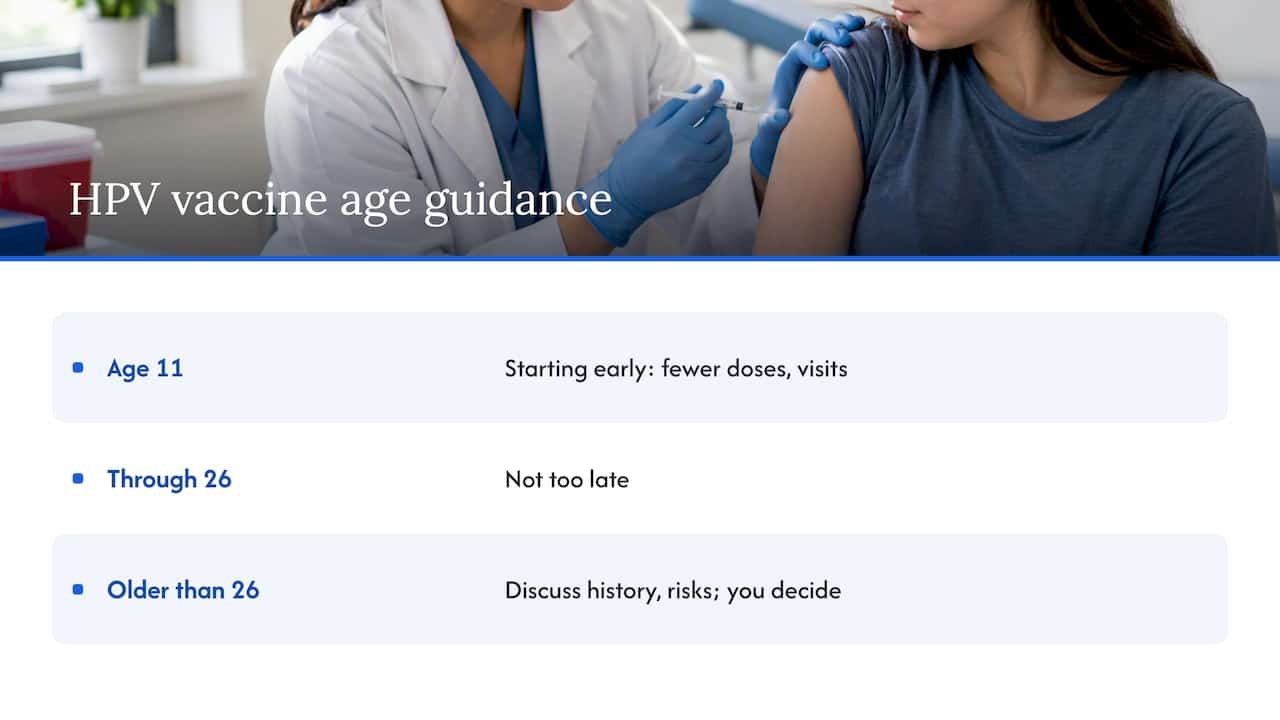
The HPV vaccine is recommended routinely at ages 11 or 12, and it can be started as early as age 9. Anyone through age 26 who missed it can still catch up. Adults ages 27 through 45 may also get it, but that is a decision you make with a clinician, not a routine recommendation. The rest of this guide covers what changes at each age, how many doses you need, and what to do if you are past the ideal window.
TL;DR
- Routine age: 11 or 12, with the option to start at 9.
- Catch-up: recommended for everyone through age 26 who was not adequately vaccinated.
- Ages 27 to 45: possible after a conversation with a clinician, because the benefit is smaller for many adults who have already been exposed.
- Doses: 2 doses if you start before age 15 (6 to 12 months apart), 3 doses if you start at 15 or older.
- Not for pregnancy: the series is put off until after pregnancy ends.
Table of Contents
- The HPV vaccine age range at a glance
- Ages 9 to 12: the routine window
- Ages 13 to 26: catch-up vaccination
- Ages 27 to 45: a decision to make with your clinician
- How many doses do you need?
- Who should wait
- Safety and what to expect
- Does vaccination replace cervical cancer screening?
- Our perspective
- Getting vaccinated in Lutz and the Tampa area
- A simple plan by situation
- FAQ
- Sources
The HPV vaccine age range at a glance
Here is the schedule most U.S. families follow, based on CDC’s HPV vaccine recommendations.
| Age when you start | What is recommended | Doses |
|---|---|---|
| 9 to 10 | May start early, at the clinician’s and parent’s discretion | 2 |
| 11 to 12 | Routine vaccination | 2 |
| 13 to 14 | Catch-up | 2 |
| 15 to 26 | Catch-up | 3 |
| 27 to 45 | Shared decision with a clinician | 3 |
| Immunocompromised, any eligible age | Recommended per the same schedule | 3 |
The recommendation applies to boys and girls alike. The FDA-approved vaccine, Gardasil 9, covers males and females ages 9 through 45, which is where the upper age limit people ask about comes from.
Ages 9 to 12: the routine window
CDC recommends routine HPV vaccination at ages 11 or 12, and says it can start at age 9. The American Academy of Pediatrics goes slightly wider in its October 2025 guidance for pediatricians: start between ages 9 and 12, at the age the clinician judges best for the family to accept and finish the series.
Why so young?
The vaccine works by preventing infection, and it works best before any exposure. CDC explains that the point of vaccinating at 11 to 12 is to build protection before HPV exposure, when vaccine effectiveness is greatest. The age has nothing to do with expecting a child to be sexually active soon. It is about timing the protection ahead of any future risk.
There is a practical reason too. Children in this age range need only two doses, and they are already seeing a clinician for other preteen vaccines and checkups. Adding HPV to that visit is easier than tracking it down later.
Why start at 9 instead of 11?
Some families choose an earlier start so the second dose is done well before the busy middle school and high school years. A 9- or 10-year-old who gets dose one at a regular checkup has a long cushion for dose two. If you are unsure which age fits your child, ask at the next visit. Both ages are within the recommendations.
What boys and girls get
HPV vaccination is recommended for boys as well as girls. The AAP notes it can prevent the infections that lead to six cancers: cervical, vaginal, vulvar, anal, penile, and oropharyngeal. Several of those affect people of any sex, so the vaccine is not just a girls’ vaccine.
Ages 13 to 26: catch-up vaccination
If your teen or young adult did not start or finish the series, it is not too late. Catch-up vaccination is recommended through age 26 for anyone not adequately vaccinated. ACIP’s evidence review confirms catch-up through age 26 across sexes.
A few situations come up often:
- A college-bound teen with one dose. You do not start over. Continue the series from where it left off.
- A 22-year-old who never started. They can begin now, and because they are 15 or older, they will need three doses.
- A young adult who is not sure what they received. Check immunization records first. Our guide to getting immunization records in Florida walks through where to look. Our post on vaccines before college is also a good checklist.
What if you already had HPV, warts, or an abnormal Pap test?
You can still be vaccinated. The vaccine does not treat an existing infection, but someone with prior exposure may still benefit against HPV types they have not encountered. CDC’s STI guidelines say vaccination is recommended regardless of a history of anogenital warts, abnormal Pap or HPV testing, or anogenital precancer.
That leads to a common question: does the vaccine help if you already have HPV? No. It prevents new infections. It is not a treatment. If you have symptoms or a positive result and want answers, that is a conversation about testing and care, not vaccination alone.
Ages 27 to 45: a decision to make with your clinician
This is the age group with the most confusion. CDC does not recommend HPV vaccine routinely for everyone older than 26. Instead, adults 27 through 45 who were not adequately vaccinated may choose to be vaccinated after discussing it with a clinician.
Why it is a shared decision
The reasoning is about benefit, not safety. By these ages, more people have already been exposed to HPV, so the vaccine provides less benefit. ACIP’s assessment describes the benefit of expanding vaccination in older young adults as small, with minimal expected harms and evidence that still favors vaccination.
In plain terms: the vaccine can still help, mostly if you are at risk of a new infection. Examples a clinician may talk through with you include a new partner, more than one partner, or a partner whose history you do not know. Every person’s situation is different, so this is a one-on-one discussion, not a rule.
Why is 45 the cutoff?
The 45 limit comes from the FDA approval, which was based on trials in women up to that age. The FDA extended Gardasil 9 to age 45 after a large trial showed it prevented persistent infection and related disease in that group. Beyond 45, the vaccine is not approved, and the expected benefit is smaller still.
How many doses do you need?
Dose count depends on your age at the first shot, not your age now. According to CDC’s schedule:
- Starting before age 15: two doses, with the second given 6 to 12 months after the first.
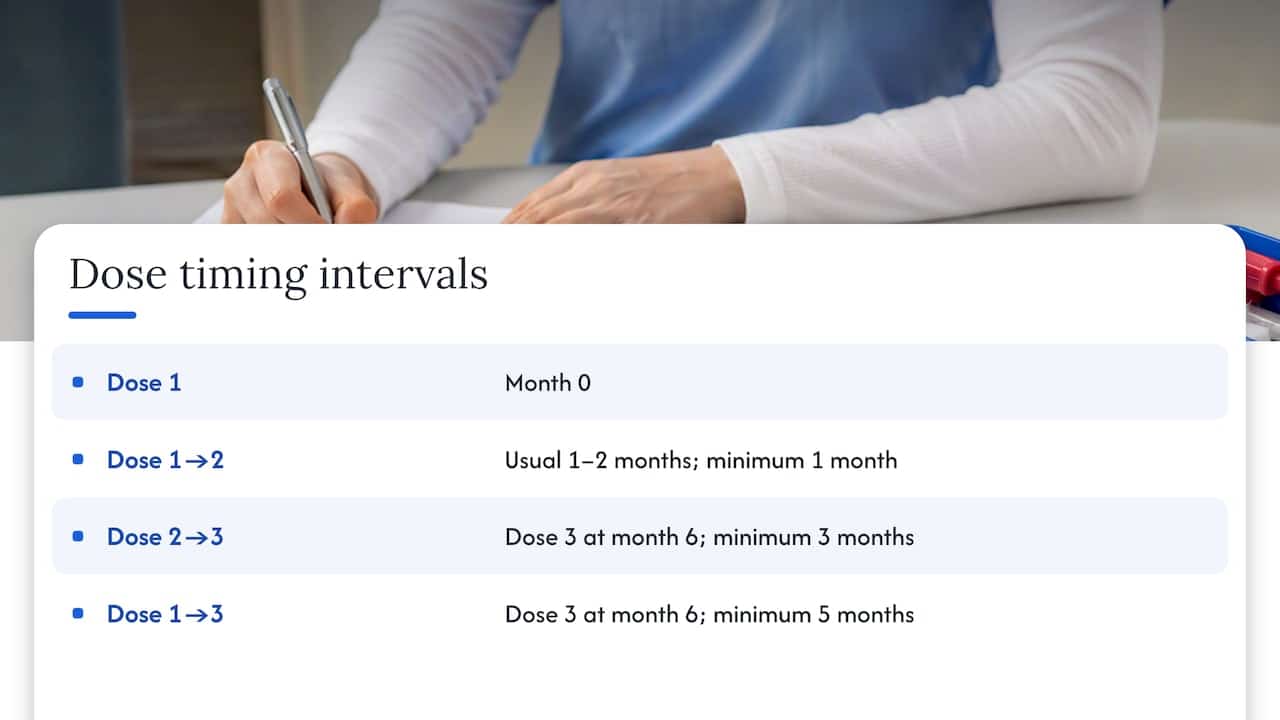
- Starting at 15 through 26 (or immunocompromised): three doses, at 0, 1 to 2 months, and 6 months.
- Two doses less than 5 months apart: a third dose is needed.
Why fewer doses for kids? CDC says two doses given at least six months apart in children ages 9 to 14 produced antibody responses as good as or better than three doses in older teens and young adults.
Minimum spacing for the three-dose series
The ACIP resolution sets minimum intervals: 1 month between doses one and two, 3 months between doses two and three, and 5 months between doses one and three. These are minimums, not targets. Following the standard 0, 1 to 2, 6 month pattern is the usual plan.
If you miss a dose
Do not restart. The same ACIP resolution states that an interrupted series does not need to be started over. You pick up where you left off, even if it has been years.
Who should wait
HPV vaccines are not recommended during pregnancy. If you are pregnant, vaccination is put off until the pregnancy is over. If you are mid-series and learn you are pregnant, tell your clinician, who will schedule the remaining doses for after delivery. Anyone who has had a severe allergic reaction to a previous dose or a vaccine component should discuss it with a provider before another shot.
Safety and what to expect
CDC reports that U.S. safety evaluations find HPV vaccines well tolerated, and that more than 120 million doses had been distributed as of its guideline publication. Typical reactions after any vaccine are mild: a sore arm, redness at the injection site, or a short-lived low fever. Fainting after any injection can happen in teens and young adults, so it is sensible to sit for 15 minutes afterward.
Parents also ask about fertility. The research we reviewed did not contain a fertility finding for HPV vaccines, so we will not make a claim either way here. If this is a concern for your family, bring it up with your clinician, who can point you to the current CDC safety information.
Does vaccination replace cervical cancer screening?
No. CDC stresses that vaccination complements rather than replaces cervical cancer screening, and vaccinated women should continue routine screening. The vaccine covers specific HPV types, and screening catches changes the vaccine does not prevent. See our overview of common health screenings for what to schedule and when.
Our perspective
At our Lutz clinic, the HPV conversation usually starts with a parent who is not sure whether their 11-year-old is ready. We tell them the vaccine is about the timing of protection, not about behavior, and that starting early means fewer doses and fewer visits.
The other common patient is a young adult who walks in because a new partner or a school form sparked the question. They often assume they are too late. Through 26, they are not. For adults older than that, we do not push. We talk through your history, your risks and your questions, and you decide.
We built our clinic around being open when families need us: seven days a week, 8 AM to 8 PM, with same-day visits. That matters for a multi-dose series, because the second visit is the one people forget. If you are not sure where you stand, an easy first step is to bring your records and let us look at them together.
— Lisa
Getting vaccinated in Lutz and the Tampa area
We provide immunizations for adults and children, along with primary care, wellness exams and school and sports physicals. See our services page for the full list, or call us at (813) 792-8555 to confirm vaccine availability and what your insurance covers before you come in. We accept major insurance plans, Medicaid and self-pay.
If you want a closer look at the topic by state, our page on HPV vaccine age in Florida covers it, and our HPV vaccine eligibility guide goes through who qualifies. Adults building a full catch-up plan can use the adult vaccine schedule.
A simple plan by situation
- Your child is 9 to 12: ask for the first dose at the next checkup. Book the second dose 6 to 12 months later.
- Your teen is 13 or 14 and unvaccinated: two doses still work. Start now.
- You or your teen is 15 to 26 and unvaccinated: begin the three-dose series. Do not wait for a perfect time.
- You are 27 to 45: schedule a visit to talk through your risk. Bring any vaccine records.
- You are pregnant: wait until after pregnancy, then talk to your clinician.
FAQ
Can adults over 26 get the HPV vaccine?
Yes, through age 45, after a shared discussion with a clinician. It is not recommended routinely for everyone in that range because many adults have already been exposed, so the benefit is smaller. People at risk of a new infection may benefit most.
Is the HPV vaccine recommended for boys?
Yes. Boys and girls are both recommended to get it at ages 11 to 12, starting as early as 9. It helps prevent infections linked to several cancers that affect people of any sex, including anal, penile and oropharyngeal cancers.
Does the HPV vaccine work if you already have HPV?
It does not treat an existing HPV infection or HPV-related disease. It can still protect against HPV types you have not encountered, and CDC recommends vaccination regardless of a history of warts or abnormal test results.
Do I need to restart the series if I missed a dose?
No. An interrupted HPV series is continued, not restarted, no matter how long the gap. Contact your clinician to schedule the next dose and confirm which one you are due for.
Why do younger kids need fewer doses?
Children who start before age 15 build an immune response with two doses that is as good as or better than three doses in older teens and young adults. That is why two doses, spaced 6 to 12 months apart, are enough if you start early.
Sources
- HPV Vaccine Recommendations, CDC
- Clinical Overview of HPV, CDC
- Evidence to Recommendations for HPV Vaccination, ACIP
- ACIP Resolution on HPV Vaccine, CDC
- Human Papillomavirus (HPV) Infection, STI Treatment Guidelines, CDC
- Vaccines (Shots) and Cancer, CDC
- How Pediatricians Can Recommend HPV Vaccination to Parents, AAP
- Gardasil 9 FDA approval for use up to age 45