


Most adults need a tetanus booster every 10 years, but a dirty or deep wound moves that window up to a shorter interval. Children follow a DTaP series starting at 2 months, with a Tdap booster at pre-adolescence, and pregnant patients need one Tdap dose each pregnancy, ideally in the late second to early third trimester. If you can’t remember your last shot, or you just got hurt and aren’t sure it counts as “dirty,” the safer move is almost always to get vaccinated rather than wait.
TL;DR:
- A dirty or deep wound requires a tetanus booster if the last vaccine was more than five years ago, while a minor or clean wound only needs one if over ten years have passed since vaccination.
- Most adults should get a Tdap booster if they have not completed the childhood series or if uncertain, especially after high-risk injuries, rather than waiting for symptoms.
- Treatment should be prompt with wound cleaning, coverage, and vaccination, and tetanus immune globulin is reserved for unvaccinated or incompletely vaccinated individuals with high-risk wounds.
- Vaccination timing is crucial because immunity lasts approximately ten years, but high-risk wounds shorten this window to five years to prevent toxin production.
- Checking personal records or state immunization systems is key to determining whether a booster or tetanus immune globulin is needed during wound care.
Table of Contents
- Tetanus Shot When: The Routine Vaccination Schedule by Age
- Tetanus Booster Timing After a Wound: The 5-Year vs. 10-Year Rule
- Tetanus Shot After a Cut: What to Do in the First Few Hours
- Who Should Wait or Skip a Tetanus Shot
- Tetanus Shot Side Effects: What’s Normal and What’s Not
- Where to Get a Tetanus Shot and How to Find Your Records
- Do I Need a Tetanus Shot Right Now? A 4-Step Checklist
- Why Tetanus Is Still Dangerous Even Though It’s Rare
- Tetanus Symptoms to Watch for After a Cut or Puncture
- How Long Does a Tetanus Shot Actually Protect You?
- A Clinic’s-Eye View of Tetanus Timing
- Get Your Tetanus Shot Today at Your Family Walk-In Clinic
- Sources
- FAQ
Tetanus Shot When: The Routine Vaccination Schedule by Age
Knowing when your next tetanus shot is due starts with knowing where you are in the schedule. The CDC’s tetanus vaccine recommendations lay out a lifelong sequence that starts in infancy and never really ends. Once you understand the pattern, figuring out “am I due?” takes about thirty seconds.
For children, the DTaP primary series runs on a predictable timeline:
- Doses at 2, 4, and 6 months of age
- A fourth dose at 15 to 18 months
- A fifth dose between 4 and 6 years old
- A Tdap booster at 11 to 12 years
That five-dose DTaP run is what clinicians mean by a “complete primary series.” It matters because everything downstream, including how doctors interpret wound risk later in life, assumes that foundation is in place. A child who’s had all five doses is treated differently than one who’s missed shots, even if both got hurt the same way.
Adults who completed that childhood series simply continue with a Td or Tdap booster at regular intervals. Adults who never received a Tdap dose should get a one-time Tdap, then continue with regular Td or Tdap boosters thereafter. Our adult vaccine schedule guide breaks down exactly where different age groups typically stand.
Tetanus Booster Timing After a Wound: The 5-Year vs. 10-Year Rule
The 10-year rule only applies to a clean, minor scrape. Once a wound is dirty, deep, or otherwise high-risk, the clock shortens to 5 years, according to CDC clinical guidance for wound management. This is the single most misunderstood piece of tetanus timing, and it’s the reason so many people get an unnecessary shot, or skip one they actually needed.
Here’s how to sort a wound into the right category:
- Identify the wound type. Dirty or major wounds include punctures, anything contaminated with soil or feces, burns, crush injuries, and compound fractures. Clean or minor wounds are superficial scrapes and cuts with no contamination.
- Check your last dose date for a dirty/major wound. If it’s been 5 years or more since your last tetanus vaccine, a booster is recommended now.
- Check your last dose date for a clean/minor wound. If it’s been 10 years or more, a booster is recommended now.
- If you don’t know your vaccination history, or the series was incomplete, treat yourself as not up to date. Vaccination is recommended, and tetanus immune globulin (TIG) may be added for some unvaccinated patients with high-risk wounds.
A clinician specializing in podiatry and wound care makes a point worth repeating: a wound that looks minor from the outside, like a small puncture from a nail or a rusty tool, can still carry tetanus bacteria deep in the tissue. Depth and contamination matter more than surface appearance. Our partners at Stride Foot & Ankle cover wound assessment in more detail if you want the clinical picture.
Tetanus Shot After a Cut: What to Do in the First Few Hours
The window for action is narrow, and it starts the moment you’re hurt, not after you decide the wound looks bad enough to worry about.
- Rinse the wound thoroughly with clean water and mild soap to remove dirt and debris.
- Apply gentle pressure with a clean cloth to control bleeding.
- Cover with a sterile bandage once bleeding slows.
- Seek care promptly for deep punctures, large gashes, animal bites, or anything contaminated with soil, rust, or feces.
- Get your booster promptly if you’re due, rather than waiting to see if symptoms develop.
TIG comes into play only for unvaccinated or incompletely vaccinated patients with high-risk wounds, and that call belongs to a clinician reviewing your history. Antibiotics don’t prevent tetanus, so don’t treat a prescription as a substitute for the vaccine itself.
Pro Tip: Don’t wait for a wound to “look infected” before getting a booster. Tetanus prevention through vaccination has to happen before the bacteria produce toxin, not after symptoms appear.
Who Should Wait or Skip a Tetanus Shot
Most people can get vaccinated without a second thought, but a few situations call for a pause and a conversation with your clinician first.
- A history of anaphylaxis to a previous tetanus, diphtheria, or pertussis vaccine, or to any component in the shot, is a true contraindication.
- Guillain-Barré syndrome within 6 weeks of a prior tetanus-containing vaccine is a precaution your clinician will want to weigh carefully.
- A history of Arthus-type hypersensitivity reactions after a previous dose is another precaution worth flagging before your next shot.
- Moderate or severe acute illness, like a high fever, usually means waiting until you’ve recovered.
- Pregnancy is not a reason to avoid Tdap. The CDC recommends Tdap during each pregnancy, ideally between weeks 27 and 36, so antibodies pass to the baby before delivery. Our page on Tdap in pregnancy covers the reasoning behind that specific window.
If you’re not sure whether a past reaction counts as a true contraindication, call your clinician before your appointment rather than skipping the shot altogether.
Tetanus Shot Side Effects: What’s Normal and What’s Not
Soreness at the injection site, mild redness, and a low fever are the most common reactions, and they usually resolve within a day or two on their own. Fatigue is common too, especially after the Tdap dose.
Less common but still recognized: some older children develop extensive swelling in the vaccinated limb after a later dose in the DTaP series. Serious allergic reactions like anaphylaxis are rare.
- Seek care right away for trouble breathing, hives spreading across the body, a fever over 104°F, or unusual neurologic symptoms.
- Everyday soreness or a mild fever doesn’t need medical attention beyond rest and over-the-counter pain relief.
The CDC notes that tetanus is now rare in vaccinated populations, largely because routine immunization works. The tradeoff of a day or two of arm soreness against a disease with a meaningful death rate isn’t a close call.
Where to Get a Tetanus Shot and How to Find Your Records
Tetanus shots are available in more places than most people realize. Primary care offices, urgent care and walk-in clinics, many retail pharmacies, and public health departments all typically stock them. If you suspect you might need TIG rather than just a booster, call ahead, since not every location carries it.
- Check your personal shot records first, whether that’s a paper card or a folder in a drawer.
- Your state’s Immunization Information System (IIS) often has your history on file even if you’ve lost your paperwork.
- Prior providers, school health offices, and college health centers can also pull old records.
- Our guide to finding immunization records walks through each of these options step by step.
Most insurance plans cover routine tetanus vaccination as preventive care. If you’re uninsured or paying out of pocket, ask the clinic about self-pay rates before your visit.
Do I Need a Tetanus Shot Right Now? A 4-Step Checklist
Run through these four steps whenever you’re unsure, whether you just got hurt or you’re simply overdue for a checkup.
- Find your last tetanus vaccine date. If it’s 10 or more years ago, you’re due for a routine booster. If it’s 5 or more years ago and you have a dirty or major wound, you’re due now.
- Check whether your primary series was ever completed. If you were never vaccinated, or the series was incomplete, start or finish it according to CDC guidance rather than assuming a single shot covers you.
- When in doubt, lean toward getting the booster. If your history is unclear and the wound is high-risk, get vaccinated and let a clinician evaluate whether TIG is also needed.
- Go to an urgent care clinic, walk-in clinic, or pharmacy, and bring whatever records you have. Records speed up the visit and help your clinician make the right call on TIG.
Why Tetanus Is Still Dangerous Even Though It’s Rare
Tetanus isn’t caused by a virus spreading person to person. It’s caused by a toxin produced by Clostridium tetani, a bacterium that lives in soil, dust, and animal waste almost everywhere on earth. The bacteria enter through breaks in the skin, and in low oxygen environments, like deep punctures or crush wounds, they multiply and release a toxin that attacks the nervous system.
That toxin is what makes tetanus so severe. It causes painful muscle stiffness and spasms, often starting in the jaw (the disease’s old name, “lockjaw,” comes from exactly this symptom). Left untreated, spasms can spread to the muscles that control breathing, which is why tetanus carries a real risk of death even with modern medical care.
The disease has become uncommon in the United States specifically because vaccination coverage is high, not because the bacteria have gone anywhere. It still lives in soil in every backyard, every garden bed, every barn. That’s the part people forget: tetanus risk isn’t about where you live, it’s about whether your immunity is current. A gardener in a well-off suburb faces the same bacterial exposure as anyone else stepping on a rusty nail.
Because tetanus doesn’t spread between people, there’s no herd immunity effect protecting the unvaccinated the way there is with measles or whooping cough. Your protection depends entirely on your own vaccination status and timing, which is exactly why the 5-year and 10-year thresholds matter as much as they do.
Tetanus Symptoms to Watch for After a Cut or Puncture
Tetanus has an incubation period that typically runs from 3 to 21 days after exposure, though it can occasionally show up sooner or later. That gap is part of what makes the disease dangerous: by the time symptoms appear, the toxin is already at work in the nervous system.
Watch for these signs in the days and weeks following a wound, especially a deep or contaminated one:
- Jaw stiffness or difficulty opening the mouth, often the first noticeable symptom
- Painful muscle stiffness in the neck and shoulders
- Difficulty swallowing
- Muscle spasms, sometimes triggered by light, sound, or touch
- A stiff, board-like abdomen
- Fever, sweating, and elevated blood pressure or heart rate as the illness progresses
Any combination of jaw stiffness and muscle spasms after an injury, particularly a puncture wound, animal bite, or wound contaminated with soil, needs immediate medical evaluation. This isn’t a wait-and-see symptom pattern. Tetanus progresses, and once spasms start affecting the muscles involved in breathing, it becomes a medical emergency.
The good news is straightforward: none of this happens if your vaccination is current. The entire point of tracking your booster date and your wound risk category is to never find yourself watching for these symptoms in the first place.
How Long Does a Tetanus Shot Actually Protect You?
Every tetanus containing vaccine, whether it’s the DTaP given to young children, the Tdap given to preteens and adults, or the Td booster used for later adult doses, is built around the same basic protection window: roughly 10 years of reliable immunity after a complete series.
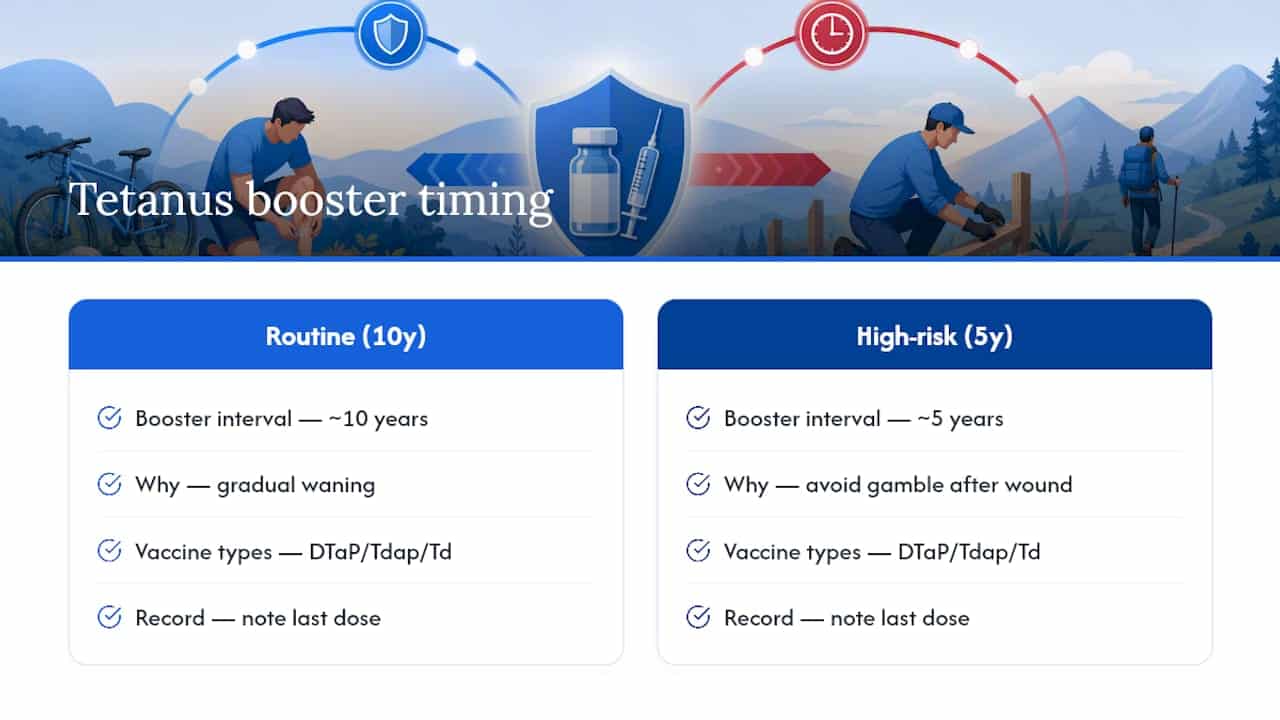
That 10-year figure is an average, not a guarantee down to the day, which is part of why the wound-based exceptions exist. Immunity doesn’t drop off a cliff at exactly year 10; it gradually wanes, and a dirty or major wound is exactly the kind of high-risk exposure where clinicians would rather not gamble on where you fall in that decline curve. That’s the entire logic behind moving the threshold to 5 years for dangerous wounds instead of waiting for the standard decade to pass.
Tdap and DTaP differ mainly in what else they protect against, not in how long the tetanus component lasts. Tdap adds pertussis and diphtheria protection for older children and adults, DTaP is the pediatric formulation for the same three diseases, and Td covers just tetanus and diphtheria for adults who’ve already had a Tdap dose. Once you’ve had one Tdap as an adult, later boosters can be either Td or Tdap, and both carry the same 10-year tetanus protection window.
The practical takeaway: mark your last dose date somewhere you’ll actually remember it. A phone note, a calendar reminder, whatever works. The entire timing system built around 5 years and 10 years only functions if you know which decade you’re in.
A Clinic’s-Eye View of Tetanus Timing
Tetanus questions come up constantly during urgent care visits, and the pattern is consistent: most people underestimate how a wound’s dirtiness changes the timing math. Clinicians reviewing an injury weigh the wound type, the patient’s last documented dose, and whether the vaccination history is verifiable, and that verification step is where things get interesting. When a patient’s immunization card or state registry record is on hand, the decision about whether TIG is needed often resolves in minutes. Without it, clinicians tend to err toward vaccinating rather than guessing, which is the right call given how much worse a missed tetanus case is compared to an unnecessary booster.
If you’re coming in for a possible booster, bring whatever records you have and know your last vaccine date if at all possible. If you’re pregnant, mention it up front, since Tdap timing and product choice can shift slightly based on gestational week.
— Lisa
Get Your Tetanus Shot Today at Your Family Walk-In Clinic
You don’t need to schedule weeks out or sit in an emergency room waiting room to get vaccinated. Some local clinics offer same-day immunizations seven days a week during regular business hours, so a wound that happened this morning can be handled promptly.

Our clinicians administer routine adult and pediatric boosters, Tdap for pregnant patients, and wound evaluations for anyone unsure whether their last shot still counts. If you’re overdue, hurt, or just can’t find your records, our urgent care services are built for exactly this kind of same-day decision. Call ahead, book online, or walk in directly, and bring whatever immunization paperwork you have on hand to speed things along. If you can’t find it, we can help you track it down before your visit.
This article is general information, not a substitute for advice from a qualified doctor. Consult a qualified healthcare professional about your own circumstances before acting on anything here.
FAQ
How Soon Do You Need a Tetanus Shot After a Cut?
Get vaccinated as soon as possible after the injury, rather than waiting to see if symptoms develop. Tetanus prevention works by giving your immune system time to respond before the bacteria produce enough toxin to cause harm.
How Likely Is Tetanus From a Small Cut?
Tetanus risk depends more on wound depth and contamination than size. A small but deep puncture contaminated with soil carries far more risk than a larger, clean surface scrape.
Is 10 Days Too Late for a Tetanus Shot?
No. There’s no strict cutoff for getting a tetanus shot after an injury, so 10 days later is still worth getting vaccinated if you’re due. That said, earlier is always better, since the point is prevention before symptoms can start.
What Happens if You Get a Tetanus Shot Too Early?
Getting a booster before it’s technically due isn’t dangerous, but it isn’t necessary either. If you’re unsure of your last dose date, many clinicians would rather vaccinate than risk leaving you unprotected against a disease this severe.