


If your teen shows persistent changes in mood or behavior lasting two weeks or more, those changes may signal depression, and the right response is straightforward: talk with your teen, keep them safe, and arrange a professional evaluation. If you hear any mention of suicidal thoughts, call 988 immediately. Depression is one of the most treatable conditions in adolescent medicine, and the sooner you act, the faster your teen starts to feel like themselves again.
TL;DR:
- Teens with persistent mood or behavioral changes lasting two weeks or more should be professionally evaluated, especially if symptoms affect daily functioning.
- Physical signs like unexplained headaches, stomachaches, or changes in sleep and appetite often mask depression, which frequently presents as irritability rather than sadness.
- Cross-setting symptoms, such as withdrawal at school and home, along with functional decline like declining grades or social isolation, distinguish depression from normal moodiness.
- Immediate help is critical if a teen talks about suicidal thoughts, has a plan, or shows signs of self-harm, requiring urgent contact with crisis services or emergency care.
- Early intervention, including rapid access to evaluation and treatment options like therapy and medication, significantly improves recovery speed and reduces long-term risks.
Table of Contents
- Depression Symptoms in Teens: Emotional, Behavioral, and Physical Signs
- Normal Teen Moodiness or Something More?
- When to Seek Help and What to Do in a Crisis
- How Depression Is Diagnosed
- Treatment That Actually Works for Teen Depression
- What You Can Do Right Now
- How Your Family Walk-In Clinic Supports Teens and Families
- Comorbidities and Risk Factors Parents Should Know
- How Depression Affects Grades and Friendships
- Common Myths About Teen Depression
- Supporting a Friend or Sibling With Depression
- Why Early Intervention Changes the Outcome
- How School Counselors Fit Into the Support System
- An Editorial Take on Recognizing Teen Depression
- Get Your Teen Evaluated Without the Wait
- Sources
- FAQ
Depression Symptoms in Teens: Emotional, Behavioral, and Physical Signs
Depression in teenagers rarely looks like the textbook sadness most adults picture. It often shows up sideways, through irritability, a slammed door, or a stomachache that sends your teen to the school nurse three times in one week. Recognizing the full range of signs matters because a teen who seems “fine” emotionally may still be struggling behaviorally or physically.
Emotional signs tend to include:
- Persistent sadness, hopelessness, or a flat, “empty” mood
- Irritability or anger that feels disproportionate to the situation
- Frequent crying spells, sometimes with no clear trigger
- Feelings of worthlessness or excessive guilt over small things
Behavioral signs often show up first at school or in friendships:
- Withdrawing from friends, family, or activities they used to enjoy
- A noticeable drop in grades or missed assignments
- Risky behavior, including substance use or reckless driving
- Self-injury, such as cutting, or talk of not wanting to be here
Physical signs are easy to miss because they look medical rather than emotional:
- Fatigue or low energy that doesn’t improve with rest
- Sleep changes, including insomnia or sleeping far more than usual
- Appetite or weight changes in either direction
- Unexplained headaches or stomachaches with no clear medical cause
That last category deserves attention. Repeated visits to the school nurse for headaches or stomachaches, without a clear physical explanation, can be one of the more overlooked ways depression presents in adolescents. Mayo Clinic researchers have also noted that teens more often present with irritability, increased sleep, or increased appetite rather than the classic adult picture of sadness and insomnia, which is part of why parents miss it.
Pro Tip: Keep a simple log for two weeks: what you observed, when, and how long it lasted. That record becomes invaluable if you end up describing symptoms to a pediatrician or therapist.
Depression is far more common among adolescents than most parents assume. About 1 in 5 teenagers experience depression at some point in their lives, which means the changes you’re noticing in your own teen are shared by millions of families navigating the same uncertainty right now.
Normal Teen Moodiness or Something More?
Every teenager has bad weeks. The difference between ordinary moodiness and clinical depression comes down to three things: how long it lasts, how consistent it is across settings, and how much it disrupts daily functioning.
- Check the timeline. Clinical depression requires symptoms present most of the day, nearly every day, for at least two consecutive weeks, with either depressed mood or loss of interest as one of the core symptoms. A rough week after a breakup doesn’t meet that bar. A rough month does.
- Look across settings. Moody teens usually still light up around friends or a favorite activity. Depressed teens tend to withdraw everywhere, at home, at school, and in social settings alike. Clinicians point to this cross-setting consistency as one of the clearest practical signals separating ordinary moodiness from depression.
- Weigh the functional impact. Has your teen stopped showering regularly? Are grades slipping across multiple classes? Has their friend group quietly disappeared? Functional decline is a bigger red flag than any single mood swing.
- Compare against baseline. You know your teen better than any checklist does. A shy kid who stays shy isn’t necessarily depressed. A social, energetic kid who suddenly isolates for a month is a different story.
Pro Tip: If you’re unsure whether what you’re seeing counts as moodiness or something clinical, err on the side of asking a professional. A screening conversation costs you an appointment; missing depression costs your teen far more.
When to Seek Help and What to Do in a Crisis
Not every symptom requires the same urgency, and knowing the difference helps you respond appropriately instead of either overreacting or waiting too long.
Seek a routine evaluation when:
- Symptoms have lasted two weeks or more
- Mood or behavior changes are affecting school, friendships, or daily routines
- Your teen tells you, in any words, that they’re struggling
Treat it as an emergency when you see:
- Talk of suicide, wanting to die, or feeling like a burden
- A specific plan or means to harm themselves
- Any suicide attempt or serious self-harm
- An inability to care for basic needs, like eating or getting out of bed
If your teen expresses suicidal thoughts, stay with them. Remove access to firearms, medications, or anything they could use to harm themselves. Then call 988 or go to the nearest emergency room. The 988 Suicide & Crisis Lifeline connects you to trained counselors by phone at 988 or by webchat, any hour of the day.
Schools can also serve as an immediate bridge to care. A school counselor can often arrange a same-day check-in, and many pediatric providers now offer virtual therapy appointments within a day or two, which matters when a routine wait for a specialist could stretch for weeks.
How Depression Is Diagnosed
A depression diagnosis isn’t based on a single bad day or a single symptom. Clinicians require symptoms present most of the day, nearly every day, for at least two weeks, and one of those symptoms has to be either depressed mood or a loss of interest in activities the teen used to enjoy.
At an appointment, expect the provider to:
- Ask detailed questions about mood, sleep, appetite, energy, and concentration, sometimes using a structured tool like the PHQ-A
- Review family mental health history, since depression often runs in families
- Rule out medical causes, such as thyroid problems or anemia, that can mimic depressive symptoms
- Ask about school performance and any changes in friendships or activities
- Discuss medication history and any substances that might be affecting mood
Most providers will schedule a follow-up within two to four weeks of the initial evaluation to track progress and adjust the plan. Bringing notes on when symptoms started and how they’ve changed speeds this process considerably.
Treatment That Actually Works for Teen Depression
The good news, and it’s worth sitting with, is that teen depression responds well to treatment in the majority of cases when families follow through on care.
Therapy is usually the starting point, particularly:
- Cognitive behavioral therapy (CBT), which helps teens identify and reframe unhelpful thought patterns
- Interpersonal therapy, which focuses on relationship and communication skills
A typical course runs multiple weekly sessions, though more severe cases may need longer.
Medication, typically an SSRI, comes into play for moderate to severe depression, especially when therapy alone isn’t producing enough improvement. Any teen starting an antidepressant needs close monitoring in the first several weeks, since some medications carry warnings about increased suicidal thinking in adolescents during initial treatment. This is exactly why medical supervision, not self-adjustment of doses, matters here.
Combined care, therapy plus medication, is generally recommended for moderate to severe cases because the two approaches address different mechanisms: therapy builds coping skills while medication addresses the underlying chemistry.
Pro Tip: If a first medication doesn’t seem to help after several weeks, that’s not a failure, it’s information. Stanford Medicine’s research on depression biotypes suggests different biological subtypes of depression may respond differently to treatment, which is part of why some trial and error happens before finding the right fit.
What You Can Do Right Now
While you’re arranging professional care, there’s plenty you can do at home to support your teen and keep them safe.
- Start the conversation gently. Ask open questions like “You’ve seemed really tired lately, what’s going on?” rather than “Are you depressed?” Listen more than you talk, and resist the urge to minimize (“everyone feels that way sometimes”).
- Build a basic safety plan. Write down emergency contacts, including 988, remove or lock away medications and firearms, and agree in advance on what your teen will do if suicidal thoughts return.
- Protect daily routines. Consistent sleep and wake times, regular meals, and some physical activity all support mood stability more than people expect.
- Watch substance use and screens. Both can worsen depressive symptoms and mask progress, so keep an eye on patterns without turning it into constant surveillance.
- Loop in the school. A counselor can flag academic accommodations, and documentation of symptoms may support a 504 plan or IEP referral if grades are slipping.
For a broader sense of which physical symptoms warrant a closer look, this guide on symptoms that shouldn’t be ignored is worth reviewing before your appointment.
How Your Family Walk-In Clinic Supports Teens and Families
Your Family Walk-In Clinic has provided family-centered care in Lutz for more than 25 years, with same-day appointments for both urgent evaluations and ongoing primary care. For teens showing possible depression signs, the clinic offers initial evaluation, referrals to therapy (including virtual sessions), and safety planning support.
Before your visit, bring a simple symptom timeline and any relevant school reports. It helps the provider get a fuller picture faster and move your family toward the right next step sooner.
Comorbidities and Risk Factors Parents Should Know
Depression rarely travels alone. Anxiety disorders are among the most common companions, and a teen dealing with both often shows physical symptoms, like a racing heart or stomach upset, layered on top of low mood. Attention-deficit/hyperactivity disorder (ADHD) also overlaps frequently with depression, particularly when unmanaged ADHD symptoms lead to years of academic struggle and damaged self-esteem.
Substance use deserves particular attention, since teens sometimes turn to alcohol or drugs to numb depressive symptoms, which then worsens the depression in a cycle that’s hard to break without intervention.
Several risk factors raise the odds of teen depression without guaranteeing it:
- Family history. A parent or sibling with depression meaningfully increases risk, likely through both genetics and shared environment.
- Chronic illness or pain. Managing a long-term health condition wears on mental health over time.
- Trauma or major loss. Bullying, family conflict, a parents’ divorce, or the death of someone close can trigger depressive episodes.
- Identity-related stress. LGBTQ+ teens face elevated rates of depression, often tied to family rejection or bullying rather than identity itself.
- Social isolation. Fewer close friendships and less family connectedness both correlate with higher depression risk.
None of these factors make depression inevitable, but they’re worth mentioning to a provider during an evaluation, since they shape both the diagnosis and the treatment plan.
How Depression Affects Grades and Friendships
Depression doesn’t stay contained to mood. It bleeds into every part of a teen’s life, and academics are often where parents notice it first. Concentration problems make it hard to focus during class or finish homework, and low energy turns a manageable assignment into an overwhelming one. Grades that were solid for years can slide across multiple subjects within a single semester.
Social relationships take a similar hit. A teen who used to text friends constantly may stop responding altogether. Group chats go unanswered, invitations get declined, and eventually friends stop asking. This withdrawal isn’t teens choosing isolation, it’s depression making connection feel exhausting or pointless. The irritability that often comes with teen depression can also strain friendships directly, since snapping at friends or family pushes people away right when your teen needs them most.
The academic and social effects tend to reinforce each other. Falling grades add stress and shame, which deepens the depression, which further reduces motivation and energy for both schoolwork and friendships. Breaking that cycle is exactly why early evaluation matters. Catching the pattern before a full semester is lost, or before a friend group has fully drifted away, makes recovery considerably faster.

Common Myths About Teen Depression
Myth: “It’s just hormones” or “all teens are moody.” Hormonal shifts are real, but they don’t typically cause the sustained, functionally impairing symptoms that define clinical depression. Dismissing real symptoms as normal adolescence is one of the most common reasons teens go untreated for months or years.
Myth: Depression always looks like sadness. As covered earlier, teen depression frequently shows up as irritability, anger, or physical complaints instead. A teen who seems angry rather than sad can still be depressed.
Myth: Talking about suicide puts the idea in a teen’s head. Research consistently shows the opposite: asking directly about suicidal thoughts does not increase risk and often provides relief, since it opens the door to a conversation the teen may have wanted to have.
Myth: Medication is either dangerous or a magic fix. Antidepressants require careful monitoring, particularly early on, but for moderate to severe depression they’re a legitimate, well-studied tool, not a shortcut to avoid or a cure that works alone without therapy.
Myth: Depression will just pass with time. Some episodes do improve without treatment, but many don’t, and untreated depression carries real risks to school performance, relationships, and safety. Waiting to “see if it passes” costs time your teen may not need to lose.
Supporting a Friend or Sibling With Depression
Teens are often the first to notice something’s wrong with a friend, sometimes before any adult does. If you’re a teen reading this because a friend or sibling seems different, here’s what actually helps.
Show up consistently, even when they don’t respond right away. A depressed teen may not initiate contact, so keep texting, keep inviting them places, without pressuring them to explain themselves. When they do talk, listen without trying to fix it immediately. Phrases like “that sounds really hard” land better than “have you tried exercising more?”
Take any mention of self-harm or suicide seriously, every time, even if it’s said casually or “as a joke.” Tell a trusted adult, even if your friend asks you to keep it secret. That’s not betrayal, it’s protecting someone who might not be able to protect themselves right now. You can also share the 988 line directly with them, or offer to sit with them while they call.
Watch your own limits, too. Supporting a depressed friend or sibling is emotionally heavy, and you’re allowed to loop in a parent, counselor, or other adult rather than carrying it alone. Caregivers managing this at home can also run into their own exhaustion, and resources on pediatric caregiver burnout address that toll directly.
Why Early Intervention Changes the Outcome
Depression caught and treated early tends to resolve faster and with less academic and social damage than depression left to run for months. A teen who gets into therapy within a few weeks of symptoms starting has a shorter road back than one who struggles silently through an entire school year.
Delayed treatment compounds the problem in ways that aren’t always obvious upfront. Grades slip further, friendships fray past easy repair, and the depression itself can deepen, since untreated depressive episodes sometimes worsen over time rather than staying static. Early intervention interrupts that trajectory before it gains momentum.
There’s also a longer-term argument for acting fast: teens who experience an untreated depressive episode face a higher likelihood of recurrence later in life. Getting effective treatment the first time around, rather than letting it linger unaddressed, appears to support better long-term mental health patterns. Preventive care built into a teen’s regular checkups, the kind covered in guides on what preventive care means for teens, gives providers more chances to catch symptoms before they become entrenched.
How School Counselors Fit Into the Support System
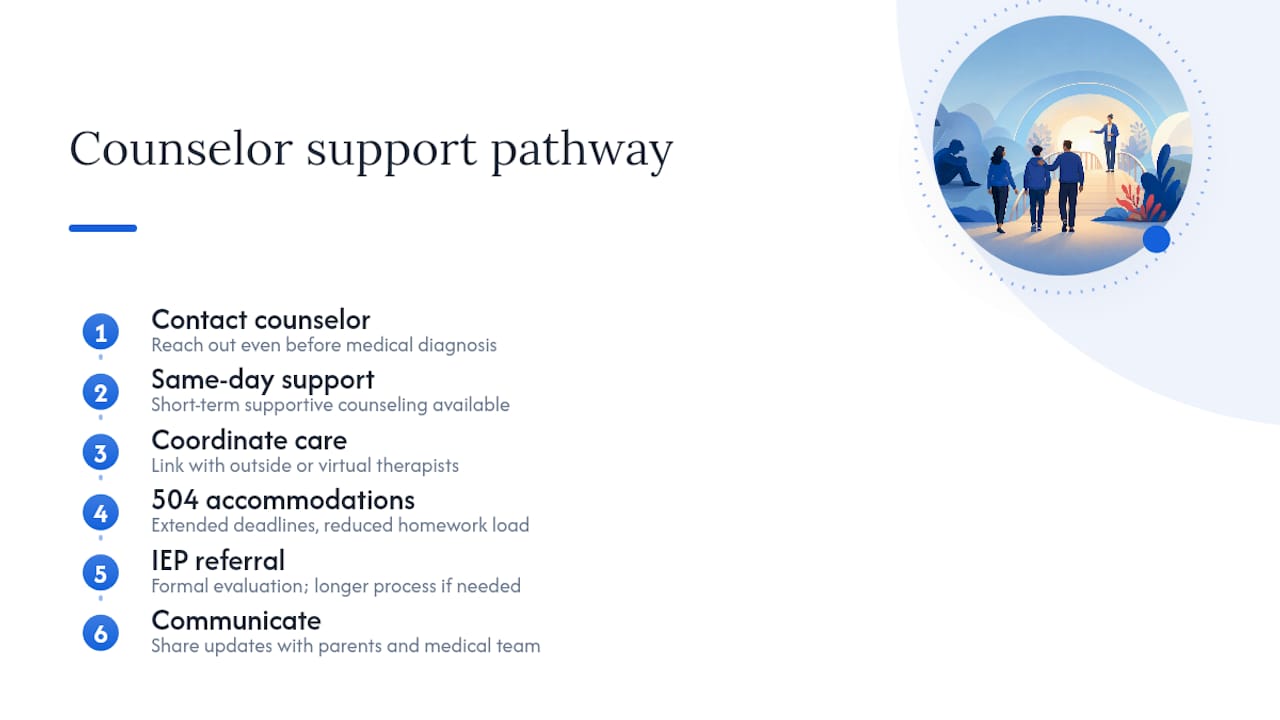
School counselors are one of the most underused resources in the entire teen depression support system, largely because parents don’t always know what they’re equipped to do. Most school counselors can provide short-term supportive counseling, coordinate with outside therapists, and flag academic accommodations without requiring a formal diagnosis first.
If grades are slipping because of depression, a counselor can help set up a 504 plan, which might include extended deadlines, reduced homework load during a crisis period, or permission to leave class if a teen feels overwhelmed. For more significant academic impact, an IEP (Individualized Education Program) referral may apply, though that process typically takes longer and involves formal evaluation.
Counselors also serve as an early warning system, since they see patterns across a teen’s full school day that parents don’t. A counselor noticing a formerly engaged student go silent in three different classes has information that’s hard for any single teacher, or any parent, to piece together alone.
Reach out to your teen’s school counselor directly if you suspect depression, even before a medical diagnosis is confirmed. Ask what support is available now, not just what happens after a formal evaluation. That single call can open up resources, and buy time, while you arrange the medical side of care.
An Editorial Take on Recognizing Teen Depression
The conventional advice on teen depression tends to focus almost entirely on symptom checklists, as if recognition were the hard part. It isn’t. Most parents who read this far already suspect something’s wrong; that’s why they’re here. The harder part, and the part most guides skip, is the gap between suspicion and action.
What the research actually supports is this: the two-week threshold and the core-symptom requirement aren’t bureaucratic hoops, they’re a useful filter against both under-reacting and over-reacting. A teen having a hard week doesn’t need a diagnosis. A teen showing consistent changes across home, school, and friendships for a month needs an appointment, not more waiting to “see how it goes.”
Where I’d push back on the usual framing is the assumption that parents need to become amateur diagnosticians before seeking help. You don’t. If your gut says something’s off and it’s lasted more than two weeks, that’s enough to call a provider. Evaluation exists precisely for the cases you’re unsure about.
— Lisa
Get Your Teen Evaluated Without the Wait
You don’t need a referral, a weeks-long wait, or a specialist directory to get your teen’s first evaluation started. Your Family Walk-In Clinic offers same-day appointments seven days a week, from 8 AM to 8 PM, for exactly this kind of situation: a parent who’s noticed changes and wants answers now, not next month.

Beyond initial evaluation, the clinic provides ongoing primary care, referrals for therapy including virtual sessions, and follow-up visits that track how treatment is working over time. That combination matters when depression often requires more than one conversation to fully address. If you’ve noticed the signs covered here, whether it’s withdrawal, sleep changes, or unexplained physical complaints, same-day urgent care at Your Family Walk-In Clinic in Lutz gives you a place to start today, rather than adding your teen to another waiting list.
This article is general information, not a substitute for advice from a qualified doctor. Consult a qualified healthcare professional about your own circumstances before acting on anything here.
Sources
For deeper reading, NIMH’s teen depression fact sheet covers common signs and next steps. MedlinePlus offers a symptom overview and prevalence data. Mayo Clinic details symptoms and treatment pathways. For crisis support, call or text 988 anytime.
- Recognizing teen depression: MedlinePlus Medical Encyclopedia
- Depression — National Institute of Mental Health (NIMH)
- FCC: 988 Suicide and Crisis Lifeline
FAQ
What are the six types of depression?
Common recognized types include major depressive disorder, persistent depressive disorder (dysthymia), seasonal affective disorder, postpartum depression, bipolar-related depressive episodes, and disruptive mood dysregulation disorder in younger patients. In teens, major depressive disorder and persistent depressive disorder are the most frequently diagnosed.
How should parents discipline a depressed teenager?
Standard discipline approaches often backfire with depression, since irritability, withdrawal, and slipping grades are symptoms, not defiance. Focus on structure and support, consistent routines, open conversation, and professional evaluation, rather than punishment for behaviors rooted in the illness itself.
What are the signs of depression in a 12-year-old?
Younger adolescents often show irritability, anger, or clinginess more than obvious sadness, along with physical complaints like stomachaches, sleep changes, and a drop in school performance. Watch for these lasting two weeks or more before assuming it’s just a phase.
How can parents best support a teen with depression?
Listen without minimizing, keep daily routines steady, remove access to means of self-harm, and get a professional evaluation as soon as symptoms persist beyond two weeks. Your Family Walk-In Clinic offers same-day appointments for families who want to start that evaluation quickly.
When does teen moodiness become an emergency?
Any mention of suicidal thoughts, a specific plan, or an inability to care for basic needs is an emergency. Stay with your teen, remove dangerous items, and call 988 or go to the nearest emergency room immediately.