

Screen every adult 18 and older with a standardized office blood pressure measurement, and confirm any elevated reading with ambulatory or validated home monitoring before starting medication. Screening frequency should follow risk: annually for adults 40 and older or those with elevated readings, every three to five years for lower-risk adults 18 to 39. Treatment decisions should weigh numeric blood pressure category alongside your overall cardiovascular risk, not the office number alone.
TL;DR:
- Confirm all elevated office blood pressure readings with ambulatory or home monitoring before initiating medication, regardless of risk level.
- Use validated upper-arm cuffs, document cuff size, arm used, and wait five minutes before measurement to ensure accuracy.
- Employ home blood pressure monitoring over seven days with two readings in the morning and evening, discarding the first day’s data for reliable results.
- Screen every adult at every visit, not just annually for high-risk groups, and leverage team-based follow-up to improve detection and management.
- Treat stage 2 hypertension immediately and assess symptoms carefully, reserving emergency care for cases with organ damage or severe symptoms.
Table of Contents
- What Do the Current Blood Pressure Screening Guidelines Say?
- How Should Office Blood Pressure Be Measured?
- When Should ABPM or HBPM Confirm a Diagnosis?
- What Are the Diagnostic Categories for Blood Pressure?
- How Often Should Blood Pressure Be Screened?
- How Can Clinics Improve Screening Reliability?
- What Should Patients Know About Home Blood Pressure Monitoring?
- When Does High Blood Pressure Require Urgent Care?
- How Your Family Walk-In Clinic Approaches Screening
- Where to Read the Full Guidelines
- A Closing Perspective on Screening Culture
- Sources
- FAQ
What Do the Current Blood Pressure Screening Guidelines Say?
The 2025 guideline landscape brings welcome clarity after years of shifting numbers and mixed messages between major health organizations. Three sources drive clinical practice today: the U.S. Preventive Services Task Force, the American Heart Association and American College of Cardiology’s 2025 guideline update, and the CDC’s Million Hearts initiative. They agree on far more than they disagree on, which is unusual for cardiovascular guidance.
The USPSTF’s position, reaffirmed with an “A” grade recommendation (its strongest level, meaning high certainty of substantial benefit), calls for screening all adults 18 and older with office blood pressure measurement. It recommends confirming any elevated reading with out-of-office testing, either ambulatory monitoring or home monitoring, before a clinician starts antihypertensive therapy. That single requirement, out-of-office confirmation before treatment, is the piece most primary care visits still skip.
The 2025 AHA/ACC guideline builds on that screening foundation with sharper treatment guidance. It defines blood pressure categories, sets a general treatment goal below 130/80 mm Hg for most adults, and formally endorses PREVENT, a newer cardiovascular risk estimator, to guide when medication should start. The guideline also pushes fixed-dose combination therapy for stage 2 hypertension and leans harder into team-based care, involving pharmacists, nurses, and community health workers.
CDC and Million Hearts operate at the population level rather than the individual visit. Their measurement guidance underpins the technique every clinic should use, while Million Hearts provides implementation tools aimed at raising detection and control rates nationally. Hypertension affects a large portion of American adults, and a meaningful share of them don’t know it. That’s the gap these programs target.
By the numbers: The USPSTF’s screening recommendation carries an “A” grade, its highest certainty rating, applying to every adult 18 and older regardless of baseline risk.
Here’s the practical synthesis for a busy clinic day:
- Screen every adult patient at every appropriate visit, not just annual physicals.
- Treat one elevated office reading as a prompt for confirmation, not a diagnosis.
- Use PREVENT or an equivalent risk calculator before deciding on medication, especially near threshold values.
- Build home monitoring into your standard workflow rather than treating it as an afterthought.
How Should Office Blood Pressure Be Measured?
Office blood pressure measurement, often abbreviated OBPM, remains the front door for screening. But the protocol matters more than most clinics acknowledge. A rushed reading taken seconds after a patient walks in from the parking lot in July heat can run 10 to 15 points high, enough to misclassify a normal patient as hypertensive.
Follow this sequence for every screening measurement:
- Seat the patient quietly for five minutes before the first reading, with their back supported and feet flat on the floor, not dangling.
- Support the arm at heart level, ideally resting on a table or armrest, never held up by the patient or dangling at their side.
- Confirm the patient hasn’t smoked, exercised, or consumed caffeine in the 30 minutes prior. Reschedule the reading if they have.
- Select the correct cuff size based on mid-arm circumference. A cuff that’s too small overestimates pressure; one too large underestimates it.
- Measure both arms at the first visit. Use the arm with the higher reading for all future measurements and document which arm that is in the chart.
- Take at least two readings, spaced one to two minutes apart, and average them. If the first two differ by more than 5 mm Hg, take a third and average all three.
- Avoid talking to the patient during measurement. Conversation during cuff inflation reliably inflates the reading.
The most common errors are also the easiest to fix: an unsupported arm, a cuff over clothing instead of bare skin, and a single rushed reading recorded as definitive. A 2019 policy update added CMS coverage for ambulatory monitoring specifically because so many “hypertensive” office readings turned out to be white-coat elevation once confirmed properly.
Pro Tip: Keep a mid-arm circumference tape measure clipped to every blood pressure cart. Eyeballing cuff size is the single most common source of measurement error in primary care, and it takes fifteen seconds to measure correctly.

Document the higher-arm reading prominently in the chart, along with cuff size used and time since last caffeine or nicotine. That documentation matters later if a patient’s readings trend upward and you need to rule out technique as the cause. Many clinics that struggle with inconsistent readings trace the problem back to skipping steps one and two under time pressure, not to faulty equipment.
When Should ABPM or HBPM Confirm a Diagnosis?
Out-of-office confirmation exists because office readings, even done well, overestimate hypertension in a meaningful share of patients. Ambulatory blood pressure monitoring (ABPM) and home blood pressure monitoring (HBPM) both fill that gap, though they work differently and suit different patients.
ABPM has the patient wear an automated cuff for 24 hours that takes readings every 20 to 30 minutes during the day and roughly hourly overnight. It captures nighttime dipping patterns, variability across the day, and can catch masked hypertension, where office readings look normal but real-world pressure runs high. That nighttime data is genuinely useful: patients whose pressure fails to dip overnight carry higher cardiovascular risk even at similar daytime averages.
HBPM is the more practical option for most patients and most clinics. The protocol that balances reliability against patient burden calls for at least two readings each at morning and evening, over seven days, discarding the first day’s data and averaging what remains. That gives you roughly 24 readings, enough to smooth out day-to-day noise without asking a patient to wear a cuff to bed for a month.
By the numbers: HBPM combined with structured follow-up, meaning education, telehealth check-ins, and a clear clinical algorithm, improves blood pressure control rates compared with usual care that relies on office visits alone.
Choosing between the two comes down to a few practical questions:
- Cost and access: ABPM devices are less widely available and, despite CMS extending coverage in 2019 for suspected white-coat or masked hypertension, still carry more logistical friction than a home cuff.
- Patient tolerance: Some patients can’t sleep with a cuff inflating hourly; HBPM avoids that problem entirely.
- Clinical question: If you specifically need nocturnal dipping data or suspect masked hypertension with normal office readings, ABPM is the better tool.
- Diagnostic thresholds differ by method. An office reading of 130/80 mm Hg roughly corresponds to a daytime ABPM average or HBPM average closer to 130/80 as well, but 24-hour ABPM averages run slightly lower, and clinicians should use method-specific cutoffs rather than applying office thresholds across the board.
For most primary care settings, HBPM with a validated device and clear patient instructions is the workhorse. Reserve ABPM for cases where the clinical picture is genuinely ambiguous.
What Are the Diagnostic Categories for Blood Pressure?
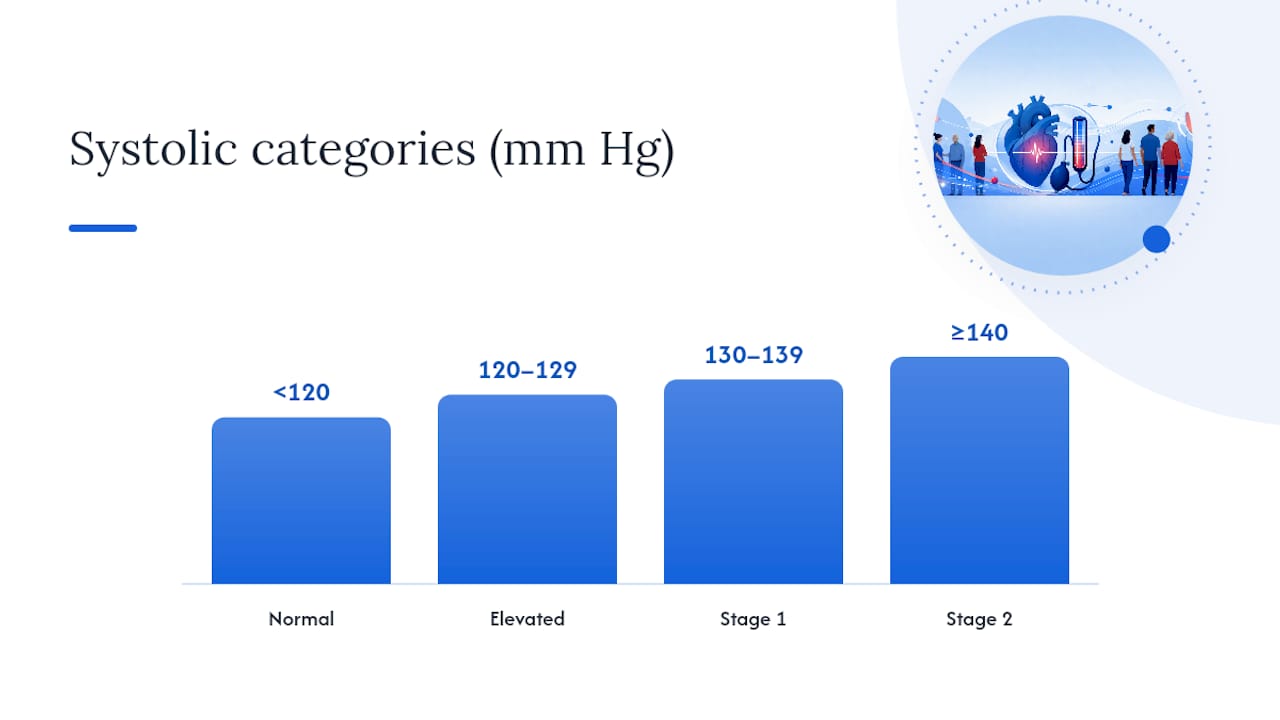
Numeric categories give you the vocabulary for staging, but the treatment decision depends on more than the number alone. The 2025 AHA/ACC guideline maintains four categories:
- Normal: below 120/80 mm Hg
- Elevated: systolic 120 to 129 and diastolic below 80 mm Hg
- Stage 1 hypertension: systolic 130 to 139 or diastolic 80 to 89 mm Hg
- Stage 2 hypertension: systolic 140 or higher, or diastolic 90 or higher
These categories apply whether the reading comes from the office, ABPM, or HBPM, though the numeric equivalence between methods isn’t perfectly one-to-one, out-of-office averages tend to run a few points lower than office readings for the same underlying pressure.
The treatment threshold question is where the 2025 update sharpens earlier guidance. Stage 2 hypertension generally warrants medication regardless of other risk factors. Stage 1 hypertension is where individualized risk assessment matters most: a patient with stage 1 readings and no other risk factors might reasonably start with lifestyle changes and closer monitoring, while a patient with stage 1 readings plus diabetes, chronic kidney disease, or elevated 10-year cardiovascular risk often benefits from starting medication sooner.
That’s where PREVENT comes in. The 2025 guideline formally recommends using PREVENT, an updated cardiovascular risk estimator that replaces the older Pooled Cohort Equations in many practice settings, to calculate 10-year risk and inform the initiation conversation. A stage 1 patient with a PREVENT score suggesting elevated cardiovascular risk gets a different treatment recommendation than a stage 1 patient with a low score, even though their blood pressure numbers look identical.
The general treatment goal for most adults on medication is below 130/80 mm Hg. That target applies broadly, though clinicians should adjust for frailty, comorbidities, and patient-specific factors rather than treating it as universal. Individualizing that decision, weighing comorbidities and personal risk rather than applying the numeric threshold mechanically, is exactly what separates guideline literacy from guideline application.
How Often Should Blood Pressure Be Screened?
Screening frequency isn’t one-size-fits-all, and the USPSTF built flexibility into its recommendation for a reason. Annual screening applies to adults 40 and older, and to adults 18 to 39 who fall into higher-risk categories. Lower-risk adults ages 18 to 39, meaning those with no elevated readings and no major risk factors, can reasonably go three to five years between formal screenings.
The higher-risk category that triggers annual screening in younger adults includes several overlapping factors:
- A previous blood pressure reading in the elevated range, even if it never crossed into hypertension.
- Obesity, particularly with a BMI in ranges associated with elevated cardiovascular risk.
- Black race or ethnicity, given documented higher population-level hypertension prevalence and earlier onset.
- A family history of hypertension or early cardiovascular disease.
- Existing conditions like diabetes or chronic kidney disease that compound cardiovascular risk independent of blood pressure.
The operational lesson for busy clinics is that screening shouldn’t wait for the annual physical. Every visit, urgent care, sports physical, immunization appointment, is an opportunity for opportunistic screening, especially for patients who don’t reliably schedule preventive visits. A patient who comes in for a laceration repair and hasn’t had a blood pressure check in three years is exactly who benefits from a five-minute cuff reading before they leave.
Population outreach matters too. Clinics that flag overdue screenings through their scheduling system, rather than relying on patients to request one, catch more undiagnosed hypertension. That’s the entire premise behind Million Hearts: screening only works as prevention if it actually happens, not just if the guideline says it should.
How Can Clinics Improve Screening Reliability?
Guideline knowledge doesn’t automatically translate into accurate readings. The gap between what a guideline recommends and what happens in an exam room usually comes down to equipment and workflow, not clinical knowledge.
Follow these implementation steps to close that gap:
- Standardize on validated upper-arm devices. Cuffless wearable devices, including smartwatches marketed for blood pressure tracking, are not yet precise or validated enough for diagnosis. Keep them out of your diagnostic workflow entirely, however useful patients find them for general trend awareness.
- Set a calibration and maintenance schedule for every device in the clinic, checked at minimum annually against a reference standard.
- Stock a full range of cuff sizes at every station, small adult through large adult and thigh cuffs for larger patients, so staff never default to “whatever’s on the wall.”
- Train every staff member who takes readings on the full protocol, not just physicians and nurses. Medical assistants often take the majority of screening readings, and inconsistent training there is the most common source of variability.
- Build EHR prompts that flag overdue screenings and auto-populate a confirmation order when an office reading lands in the elevated or stage 1 range.
- Route confirmed diagnoses into team-based follow-up. Pharmacists, nursing staff, and community health workers extending care between visits materially improve follow-up rates and long-term control, more than physician visits alone typically achieve.
Pro Tip: If your clinic sees a spike in “hypertensive” readings during flu season or back-to-school rushes, check your wait-room-to-cuff time before assuming blood pressure actually worsened. Rushed intake is a common seasonal culprit.
Documentation deserves its own line item here. A reading without cuff size, arm used, and time since last caffeine noted in the chart is hard to interpret six months later when you’re deciding whether a trend is real or a measurement artifact. Templates that force those fields at the point of entry save real clinical judgment down the line.
What Should Patients Know About Home Blood Pressure Monitoring?
Home monitoring works only when patients use their device correctly, and most never receive clear instructions beyond “check it and write it down.” Give patients this specific protocol, and the data you get back will actually be usable for diagnosis.
Patient instructions for reliable HBPM:
- Sit quietly for five minutes before measuring, with back supported and feet flat.
- Rest the arm on a table at heart level. Don’t measure with the arm hanging or braced against a body part.
- Avoid caffeine, nicotine, and exercise for 30 minutes before checking.
- Take two readings one minute apart, morning and evening, for seven days.
- Record every reading, even ones that look “off.” Don’t discard unusual numbers before reporting them.
- Bring the device to the first appointment so staff can confirm it against a manual reading for accuracy.
Device validation matters as much as technique. Not every cuff sold at a pharmacy has been independently validated for accuracy, and patients rarely know how to check. Point them toward manufacturer validation statements, and confirm any device brought into your clinic against a manual reading before trusting its data.
By the numbers: The protocol that best balances reliability and patient burden uses two readings each, morning and evening, over seven days, discarding day one, then averaging the remainder, roughly 24 usable readings per diagnostic cycle.
Once you have that average, compare it against method-specific HBPM thresholds rather than office cutoffs. If home readings stay borderline or inconsistent despite good technique, that’s the signal to escalate to ABPM rather than keep repeating HBPM cycles. Reimbursement varies by plan, but CMS coverage expansions for ambulatory monitoring have made that escalation path more accessible than it was even a few years ago. For patients managing ongoing hypertension, our primary care team can review home monitoring logs at follow-up visits and adjust treatment based on trends rather than a single number.
When Does High Blood Pressure Require Urgent Care?
Most elevated readings are not emergencies, and treating every stage 2 reading as a crisis creates unnecessary alarm. But a specific threshold and a specific set of symptoms do warrant immediate action.
- Define severe hypertension correctly. A reading above 180/120 mm Hg qualifies, but the response depends entirely on whether the patient has symptoms or evidence of organ damage.
- If there’s no chest pain, vision change, confusion, or shortness of breath, severe hypertension without those symptoms can typically be managed with a same-day outpatient visit: recheck the reading after rest, review medications, and adjust treatment or arrange close follow-up within 24 to 48 hours.
- If any of these symptoms are present, treat it as a hypertensive emergency and send the patient to the emergency department immediately: chest pain, severe headache with vision changes, confusion or altered mental status, shortness of breath, or signs of stroke.
- Document the triage decision clearly, including the reading, symptom review, and rationale for outpatient versus ED management, in case the patient re-presents shortly after.
A same-day outpatient visit for asymptomatic severe hypertension is appropriate and avoids overwhelming emergency departments with patients who don’t need emergency-level intervention. Our urgent care services, open seven days a week, exist specifically for that same-day evaluation window.
How Your Family Walk-In Clinic Approaches Screening
Screening works best when it’s built into every visit rather than reserved for annual physicals, and that’s the model we follow. A patient who comes in for a sports physical, an immunization, or an urgent care visit gets an opportunistic blood pressure check as part of standard intake, using properly sized cuffs and CDC-aligned technique.
When a reading comes back elevated, the next step isn’t an immediate prescription. We walk patients through home monitoring instructions, sometimes send them home with a loaner device, and schedule a follow-up to review the seven-day average before making any treatment decision. Patients who need ambulatory monitoring or ongoing management get referred into our primary care program rather than being left to figure out next steps on their own.
Because we offer convenient scheduling with same-day availability, patients don’t have to wait weeks for a screening or a confirmatory recheck. A visit typically includes the blood pressure measurement itself, a conversation about what the number means for your specific risk profile, and a clear plan for what happens next, whether that’s lifestyle counseling, home monitoring, or a same-day escalation for concerning readings. If you’re overdue for a check, same-day urgent care is available without an appointment.
Where to Read the Full Guidelines
Clinicians who want the primary sources rather than a summary should start here:
- The USPSTF final recommendation statement covers the full evidence review behind the screening and confirmation recommendations.
- The 2025 AHA/ACC guideline lays out updated categories, treatment thresholds, and PREVENT risk-tool integration in full.
- Million Hearts offers implementation toolkits for clinics building population-level screening programs.
- The HBPM protocol evidence summary supports the seven-day home monitoring averaging method described above.
A Closing Perspective on Screening Culture
Most of the friction in blood pressure screening isn’t clinical uncertainty. It’s habit. Clinicians know the numbers; the guidelines aren’t exactly obscure. What breaks down is the follow-through: the elevated reading that gets a “let’s watch it” instead of a home monitoring kit, the cuff that’s the wrong size because nobody restocked the small adult sizes, the patient who never got clear instructions for taking their own readings at home.
The 2025 AHA/ACC update didn’t reinvent screening. It sharpened the treatment-threshold conversation by giving clinicians PREVENT as a more current risk tool, and it leaned harder into team-based care because the data on pharmacist and nursing follow-up is genuinely persuasive. But the screening backbone, screen everyone 18 and up, confirm before you treat, hasn’t changed since the USPSTF reaffirmed it. That consistency is actually the story here: this is one of the few areas of preventive medicine where the evidence has held steady long enough for protocols to mature.
What I’d push back on is the instinct to treat a single office reading as diagnostic, especially under time pressure. A 15 minute rushed visit that ends in a prescription based on one number, taken with the wrong cuff size, after the patient walked in from the parking lot, isn’t following the guideline. It’s skipping the part of the guideline that actually protects patients from overtreatment. The confirmation step exists because office readings lie more often than clinicians want to admit, and the fix costs a clinic almost nothing: a loaner cuff, seven days, and a follow-up call.
— Lisa
This article is general information, not a substitute for advice from a qualified doctor. Consult a qualified healthcare professional about your own circumstances before acting on anything here.
Sources
- Recommendation: Hypertension in Adults: Screening | USPSTF (final statement / clinician summary)
- 2025 AHA/ACC Guideline for prevention, detection, evaluation, and management of high blood pressure in adults
- Home blood pressure monitoring and interventions (PMC review)
- Million Hearts initiative
FAQ
What are the new blood pressure guidelines for 2026?
The current guidance combines the USPSTF’s reaffirmed screening recommendation for adults 18 and older with the 2025 AHA/ACC guideline, which sets a general treatment goal below 130/80 mm Hg and recommends using the PREVENT risk tool to guide medication decisions.
What is the new blood pressure range according to the guideline?
The categories are normal (below 120/80 mm Hg), elevated (120 to 129 systolic with diastolic below 80), stage 1 (130 to 139 systolic or 80 to 89 diastolic), and stage 2 (140 or higher systolic, or 90 or higher diastolic).
What are the newest guidelines for blood pressure screening frequency?
Adults 40 and older, or younger adults with elevated risk factors, should be screened annually; lower-risk adults 18 to 39 can be screened every three to five years, per the USPSTF recommendation.
What do the new guidelines say for adults over 60?
Adults over 60 fall into the annual screening group regardless of baseline risk, and treatment decisions should weigh the same 130/80 mm Hg general goal alongside individual comorbidities, frailty, and PREVENT-based cardiovascular risk estimation rather than a uniform threshold.
Do I need home monitoring if my office reading is elevated?
Yes. Current guidance calls for confirming any elevated office reading with ambulatory or validated home monitoring before starting medication, since office readings alone can overestimate true blood pressure in a meaningful share of patients.