


Most sore throats need nothing more than rest, fluids, and time. If your symptoms are mild, home care is enough. If you have a high fever, white patches, or symptoms lasting more than a few days, urgent care or your primary care provider can test for strep and get you treated the same day. If you have trouble breathing, drooling, or can’t swallow your own saliva, that’s an emergency: call 911 or go straight to the ER.
TL;DR:
- Most sore throats are viral and improve within 5 to 7 days without antibiotics, making home care sufficient for mild cases.
- Urgent care provides rapid testing and treatment for moderate symptoms like high fever, white patches, or swollen glands, usually within minutes.
- Red flags such as difficulty breathing, drooling, or inability to swallow indicate airway obstruction and require immediate emergency evaluation.
- Only about 5 to 10 percent of adult sore throats are caused by strep; testing with rapid antigen tests or cultures is essential before prescribing antibiotics.
- Emergency rooms are necessary only for severe airway compromise, abscess drainage, or systemic infection, not routine sore throat management.
Table of Contents
- Sore Throat Doctor or Urgent Care: A Quick Comparison
- What Red Flags Mean You Need Emergency Care?
- How Do Doctors Decide If a Sore Throat Is Strep?
- What Happens at Each Type of Sore Throat Visit?
- How Do You Treat a Sore Throat at Home and With Medication?
- Sore Throats in Children vs. Adults: What Changes the Urgency
- How Your Family Walk-In Clinic Approaches Sore Throat Cases
- What the Research Actually Supports
- Get Same-Day Sore Throat Care at Your Family Walk-In Clinic
- Sources
- FAQ
Sore Throat Doctor or Urgent Care: A Quick Comparison
Choosing between urgent care, your primary care provider, telehealth, and the emergency room comes down to speed, severity, and what kind of testing you need. Here’s how the decision usually breaks down.
If your sore throat is mild and you have no fever, a runny nose, or a cough that suggests a common cold, home care and time are your best first move. If it’s a sore throat doctor or urgent care decision, meaning symptoms are moderate to severe (painful swallowing, fever above 101°F, white patches on the tonsils, or swollen glands), same-day evaluation matters, and that’s where urgent care usually wins on speed. If you notice any breathing difficulty, drooling, or inability to swallow liquids, none of the above apply. That’s an ER situation, full stop.
Here’s how the settings actually differ:
- Home care: Appropriate for mild congestion, scratchy throat, or symptoms alongside an obvious cold. No exam needed unless things worsen.
- Urgent care: Best for suspected strep, fever, or symptoms lasting 3 to 4 days. You’ll typically get a rapid strep test and results within 15 minutes, plus a prescription the same visit if needed.
- Primary care provider: A strong option if you already have an established relationship with a doctor and can get a same-day or next-day appointment, especially for recurring sore throats or complicated medical history.
- Telehealth: Useful for a quick assessment of mild-to-moderate symptoms or to determine whether you need in-person testing. It cannot perform a rapid strep test or examine your throat directly, so it’s a triage step, not a final answer, for anything beyond mild cases.
- Emergency room: Reserved for airway concerns, severe dehydration, or suspected abscess. The ER has imaging and drainage capability that neither urgent care nor a doctor’s office offers.
The trade-off is straightforward. Urgent care and same-day urgent care visits give you fast answers and treatment without an appointment. Your primary care provider gives you continuity, someone who knows your history and can track recurring throat infections over time. The ER gives you capabilities the other two don’t have: airway stabilization, IV fluids, and surgical intervention when a sore throat has turned into something more dangerous.
What Red Flags Mean You Need Emergency Care?
Certain sore throat symptoms point to airway compromise or a spreading infection, and those need emergency evaluation, not a next-day appointment. Difficulty breathing, difficulty swallowing, excessive drooling, or a muffled voice can signal epiglottitis, a swelling of the flap that covers the windpipe, or a deep-tissue infection pressing on the airway.
Watch for these signs specifically:
- Stridor or a high-pitched, noisy breathing sound
- Drooling because swallowing has become too painful or difficult
- A muffled, “hot potato” voice (as if speaking with a mouth full of food)
- Visible or rapidly worsening swelling in the neck
- Trismus, meaning you can’t fully open your jaw
- Signs of severe dehydration: no urination for 8+ hours, dizziness, or extreme fatigue
These matter because the throat and neck contain tight anatomical spaces. When swelling or infection builds in the wrong spot, it can narrow the airway faster than most people expect. A peritonsillar abscess, for example, often starts as one-sided throat pain that gets dismissed as “just a bad sore throat” until the voice changes and the jaw locks up. At that point, drainage and IV antibiotics usually can’t wait.
If you or your child shows any of these signs, call 911 or get to the nearest emergency room immediately. Do not attempt to examine the back of the throat with a spoon or flashlight if breathing already sounds strained. Pressing on the tongue can trigger gagging or spasm that worsens airway obstruction in a compromised patient.
How Do Doctors Decide If a Sore Throat Is Strep?
Clinicians can’t reliably tell strep from a viral sore throat just by looking. That’s why the Centor criteria exist: a simple four-point scoring system that estimates how likely your sore throat is bacterial before ordering a test.
The four criteria are:
- Fever over 100.4°F
- Tonsillar exudate (white or yellow patches on the tonsils)
- Tender, swollen lymph nodes in the front of the neck
- Absence of cough
The Centor criteria score guides testing decisions, with higher scores indicating increased likelihood of bacterial infection and need for testing or treatment.
The rapid antigen detection test, or RADT, delivers results in about 15 minutes using a throat swab. It’s fast but imperfect: its sensitivity means a negative result in a patient with a high Centor score sometimes still gets backed up by a throat culture or NAAT (nucleic acid amplification test), particularly in children, where clinical judgment plays a bigger role because pediatric pharyngitis visits and RADT limitations are well documented.
When a rapid test comes back negative but the clinical picture still looks like strep, that’s not a dead end. It usually means a culture or NAAT gets sent to confirm or rule it out, especially in kids who are more prone to false negatives.
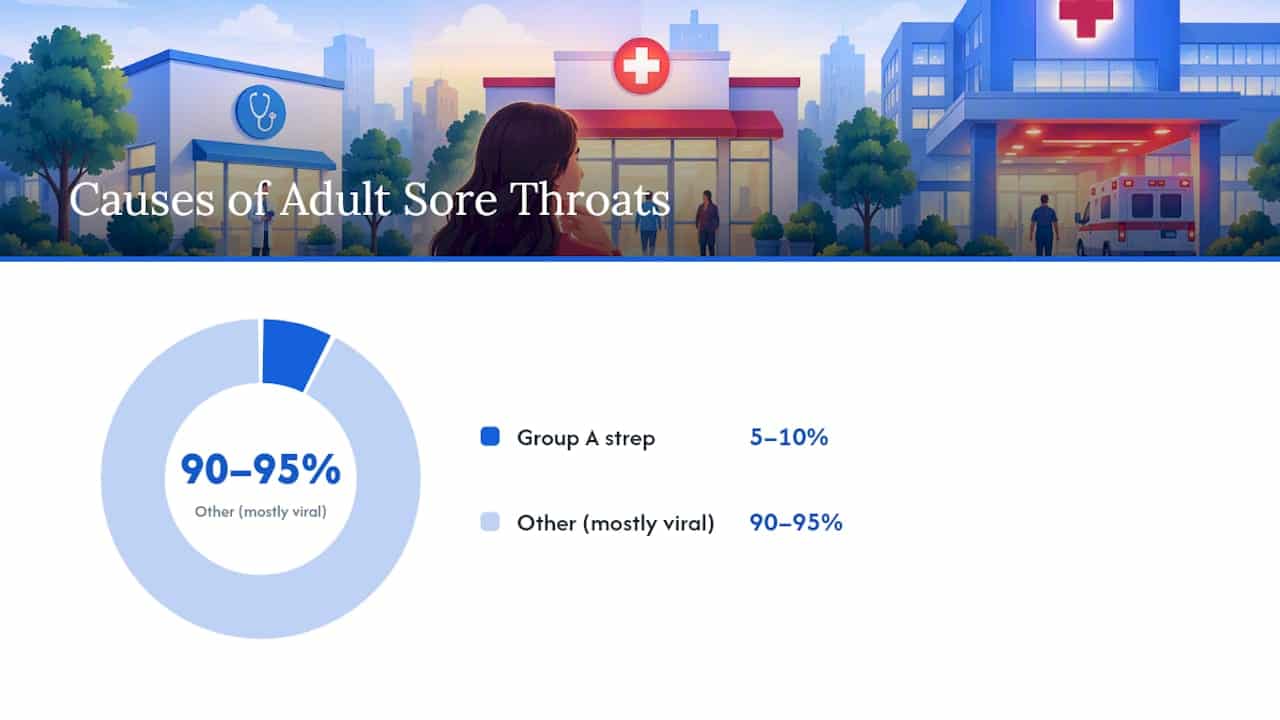
Here’s the number that reframes most sore throat visits: Group A strep causes only about 5 to 10 percent of adult sore throat cases. The overwhelming majority are viral, and viral sore throats resolve on their own in 5 to 7 days regardless of what medication you take. That’s why testing before treating matters so much. Antibiotics don’t touch a virus, and using them when they’re not needed contributes to resistance down the line. If you want more detail on how the testing process works in practice, strep throat testing protocols walk through exactly what happens during the swab and how results guide next steps.
What Happens at Each Type of Sore Throat Visit?
What you can expect depends heavily on where you go, and knowing that ahead of time saves you from arriving somewhere that can’t actually give you what you need.
- Urgent care visit: You’ll be triaged quickly, usually within minutes of arrival. A clinician examines your throat, checks your Centor criteria, and typically runs a RADT on the spot. If it’s positive, you can leave with a prescription the same day. If negative but suspicion remains high, they may send a culture and start symptomatic treatment while you wait for results. Most visits run 30 to 60 minutes total.
- Primary care visit: Similar exam and testing process, but with the advantage of your provider already knowing your history, allergies, and past infections. This matters most for recurring sore throats, where a pattern over months tells a different story than one isolated episode. Wait times depend on how quickly you can get an appointment, which is often the trade-off against urgent care’s walk-in model.
- Telehealth visit: A video consultation can assess your symptoms, review your history, and rule out some obvious viral causes, but it cannot physically examine your throat or run a rapid strep test. It works well as a first step to determine urgency, but suspected strep, drooling, or breathing symptoms all require converting to an in-person visit.
- Emergency room visit: Expect airway assessment first, often before anything else. If imaging shows an abscess, you may need drainage, IV fluids for dehydration, and IV antibiotics rather than an oral prescription. ER visits for sore throat are reserved for the minority of cases where the throat problem has become a airway or systemic emergency, not routine strep management.
How Do You Treat a Sore Throat at Home and With Medication?
Most sore throats respond well to basic home care while your body clears the virus. Rest and hydration come first: drinking enough fluids keeps your throat tissue from drying out and worsening irritation, and warm liquids like tea or broth soothe more than they treat.
Practical steps that actually help:
- Gargle with warm salt water (about half a teaspoon of salt in 8 ounces of warm water), several times a day
- Use honey for soothing relief if you’re an adult or a child over 1-year-old (never give honey to infants under 12 months)
- Try throat lozenges or hard candy to stimulate saliva production and ease dryness
- Run a humidifier, especially overnight, if your home air is dry
- Take acetaminophen or ibuprofen for pain and fever, following label dosing
Antibiotics should be given only when a bacterial infection is confirmed, not for sore throats alone. Penicillin or amoxicillin for 10 days remains first-line treatment for confirmed strep in patients without a penicillin allergy. If you’re allergic, your provider will typically switch to a cephalosporin or macrolide, though rising macrolide resistance in some regions means your clinician may choose carefully based on local patterns.
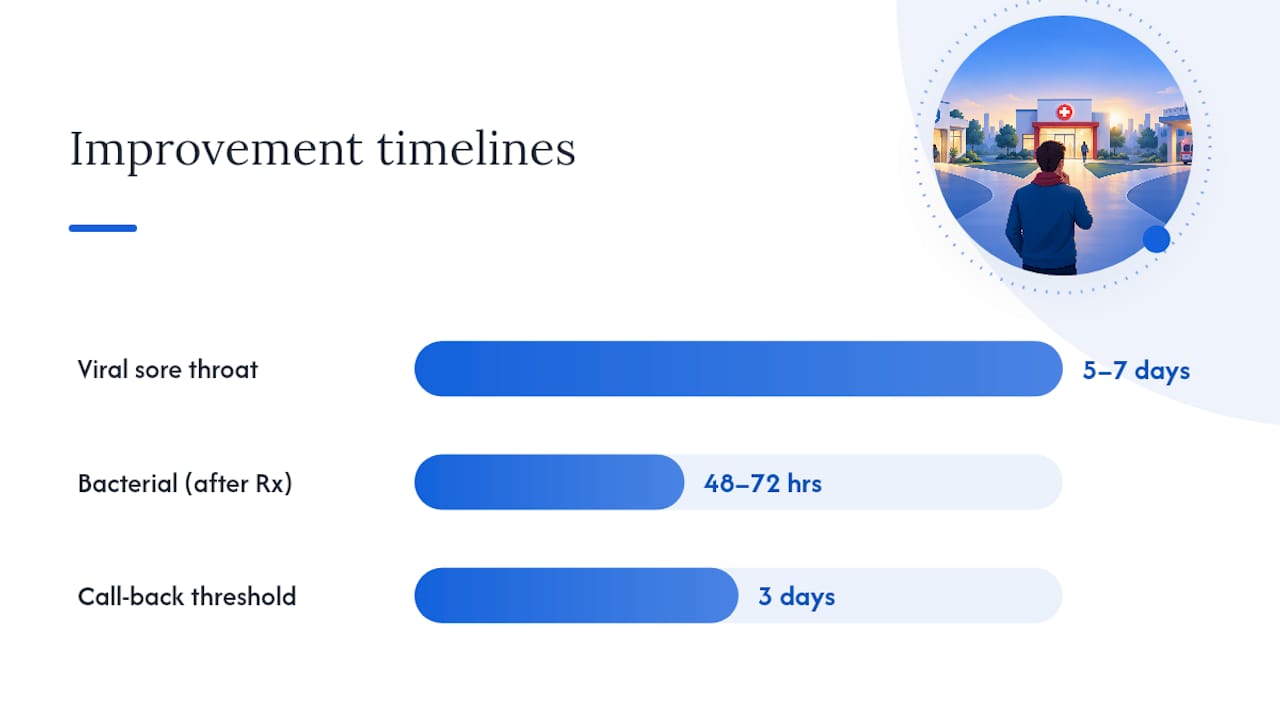
Timeline matters here. Viral sore throats generally improve within 5 to 7 days no matter what you do. Bacterial infections treated with the correct antibiotic usually show improvement within 48 to 72 hours; if you’re on antibiotics and feeling no better after 3 days, that’s worth a call back to whoever prescribed them.
Pro Tip: Keep a simple symptom log for the first 48 hours, noting fever, pain level, and whether swallowing gets easier or harder. If anything trends the wrong direction, especially new drooling, jaw stiffness, or breathing changes, don’t wait for your next scheduled follow-up. Go back in or head to the ER.
Sore Throats in Children vs. Adults: What Changes the Urgency
Age changes the calculus significantly, and the threshold for “go get it checked” drops fast for infants and young children.
For infants under 3 months, any fever of concern requiring prompt clinical attention warrants an immediate call to a clinician, sore throat or not. Their immune systems and airways are small enough that infections can escalate quickly, and pediatric providers treat this age group with far less margin for waiting.
For older children, strep is genuinely more common than in adults, and parents should watch for a specific cluster: drooling, refusal to drink anything (a strong sign swallowing has become too painful), fevers above 102°F, and noticeably less urination than usual, which signals dehydration setting in.
For adults, most sore throats don’t need medical attention unless one of these applies:
- Symptoms persist beyond a week without improvement
- Hoarseness lasts more than 2 weeks (worth ruling out something beyond a simple infection)
- You get recurrent strep-like episodes multiple times a year
- Fever, swollen glands, or breathing trouble accompany the pain
Mayo Clinic’s guidance draws the same line: a week without improvement, or any breathing or swallowing difficulty, is the signal to stop waiting it out.
How Your Family Walk-In Clinic Approaches Sore Throat Cases
Same-day urgent care exists precisely for the gray zone between “wait it out” and “this is an emergency.” At Your Family Walk-In Clinic, a sore throat visit starts the same way every time: a physical exam, a Centor-style assessment, and, when indicated, a rapid strep test that delivers results in minutes rather than days.
The advice given to patients tends to follow a consistent pattern. If symptoms are mild and there’s no fever, staying home and monitoring is often the right call. If pain is worsening, swallowing is becoming difficult, or a fever has climbed past 101°F, coming in for testing beats guessing at home, especially because a positive strep result means a prescription the same day rather than a delayed diagnosis.
Safety comes first in every case. If a patient arrives with drooling, visible neck swelling, or breathing that sounds strained, the clinic’s role shifts immediately from testing to referral: getting that patient to an emergency room or ENT specialist without delay. Extended hours, seven days a week, mean fewer patients face the choice between “wait until Monday” and “go to the ER for something that isn’t an emergency yet.”
What the Research Actually Supports
Conventional advice tends to oversimplify sore throat decisions into “see a doctor if it’s bad enough,” which is technically true but useless in the moment you’re actually deciding. The more useful framework is the one clinicians already use: Centor criteria plus red flags, not vague severity.
What gets underestimated is how often people wait too long specifically because their symptoms don’t feel like an emergency. Trismus and drooling build gradually. By the time someone recognizes those as serious, a same-day urgent care visit sometimes should have happened two days earlier.
What the evidence supports clearly: test before treating, since only 5 to 10 percent of adult sore throats are actually strep, and act immediately, not cautiously, on airway symptoms. The middle ground, ordinary moderate sore throat, is where same-day access matters most, because delay there is what turns a manageable infection into a harder one to treat.
— Lisa
Get Same-Day Sore Throat Care at Your Family Walk-In Clinic
The clinic offers rapid strep tests and same-day prescriptions, without the wait that sometimes comes with scheduling a primary care visit or an ER visit that may not be necessary.
Open seven days a week with extended hours, the clinic sees both adults and children for sore throat evaluation, with no long-term relationship or referral required to walk in. If your symptoms match the moderate category, painful swallowing, fever, swollen glands, or a sore throat that’s stuck around for several days, same-day urgent care means you get tested and treated in one visit rather than juggling appointments across a week. If you’d rather build an ongoing relationship for recurring throat issues or general health, the clinic’s primary care provider option offers that continuity too. Major insurance plans, Medicaid, and self-pay are all accepted. If you’re experiencing any airway red flags, breathing trouble, drooling, or an inability to swallow, skip the clinic and call 911 or go to the nearest ER. For everything else, walk in or call ahead to be seen today.
Sources
This guide draws on established clinical resources rather than general health blogs, because sore throat decisions carry real stakes when airway symptoms are involved.
This article is general information, not a substitute for advice from a qualified doctor. Consult a qualified healthcare professional about your own circumstances before acting on anything here.
FAQ
At What Point Should You Go to the Doctor for a Sore Throat?
See a doctor or urgent care if your sore throat lasts more than a week, comes with a fever over 101°F, white patches on your tonsils, or swollen glands. Mayo Clinic recommends contacting a healthcare professional once symptoms cross that threshold rather than waiting it out further.
How Can I Tell if My Sore Throat Is Bacterial or Viral?
You can’t reliably tell from symptoms alone, which is exactly why clinicians use the Centor criteria, fever, tonsillar patches, tender neck nodes, and no cough, combined with a rapid strep test to confirm. A cough alongside your sore throat leans viral, since strep classically doesn’t cause one.
What Virus Usually Causes a Sore Throat?
Common cold viruses, influenza, and other respiratory viruses are the most frequent cause of sore throat, accounting for the vast majority of cases. Group A strep causes only about 5 to 10 percent of adult sore throat cases, meaning most sore throats simply need supportive care while your immune system handles the rest.
Will a Doctor Give Me Anything for a Sore Throat?
If a rapid strep test confirms Group A strep, you’ll typically get a prescription for penicillin or amoxicillin for 10 days, or an alternative if you’re allergic to penicillin. If your test is negative, treatment focuses on symptom relief, pain relievers, fluids, and rest, since antibiotics don’t help viral infections. At Your Family Walk-In Clinic, same-day rapid testing means you find out which category you’re in during a single visit.