


If your symptoms hit hard and fast, with a high fever, severe body aches, and exhaustion that makes it hard to get off the couch, you’re likely dealing with the flu. If things started slowly with a runny nose, sneezing, and milder aches, a cold is the more probable culprit. That distinction matters because flu treatment is time-sensitive.
According to the CDC, flu symptoms come on abruptly, while cold symptoms build gradually over a day or two. Here’s what to do next based on what you’re feeling:
- Sudden fever, aching muscles, and fatigue that stopped you mid-task: Consider flu. Antiviral medication works best when started within 48 hours of symptom onset.
- Stuffy nose, sneezing, sore throat that crept up on you: Likely a cold. Rest and fluids usually do the job.
- Trouble breathing, chest pain, confusion, or symptoms that improve then suddenly worsen: Seek care immediately, regardless of which virus you suspect.
Your Family Walk-In Clinic offers same-day evaluation and rapid testing seven days a week if you need a clear answer rather than a guess.
Key Takeaways
Flu announces itself abruptly with high fever and severe body aches, while a cold builds gradually around nasal symptoms, and that difference should guide how fast you act.
| Point | Details |
|---|---|
| Onset speed is the first clue | Flu hits within hours; colds build gradually over a day or two. |
| Fever and aches point to flu | High fever and severe muscle aches are common with flu, rare with colds. |
| The 48-hour window matters | Antiviral medication works best when started within 48 hours of flu symptoms starting. |
| Duration differs after the acute phase | Colds resolve in 7 to 10 days; flu cough and fatigue can linger for weeks. |
| High-risk groups should act fast | Children under 5, adults 65+, pregnant people, and those with chronic conditions need prompt evaluation. |
Table of Contents
- Flu vs. Cold Symptoms: A Side-by-Side Comparison
- How Long Do Cold and Flu Symptoms Last?
- Do You Need a Flu Test to Know for Sure?
- When Should You See a Doctor for Flu or Cold Symptoms?
- How to Prevent and Treat Flu vs. Cold Symptoms
- How Your Family Walk-In Clinic Helps You Sort Flu From Cold
- Symptom-First Self-Assessment Only Gets You Halfway
- Sources
- FAQ
Flu vs. Cold Symptoms: A Side-by-Side Comparison
Both illnesses attack the respiratory system, but they rarely behave the same way once they take hold. The clearest tell is usually onset speed combined with how severe the fatigue and aches feel, not any single symptom on its own.
| Symptom | Cold | Flu |
|---|---|---|
| Onset | Gradual, over a day or two | Abrupt, often within hours |
| Fever | Rare, usually low-grade if present | Common, often a high fever |
| Body/muscle aches | Mild | Common and often severe |
| Cough | Mild to moderate | Common, can be severe |
| Sore throat | Common | Sometimes |
| Runny or stuffy nose | Very common | Sometimes |
| Sneezing | Common | Uncommon |
| Headache | Uncommon | Common |
| Fatigue | Mild | Severe, can last weeks |
| GI symptoms (nausea, vomiting, diarrhea) | Rare | Occasionally, more common in children |
A few things the table can’t show on its own:
- Children with the flu are more likely than adults to develop vomiting or diarrhea alongside respiratory symptoms.
- A flu vaccine doesn’t guarantee you’ll dodge the virus entirely, but vaccinated people who catch the flu often report milder symptoms and a shorter illness.
- Sore throat and cough overlap so heavily between the two illnesses that neither is a reliable symptom to lean on by itself.
- Fatigue is the symptom people underestimate most. Cold-related tiredness usually lets you keep functioning; flu-related fatigue often means you physically cannot get through your day.
The CDC’s cold versus flu comparison confirms this pattern: fever and significant body aches point toward flu, while sneezing and nasal congestion point toward a cold. No single symptom clinches the diagnosis, but the combination usually does.
How Long Do Cold and Flu Symptoms Last?
Colds tend to run a shorter, more predictable course than the flu, and knowing the rough timeline helps you judge whether you’re recovering normally or need a second look.
- Cold timeline: Symptoms build gradually, peak around day 5, and typically resolve within 7 to 10 days total.
- Flu timeline: Symptoms hit abruptly and stay acute for about 7 to 10 days, but cough and fatigue frequently linger for several weeks after the fever breaks.
- Watch for relapse: If you start feeling better and then symptoms return, especially with a new fever or worsening cough, that pattern can signal a secondary infection like bacterial pneumonia rather than normal recovery. A lingering dry cough by itself is common and usually nothing to worry about, according to Mayo Clinic.
If day 10 arrives and you’re still running a fever or feeling worse rather than better, that’s your cue to get evaluated rather than wait it out.
Do You Need a Flu Test to Know for Sure?
Testing can settle the question when symptoms alone leave you guessing, but it isn’t always necessary. Rapid antigen tests deliver results in about 15 to 30 minutes and are widely used in clinics, though their sensitivity varies and a negative result doesn’t always rule out flu. PCR testing takes longer to process but detects the virus more reliably, which is why clinics often reserve it for cases where the antigen test result seems inconsistent with symptoms.
- Testing is most useful early in the illness, ideally within the first few days of symptoms.
- A positive flu test can help your provider decide whether antiviral medication makes sense for your case.
- Because cold viruses, RSV, and COVID-19 all overlap with flu symptoms, the CDC notes that testing is often the only way to get a definitive answer.
- Clinicians rarely diagnose flu from one symptom alone; they weigh the full pattern, and testing fills the gap when that pattern is unclear, according to Cleveland Clinic.
Pro Tip: If you’re in a high-risk group and symptoms started less than 48 hours ago, don’t wait for a scheduled appointment. Same-day urgent care testing can confirm flu while antiviral treatment still has time to work.
When Should You See a Doctor for Flu or Cold Symptoms?
Most people recover from both colds and flu without medical intervention, but certain signs and certain people warrant faster action. The CDC is direct about this: most healthy adults with flu can manage at home, but specific warning signs change that calculation immediately.
Get emergency care right away if you or someone you’re caring for has:
- Trouble breathing or shortness of breath
- Persistent chest pain or pressure
- Sudden confusion or difficulty waking up
- Severe or persistent vomiting
- Signs of dehydration, such as no urination or dizziness when standing
Certain groups face higher complication risk and should contact a provider at the first sign of flu symptoms, not after days of waiting: children under 5, adults 65 and older, pregnant people, and anyone with a chronic condition like asthma, diabetes, or a weakened immune system. This urgency isn’t arbitrary. Antiviral medication works best when started within 48 hours of symptom onset, so a delayed call can mean missing the window entirely. If you fall into a high-risk group, treat “maybe it’s just a cold” as a question worth answering same-day, not something to sit on.
How to Prevent and Treat Flu vs. Cold Symptoms

Prevention looks different for each illness, but the daily habits that limit spread overlap almost completely. The annual flu vaccine remains the single best tool against influenza specifically. It won’t prevent colds, but it lowers your chance of catching flu and tends to soften the illness when it does slip through, according to the CDC’s flu prevention guidance.
For flu specifically:
- Antiviral medications can shorten illness and reduce complication risk, but only when started within that same 48-hour window after symptoms begin.
- High-risk patients often benefit from starting treatment even before test results come back, based on symptoms and exposure alone.
- Annual flu shots are worth scheduling before flu season peaks, not after you’re already exposed.
For both illnesses, the basics still carry the most weight:
- Rest and fluids remain the foundation of recovery for colds and flu alike.
- Over-the-counter medications can ease fever, aches, and congestion, but they treat symptoms, not the virus itself.
- Stay home while you’re contagious. Flu spreads for about a day before symptoms even start and can continue for five to seven days after.
- Wash your hands frequently and consider a mask around others if you’re coughing or sneezing.
Pro Tip: Don’t wait until you’re miserable to book your flu shot. Immunity takes about two weeks to build, so getting vaccinated in early fall gives you protection before flu activity typically climbs.
How Your Family Walk-In Clinic Helps You Sort Flu From Cold
Guesswork gets harder when symptoms overlap this much, which is exactly where a same-day visit earns its value. Your Family Walk-In Clinic offers walk-in urgent care, rapid flu and respiratory testing, seasonal flu shots, and same-day appointments for both adults and children, backed by more than 25 years of clinical experience.
If your fever spikes suddenly, your body aches feel severe, or you fall into a high-risk group, a same-day visit can confirm what you’re dealing with while antiviral treatment still has a chance to work. That window closes fast, and waiting it out at home isn’t the safer choice for everyone.
Visit the clinic when symptoms hit hard and fast, when you’re in a high-risk category, or when a cold seems to be dragging past 10 days without improvement. Call your primary care provider instead for routine follow-up or ongoing management of a chronic condition. The clinic is open seven days a week from 8 AM to 8 PM, making it a practical option when symptoms don’t wait for regular office hours.
Ready to get a clear answer instead of a guess? Schedule same-day urgent care at Your Family Walk-In Clinic in Lutz and get tested, treated, or reassured, whichever the situation calls for.
Symptom-First Self-Assessment Only Gets You Halfway
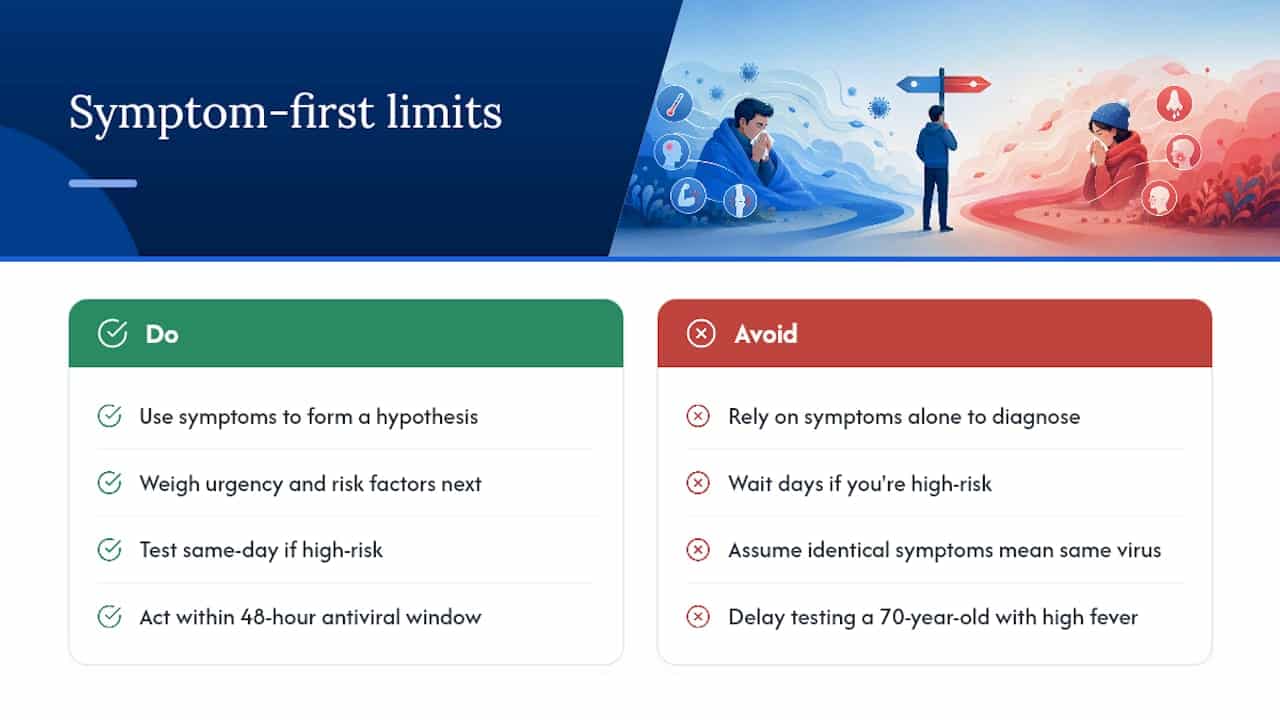
Most advice on telling flu from a cold stops at the symptom chart, as if matching your fever and fatigue against a list settles the matter. It doesn’t, not entirely. Overlapping viruses, including RSV and COVID-19, mean two people with identical-sounding symptoms can be fighting completely different infections, and no chart resolves that ambiguity.
What the evidence actually supports is a two-step approach: use symptom patterns to form a reasonable hypothesis, then let urgency and risk factors decide whether that hypothesis needs confirming. The conventional advice undersells how much the 48-hour antiviral window should drive behavior. Waiting three or four days to “see if it gets better” is a defensible strategy for a healthy 30-year-old with a mild cold. It’s a costly mistake for a 70-year-old with sudden high fever and body aches.
Prioritize speed over certainty when you’re high-risk. A same-day test beats a week of wondering, especially when treatment only works if you act early.
— Lisa
This article is general information, not a substitute for advice from a qualified doctor. Consult a qualified healthcare professional about your own circumstances before acting on anything here.
Sources
- Cold Versus Flu | Influenza (Flu) – CDC
- Cold vs. flu: Comparing the symptoms – Cleveland Clinic
- Flu: What To Do If You Get Sick | Influenza (Flu) | CDC
FAQ
How do I know if I have the flu or just a cold?
Flu symptoms come on abruptly and include high fever, severe body aches, and intense fatigue, while colds build gradually with a runny nose, sneezing, and milder discomfort. If you’re unsure or fall into a high-risk group, testing gives a more reliable answer than symptoms alone.
How long does the flu last compared to a cold?
Colds typically resolve within 7 to 10 days, peaking around day 5, while flu symptoms are acute for a similar 7 to 10 days but cough and fatigue often linger for several weeks afterward.
What are the stages of a cold?
A cold generally moves through gradual onset, a peak around day 5 with the most congestion and cough, then a tapering phase where symptoms fade over the following days until resolution by day 7 to 10.
What are the stages of the flu?
Flu typically starts abruptly with fever, aches, and fatigue, stays acute for about a week, and then enters a recovery phase where the fever resolves first while cough and tiredness can persist for weeks.
Should I get tested if I think I have the flu?
Testing is most useful early in illness, especially if you’re high-risk or considering antiviral treatment, since a confirmed diagnosis can guide whether medication started within the 48-hour window makes sense.