

If you can still speak clearly, have urinated within the last eight hours, and are keeping small sips of fluid down, dehydration urgent care is usually the right call. If confusion, fainting, or a lack of urine for eight or more hours has set in, that’s an emergency room situation, and severe cases warrant calling 911. This tie-breaker comes straight from guidance that Harvard Health and pediatric groups like the AAFP and AAP use to help families sort mild cases from dangerous ones.
At Your Family Walk-In Clinic, we see this decision play out daily. Most dehydration doesn’t need a hospital. It needs fluids, monitoring, and someone trained to know the difference.
Red flags that mean skip urgent care entirely:
- Confusion, extreme drowsiness, or trouble waking up
- No urination in 8+ hours
- Fainting, seizures, or a rapid, weak pulse
- Signs of shock: cold, clammy skin or bluish lips
When you do come in for urgent care, expect a quick check of vitals, a urine sample, and oral rehydration attempts before anything more invasive. Clinics equipped for it can move to IV fluids when needed.
Key Takeaways
Mild and moderate dehydration usually respond to oral rehydration or an urgent care visit, while confusion, fainting, or no urine for eight or more hours require emergency care immediately.
| Point | Details |
|---|---|
| Use the three-question triage | Alertness, urine output in the last 8 hours, and ability to keep fluids down decide the right level of care. |
| Try oral rehydration first | ORS or Pedialyte outperforms plain water for moderate dehydration and often prevents the need for an IV. |
| Know the ER red flags | Confusion, fainting, seizures, no urine for 8+ hours, or signs of shock mean ER or 911, not urgent care. |
| Lower the threshold for infants and seniors | Sunken fontanelle, no tears, or sudden confusion warrant faster evaluation in these groups. |
| Same-day urgent care is available locally | Your Family Walk-In Clinic offers vitals checks, oral rehydration, and IV fluids when indicated, seven days a week. |
Table of Contents
- Recognizing Mild, Moderate, and Severe Dehydration
- What’s the Right Choice: Urgent Care or the ER?
- What to Expect During an Urgent Care Visit
- When Dehydration Means the Emergency Room, Not Urgent Care
- Infants, Older Adults, and Pregnant People Need Different Thresholds
- Safe Ways to Manage Mild Dehydration at Home
- Why Choose Your Family Walk-In Clinic for Dehydration Care
- A Straight Take on the Urgent Care vs. ER Question
- Get Same-Day Dehydration Care Without the ER Wait
- Sources
- FAQ
Recognizing Mild, Moderate, and Severe Dehydration
Dehydration exists on a spectrum, and knowing where you land on it determines everything else. Clinicians grade severity using a mix of what you feel and what they can measure.
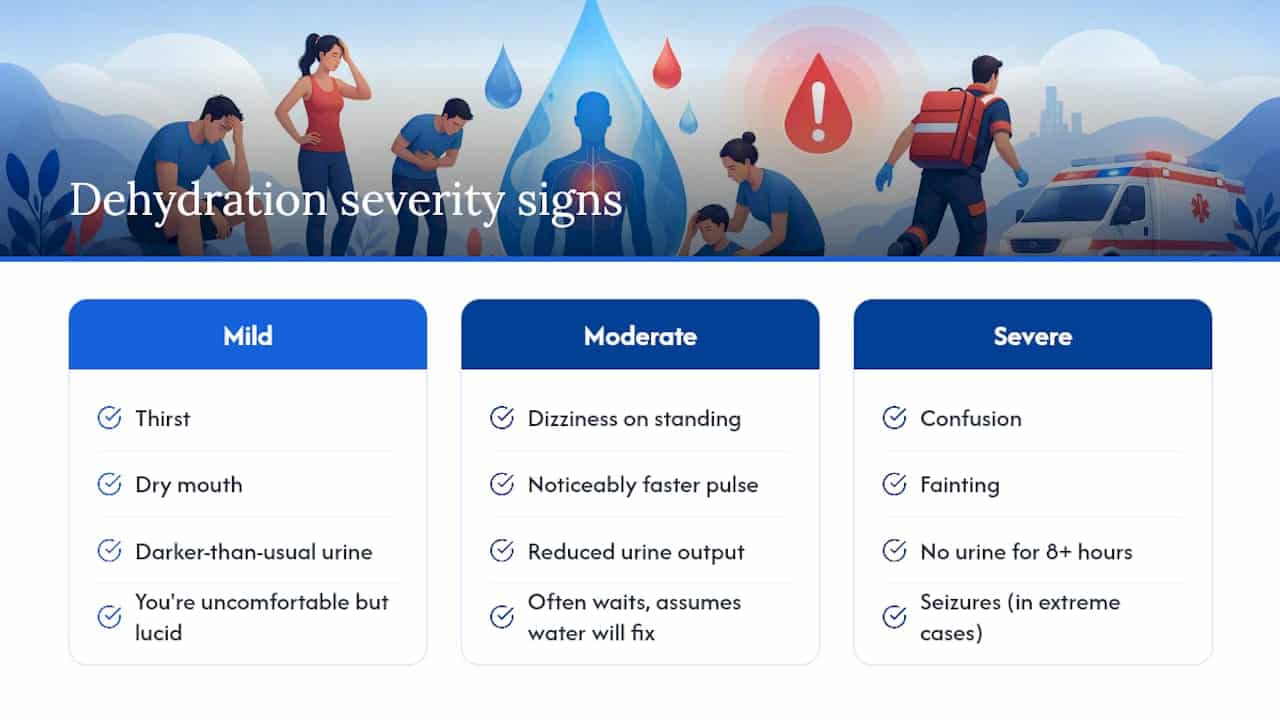
Mild dehydration looks like thirst, a dry mouth, and urine that’s darker than usual. You’re uncomfortable, but you’re still yourself.
Moderate dehydration brings dizziness when you stand, a noticeably faster pulse, and urine output that’s dropped off. This is the range where a lot of people wait too long, assuming rest and a glass of water will fix it.
Severe dehydration is a different category altogether: confusion, fainting, no urine for eight hours or more, and in extreme cases, seizures. Mayo Clinic lists these as signals that intravenous fluids and hospital monitoring are likely necessary.
Clinicians confirm severity with a few simple checks: blood pressure and pulse lying down versus standing (a big drop suggests moderate to severe fluid loss), skin turgor (pinch the skin, see how fast it snaps back), and how moist the gums and mouth look.
Vomiting, diarrhea, fever, and heat exposure are the usual culprits behind sudden dehydration, especially in Florida’s summer months. Watch two things right now: your urine color and how many times you’ve gone in the last several hours. Pale yellow and regular trips to the bathroom mean you’re managing. Dark amber or none at all means it’s time to act.
What’s the Right Choice: Urgent Care or the ER?
Three questions can settle this in under a minute.
- Is the person alert and speaking normally? If yes, continue to question two. If confused, slurring words, or hard to wake, go to the ER now.
- Have they urinated in the last 8 hours? No urine output is a serious sign that belongs in the emergency room, not the waiting room.
- Can they keep sips of fluid down? If yes, urgent care can almost always manage it. If they’re vomiting everything, urgent care can still help with anti-nausea medication before things escalate.
Urgent care fits: stable vitals, mild to moderate symptoms, vomiting or diarrhea under 24 hours, and the ability to sip fluids even if uncomfortable.
The ER fits: confusion, fainting, seizures, or any sign that points to shock.
Cost matters here too. Harvard Health notes that emergency rooms typically charge significantly more than urgent care visits for comparable conditions, and some insurers scrutinize ER claims for medical necessity after the fact. That’s a real consideration when you’re deciding between the two for a moderate case, but it should never outweigh safety.
Pro Tip: If you’re genuinely unsure which way to go, call your primary care provider first. If you can’t reach anyone or you’re still uneasy, choose the ER. That’s the safest default when in doubt.
What to Expect During an Urgent Care Visit
Walk in with dehydration symptoms and the process usually starts the same way: a quick triage, a set of vital signs, and a urine sample to check concentration. Many clinics also run a point-of-care glucose check, and some can pull a basic metabolic panel if labs are on-site.
Treatment escalates based on what’s found. Oral rehydration solutions like Pedialyte come first whenever possible, since AAP and AAFP guidance favors oral rehydration as the first-line approach for most mild to moderate cases. If nausea is blocking that path, anti-nausea medication such as ondansetron often lets patients rehydrate by mouth instead of needing a needle at all.

When oral rehydration isn’t enough, IV fluids like normal saline or lactated Ringer’s solution are the next step, provided the clinic is staffed and stocked for it. According to Solv’s guidance on urgent care IV treatment, a typical IV visit usually takes between 30 and 90 minutes, with out-of-pocket costs often in the low hundreds plus the visit fee.
One caveat worth knowing before you go: not every urgent care clinic offers pediatric IV therapy. Infants and very young children with severe symptoms often need direct ER evaluation instead. If you’re weighing your options, our guide on choosing between a walk-in clinic and the ER breaks down the practical differences further.
When Dehydration Means the Emergency Room, Not Urgent Care
Some signs leave no room for judgment calls. These belong in the ER, and in the more severe versions, they belong in an ambulance.
- Confusion, disorientation, or difficulty staying awake.
- Fainting or a seizure of any kind
- No urine output for 8 or more hours
- A rapid, weak pulse or noticeably low blood pressure
- Severe shortness of breath
- High fever combined with altered mental status
- In infants: a sunken fontanelle, no tears when crying, or no wet diapers
Emergency rooms exist for exactly this tier of severity because they offer round-the-clock advanced monitoring, rapid lab and imaging turnaround, and specialist backup that a same-day clinic isn’t built for. Harvard Health is direct about this: conditions like suspected shock or loss of consciousness call for ER care or 911, full stop.
One more thing: if someone has fainted, is severely weak, or has had a seizure, do not let them drive themselves. Call 911 or have someone else take the wheel.
Infants, Older Adults, and Pregnant People Need Different Thresholds
Dehydration doesn’t hit every body the same way, and the threshold for concern shifts depending on who’s affected.
Infants and young children dehydrate faster than adults and show it differently. Fewer wet diapers, no tears when crying, and a sunken fontanelle (the soft spot on a baby’s skull) are signals that shouldn’t wait. MedlinePlus notes that infants under six months with these signs generally need prompt evaluation rather than a wait-and-see approach at home.
Older adults often show subtler symptoms, confusion or dizziness rather than obvious thirst, which makes dehydration easy to miss until it’s advanced. Earlier evaluation tends to prevent bigger problems later.
Pregnant people and those with chronic conditions like kidney disease, heart failure, or anyone on diuretics face higher stakes if severe symptoms appear, since their bodies have less room to compensate. If you fall into one of these groups and symptoms move past mild, lean toward faster evaluation rather than waiting it out.
Safe Ways to Manage Mild Dehydration at Home
For mild cases, home care works, but it works better with the right tools. Oral rehydration solutions such as Pedialyte or WHO ORS outperform plain water because they replace lost electrolytes, not just fluid volume. AAFP and AAP guidance consistently points to ORS as the preferred first step over water alone for moderate dehydration.
- Take small, frequent sips rather than large gulps, especially if nausea is present
- Track urine color and frequency as your progress marker
- Move to shade or air conditioning immediately if heat exposure caused the dehydration
- Skip salt tablets, and avoid alcohol or heavy caffeine while rehydrating
Never mix a homemade rehydration solution by guessing at salt and sugar ratios. The balance in commercial ORS products is precise for a reason, and getting it wrong can do more harm than good. If symptoms aren’t improving within a few hours, or you’re seeing any signs from the moderate list, that’s your cue to stop treating it at home. Our Florida hydration and heat illness guide covers more prevention strategies for the state’s long, hot stretch of the year.
Why Choose Your Family Walk-In Clinic for Dehydration Care
Your Family Walk-In Clinic has provided affordable, accessible family medical care in Lutz, Florida, for over 25 years. That kind of longevity in a community means we’ve treated dehydration across every age group, from toddlers with stomach bugs to seniors managing chronic conditions.
- Open seven days a week from 8 AM to 8 PM, with same-day appointments available for urgent needs
- Services span urgent care, primary care, immunizations, STD testing, sports physicals, and health screenings under one roof
- A welcoming, patient-centered environment for both adults and children, with experienced clinicians leading every visit
If you’d like to see what a visit looks like before you need one, our clinic tour shows the space and setup patients walk into.
A Straight Take on the Urgent Care vs. ER Question
The conventional advice on dehydration tends to swing between two extremes: “drink some water, you’re fine” or “go to the ER to be safe.” Neither serves people well. Most dehydration falls in a middle zone that responds to oral rehydration and, when needed, a same-day clinic visit with labs and IV fluids on hand.
What gets underestimated is how much the ability to keep fluids down matters as a triage marker. It’s more useful in the moment than a thermometer reading or how thirsty someone feels, because it tells you directly whether the body can recover on its own or needs help doing it.
The bigger gap is that people wait too long to act on moderate symptoms, treating dizziness or a racing pulse as something to sleep off. That’s exactly when a same-day visit, not a hospital admission, makes the difference. Prioritize the three triage questions over gut feeling, and default to urgent care unless a genuine red flag shows up.
— Lisa
Get Same-Day Dehydration Care Without the ER Wait
Your Family Walk-In Clinic is the practical alternative to spending hours in an emergency room waiting area for dehydration that doesn’t require one. We offer vitals checks, urine testing, oral rehydration support, anti-nausea treatment, and IV fluids when indicated, all without the ER’s typical wait times or higher price tag for cases that don’t need hospital-level care.

Open seven days a week from 8 AM to 8 PM, our clinic sees adults and children with the same urgency and attention a family deserves. If you or your child is showing signs of moderate dehydration right now, book a same-day urgent care visit and get seen before symptoms progress further.
This article is general information, not a substitute for advice from a qualified doctor. Consult a qualified healthcare professional about your own circumstances before acting on anything here.
Sources
- Urgent care vs. emergency room: What’s the right choice? – Harvard Health
- Clinical guidance on oral rehydration and ondansetron (PMC review)
- Can Urgent Care Give IV Fluids for Dehydration? What to Expect – Solv
- Dehydration — Diagnosis and Treatment – Mayo Clinic
FAQ
Can urgent care do anything for dehydration?
Yes. Urgent care clinics can check vitals, test urine, provide oral rehydration solutions, give anti-nausea medication, and administer IV fluids when the clinic is equipped for it.
How can urgent care tell if you’re dehydrated?
Clinicians check blood pressure and pulse (including changes from sitting to standing), assess skin turgor and mucous membranes, review urine color and output, and sometimes run a basic metabolic panel for more severe cases.
What are five symptoms of severe dehydration?
Confusion or disorientation, fainting, no urine output for eight or more hours, a rapid or weak pulse, and seizures are five signs that point to severe dehydration requiring emergency evaluation.
At what point do I go to the ER for dehydration?
Go to the ER or call 911 if there’s confusion, fainting, seizures, no urination in eight or more hours, or any sign of shock like cold, clammy skin, since these require the advanced monitoring only an emergency room can provide.