
A sports physical, also called a preparticipation physical evaluation (PPE), is a health exam a licensed provider completes before a student tries out or practices for a team. The exact requirements depend on your state, school and league. In Florida, student-athletes need a signed physical on the state athletic association’s form, and first-time high school athletes now need an ECG screening too. Below, we walk you through the forms, the exam, what to bring and when to book.
TL;DR
- Most schools and leagues require a sports physical before tryouts or practice. How often you need one is set by your state, not by the clinic.
- In Florida, the form is the FHSAA EL2. First-time high school athletes also need an ECG screening, documented on the EL1 form, under a rule that took effect July 1, 2026.
- The exam covers your history, vitals, vision, heart, lungs, joints and more. Most athletes are cleared without restriction.
- Book 6 to 8 weeks before the season, and bring your completed history form and any form your school supplied.
- We do sports and school physicals, including a sports physical with EKG, seven days a week in Lutz.
Table of Contents
- Are sports physicals required?
- Florida sports physical requirements
- Who can perform a sports physical?
- What happens during a sports physical?
- Sports physical checklist: what to bring
- Who completes which part of the form
- When to schedule a sports physical
- Sports physical vs. a yearly physical
- Our perspective
- Get your sports physical in Lutz
- FAQ
- Sources
Are sports physicals required?
Usually, yes. There is no single national rule, so the answer depends on where the athlete plays. The American Academy of Pediatrics (AAP) says the frequency of a PPE is determined by the state.
States write this differently. Some examples:
- Virginia requires public middle and high school students to submit a signed PPE from an authorized physician, advanced practice registered nurse or physician assistant, based on an exam no more than 14 calendar months old.
- New Jersey requires the physical to be completed within 365 days of the first practice and approved by the school physician before participation.
- Delaware regulations say a student athlete is not eligible to try out, practice, scrimmage or compete without a qualifying current PPE.
Schools can also set their own rules. A Washington State Attorney General opinion confirms that a school district may require a physical before students compete in interscholastic athletics.
Can you refuse a sports physical?
You can decline, but the school can then decline to let the student play. Where a physical is required, a missing or late form can keep an athlete out of tryouts. New Jersey’s guidance, for example, notes that districts may set submission deadlines, so late or missing paperwork can block participation. If you have concerns about the exam, talk to the provider and the school’s athletic director before the deadline, not on the first day of practice.
Florida sports physical requirements
Florida law, section 1006.20 of the Florida Statutes, covers high school athletics. Here is what Florida student-athletes should plan for.
The FHSAA EL2 physical form
The Florida High School Athletic Association (FHSAA) uses a standard form, the EL2 Preparticipation Physical Evaluation, along with the EL3 Consent and Release from Liability Certificate. Miami-Dade schools’ athletic packet lists both as part of the required paperwork. The EL2 has to be completed by a licensed provider. Forms get revised, so download the current version from your school or the FHSAA, and ask the athletic office how long a completed form stays valid for your school.
The ECG requirement for first-time athletes
Florida added a heart screening. The FHSAA’s EL1 form states that, under the Second Chance Act, effective July 1, 2026, all first-time high school participants in FHSAA athletics must have an electrocardiogram (ECG) screening before participation.
Key points from that form:
- It applies to students with no cardiac symptoms. Students who do have cardiac symptoms should talk to their healthcare provider.
- An ECG completed within two years before July 1 of the participation year satisfies the requirement.
- If the ECG needs further evaluation, the student must be cleared by a licensed medical practitioner before taking part.
This is why families in Lutz and Tampa often ask for a sports physical with an EKG. It lets an incoming athlete handle the physical and the heart screening in one visit. Ask your school’s athletic office whether your student counts as a first-time participant.
Who can perform a sports physical?
The AAP says that, depending on state law, an MD, DO, nurse practitioner or physician assistant with relevant clinical training may conduct the PPE. That means a family doctor, a pediatrician or a walk-in clinic with licensed providers can all be options, provided your state and school accept the provider type. Check the form’s instructions for the credentials it lists.
What happens during a sports physical?
The visit has two parts: a medical history and a physical exam. It usually takes less time than parents expect.
The medical history
The athlete and a parent or guardian should complete the history form together before the visit. The AAP recommends that the provider review it privately with the athlete and guardian, and again privately with the athlete if confidential topics may need discussion.
Heart-related questions matter most. The AAP says screening should cover exercise symptoms, prior heart evaluations or high blood pressure, and family history of heart problems. Answer these fully and honestly, especially the family history questions.
The physical exam
Expect the following:
- Vitals: height, weight, pulse and blood pressure.
- Vision check.
- Heart and lungs: the provider listens and checks for anything that could make hard exercise risky. MedlinePlus says the provider focuses especially on the heart, lungs, bones and joints.
- Abdomen, skin and general health.
- Musculoskeletal check: joints, posture, strength and flexibility, often with a few simple movements.
- Lifestyle questions: MedlinePlus notes the provider may ask about diet, drug, alcohol and supplement use, and menstrual periods.
The AAP’s examination form is organized by body system, covering cardiovascular, respiratory, musculoskeletal, skin and mental-health considerations, among others. The AAP also says a PPE can be a private, safe setting to bring up concerns such as anxiety, depression, stress or attention problems. If your teen has been struggling, this is a good moment to say so.
Possible results
The AAP lists these outcomes: unrestricted clearance, clearance with a recommendation for further evaluation or treatment, clearance after evaluation, clearance for specified sports, or no medical eligibility. The AAP notes that most children are cleared without restriction. When a provider asks for a follow-up, it is usually about making sure the athlete can play safely.
Sports physical checklist: what to bring
The AAP advises families to complete the history form honestly and fully and bring the sport’s medical eligibility form if one was supplied. MedlinePlus gives a longer list of details to have ready. Pull it together as follows:
- The completed history form, signed by a parent or guardian for minors
- The school or league’s physical form (in Florida, the EL2 and related FHSAA forms)
- Immunization dates
- A list of allergies and reactions
- All medicines and supplements, with doses
- Glasses, contact lenses, dental appliances, orthotics or braces
- Past injuries, concussions, fractures, dislocations, hospital stays and surgeries
- Any history of fainting, dizziness, chest pain, heat illness or breathing problems with exercise, per MedlinePlus
- Family history of heart disease or exercise-related sudden death
- Recent weight changes
- A copy of any prior ECG, if the athlete has had one
A parent or guardian should come along for a minor. If you need vaccine dates, our guide to getting immunization records in Florida shows where to look.
Who completes which part of the form
A typical PPE has three pieces: a history form, a physical examination form and a medical eligibility form. The athlete and parent fill out the history, the provider records the exam, and the provider decides eligibility. Missouri’s state athletic association describes the split this way.
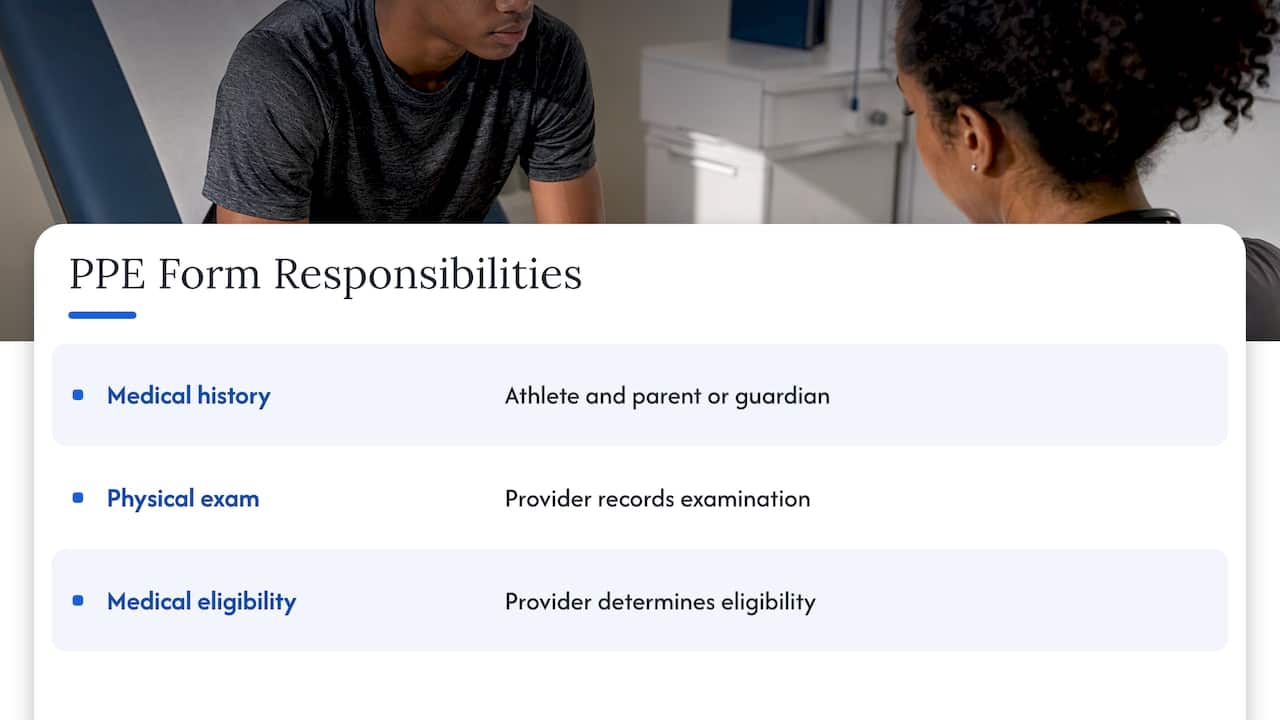
Privacy matters here. The AAP says only the eligibility form goes to nonmedical school personnel. Maryland’s Montgomery County Public Schools and New Jersey’s guidance say the same: the provider keeps the history and exam pages. Florida’s packet differs in its details, so follow your school’s instructions on which pages to turn in.
When to schedule a sports physical
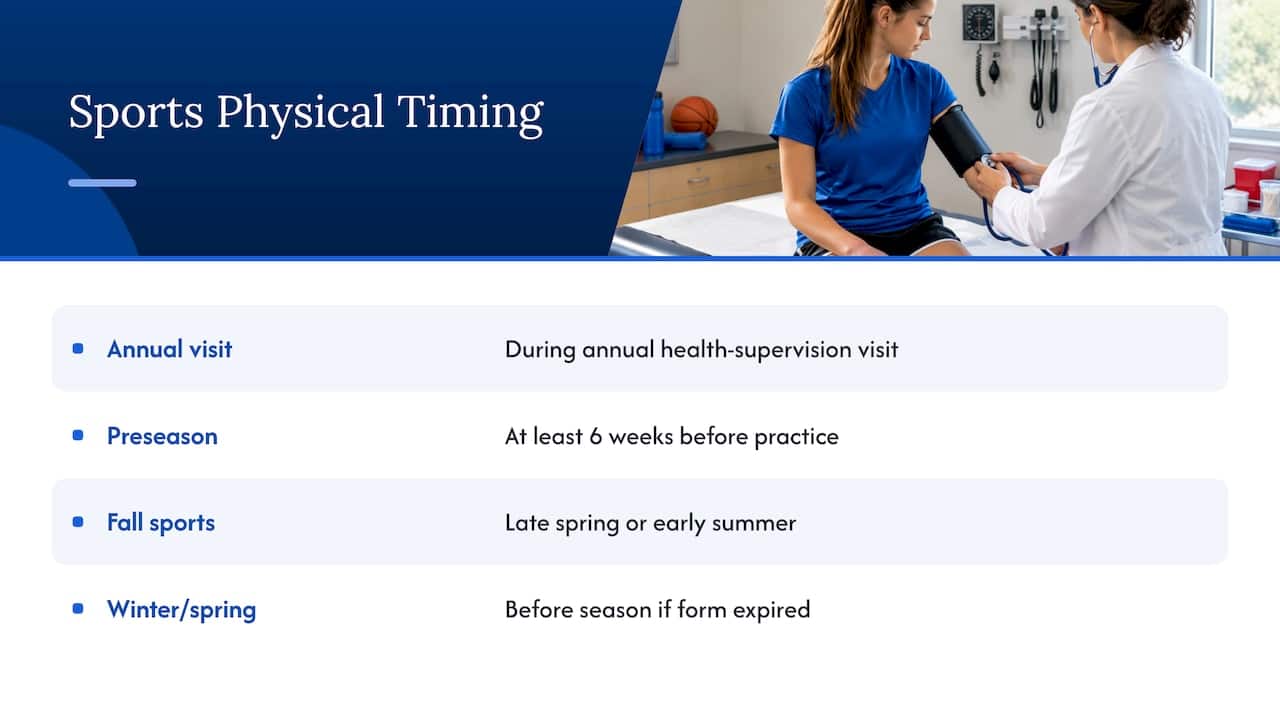
The AAP recommends doing the PPE during the annual health-supervision visit or at least 6 weeks before preseason practice. A 6 to 8 week lead time leaves room to follow up if the provider spots something, such as a blood pressure reading to recheck or a joint that needs attention. It also gives you time to get a missing form or an ECG.
Timing also helps the athlete. Booking early lets a young player build conditioning before the season starts, and here is why physical fitness for young pitchers matters before the first throw of spring.
For Florida families, the practical pattern is simple: book in late spring or early summer for fall sports, and again before winter and spring sports if the form has expired. Look at your school’s athletic office page for the current deadlines.
Sports physical vs. a yearly physical
They overlap, but they are not the same visit. A yearly checkup is broader. It covers vaccines, growth, preventive screenings and chronic conditions. A sports physical is focused on whether it is safe to play. If your child is due for both, ask whether one visit can cover both purposes. Our post on why yearly physicals matter explains what a full wellness exam adds, and our back-to-school health checklist pulls the school-year items into one list.
Our perspective
We see the same thing every season: families remember the sports physical the week before tryouts. That is stressful, and it is avoidable.
Our view is that the best sports physical is one that happens early, with the right form in hand and a parent in the room. We are open seven days a week from 8 AM to 8 PM, and we offer same-day appointments, so the visit can fit around practice and school instead of competing with it.
We treat the exam as more than a signature. Our providers have over 25 years of experience, and we use the visit to ask about heart symptoms, past injuries and how the athlete is really doing. For families who need the heart screening, we offer a sports physical with EKG, so the form and the screening can be handled together.
We also see this as a chance to bring a teen into the habit of regular care. A student who feels comfortable talking to a provider is more likely to speak up about a sore knee, a dizzy spell or a hard month.
Lisa
Get your sports physical in Lutz
We provide sports and school physicals for children, teens and adults at our Lutz clinic, and we offer a sports physical with EKG for athletes who need it. We accept major health insurance plans, Medicaid and self-pay. Walk in or ask about a same-day appointment.

Bring the completed history form and your school’s paperwork. You can see our sports and school physical page, review our full list of services, or start from our home page. You can also download our sports physical form to fill out ahead of time, though we recommend you confirm with your school which version it requires.
FAQ
Are physicals required for sports?
In most states and school districts, yes. The state sets how often, and the school or league can add its own rules. In Florida, student-athletes need a completed FHSAA physical form, and first-time high school athletes need an ECG screening. Ask your school’s athletic office for the current forms.
What should I bring to a sports physical?
Bring the completed history form and the school’s physical form. Add a list of medicines, allergies, immunization dates, past injuries and any heart-related family history. Glasses, contacts, braces or orthotics should come along too. A parent or guardian should attend for minors.
Does a sports physical hurt or include blood work?
No. The exam is hands-on but not painful: vitals, vision, listening to the heart and lungs, and movement checks. Lab work is not part of a standard sports physical. If the provider has a concern, they may recommend further tests. An ECG is a quick, painless test that records the heart’s electrical activity.
How long does a sports physical take?
Plan on about 20 to 30 minutes in most offices, including paperwork, though this varies by provider and by whether an EKG is added. Having the history form already filled out is the easiest way to keep the visit short.
What if the provider finds a problem?
A flagged concern does not mean the end of a season. The provider may clear the athlete for certain sports, recommend more evaluation, or ask for a follow-up before signing off. Time matters here, which is why we suggest booking 6 to 8 weeks before the season starts.
Sources
- PPE: Preparticipation Evaluation, American Academy of Pediatrics
- Does My Child Need a Sports Physical? HealthyChildren.org
- Sports physical, MedlinePlus Medical Encyclopedia
- Virginia Code § 22.1-271.7
- New Jersey Scholastic Student-Athlete Safety Act FAQ
- 14 Del. Admin. Code § 1034-3.0, Physical Examinations
- Washington Attorney General opinion on student sports physical examinations
- FHSAA EL1 ECG Screening Form
- Athletic Physical Packet Procedures, Miami-Dade County Public Schools
- MSHSAA Preparticipation Physical Forms/Procedure
- Pre-Participation Physical Evaluation for Athletics, Montgomery County Public Schools
- Why Physical Fitness for Young Pitchers Matters