

Couples therapy helps partners communicate by giving them a calm, structured place to talk. A trained therapist slows the conversation down, teaches specific skills such as listening and reflecting back, and gives you small practices to repeat at home. Most couples do not need to be in crisis to benefit. If the same argument keeps returning, or you have stopped sharing what matters, that is a good time to ask for help.
This guide explains what happens in sessions, which exercises therapists use, what “homework” usually looks like, and how to tell when it is time to book a first appointment.
TL;DR
- Couples therapy teaches communication skills directly: how to speak without blaming, how to listen without interrupting, and how to pause a fight before it escalates.
- Common exercises include the Speaker-Listener technique, “I” statements, soft startups and agreed timeouts.
- Between sessions, therapists often assign 10 to 30 minutes of practice, a few times a week. Small, steady effort beats rare long talks.
- Repeating the same fight, silent treatments, feeling like roommates and broken trust are all signs to seek counseling sooner rather than later.
- We offer in-office and virtual therapy for adults at our Lutz clinic. Call us to ask what fits your situation.
Table of Contents
- How couples therapy improves communication
- Communication exercises couples use
- What the research says about conflict
- Couples therapy homework: what to expect
- Why some arguments never fully end
- When to seek couples counseling
- In person or online
- Our perspective
- Talk to us about counseling in Lutz
- FAQ
- Sources
How couples therapy improves communication
People often assume therapy is where a referee decides who is right. It is closer to a coaching room. According to Harvard Health, couples therapy combines better communication, working through emotions and exploring past experiences in a personalized approach. The therapist acts as a neutral mediator and helps both partners express feelings honestly and respectfully, in a safe, nonjudgmental setting.
The same source notes that most couples therapy aims to reduce relationship stress and support well-being. It can also address issues that belong to one partner, such as anxiety or low mood, alongside issues between the two of you.
What a session looks like
Sessions typically run about an hour and are usually weekly, according to Harvard Health. Therapy often lasts between three and 12 months, though some couples need only a few sessions for a specific concern. A typical session might include:
- A check-in on how the week went.
- A look at one recent conflict or misunderstanding, slowed down so each of you can say what happened inside you, not only what happened between you.
- A skill practiced live, with the therapist coaching.
- A small assignment to try before the next visit.
Nothing here requires you to be good at talking. The point is to learn it with support.
Different approaches, different emphasis
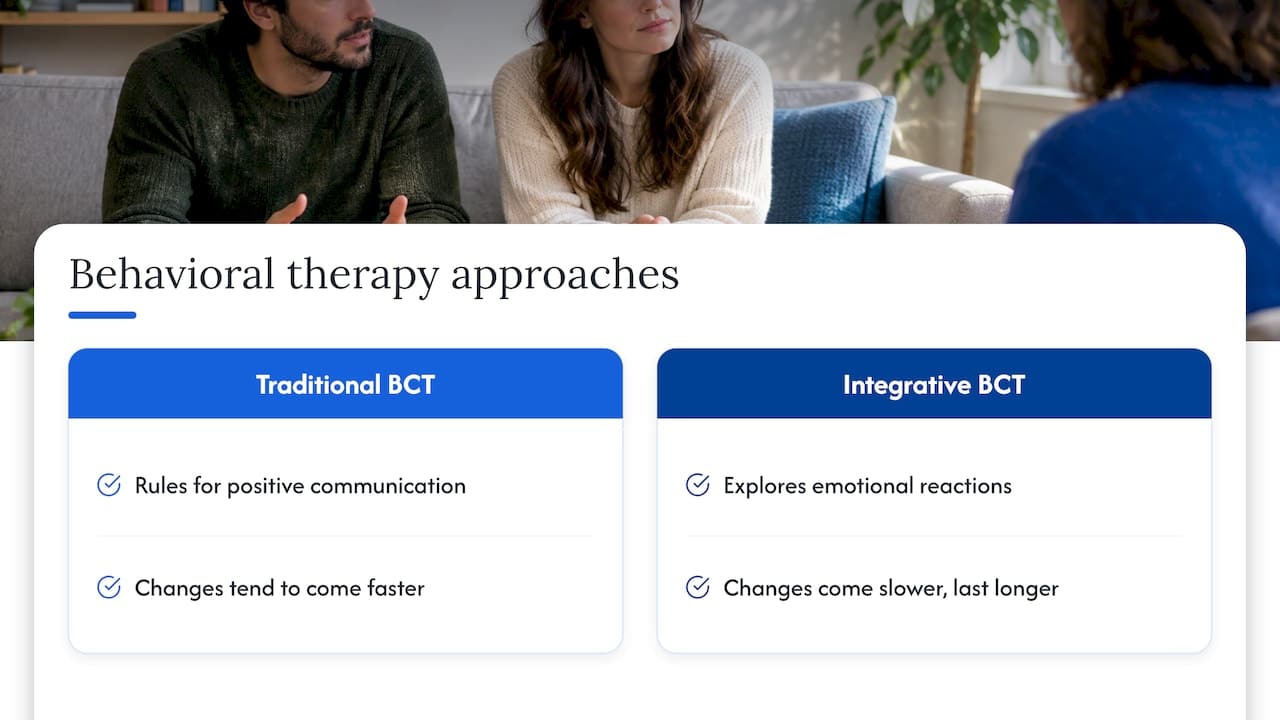
Therapists draw on several models. Research on behavioral couple therapy, published in PMC, describes two versions. Traditional Behavioral Couple Therapy gives rules and guidelines for specific positive communication strategies and tends to produce faster changes. Integrative Behavioral Couple Therapy explores each partner’s emotional reactions to the other’s communication, and its changes tend to come more slowly but last longer.
Other well-known models include Emotionally Focused Therapy, which looks at the emotional cycle you get stuck in, and the Gottman Method, which focuses on specific habits of conflict and connection. You do not need to pick a model before your first visit. A good therapist will explain how they work and adjust to what you need. If you are unsure how to choose, our guide on how to choose a therapist walks through the questions worth asking.
Communication exercises couples use
Most exercises come down to the same idea. The American Psychological Association’s primary care behavioral health materials describe good communication as speaking plus listening. Their listening strategies include facing the speaker, keeping eye contact, nodding, not interrupting, summarizing what you heard, and reflecting back the key thoughts and emotions.
The Speaker-Listener technique
This is the exercise therapists reach for most often when conversations break down. One partner speaks, using first-person language. The other reflects back what they heard before responding. Some couples hold an object, such as a coaster or a pen, to mark who has “the floor.” It is described in a guide to couples therapy activities as helpful for repeated breakdowns, defensiveness and difficulty feeling heard during conflict.
The Family Institute at Northwestern gives a practical version for tense conversations:
- The speaker uses “I” statements in short chunks of 15 to 30 seconds.
- The listener paraphrases without rebutting.
- Roles switch after three or four paraphrases.
Here is how it sounds in a real moment:
- Speaker: “I felt alone at dinner when you were on your phone. I miss talking with you.”
- Listener: “You felt alone at dinner because I was on my phone, and you miss talking. Did I get that right?”
- Speaker: “Yes. And I worry we only talk about schedules.”
The listener has not agreed or defended anything yet. That comes later. First, the speaker feels heard, which often lowers the temperature on its own.
Soft startups and “I” statements
How a conversation begins strongly shapes how it ends. Compare “You never help around here” with “I’m worn out tonight and I’d like help with the dishes.” The second version describes your feeling and makes one clear request. It gives your partner something to say yes to instead of something to defend against.
A simple template:
- “I feel ___ when ___.”
- “I need ___.”
- “Would you be willing to ___?”
Timeouts that actually work
When anger rises, talking harder rarely helps. The Family Institute recommends calling a timeout at the first signs of anger. You say you need a break and agree on a time to come back, such as 15 minutes. The agreement to return is what makes it a timeout and not a retreat.

Therapy Explained describes Gottman-style homework that includes a 20-minute self-soothing break when your heart rate climbs past about 100 beats per minute. Use that time to walk, breathe or listen to music, not to rehearse your argument.
Daily connection
Communication is not only about fighting. The American Psychological Association notes that couples do not have to wait for trouble before strengthening their relationship, and that healthy couples check in regularly, spending a few minutes each day on deeper or more personal subjects. A short daily check-in is one of the easiest habits to start.
What the research says about conflict
Research by psychologist John Gottman is behind many of the exercises above. In a 2004 analysis, a mathematical model built from videotaped conversations predicted with 94 percent accuracy which couples would divorce, based on the first few moments of a conversation about a point of disagreement. The model’s key predictor was the ratio of positive to negative interactions during conflict. A companion University of Washington report describes a “magic ratio” of 5 to 1, and says a marriage can be in trouble when it falls below that.
Science News reported that the single best predictor of divorce was contempt, shown as a contemptuous facial expression by one partner while the other spoke.
These findings come from a specific research setting and describe patterns, not destiny. The practical takeaway is encouraging: tone, warmth and small positive moments during disagreements matter, and all three can be practiced. Contempt, sarcasm and eye-rolling are habits that a therapist can help you notice and replace with something more respectful.
Couples therapy homework: what to expect
Searching for homework is a sign you want to do the work, which therapists value. Harvard Health says couples therapy may include tasks to continue the work between meetings. Psychotherapy Networker’s David Treadway writes that couples should treat assignments with the same priority as showing up to appointments, because even a 15-minute weekly exercise is surprisingly hard to follow through on.
Therapy Explained’s homework guide by approach lists common assignments:
| Approach | Typical homework |
|---|---|
| Gottman-based | Daily questions about your partner’s inner world, daily appreciation, noticing and answering bids for connection, soft startup practice, self-soothing breaks |
| Emotionally Focused | Naming your negative cycle, tracking triggers, noticing the emotions underneath anger or withdrawal, soft disclosures |
| Imago | Daily dialogue on a low-stakes topic for 10 to 15 minutes, appreciation dialogues, frustration dialogues |
The same guide says most couples therapists recommend 15 to 30 minutes of deliberate practice on most days. Its practical tips are worth borrowing:
- Start small.
- Practice on easy topics first, such as weekend plans, before tackling money or in-laws.
- Debrief in your next session.
- Be patient with each other.
- Celebrate small wins.
A simple week of practice
If your therapist has not given you a plan yet, or you are waiting for a first visit, this is a gentle way to begin:
- Monday and Thursday: a 10-minute check-in with phones away. Each of you shares the best part of your day and the hardest part.
- Tuesday: say one specific thing you appreciated about your partner, and what it meant to you.
- Saturday: practice Speaker-Listener on a low-stakes topic for 10 minutes.
- Any day: agree on a word or gesture that means “pause,” and use it once, even over something small, so it feels normal when you need it.
Make it stick
If a particular exercise feels uncomfortable, say so in your next session. Your therapist can adapt it. Some discomfort is normal when you try a new way of talking, but you should never feel pushed into something that feels unsafe.
Why some arguments never fully end
Therapy Explained reports Gottman’s finding that roughly 69 percent of relationship conflicts are perpetual. They come from differences in personality, values or needs, and will not fully resolve. That can sound discouraging, but it changes the goal. You are not trying to win or to make the disagreement disappear. You are learning to discuss it with humor, curiosity and respect, without it hurting your connection.
This is where understanding emotional needs helps. If you want to see how couples get stuck in cycles of pursuing and withdrawing, this explanation of why couples stop communicating effectively shows how identifying the need behind a complaint can bring partners closer.
When to seek couples counseling
You do not need to be near a breaking point. Cleveland Clinic lists six signs that it may be time to try couples therapy:
- Communication struggles: frequent arguments about the same topic, or silent treatments.
- A drop in intimacy: feeling more like roommates than partners.
- Broken trust: lying, or physical or emotional infidelity.
- Major life changes: new parenthood, grief, a move, job loss or retirement.
- Mental health concerns: depression or anxiety affecting how you relate.
- Physical health concerns: a sudden or long-term condition putting pressure on the relationship.
The APA adds that repeating versions of the same fight is a sign of a relationship problem, and that psychologists can help couples improve communication and move beyond it. It also notes that education programs teaching communication, listening and conflict skills have been shown to reduce the risk of divorce.
A simple test: if you have had the same argument three times and nothing changed, or if one of you has stopped bringing things up to avoid conflict, a few sessions can help.
If you feel unsafe with your partner, or fear for your safety, couples therapy is not the first step. Call 911 in an emergency, and contact a domestic violence advocate or your primary care provider, who can connect you with confidential help.
In person or online
Many couples find online sessions easier to fit around work and childcare. A 2024 randomized trial of the Gottman Seven Principles program, reported by Sentio Counseling Center, found it improved relationship quality about equally in person and online. If you plan to join a video session, our checklist to prepare for online therapy covers privacy, setup and what to have ready. Our summary of online therapy effectiveness explains what the research shows.
Our perspective
Many people reach us after months of putting off a hard conversation. Couples tell us they felt they should be able to fix it alone, or that things were not “bad enough.” We see it differently. Asking for help early is a sign you value the relationship.
At our Lutz clinic, we treat emotional health as part of whole-family care. Stress at home shows up in sleep, mood, headaches and how children are doing. That is why we offer therapy and counseling for adults and children, both in the office and virtually, alongside primary and urgent care, so you do not have to find a separate provider for each need.
Our approach is practical and respectful. We want you to leave a first conversation knowing what to expect, what is being asked of you, and one small thing you can try this week. We are open seven days a week from 8 AM to 8 PM, which helps when both partners work.
Lisa
Talk to us about counseling in Lutz
If you are ready to start, we can help you find the right next step. Our clinic in Lutz serves families across the Tampa area, offers in-office and virtual therapy sessions, and accepts major health insurance plans, Medicaid and self-pay. Learn more on our therapy page, or see all services. Call to ask which counseling option fits your situation.

If your concern is also physical, such as a health condition affecting your relationship, our primary care providers can see you too.
FAQ
What is the best communication exercise for couples?
The Speaker-Listener technique is the one therapists use most. One partner speaks in short “I” statements while the other paraphrases before replying. It slows conversations down so each person feels heard. Start with a low-stakes topic before using it on a heated one.
How long should couples therapy homework take?
Most therapists suggest 15 to 30 minutes of deliberate practice on most days, according to Therapy Explained. Other guides suggest 10 to 15 minutes, two or three times a week, when you are starting out. Your therapist will set a pace you can keep.
How do I improve communication in my marriage without therapy?
Begin with a daily check-in of a few minutes, use soft startups and “I” statements, and agree on a timeout signal for heated moments. The APA recommends regular check-ins as a way to stay connected. If the same fights keep returning, a therapist can help you break the pattern.
How long does couples therapy take?
Harvard Health says sessions are typically weekly and about an hour. Therapy often lasts three to 12 months, though some couples need only a few sessions for a specific concern.
Can my partner and I try virtual sessions?
Yes, many people do. We offer virtual therapy sessions as well as in-office visits. Call the clinic to ask about availability and how to get started.
Sources
- Could couples therapy be right for you? Harvard Health
- Changes in Dyadic Communication During and After Couple Therapy, PMC
- APA Integrated Behavioral Health in Primary Care, relationship communication handout
- Couples therapy activities, ICANotes
- Trouble communicating with your partner? The Family Institute
- Happy couples: How to keep your relationship healthy, APA
- Math and marriage: Five-to-one ratio predicts who will stay married, University of Washington
- It all adds up: mathematical model shows which couples will divorce, University of Washington
- The calculus of love, Science News
- Couples Therapy Homework Guide by Approach, Therapy Explained
- Taking Therapy Home, Psychotherapy Networker
- Does Marriage Counseling Work? Cleveland Clinic
- Communication Exercises for Couples, Sentio Counseling Center