


At a therapy intake, your therapist asks about what brought you in, how long it has been going on, your mental and physical health history, your relationships and daily life, your safety, and what you hope to change. None of it is a test. Each question helps the therapist understand you well enough to plan care that fits. You can pause, ask why a question matters, or say you are not ready to answer it yet.
This guide walks through the questions by topic, explains the reason behind each group, and shows you how to prepare. If you are thinking about starting therapy in Lutz or the Tampa area, it also explains what your first visit with us looks like.
TL;DR
- An intake is the first interview with a therapist. It gathers the reasons you came, plus background on your history and family.
- Expect questions about your concerns, symptoms, health, medications, past treatment, relationships, coping, safety and goals.
- Questions about self-harm, substance use or trauma are routine. They are asked of everyone and are not a sign that the therapist sees you as in crisis.
- You set the pace. A good therapist explains why they ask and lets you skip or pause.
- A little preparation helps: jot down your main concerns, your medications, and what you want from therapy.
Table of Contents
- What a therapy intake is
- The paperwork before you talk
- Questions about what brought you in
- Questions about your mental health history and past treatment
- Questions about your physical health and medications
- Questions about daily life, relationships and support
- Questions about coping and strengths
- Questions about safety, substance use and trauma
- Privacy and the limits of confidentiality
- Questions about your goals
- How to prepare for your intake
- Our perspective on the first visit
- Start therapy at Your Family Walk-In Clinic
- What happens after the intake
- FAQ
- Sources
What a therapy intake is
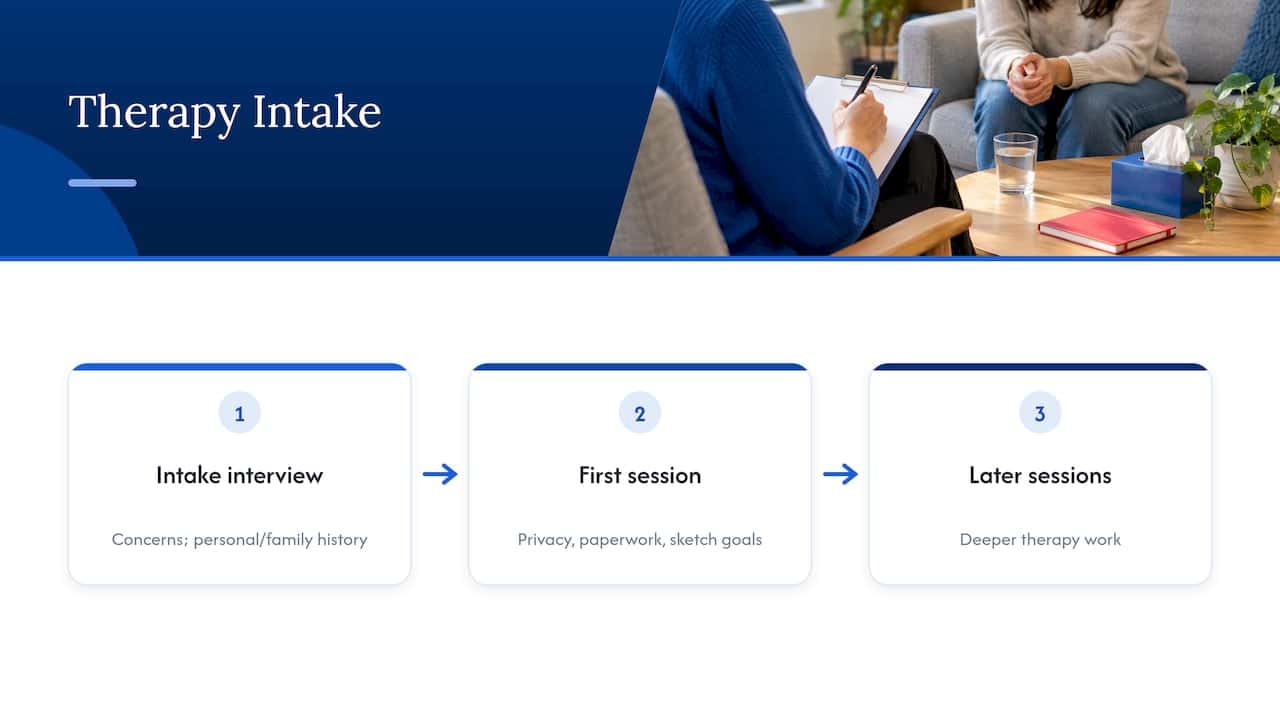
The American Psychological Association defines an intake interview as the first interview between a client and a therapist or counselor. Its purpose is to learn what problems brought the person in and to collect preliminary information about their personal and family history.
In practice, the first session is mostly information gathering. You and the therapist meet one-on-one, usually talk through confidentiality and paperwork, and begin to sketch goals. The deeper work of therapy comes in later sessions. Many people feel nervous before this visit, and that is normal. The therapist’s job in the first hour is to make the conversation manageable, not to dig as deep as possible.
If you want a fuller picture of the visit itself, our guide on how to prepare for your first therapy session covers the day step by step.
The paperwork before you talk
Most practices ask you to complete forms first, either on paper or online. Typical forms collect:
- Your contact details and an emergency contact
- Insurance information, or your self-pay choice
- A consent and privacy notice
- A short health and history questionnaire
At our clinic, new therapy clients can review the New Client Counseling Packet and the intake and HIPAA form ahead of time, so you are not rushing through them in the waiting area.
Questions about what brought you in
The conversation almost always opens here. You will likely hear versions of these:
- What brings you to therapy right now?
- How long have you been dealing with this?
- What made you decide to reach out at this point?
- What are your main symptoms or challenges day to day?
- What makes things better? What makes them worse?
- Are there particular situations or triggers that make it harder?
Why they ask. Timing tells the therapist whether this is a recent change, a long pattern, or something that flared after an event. Triggers and relief point toward what to work on first.
How to answer. You do not need clinical language. “I haven’t slept well in two months and I snap at my kids” is exactly the kind of detail that helps. If you are unsure where to start, begin with the thing that is bothering you most this week.
Questions about your mental health history and past treatment
Expect questions such as:
- Have you seen a therapist or counselor before? Was it helpful?
- Have you ever been given a diagnosis?
- Have you ever been hospitalized for mental health reasons?
- Are you taking, or have you taken, medication for your mood, anxiety or sleep?
- Is there a history of mental health concerns or substance use in your family?
Why they ask. What helped before is a shortcut to what might help now, and what did not work saves you from repeating it. Family history matters because patterns in a family can shape risk and inform treatment planning.
Families looking at higher levels of care for a teenager or young adult sometimes find it useful to see how teen and young adult behavioral healthcare programs describe their range of outpatient and residential options. Your therapist can help you work out which level of support fits.
Questions about your physical health and medications
This part can surprise people, but it is standard. You may be asked:
- Do you have any current medical conditions?
- What medications and supplements do you take?
- Have you had recent changes in your health, weight, appetite or sleep?
- How much do you exercise?
Why they ask. Physical health and emotional health affect each other. Thyroid problems, sleep disorders, pain and some medications can look like anxiety or depression, or make them worse. Bring a list of everything you take, including over-the-counter products and vitamins.
Because we are a family medical clinic as well as a therapy practice, your therapy visit and your medical care can sit under the same roof. If something physical comes up, you can follow up with our primary care providers without starting over.
Questions about daily life, relationships and support
A therapist is trying to see the whole picture of your life, not just the symptoms. Common questions:
- Who do you live with?
- Who do you turn to when things are hard?
- How are your relationships with family, a partner, friends or coworkers?
- What does a typical day or week look like?
- How are work or school going?
- Are there patterns you have noticed in how you handle conflict or stress?
Why they ask. Stress rarely comes from one place. Knowing who supports you, and where the gaps are, shapes the plan. Routines show where stress builds and where small changes could help.
Questions about coping and strengths
You may be asked:
- How do you usually cope with stress or hard emotions?
- What have you already tried on your own? Did it help?
- What are you good at? What are you proud of?
- How do you feel about the role alcohol or other substances play in your life?
Why they ask. The goal is to build on what already works and to find where you need new tools. Strengths are part of the assessment, not an afterthought.
It can help to think about this before you come in. If your concerns involve communication with a partner or co-parent, you may find it useful to look at a coparenting communication plan beforehand, so you can tell your therapist what you have already tried.
Questions about safety, substance use and trauma
These are the questions people dread most, so here is what to know.
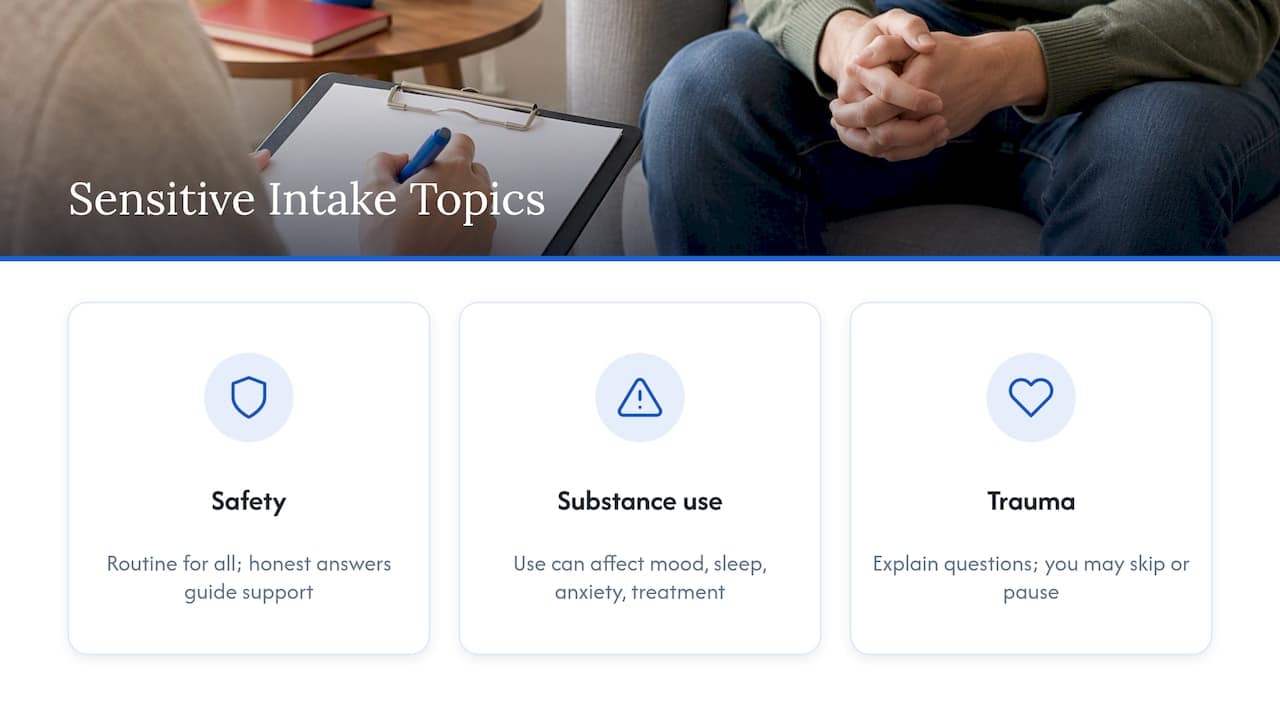
Safety questions. A therapist will ask whether you have had thoughts of hurting yourself or anyone else. They ask every client. It is a routine, standardized part of an intake, and it does not mean the therapist thinks you are in crisis. Answering honestly lets them make sure you get the right level of support. If you are in immediate danger or thinking about suicide, call or text 988, the Suicide & Crisis Lifeline, or call 911.
Substance use. You may be asked how often you use alcohol, nicotine, cannabis or other drugs, and whether use has changed lately. This is not about judgment. Substance use can affect mood, sleep and anxiety, and it changes which treatments make sense. If cravings are part of what you are working on, sobriety resources such as coping skills for cravings can sit alongside therapy, and your therapist can tell you how they fit.
Trauma. Many therapists use a trauma-informed approach. That means they explain why they are asking, put your safety first, and let you skip or pause a question if it feels like too much. You do not have to tell the whole story at the first visit. Saying “I’d rather not go into that yet” is a complete answer.
Privacy and the limits of confidentiality
What you say in therapy is private and protected by law and professional ethics, and your therapist should explain this at the start. There are exceptions, and a good intake names them clearly. In general, a therapist may need to share information when:
- A child, an older adult or a dependent adult is being abused or neglected
- There is a serious, imminent risk to you or to an identifiable other person
- A valid court order requires records
If you have questions about teens and who can see records in Florida, read our guide on therapy for minors and confidentiality in Florida. Ask your therapist to walk through the details before you share anything you are unsure about.
Questions about your goals
The intake usually ends by turning to the future:
- What would you like to be different?
- What would “feeling better” look like for you?
- How will we know therapy is helping?
- How often can you come, and do you prefer in-person or virtual sessions?
Vague goals are fine to start. “I want to stop dreading Sundays” or “I want to feel like myself again” gives the therapist something real to work with, and you can refine it together. The relationship you build with your therapist matters a great deal, so use the first visit to notice whether you feel heard.
How to prepare for your intake
Psychology Today suggests that thinking ahead about what you want to discuss, what the therapist should know and what you hope to get from the session can help you feel more comfortable. It also advises bringing your insurance information and arriving a few minutes early for paperwork.
A simple checklist:
- Write down your top three concerns and roughly when each began.
- List your medications and supplements, with doses if you know them.
- Note past treatment: therapists, diagnoses, hospital stays, what helped.
- Think about your goals, even in rough terms.
- Decide what you are not ready to discuss. You can say so.
- Bring your insurance card and ID, or be ready to choose self-pay.
- Plan your route or test your connection. For a video visit, our online therapy preparation checklist covers the setup.
If you are comparing your options, our guide to choosing a therapist lists what to look for, and our page on therapy costs in Florida explains how to confirm what you will pay before you book.
Our perspective on the first visit
We built our therapy services around the idea that getting started should not feel like a hurdle. Many of the people who come to us have been putting it off for months. Some are parents who have been focused on a child’s needs and finally want support of their own.
Because we are a family clinic, we see how health and emotions overlap every day: a sleepless month, a stressful diagnosis, a teenager who has stopped eating with the family. We offer therapy in the office and virtually, for adults and children, so the format can fit your life instead of the other way around.
Our approach to the first visit is collaborative. We explain why we ask what we ask, we let you set the pace, and we name the limits of confidentiality up front. You will meet Emily Gilbert, our collaborative therapist, and you will leave knowing what happens next.
If your concerns also involve your physical health, we can help with that in the same place. That continuity is what we believe makes a difference.
Lisa
Start therapy at Your Family Walk-In Clinic
We are open seven days a week from 8 AM to 8 PM in Lutz, Florida, and we offer therapy and counseling for adults and children, in the office or by video. We accept major health insurance plans and Medicaid, and you can also pay out of pocket.

Ready to take the first step? See our therapy page or call (813) 793-8555. If you would like to see the space first, you can tour our clinic.
What happens after the intake
At the end of the first session, the therapist typically summarizes what they heard, suggests a direction, and schedules your next visit. Over the next few sessions the plan becomes clearer. You may agree on how often to meet, which skills to practice between sessions, and whether any other support would help, such as a medical check-up or a medication review with a prescriber.
It is also fine to decide after one visit that the fit is not right. Therapy works best when you trust the person you are talking to, and it is reasonable to look for a different therapist.
FAQ
How long does a therapy intake take?
Plan for about an hour, though it varies by practice. Part of the time goes to paperwork and confidentiality, and the rest to questions about you. Ask when you book so you can set aside enough time.
Do I have to answer every intake question?
No. You can skip a question, answer it partly, or ask the therapist to come back to it later. Telling them why you are hesitant helps them adjust. The only questions that need a clear answer are about immediate safety, and those exist to protect you.
Why does my therapist ask about suicide or self-harm?
It is a standard question for every client. It helps the therapist understand your safety and choose the right level of care. It does not mean they think you are in danger. If you are in crisis, call or text 988 or call 911.
Will my intake answers stay private?
Yes, with limited legal exceptions such as abuse of a child or vulnerable adult, or a serious and imminent threat of harm. Your therapist should explain these before you begin. For minors in Florida, see our guide on who can see records.
Can I do the intake by video?
Yes. We offer virtual therapy sessions as well as in-office visits. Choose a private space, check your connection ahead of time, and have your medication list nearby.
Sources
- APA Dictionary of Psychology: intake interview
- Psychology Today: Your First Therapy Session
- Couples Fight School: coparenting communication plan
- Reclaim Sobriety: coping skills for cravings
- Newport Healthcare: teen and young adult behavioral healthcare