


Most people who get a flu shot feel nothing more than a sore arm, and any symptoms that do show up settle within a day or two. The flu shot cannot give you the flu because injectable vaccines contain inactivated virus that cannot replicate in your body. Call 911 for trouble breathing, facial or throat swelling, or sudden dizziness. See your provider if a fever or soreness lingers past a few days.
TL;DR:
- Serious vaccine reactions such as Guillain-Barré syndrome and anaphylaxis are extremely rare, occurring in fewer than 2 cases per million and requiring immediate medical attention.
- Mild side effects like soreness, headache, mild fever, and fatigue typically appear within the first 48 hours and resolve within three days.
- Children may experience a low fever, runny nose, or vomiting, especially when multiple vaccines are administered during the same visit, but these are immune responses rather than adverse effects.
- Most adverse reactions are short-lived and can be managed at home with cold compresses, rest, and over-the-counter pain relievers; signs of complications warrant prompt medical contact.
- Two systems, VAERS and VSD, monitor vaccine safety continuously, helping identify rare patterns of serious reactions across large populations.
Table of Contents
- Common Flu Shot Side Effects in Adults and Children
- How Rare Are Serious Flu Vaccine Reactions?
- How Long Do Flu Shot Side Effects Last?
- How to Relieve Flu Shot Side Effects at Home
- How Are Flu Vaccine Reactions Tracked and Reported?
- Special Considerations for Children, Seniors, and Allergy History
- What Our Clinic Sees Every Flu Season
- Why the Fear Around Flu Shot Side Effects Outpaces the Actual Risk
- Get Your Flu Shot or Follow-Up Care at Your Family Walk-In Clinic
- Where to Find Official Flu Vaccine Safety Information
- Sources
- FAQ
Common Flu Shot Side Effects in Adults and Children
The soreness at the injection site is the most predictable part of getting a flu shot, and it’s also the least worrisome. You might notice redness, mild swelling, or a small firm lump under the skin where the needle went in. That lump is harmless and can stick around for several weeks. It’s not a sign of infection unless it comes with spreading redness, fever, or drainage, in which case it’s worth a call to your provider.
Beyond the arm, the CDC lists headache, low-grade fever, muscle aches, fatigue, and nausea as the most frequently reported reactions. These usually show up within the first day and fade within one to three days. They’re not the flu sneaking in through the vaccine. They’re your immune system doing exactly what the shot is designed to make it do.
Common flu shot side effects break down roughly like this:
- Injection-site reactions: soreness, redness, swelling, or a small lump that can last weeks.
- Low-grade fever: typically under 101°F, resolving in one to three days.
- Headache and muscle aches: mild and self-limited.
- Fatigue: a day or two of feeling run down is common.
- Nausea: usually mild, more often reported in children than adults.
Children have their own patterns worth knowing. A child who gets several vaccines in one visit, or the nasal spray version, may run a low fever, develop a runny nose, or vomit shortly afterward. That’s more about the immune response to multiple antigens at once than anything unusual about the flu vaccine itself.
Most people report no side effects at all, and those who do typically describe them as mild, according to CDC safety data. If you’ve had a flu shot before and felt fine, there’s a good chance this year looks the same.
How Rare Are Serious Flu Vaccine Reactions?
Serious flu vaccine reactions exist, but they are genuinely uncommon, and knowing what they look like matters more than memorizing statistics. Two categories deserve real attention: Guillain-Barré syndrome and anaphylaxis.
Guillain-Barré syndrome (GBS) is a rare condition where the immune system attacks the nerves, causing weakness that can progress over days. The estimated risk after a flu shot is fewer than 1 to 2 cases per one million people vaccinated, and influenza infection itself carries a higher GBS risk than the vaccine does. If you develop unusual weakness, tingling, or trouble walking in the weeks after vaccination, contact your provider promptly. This isn’t a same-day emergency in most cases, but it does need evaluation.
Anaphylaxis is different: it’s fast, and it’s an emergency. Symptoms typically appear within minutes to a few hours and include hives, swelling of the face or throat, wheezing, or difficulty breathing. If any of these signs of a severe allergic reaction appear, call 911 immediately. This is exactly why clinics ask you to stick around for a short observation period after your shot.
Two other reactions round out the rare-but-real list:
- Febrile seizures in young children, more likely when several vaccines are given during the same visit.
- Fainting (syncope), a reaction to the injection process itself rather than the vaccine’s ingredients.
For fainting specifically, sitting or lying down for 15 minutes after vaccination measurably reduces the risk of falls and injury. It’s a small habit with an outsized payoff.
How Long Do Flu Shot Side Effects Last?
The timeline for flu shot side effects follows a fairly predictable pattern, which makes it easier to tell a normal reaction from something else going on.
- Hours 1 to 48: Injection-site soreness, fatigue, or a mild headache typically begins here. This is the most common window for symptoms to start.
- Days 1 to 3: Systemic symptoms like low-grade fever, muscle aches, and nausea usually peak and then resolve.
- Weeks 1 to several: A firm lump at the injection site may persist even after everything else has cleared. That’s normal tissue response, not infection.
- Roughly two weeks out: Full immune protection develops. Clinical experts note it takes about two weeks for the body to build full protection against influenza after vaccination.
That two-week gap explains a lot of confused phone calls to clinics every fall. If you catch a respiratory illness five days after your flu shot, the vaccine didn’t cause it and hasn’t had time to fully protect you yet. You were likely exposed to the virus before your immunity kicked in. If a fever or fatigue starts well after 48 hours, or drags on past three to four days, that’s a signal to get checked rather than wait it out. Our guide to flu versus cold symptoms can help you sort out what you’re actually dealing with.
How to Relieve Flu Shot Side Effects at Home
Most flu shot side effects respond well to basic home care, and you probably already have what you need in your medicine cabinet.
- Apply a cold compress to the injection site for 10 to 15 minutes at a time to ease soreness and swelling.
- Keep the arm moving gently. Full range-of-motion exercise helps more than resting it stiffly, and avoid aggressively massaging the site.
- Acetaminophen or ibuprofen, taken according to label instructions or your provider’s guidance, can address fever, headache, or muscle aches. Dosing for children should always follow age and weight guidelines, not adult amounts scaled down by guesswork.
- Drink water, rest, and keep an eye out for symptoms that worsen instead of improve.
- Sit or lie down for about 15 minutes right after your shot if you’re prone to fainting or feeling lightheaded around needles.
Pro Tip: If a fever climbs above 102°F, if swelling at the injection site spreads rather than stays contained, or if symptoms are still getting worse on day three instead of easing up, stop treating it at home and call your provider. Those patterns point to something other than a routine vaccine reaction.
How Are Flu Vaccine Reactions Tracked and Reported?
Vaccine safety doesn’t rely on guesswork. Two systems work together in the background every flu season.
- VAERS (Vaccine Adverse Event Reporting System) is a passive reporting system co-managed by CDC and FDA that collects reports from patients, parents, and clinicians. A report doesn’t prove the vaccine caused the event. It flags a pattern worth investigating.
- VSD (Vaccine Safety Datalink) works differently. It actively searches health records across large populations to look for safety signals, rather than waiting for reports to come in.
Anyone can file a VAERS report, though healthcare providers usually handle it when a patient reports a reaction during a visit. This layered system, one passive and one active, is part of why unusual patterns tend to surface quickly rather than going unnoticed for years.
Special Considerations for Children, Seniors, and Allergy History
Age and health history change how the flu shot may affect you, and a few groups deserve specific guidance rather than a one-size-fits-all answer.
- Children getting several vaccines at the same visit are more likely to run a transient fever, and parents should expect this rather than panic over it. The nasal spray flu vaccine carries a somewhat different side-effect profile than the injection, including more frequent runny nose or nasal congestion.
- Older adults often report fewer systemic reactions like fever or fatigue than younger adults, though soreness at the injection site is just as common. Several vaccine formulations exist for adults over 65, and public health guidance doesn’t favor one licensed option over another for most people.
- Anyone with a prior severe allergic reaction to a flu vaccine, or a history of Guillain-Barré syndrome, should talk with their provider before their next dose. This is a conversation, not necessarily a disqualification.
- Pregnant and breastfeeding patients are specifically included in CDC’s flu vaccination guidance, with a well-established safety record supporting the recommendation.
If you’re unsure which category applies to you, our adult vaccine schedule guide breaks down age-based recommendations in more detail.
What Our Clinic Sees Every Flu Season
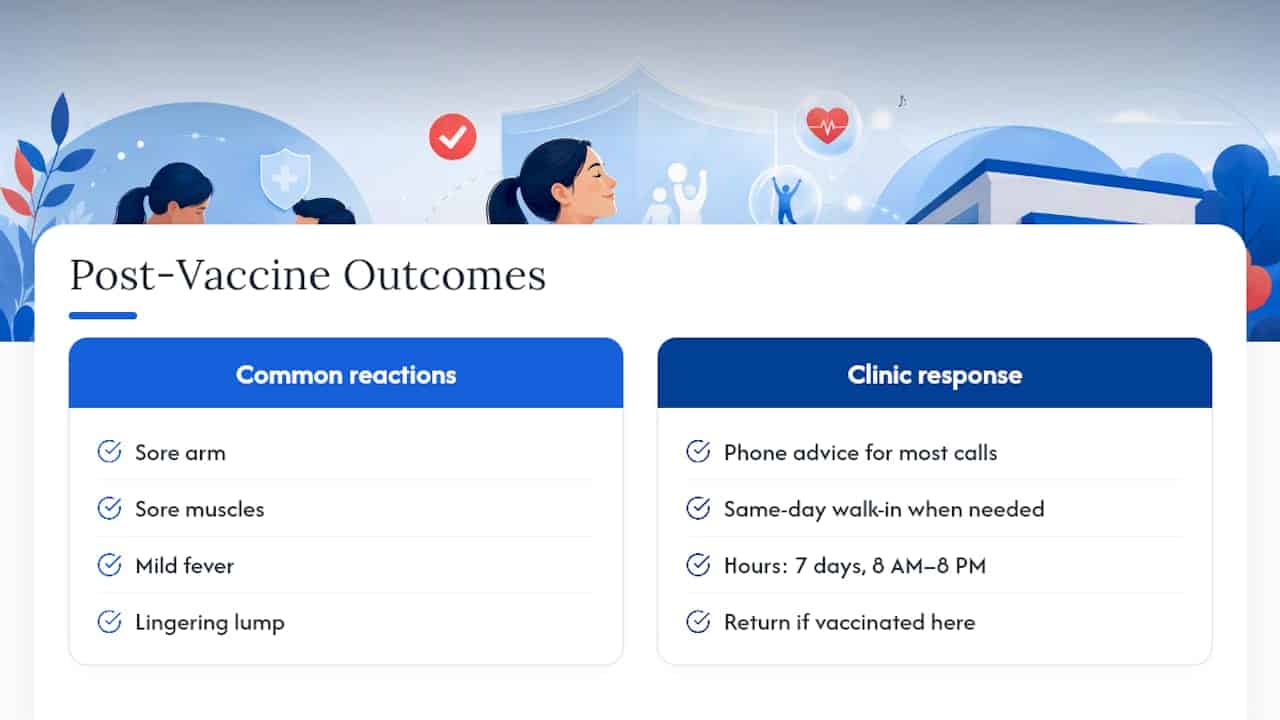
Every fall, flu shots are administered to patients ranging from toddlers to grandparents, and the pattern holds steady year after year: most people leave with nothing more than a sore arm. When someone does call about a reaction, it’s almost always a question we can answer over the phone, sore muscles, a mild fever, a lump that’s taking its time to fade.
Occasionally a reaction warrants a same-day look, and that’s exactly what walk-in urgent care hours exist for. Seven days a week, 8 AM to 8 PM, you don’t need to wait out a worrisome symptom until Monday. If you’re vaccinated here and something feels off afterward, come back in. We’d rather take five minutes to reassure you than have you spend a weekend worrying.
Why the Fear Around Flu Shot Side Effects Outpaces the Actual Risk
The gap between how people talk about flu shot side effects and what the evidence actually shows is wider than it should be. A sore arm and a day of fatigue get repeated as cautionary tales, while the genuinely rare events, GBS, anaphylaxis, get treated with the same casual worry as a headache. That’s backwards. The mild stuff is common and forgettable. The serious stuff is rare and has clear warning signs.
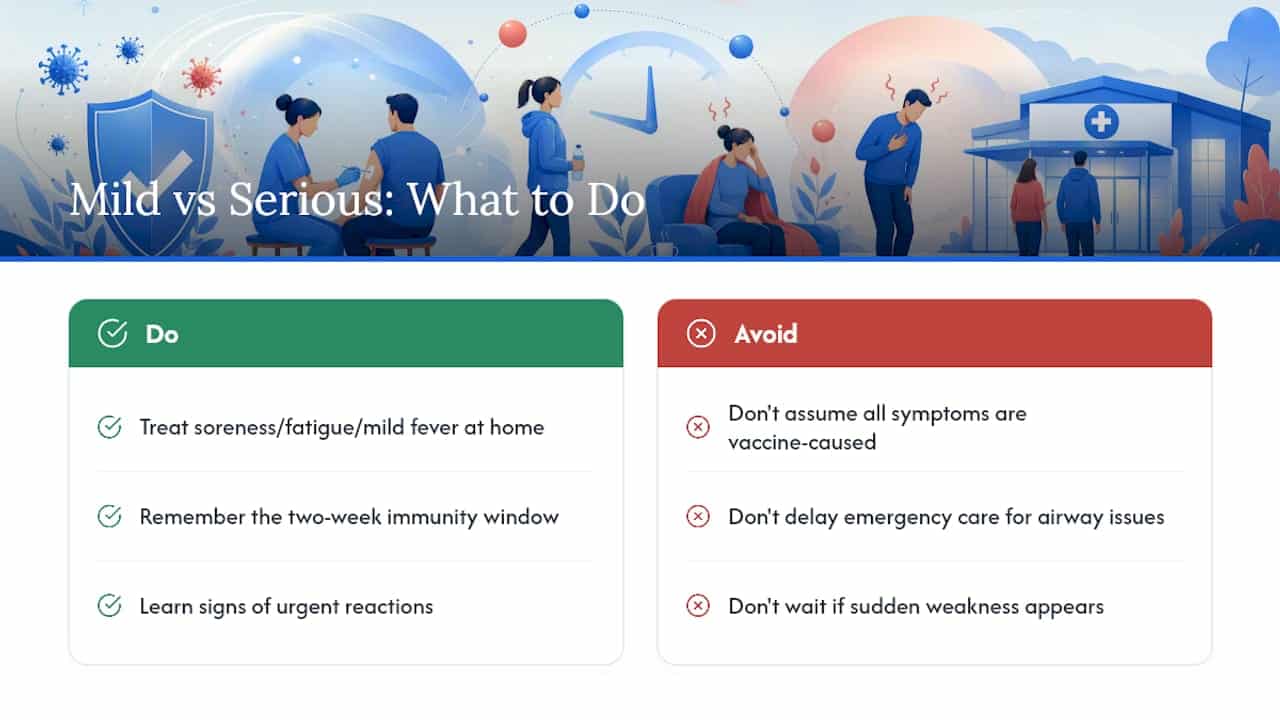
What gets underrated is timing. People blame the vaccine for illnesses that show up a week later, when the real explanation is a virus they picked up before their immunity fully built. That two-week window matters more than most side-effect lists ever mention.
If there’s one thing worth prioritizing, it’s this: know the difference between “uncomfortable” and “urgent” before you need to use that knowledge. Soreness, fatigue, a mild fever, treat those at home. Swelling in the throat, trouble breathing, sudden weakness, that’s a call to 911 or your provider, not a wait-and-see situation.
— Lisa
Get Your Flu Shot or Follow-Up Care at Your Family Walk-In Clinic
Your Family Walk-In Clinic gets you vaccinated and seen the same day, without the weeks-long wait for a primary care appointment that many practices require this time of year. If you’re weighing whether to get your flu shot at a pharmacy counter or a clinic that can actually examine you if something feels off afterward, that’s the real difference: one setting hands you a bandage and sends you on your way, the other can check your reaction on the spot.

Our team gives flu shots seven days a week, from 8 AM to 8 PM, with same-day appointments and walk-ins welcome. If you experience a reaction that seems worse than the usual sore arm or mild fever, our urgent care services are open the same hours, every day of the week. Call ahead or walk right in, either works, and bring your questions with you.
Where to Find Official Flu Vaccine Safety Information
- CDC: Key Facts About Seasonal Flu Vaccine, covering how the vaccine works and common reactions.
- CDC: Influenza Vaccine Safety, the primary source for rare-event risk estimates.
- CDC: About Fainting After Vaccination, explaining syncope and prevention.
- Align Integrated Medical Clinic: Should You Get the Flu Vaccine?, a patient-friendly explainer on why the shot can’t cause flu.
This article is general information, not a substitute for advice from a qualified doctor. Consult a qualified healthcare professional about your own circumstances before acting on anything here.
Sources
- Key Facts About Seasonal Flu Vaccine | Influenza (Flu) | CDC
- Influenza (Flu) Vaccine Safety | Vaccine Safety | CDC
- Vaccine safety: About fainting | CDC
- Inactivated Influenza Vaccine VIS | Vaccines & Immunizations | CDC
FAQ
How long after a flu shot do you feel unwell?
Most people who notice symptoms feel them within 1 to 48 hours of vaccination, and mild reactions like soreness, fatigue, or a low fever typically resolve within one to three days.
What should you avoid after a flu vaccine?
Avoid vigorously rubbing or massaging the injection site, and skip strenuous exercise on that arm for the rest of the day; otherwise, normal activity is fine.
What are the downsides of getting a flu shot?
The main downsides are temporary: arm soreness, possible low-grade fever, headache, or fatigue for a day or two, while serious reactions like anaphylaxis or Guillain-Barré syndrome are rare.
Why do I feel so bad after the flu vaccine?
Feeling achy or tired after a flu shot usually means your immune system is actively building protection, since the vaccine cannot cause influenza itself; these symptoms are a normal immune response, not a sign of illness.
How long do flu shot side effects last?
Most flu shot side effects last one to three days, though a small lump at the injection site can persist for several weeks without being a cause for concern.